A trip to China combines imperial capitals, ultra-modern megacities and landscapes of karst peaks, terraced rice fields and high plateaus. For a first visit, the Beijing – Xi’an – Shanghai trio, linked by high-speed train, covers the essentials in two weeks. This China travel guide gathers the practical information you need to plan your stay. After Beijing, Xi’an and Shanghai, the neighboring steppes offer a very different trip: see things to do in Mongolia for a second journey. For entry rules, our guide to the China visa explains the details.
To locate cities, regions, terrain, national parks and airports, see our map of China.
China at a glance
CapitalBeijing
LanguageMandarin Chinese (Putonghua)Cantonese in Hong Kong and Guangdong. Little English is spoken outside hotels and major sights
Currencythe yuan renminbi (CNY) · currenciesHong Kong dollar (HKD) in Hong Kong
Time zoneUTC+8, no daylight saving · details8 h ahead of London and 13 h ahead of New York in winter
AirportsBeijing, Shanghai, Guangzhou, Chengdu and other major hubsCheck current routes with the airlines
EntryUS: visa required (visa-free transit and Hainan exceptions); UK: visa-free up to 30 days until 31 December 2026 · travel.state.gov · GOV.UK
Electricitycheck plug types and voltage before you travel · plugs
The best periods are spring (April–May) and autumn (September–October): mild temperatures and moderate rain in Beijing, Xi’an and Shanghai. Summer is hot, humid and rainy almost everywhere; winter is freezing in the north but mild in the south. Above all, avoid the major Chinese holidays: Lunar New Year, the May 1 week and Golden Week (October 1–7). For Guilin, aim for September to November; for Hong Kong, October to December. All the details, month by month and region by region, are in our article best time to visit China.
Where to go in China: the highlights
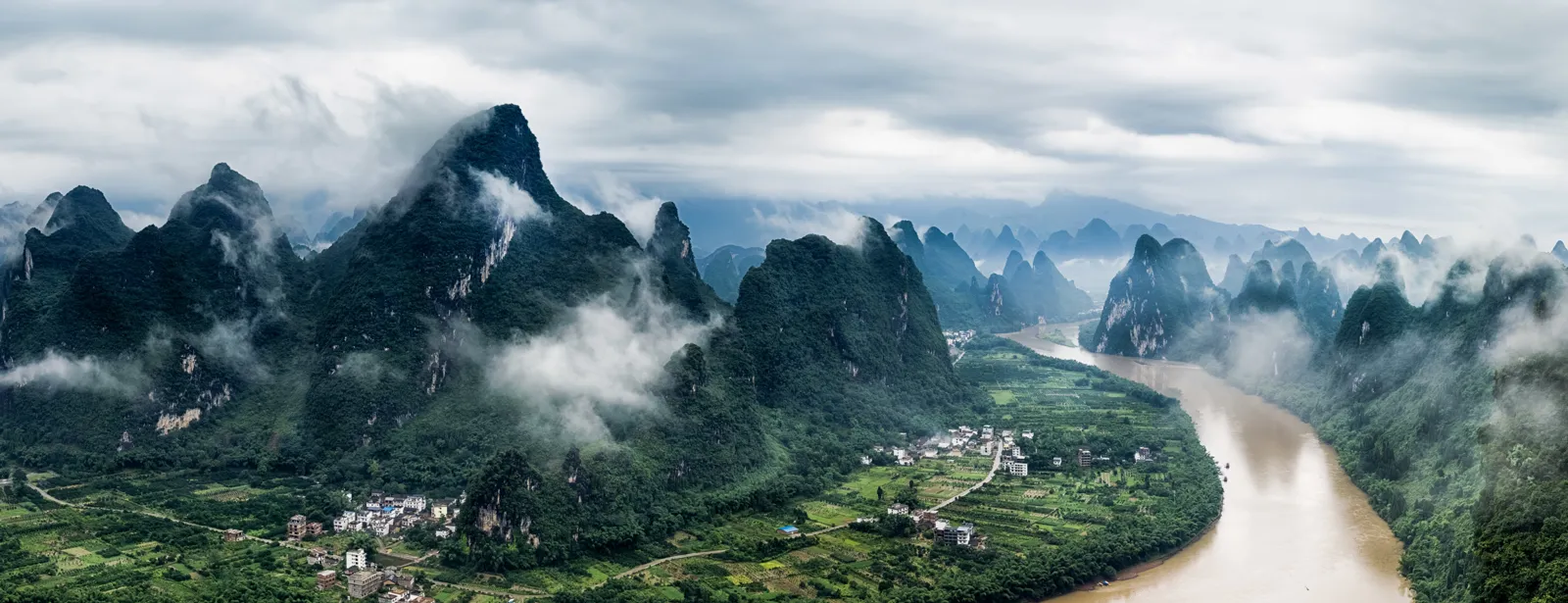
The Li River and the karst peaks of Yangshuo, near Guilin
Beijing and the Great Wall
The capital holds the great symbols of imperial China: the Forbidden City, Tiananmen Square, the Temple of Heaven and the Summer Palace. Take time to wander the hutongs, the traditional alleys around the Houhai lakes. The Great Wall is a day trip: Mutianyu is the most accessible and restored section, while Jinshanling is better for hiking. Allow three to four days.
Xi’an and the Terracotta Army
A former capital at the start of the Silk Road, Xi’an is known for the Terracotta Army of Emperor Qin Shi Huang, about an hour from the center. The city also keeps its walls, which you can ride around by bike, the Big Wild Goose Pagoda and the Muslim Quarter, known for its street food. It is a few hours from Beijing by high-speed train.
Shanghai
China’s largest city is the showcase of modern China. The Bund and its 1920s–1930s buildings face the towers of Pudong. Add Yuyuan Garden, the former French Concession with its plane-tree-lined streets, and the Shanghai Museum. It is also a good base for the nearby water towns.
Suzhou and Hangzhou
Less than two hours from Shanghai by train, Suzhou is known for its classical gardens and canals, and Hangzhou for its West Lake and Longjing tea plantations. Visit them on a day trip or with one overnight stop.
Guilin and Yangshuo
The limestone peaks around Guilin form one of China’s most famous landscapes. The Li River cruise to Yangshuo is the classic excursion. Yangshuo is then a base for cycling in the countryside, climbing or bamboo rafting on the Yulong River. The Longji rice terraces are a few hours away by road.
Chengdu and Sichuan
The capital of Sichuan, Chengdu is known for its giant panda research base, teahouses and spicy food flavored with Sichuan pepper. The Leshan Giant Buddha and Mount Emei are day trips. It is also the gateway to the Tibetan-culture areas in the west of the province.
Yunnan: Kunming, Dali and Lijiang
Yunnan, in the southwest, stands out for its mild high-altitude climate and many ethnic minorities. The old towns of Dali and Lijiang, Tiger Leaping Gorge and the Yuanyang rice terraces make it ideal for a second trip or an extension. In the south, our guide to Macao, special administrative region covers a separate stop, often combined with Hong Kong.
Hong Kong
Hong Kong offers a striking contrast between skyscrapers, markets, temples and hiking trails. Ride up to Victoria Peak, cross the harbor on the Star Ferry, explore Kowloon and take time to visit Lantau Island. Entry rules differ from mainland China. Victoria Peak, Star Ferry, Lantau: knowing the best time to visit Hong Kong helps you avoid the humid heat for these outdoor outings.
Things to do in China: experiences to plan
Beyond the places to see, here are the activities found on most itineraries:
Walk on the Great Wall: Mutianyu for an easy visit, Jinshanling for a real hike. GOV.UK advises against hiking alone in isolated areas, including on the Wall.
Stroll through Beijing’s hutongs around the Houhai lakes, after the Forbidden City and the Temple of Heaven.
Cycle around Xi’an’s city walls and try the street food of the Muslim Quarter.
Sail down the Li River from Guilin to Yangshuo, then cycle in the countryside or raft the Yulong on bamboo.
See the giant pandas in Chengdu and spend time in a teahouse.
Walk along the Bund in Shanghai, facing the Pudong towers, then visit the gardens of Suzhou.
Take the high-speed train between Beijing, Xi’an and Shanghai.
Itinerary ideas for China
10 days: the great classics
Days 1 to 4: Beijing (Forbidden City, Temple of Heaven, hutongs) and a day on the Great Wall
Days 5 and 6: high-speed train to Xi’an, Terracotta Army and city walls
Days 7 to 10: Shanghai, with a day trip to Suzhou or Hangzhou
2 weeks: from the north to the southern mountains
Days 1 to 4: Beijing and the Great Wall
Days 5 and 6: Xi’an
Days 7 and 8: Chengdu and the pandas, or the Leshan Giant Buddha
Days 9 to 11: Guilin, Li River cruise and Yangshuo
Days 12 to 14: Shanghai, or Hong Kong to fly home from the south
Budget for a trip to China
Once there, China is cheaper than Japan or South Korea, but the big eastern cities and Hong Kong cost much more than the interior. Indicative amounts per person per day, excluding international flights (converted from our euro estimates at the ECB rate of 23 October 2026, roughly €1 = ¥7.47):
Item
Budget
Comfort
Accommodation (based on a shared double room)
roughly ¥110–220
roughly ¥450–970
Meals
roughly ¥75–150
roughly ¥220–450
Transport (subway, trains)
roughly ¥75–150
roughly ¥150–300
Activities and sightseeing
roughly ¥75–110
roughly ¥150–300
Total per day
roughly ¥370–600
roughly ¥970–1,870
Indicative estimates, varying by city and season. Hong Kong and Chinese holiday periods cost more.
High-speed trains are a significant share of the budget on a tour: Beijing – Shanghai or Beijing – Xi’an costs far more than a subway ticket. Domestic flights can be competitive over long distances, such as Xi’an – Guilin.
Getting around China
High-speed train: the most practical way between major cities (Beijing, Xi’an, Shanghai, Chengdu, Guilin). According to GOV.UK (updated 27 August 2026), you must show your passport to buy a ticket and to board a train. Book on the official railway app or through an agency, and arrive early: stations are huge and security checks are systematic.
Plane: useful for long distances and Yunnan. The domestic network is very dense.
Subway: efficient and cheap in all major cities, with English signage. The U.S. Department of State (travel.state.gov, last updated March 12, 2026) notes that public transport is generally safe, but pickpockets target crowded buses and subways.
Taxis and ride-hailing: Chinese ride-hailing apps work well; drivers rarely speak English, so keep your hotel address written in Chinese. GOV.UK advises avoiding unmarked or unmetered taxis, insisting on the meter and asking for a receipt.
Driving: you may not drive in China with a US or international license (travel.state.gov); GOV.UK states that you must have a Chinese driving licence and valid insurance. Trains and planes remain the simplest options.
Where to stay in China
In Beijing, stay near the Forbidden City or in a traditional courtyard hotel (siheyuan) in the hutongs, close to a subway station. In Xi’an, staying inside the city walls lets you do everything on foot. In Shanghai, choose the area around the Bund, People’s Square or the former French Concession. In Yangshuo, many guesthouses sit in the countryside at the foot of the peaks.
For small guesthouses and private rentals, check that they accept foreign guests before booking. According to the UK FCDO (GOV.UK, updated 27 August 2026) and the U.S. Department of State, you must register your place of stay with the police within 24 hours of arrival; hotels do this when you check in.
Entry requirements for China
US citizens
According to the U.S. Department of State (travel.state.gov, last updated March 12, 2026), you must obtain a visa before arriving in mainland China, and your passport must have at least six months’ validity remaining. US citizens can apply for a ten-year multiple-entry visa.
Exceptions: visa-free transit is possible through certain airports, for specific cities or regions and durations, with an onward ticket to a third country; and US citizens can visit Hainan province visa-free for up to 30 days, arriving by direct international flight or via Hong Kong or Macau. Check the current list with the Chinese Embassy in Washington.
You must leave before your authorized stay expires: overstaying leads to fines, detention and deportation.
UK citizens
According to the UK FCDO (GOV.UK foreign travel advice, updated 27 August 2026), until 31 December 2026 you can enter China visa-free for stays of up to 30 days for business, tourism, family or friend visits, or transit. For longer stays or other purposes (work, study, journalism), you need a visa before you travel. Emergency travel documents are not eligible.
Your passport must have an expiry date at least 6 months after your arrival, with 2 blank pages.
Immigration may take fingerprints and photos, and you may go through medical screening on arrival. A yellow fever certificate is required if you come from a country with a risk of transmission.
Hong Kong and Macao have their own entry rules: see our Hong Kong travel guide. Tibet requires a special permit, obtained through a travel agent in China, and travel on an organized tour (GOV.UK, travel.state.gov). Entry requirements checked on 24 October 2026; check them again before you travel.
Health and safety
Health: according to the UK FCDO (GOV.UK, updated 27 August 2026), check vaccine recommendations at least 8 weeks before your trip (TravelHealthPro); risks include avian influenza and dengue (Guangdong and other areas, mainly May to November), and tap water is generally not safe to drink. The U.S. Department of State lists typhoid, measles, hepatitis A and B and tuberculosis as prevalent and recommends being up to date on routine vaccines. Air pollution is a significant problem in many places (travel.state.gov).
Altitude: most roads and towns in Tibet, Qinghai, parts of Xinjiang and western Sichuan are above 10,000 ft (3,000 m) (travel.state.gov).
Healthcare: treatment is not free and can be very expensive (GOV.UK); public hospitals require payment before treatment, often in cash or via mobile payment apps (travel.state.gov). Take insurance covering medical evacuation and repatriation.
Safety: most visitors encounter no safety problems, and traffic accidents are the most common concern (travel.state.gov). Beware of « tea tasting » and massage scams in tourist areas (GOV.UK). In Xinjiang, extraordinary security measures are in place, and the UK FCDO details specific risks for Xinjiang, Tibet and the China–Myanmar border.
Laws: always carry your passport (police do not accept copies). Drug laws are zero-tolerance, with random testing possible, and penalties include the death penalty. National security laws are broad, and posting political statements critical of the authorities can be considered illegal (GOV.UK).
Natural hazards: China lies in an active seismic zone, and the typhoon season normally runs from May to November on southern and eastern coasts (GOV.UK).
Emergency numbers: police 110, ambulance 120, fire 119 (GOV.UK).
Practical tips for China
Money: cashless payments through apps such as WeChat or Alipay are almost universal; outside major cities, credit cards are not always accepted and ATMs are limited (GOV.UK). The U.S. Department of State notes that fewer places accept foreign credit cards and advises setting up mobile payment before you travel. Also keep some cash in yuan. Estimate your spending with our currency converter.
Internet: according to GOV.UK, some services are permanently blocked, including Google, Facebook, YouTube and X, and VPNs must be licensed by the Chinese government. Download offline maps and a translation app that works in China before you go.
Language: little English is spoken. Keep the name and address of your hotels in Chinese characters.
Etiquette: avoid political debates, especially on sensitive subjects. Do not stick your chopsticks upright in rice. Tipping is not customary in mainland China.
Customs: there are strict rules on goods you can bring in or take out, and you must declare anything prohibited or subject to duty (GOV.UK); the import and use of drones is strictly regulated. Check your home country’s allowances for the return trip (e.g. CBP in the US, HMRC in the UK).
Food: cuisine varies greatly by region: Peking duck in Beijing, dumplings and noodles in Xi’an, xiaolongbao in Shanghai, spicy dishes and hot pot in Chengdu, dim sum in Hong Kong. Drink bottled water.
Who is China for?
First trip to Asia: possible with some preparation: the Beijing – Xi’an – Shanghai trio works well by high-speed train, but little English is spoken, many Western services are blocked and payment is mostly by phone.
Culture and history: yes: the Forbidden City, the Great Wall, the Terracotta Army, the gardens of Suzhou.
Nature and landscapes: yes: the Li River and the peaks of Yangshuo, the Longji and Yuanyang rice terraces, Tiger Leaping Gorge.
Food lovers: yes: Peking duck, the street food of Xi’an’s Muslim Quarter, xiaolongbao in Shanghai, Chengdu’s spicy cuisine.
Budget travelers: fairly: roughly ¥370–600 a day, less than in Japan or South Korea, but high-speed trains weigh on a tour.
It depends on your passport. According to GOV.UK (updated 27 August 2026), British citizens can enter mainland China visa-free for up to 30 days until 31 December 2026. According to travel.state.gov (last updated March 12, 2026), US citizens need a visa, except for visa-free transit through certain airports and visa-free stays of up to 30 days in Hainan. Checked on 24 October 2026; check the latest rules before you leave.
How many days do you need in China?
Ten days lets you see Beijing, Xi’an and Shanghai by high-speed train. Two weeks leaves time to add Guilin and Yangshuo or Chengdu. The country is huge: better to choose a few regions than to try to see everything.
What is the best time to visit China?
April–May and September–October, avoiding the May 1 week and Golden Week (October 1–7). For Guilin, aim for September to November; for Hong Kong, October to December.
How much does a trip to China cost?
Excluding international flights, allow roughly ¥370–600 per person per day on a budget, and ¥970–1,870 in comfort. High-speed trains, Hong Kong and Chinese holiday periods push the bill up.
Can you use Google and WhatsApp in China?
Not reliably in mainland China: according to GOV.UK, services such as Google, Facebook, YouTube and X are permanently blocked, and VPNs must be licensed by the government. Prepare before you leave (local apps, offline maps, translation). These services work normally in Hong Kong.
What can you see in China in 10 days?
The classic 10-day route links Beijing and the Great Wall (4 days), Xi’an and the Terracotta Army (2 days), then Shanghai with a day trip to Suzhou or Hangzhou (4 days), by high-speed train. With two weeks, add Chengdu and Guilin-Yangshuo.
Entry, health and safety information read on 24 October 2026: U.S. Department of State, China country information (travel.state.gov, last updated March 12, 2026), and UK FCDO, foreign travel advice for China (GOV.UK, updated 27 August 2026)
European Central Bank: euro reference rates of 23 October 2026 (budget conversion)
China Meteorological Administration (CMA) and Hong Kong Observatory: 1991–2020 climate normals, via the English Wikipedia climate tables
Transparency: this page contains affiliate links, labelled as such. If you book through them we may earn a commission at no extra cost to you; it does not influence our content or recommendations. How we fund the site.