What is there to see and do in Hong Kong? This small territory packs waterfront skyscrapers, street markets, incense-filled temples and hills covered in trails. A Special Administrative Region of China, it has its own currency, its own entry rules and one of the most efficient transport networks in Asia. This Hong Kong travel guide helps you choose your neighborhoods, sights and day trips.
To locate cities, regions, terrain, national parks and airports, see our map of Hong Kong.
Hong Kong at a glance
StatusSpecial Administrative Region of the People’s Republic of China
The best period is October to December: the air dries out, temperatures fall from 28 to 20 °C (82 to 68 °F) and there is little rain in November and December, according to Hong Kong Observatory normals. January and February are cool and dry. From May to September, the heat is humid, rain is heavy and typhoons are possible. Month-by-month climate and traditional festivals: see our article best time to visit Hong Kong.
Things to do in Hong Kong: the highlights
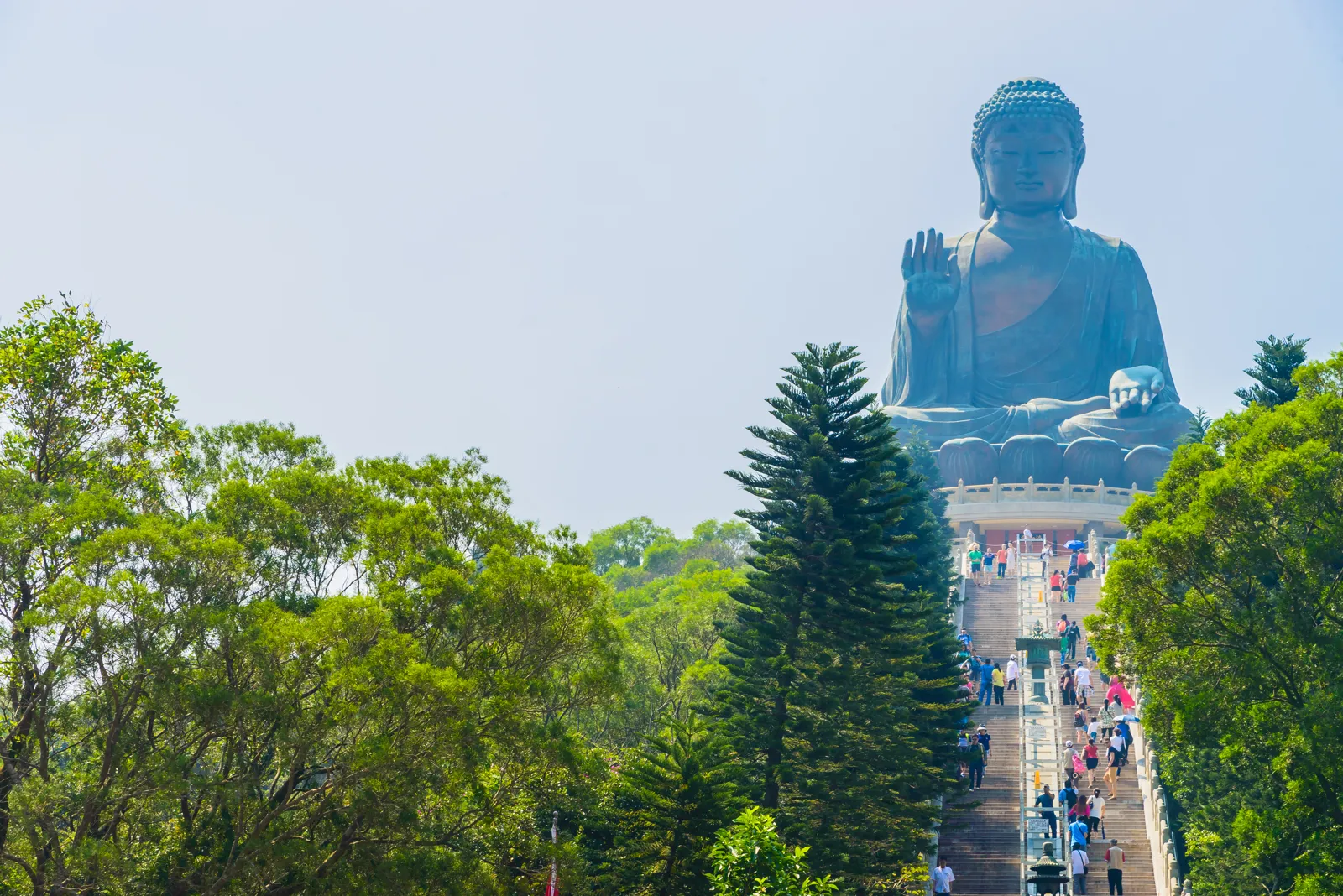
The Tian Tan Big Buddha on Lantau Island, Hong Kong
Central, the Peak and Hong Kong Island
The Central business district lines its towers along Victoria Harbour. The Mid-Levels escalators, a long system of covered moving walkways, climb to the streets of SoHo and its restaurants. The historic Peak Tram funicular runs up to Victoria Peak and its view over the harbor and Kowloon. Further west, Sheung Wan keeps its dried-goods shops and Man Mo Temple, one of the oldest in the city.
Tsim Sha Tsui and the Kowloon promenade
Across from the island, the tip of Kowloon offers the most famous skyline view. The waterfront promenade, the Avenue of Stars and the museums (Hong Kong Museum of Art, Space Museum) are easy to see in half a day. In the evening, the island’s skyline lights up. The Star Ferry links Tsim Sha Tsui and Central in a few minutes: a crossing not to miss. For a trip beyond the territory, our guide to Macao, the former Portuguese colony covers the visit.
Mong Kok, Yau Ma Tei and the markets
These very dense Kowloon districts are home to the street markets: Ladies’ Market, the Goldfish Market, the Bird and Flower Markets, and Temple Street Night Market in Yau Ma Tei. Eat in a cha chaan teng, the typical Hong Kong diner, and at noodle and dim sum stalls.
West Kowloon: M+ and the Palace Museum
Built on reclaimed land, the West Kowloon Cultural District is home to M+, a museum of contemporary visual culture, and the Hong Kong Palace Museum, which displays pieces from Beijing’s Forbidden City. A large waterfront park offers another view of the island.
Lantau: the Big Buddha and Tai O
The territory’s largest island hosts the airport, but also mountains and villages. The Ngong Ping 360 cable car climbs to the Ngong Ping plateau, home to the Tian Tan Buddha, a seated bronze statue, and Po Lin Monastery. The fishing village of Tai O, with its stilt houses, is reached by bus. Hikers can climb Lantau Peak.
The islands: Lamma and Cheung Chau
Half an hour by ferry from Central, Lamma has no cars: a trail links its two villages via beaches, and seafood restaurants line the harbor. Livelier Cheung Chau is known for its lanes, temples and its Bun Festival in spring.
Sai Kung and nature
Sai Kung harbor, in the New Territories, is the gateway to country parks, beaches reached on foot or by boat, and the Hong Kong UNESCO Global Geopark with its volcanic rock columns. On Hong Kong Island, the short, scenic Dragon’s Back trail ends near Shek O beach.
Tai Kwun and Hong Kong Disneyland
In Central, Tai Kwun occupies restored heritage buildings, including the former Central Magistracy and Victoria Prison. Run by the Hong Kong Jockey Club, the site hosts contemporary art and heritage exhibitions, performances, guided tours, shops and restaurants. For families, Hong Kong Disneyland is on Lantau Island: take the MTR and change at Sunny Bay to the Disneyland Resort Line, which stops at the park, about 30 minutes from Hong Kong and Kowloon stations.
The temples: Wong Tai Sin and Chi Lin Nunnery
The very popular Wong Tai Sin Temple blends Taoism, Buddhism and Confucianism: people come to consult fortune sticks. Nearby, Chi Lin Nunnery, built of wood without nails, and Nan Lian Garden offer a calm contrast with the city.
Itinerary ideas for Hong Kong
A weekend in Hong Kong (2 days):
Day 1: Central, Tai Kwun, the Mid-Levels escalators and Man Mo Temple; late in the day, the Peak Tram and the view from Victoria Peak
Day 2: Star Ferry to Tsim Sha Tsui, the promenade and West Kowloon; in the afternoon, Wong Tai Sin Temple and the Mong Kok markets; in the evening, Temple Street Night Market
Hong Kong in 4 to 5 days:
Day 1: Central, Mid-Levels escalators, SoHo, Sheung Wan and Man Mo Temple; in the evening, the Peak
Day 2: Star Ferry, Tsim Sha Tsui, West Kowloon (M+ or the Palace Museum); in the evening, Temple Street market
Day 3: Lantau: Ngong Ping 360, the Big Buddha, Po Lin Monastery and Tai O village
Day 4: Wong Tai Sin, Chi Lin Nunnery, then Mong Kok and its markets
Day 5: the Dragon’s Back hike and Shek O beach, or a day on Lamma
Hong Kong and Macao in 7 to 10 days:
Days 1 to 5: the itinerary above, at a gentler pace
Day 6: Sai Kung, its harbor and a beach by boat, or the Geopark
Days 7 and 8: Macao, its historic center, the Ruins of St. Paul’s and Taipa
Days 9 and 10: Cheung Chau, a last hike (Lantau Peak, MacLehose Trail) or an extension to Shenzhen or Guangzhou, depending on the visa rules in force
Our verdicts by traveler profile, based on the information in this guide:
Profile
Our verdict
Why
Couples
✅ Yes
Views over Victoria Harbour from the Peak or the Tsim Sha Tsui promenade, the Star Ferry, the skyline lit up at night.
Families
✅ Yes
Hong Kong Disneyland, the Ngong Ping cable car to the Big Buddha, the Space Museum.
Culture
✅ Yes
M+ and the Palace Museum in West Kowloon, Wong Tai Sin Temple, Chi Lin Nunnery, Tai Kwun.
Hiking
✅ Yes
The Dragon’s Back trail, car-free Lamma, the Sai Kung geopark.
Food
✅ Yes
Cha chaan teng, canteens and Kowloon markets let you eat well for little.
Budget travelers
⚠️ Possible
Accommodation among the most expensive in Asia: roughly HK$700–1,150 a day on a budget; public transport is cheap.
Budget for a trip to Hong Kong
Hong Kong is one of the most expensive cities in Asia for accommodation. Public transport, however, remains cheap, and you can eat well for little in canteens and diners. Indicative amounts per person per day, excluding flights (converted from our euro estimates at the ECB rate of 23 October 2026, roughly €1 = HK$8.78):
Item
Budget
Comfort
Accommodation (based on a shared double room)
roughly HK$350–600
roughly HK$1,050–2,200
Meals
roughly HK$175–300
roughly HK$450–900
Transport (MTR, ferry, bus)
roughly HK$45–90
roughly HK$90–220
Sightseeing and activities
roughly HK$90–175
roughly HK$220–440
Total per day
roughly HK$700–1,150
roughly HK$1,750–3,500
Indicative estimates, varying with the season and exchange rate. Accommodation prices rise sharply during Lunar New Year, major trade fairs and at year end.
To keep costs down: stay in Kowloon rather than on the island, have lunch in canteens (set lunches), enjoy the free trails, parks and promenades, and take the Star Ferry rather than a harbor cruise.
Getting around Hong Kong
Octopus card: a rechargeable contactless card valid on the MTR, buses, ferries and trams, and accepted in many shops.
MTR (subway): fast, clean and air-conditioned, serving the island, Kowloon, the New Territories and Lantau.
Airport Express: a direct train between the airport, Kowloon and Central.
Island trams: the double-decker « ding dings » run along the north of the island, slowly and for a few dollars.
Ferries: the Star Ferry crosses the harbor; other ferries leave Central for Lamma, Cheung Chau, Lantau and Macao.
Buses and minibuses: essential for Sai Kung, the south of the island and inland Lantau.
Taxis: plentiful and fairly affordable; have the address written in Chinese.
A rental car is unnecessary: traffic is dense, parking is scarce and expensive, and driving is on the left. Visitors can drive with a valid UK licence for up to 12 months, but rental companies often require an International Driving Permit (UK FCDO, GOV.UK, updated 1 April 2026); driving under the influence of alcohol can lead to immediate criminal charges (travel.state.gov).
Where to stay in Hong Kong
Tsim Sha Tsui: central, very well connected, a wide choice from budget to luxury, harbor views from waterfront hotels
Mong Kok and Yau Ma Tei: lively and cheaper, ideal for markets and street food
Central and Sheung Wan: handy for the Peak and nightlife, but expensive
Wan Chai and Causeway Bay: a good compromise on the island, with many restaurants and shops
Sai Kung or Lantau: for a quieter atmosphere, at the cost of longer journeys
Rooms are often small, especially in budget hotels and guesthouses in large Kowloon buildings. Check the floor area, whether there is a window and recent reviews. For peak periods, book several months ahead.
Entry requirements for Hong Kong
US citizens
According to the U.S. Department of State (travel.state.gov, last updated September 17, 2026), you need a passport valid for at least one month beyond your intended stay, adequate funds and evidence of onward or return travel. A visa is only needed for stays over 90 days, or to work or study.
To enter mainland China from Hong Kong, you need a valid passport and a Chinese visa (see our China travel guide). Once you pass Hong Kong exit immigration at West Kowloon station, you are under mainland China’s jurisdiction.
UK citizens
According to the UK FCDO (GOV.UK foreign travel advice, updated 1 April 2026), you can visit Hong Kong for up to 6 months without a visa. Your passport must be valid for at least one month after the date you plan to leave. BN(O) passports are not accepted for immigration clearance.
For mainland China, GOV.UK (updated 27 August 2026) states that British citizens can enter visa-free for up to 30 days until 31 December 2026; if you visit Hong Kong from the mainland and want to return, you need a visa allowing a second entry if you are not covered by that policy.
Macao has its own entry rules: see our Macao guide. Many Asian countries require six months’ passport validity: if you are continuing your trip, allow plenty of margin. Entry requirements checked on 24 October 2026; check them again before you travel.
Health and safety
E-cigarettes: according to GOV.UK (GOV.UK, updated 1 April 2026), it is prohibited to bring e-cigarettes, heated tobacco products or related devices into Hong Kong, including in your luggage, and since 30 April 2026 possessing one in a public place is illegal, whether or not it is in use.
Drugs and CBD: zero tolerance; all cannabis products, including CBD oils, creams and food, are illegal (GOV.UK).
National security: the national security laws apply to everyone regardless of nationality, including for activity outside Hong Kong and online statements critical of the authorities (GOV.UK). The U.S. Department of State (travel.state.gov, last updated September 17, 2026) cautions against taking part in demonstrations.
Crime: Hong Kong has a low crime rate (travel.state.gov), but pickpocketing happens in crowded areas.
Healthcare: good medical facilities are available, but treatment for uninsured visitors is expensive (GOV.UK): take insurance covering medical costs and evacuation. Check vaccine recommendations at least 8 weeks before your trip (TravelHealthPro).
Typhoons: the season runs from May to November; public offices and public transport shut down under a Typhoon Signal No. 8 (GOV.UK).
Emergencies: dial 999 (police, fire, ambulance).
Practical tips for Hong Kong
Money: cards are widely accepted, but keep some cash for small restaurants and markets. The Octopus card also works as a payment method.
Internet: the mobile network is excellent and free Wi-Fi is common. A local SIM card or eSIM avoids your home carrier’s roaming charges. Google, WhatsApp and other services work normally in Hong Kong, unlike mainland China.
Air conditioning: the gap between the heat outside and very cold interiors is large; always carry a light layer.
Etiquette: line up (lines are strictly respected), stand on the right on escalators, and do not eat or drink on the MTR, where it is forbidden.
Tipping: a 10% service charge is often added to restaurant bills; beyond that, tipping is optional.
Typhoons: under Signal No. 8 or higher, stay indoors: transport and shops close during the warning.
Not for a short stay: US citizens can stay up to 90 days without a visa (travel.state.gov) and British citizens up to 6 months (GOV.UK). Your passport must be valid for at least one month after your stay. Mainland China has different rules. Checked on 24 October 2026; check the latest rules before you leave.
How many days do you need in Hong Kong?
Four to five days lets you see the island, Kowloon, the Peak and Lantau. A week to ten days leaves time to add Macao, the outlying islands and a hike or two.
Is Hong Kong expensive?
Accommodation is, especially on the island and during festivals. Public transport and local food remain affordable: allow roughly HK$700–1,150 per day on a budget.
Can you go to Macao from Hong Kong?
Yes, by ferry or by bus over the Hong Kong–Zhuhai–Macao Bridge, in under an hour. Macao can be seen in a day, better in two.
What can you do in Hong Kong in 2 days?
On day one, Central, Tai Kwun, the Mid-Levels escalators, Man Mo Temple, then the Peak late in the day; on day two, the Star Ferry to Tsim Sha Tsui, West Kowloon, Wong Tai Sin, Mong Kok and Temple Street Night Market.
How do you get to Hong Kong Disneyland?
By MTR: change at Sunny Bay to the Disneyland Resort Line, which serves the park on Lantau Island. Allow about 30 minutes from Hong Kong and Kowloon stations, according to the park’s official website.
Transparency: this page contains affiliate links, labelled as such. If you book through them we may earn a commission at no extra cost to you; it does not influence our content or recommendations. How we fund the site.