With about 3 million inhabitants spread over a vast territory, Mongolia is one of the least densely populated countries in the world. People come for the endless steppe, the Gobi Desert, the northern lakes and the life of nomadic herders. Travel is mostly by 4×4 on dirt tracks, with nights in a ger (yurt). This Mongolia travel guide gathers the essentials to plan your trip: what to see, suggested itineraries, budget and entry requirements.
To locate cities, regions, terrain, national parks and airports, see our map of Mongolia.
Mongolia at a glance
CapitalUlaanbaatar
LanguageMongolian, written in the Cyrillic alphabetKazakh in the west. Little English is spoken outside tourism
Time zoneUTC+8, no daylight savingOne hour less (UTC+7) in the far west. Ulaanbaatar is 8 h ahead of London and 13 h ahead of New York in winter
AirportsUlaanbaatar Chinggis Khaan International AirportCheck current routes with the airlines; the UK FCDO reports fuel shortages that may affect flights
EntryUS: no visa for stays under 90 days; UK: no visa for tourism up to 30 days until 31 December 2026 · travel.state.gov · GOV.UK
Electricitycheck the voltage and plug type before you travel · plugs
Safety: the U.S. Department of State (travel.state.gov, last updated July 30, 2026) describes Mongolia as relatively safe for foreigners, but notes that street crime and violent crime are rising in the larger towns, recommends not driving outside Ulaanbaatar or other city centers after sunset, and advises female travelers to avoid solo travel. The UK FCDO (GOV.UK, updated 7 August 2026) advises avoiding being out alone at night in Ulaanbaatar, where foreigners have been assaulted and robbed.
When to go to Mongolia
The best time is from June to September: the steppe is green, the tracks are passable and the daily mean reaches 16 to 19 °C (61 to 66 °F) in Ulaanbaatar in summer. July is the month of Naadam (July 11 to 13), the busiest time. June and September are quieter. Winter, from November to March, is extremely cold (a January mean of −21 °C (−6 °F) in the capital). All the details, region by region and with official data, are in our article best time to visit Mongolia.
What to see in Mongolia: the highlights
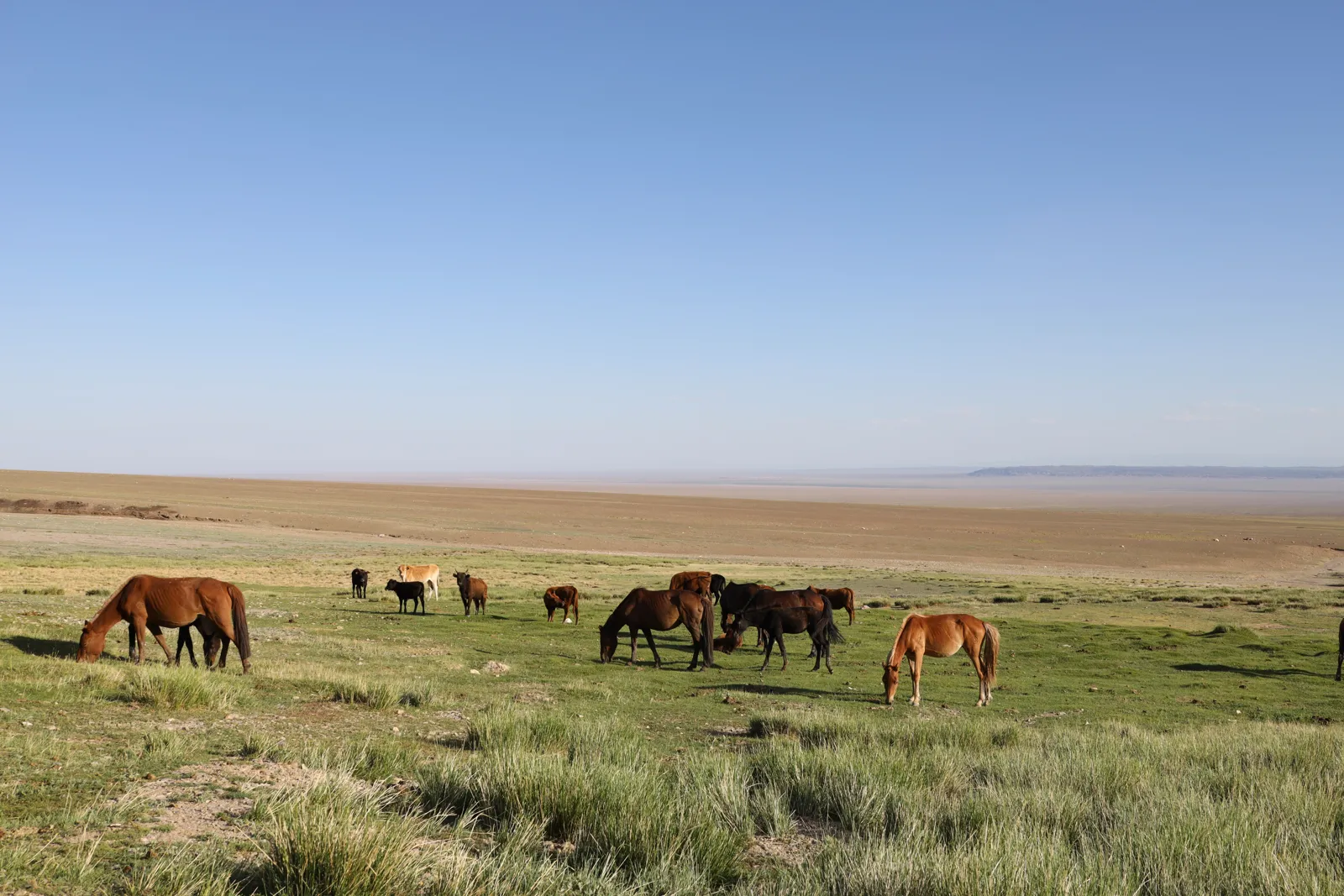
Horses grazing on the Mongolian steppe
Ulaanbaatar
The capital is home to nearly half of the country’s population. It is a city of contrasts: modern towers, ger districts on the outskirts and Buddhist monasteries. Gandan Monastery, the National Museum of Mongolia, Chinggis Khaan Square and the Bogd Khan Palace Museum help you understand the country before heading into the steppe. Allow one or two days, at the start or end of your trip.
Gorkhi-Terelj National Park
About two hours’ drive from the capital, this park of wooded hills and granite rocks is ideal for a first night in a ger, hiking and horse riding. Nearby, the giant equestrian statue of Genghis Khan at Tsonjin Boldog is a frequent stop. It is the simplest option if you only have a few days.
The Gobi Desert
The Gobi is not just a sand desert: it mixes stony steppe, canyons and mountain ranges. The most visited sites are the high, « singing » dunes of Khongoryn Els, the Yolyn Am canyon, often still icy in early summer, and the red cliffs of Bayanzag, known for their dinosaur fossils. The classic 4×4 loop takes at least a week round trip from Ulaanbaatar, or less with a domestic flight to Dalanzadgad.
The Orkhon Valley and Kharkhorin
The Orkhon Valley Cultural Landscape is a UNESCO World Heritage Site. In Kharkhorin, on the site of Karakorum, the former capital of the Mongol Empire, Erdene Zuu Monastery and its wall of white stupas are among the oldest in the country. Further south, the valley leads to the Orkhon Waterfall; the region combines well with the Tsenkher hot springs and the town of Tsetserleg.
Lake Khövsgöl
In the north, near the Russian border, Lake Khövsgöl stretches for more than 130 km (81 mi) between mountains and larch forests. Visitors come for hiking, horse riding and kayaking, and can meet reindeer herders from the nearby taiga, in remote areas reachable only with a reliable organization. The season is short: mid-June to early September. The region is reached by road or by a flight to Mörön, then a track to Khatgal.
The Altai and Bayan-Ölgii
The far west is the most mountainous region, largely inhabited by Kazakhs. It is the land of the eagle hunters, glaciers, high-altitude lakes and Altai Tavan Bogd National Park. It is an expedition destination, usually reached by a domestic flight to Ölgii, then several days on tracks.
The Elsen Tasarkhai dunes and the central steppe
On the road to Kharkhorin, this ribbon of dunes in the middle of the steppe, sometimes nicknamed the « mini-Gobi », lets you see sand and camels without going all the way south. Nearby, Hustai National Park is home to Przewalski’s horses, reintroduced in the 1990s.
Things to do in Mongolia: activity ideas
Sleep in a ger, from your first night in Gorkhi-Terelj National Park
Climb the Khongoryn Els dunes and walk through the Yolyn Am canyon, in the Gobi
Attend Naadam, the great national festival in July
Ride a horse and kayak on Lake Khövsgöl, from mid-June to early September
Watch Przewalski’s horses in Hustai National Park
Visit the monasteries of Gandan in Ulaanbaatar and Erdene Zuu in Kharkhorin
Meet the Kazakh eagle hunters in the Altai
Bathe in the hot springs of Tsenkher
Itinerary ideas: how many days in Mongolia?
7 to 8 days: central Mongolia
Day 1: Ulaanbaatar (Gandan Monastery, National Museum of Mongolia)
Day 2: Hustai National Park and Przewalski’s horses
Day 3: Elsen Tasarkhai dunes
Days 4 and 5: Kharkhorin and Erdene Zuu Monastery, Orkhon Valley
Day 6: Tsenkher hot springs or Tsetserleg
Day 7: back toward Ulaanbaatar, night in Terelj if time allows
Day 8: departure
2 weeks: the Gobi and the Orkhon Valley
Day 1: Ulaanbaatar
Days 2 and 3: drive south via the rock formations of Baga Gazriin Chuluu or Tsagaan Suvarga
Days 4 and 5: Yolyn Am canyon
Days 6 and 7: Khongoryn Els dunes
Day 8: Bayanzag cliffs
Days 9 and 10: Ongi Monastery, then the Orkhon Valley
Days 11 and 12: Kharkhorin and Erdene Zuu
Day 13: Elsen Tasarkhai and Hustai
Day 14: back to Ulaanbaatar
3 weeks: add Lake Khövsgöl
Days 1 to 12: the Gobi and the Orkhon Valley, as above
Days 13 and 14: drive north via Tsetserleg and Terkhiin Tsagaan Lake
Days 15 to 18: Lake Khövsgöl (hiking, horse riding)
Days 19 and 20: return by road, or flight from Mörön to Ulaanbaatar
Day 21: departure
Distances are huge and the tracks slow: you will often spend 5 to 8 hours a day on the road. An overloaded itinerary leaves little time to enjoy each stop.
Budget for a trip to Mongolia
Outside the capital, travel is almost always on a tour with a driver, an off-road vehicle and often a guide-interpreter. The budget therefore depends mainly on how many people share the vehicle. Indicative amounts per person per day, excluding international flights (converted from our euro estimates at the ECB rate of 23 October 2026, roughly €1 = US$1.12):
Item
Budget
Comfort
Accommodation (homestay ger or tourist ger camp, hotel in Ulaanbaatar)
roughly US$11–28
roughly US$56–134
Meals
roughly US$11–22
roughly US$28–56
Vehicle, driver and fuel (shared)
roughly US$28–45
roughly US$56–90
Guide and activities (park fees, horse riding)
roughly US$6–17
roughly US$17–45
Total per day
roughly US$55–100
roughly US$145–280
Indicative estimates for a 4×4 tour, varying with the season and group size. The budget column assumes a vehicle shared by 4 to 6 travelers.
To compare offers, ask the agency what the daily price includes: vehicle, fuel, driver, guide, meals, nights in gers, park fees and any domestic flights. Prices go up in July, around Naadam.
Who is Mongolia for?
Our verdict by travel style, based on the information in this guide:
Adventure and wide open spaces: ideal: steppe, Gobi Desert, Lake Khövsgöl and the Altai, explored by 4×4 on tracks.
Nomadic culture: yes: nights in family gers, Naadam in July, the Gandan and Erdene Zuu monasteries.
Budget travelers: yes, if you share the vehicle with 4 to 6 travelers: roughly US$55–100 per person per day on a shared tour.
Comfort: not ideal: rustic gers, a stove that goes out at night, 5 to 8 hours on tracks a day; lodges remain rare.
Families: demanding: long drives, and the U.S. Department of State notes that, with few exceptions, hospitals do not meet Western standards and medical services may be unavailable in remote areas (travel.state.gov, last updated July 30, 2026); Gorkhi-Terelj, two hours from the capital, is the simplest option.
Women traveling alone: with caution: the U.S. Department of State advises female travelers to avoid solo travel in Mongolia (travel.state.gov, last updated July 30, 2026); avoid going out alone after dark.
Getting around Mongolia
4×4 with driver: the usual way to travel. Most sites are reached by dirt tracks: according to the UK FCDO, only about 10% of roads outside the capital are tarmacked and signposting is minimal (GOV.UK, updated 7 August 2026). Choose an agency that provides a well-maintained vehicle and an experienced driver.
Domestic flights: they link Ulaanbaatar with the main provincial towns (Dalanzadgad, Mörön, Ölgii, Khovd…) and save several days on tracks. Schedules can change with the season, and the UK FCDO reports fuel shortages, including aviation fuel, that may affect flights and road travel (GOV.UK, updated 7 August 2026).
Train: the Trans-Mongolian line crosses the country from north to south via Ulaanbaatar; it can be used to enter or leave the country via China. At the China–Mongolia border, expect a delay of a few hours because the railways use different gauges (GOV.UK).
Driving: the U.S. Department of State recommends not driving outside Ulaanbaatar or other city centers after sunset and describes driving outside the capital as unsafe, particularly after dark (travel.state.gov, last updated July 30, 2026). In winter, keep high-quality cold-weather clothing in the vehicle, even for short trips. A U.S. driver’s license is not valid: U.S. tourists can drive for six months with an international driving permit, and car insurance is mandatory. UK travelers need a 1968 international driving permit and a UK licence; the 1949 IDP is no longer accepted, and the IDP cannot be bought outside the UK (GOV.UK, updated 7 August 2026).
In Ulaanbaatar: the UK FCDO advises using only licensed taxis, or the trackable UBCab app, or asking your hotel or restaurant to order a car (GOV.UK, updated 7 August 2026); the U.S. Department of State warns that mugging is more likely in unlicensed taxis.
Where to stay in Mongolia
In Ulaanbaatar, the center around Chinggis Khaan Square and Peace Avenue has international hotels, guesthouses and restaurants, and makes sightseeing on foot easy. On the steppe, you sleep in gers: either in tourist camps, with shared bathrooms and meals, or with nomadic families, with much more rustic comfort. In the most visited areas, such as Terelj, the Gobi, the Orkhon Valley and Lake Khövsgöl, a few lodges offer more comfort.
Gers are heated by a stove, which often goes out during the night: bring a good sleeping bag, even in summer, as nights can be cold. Many tourist camps are only open from about June to September. The U.S. Department of State has received reports of burglaries in occupied gers, whose doors often cannot be locked: keep your valuables with you (travel.state.gov, last updated July 30, 2026).
Entry requirements for Mongolia, health and safety
US citizens
According to the U.S. Department of State (travel.state.gov, last updated July 30, 2026), no visa is needed for tourism or business visits under 90 days, but your passport must be valid for at least six months beyond your arrival date. All foreign nationals must register with the Immigration Agency of Mongolia within 48 hours of arrival, whatever the length of stay; your accommodation can do it, or you can register online. Failing to register, or staying beyond 90 days, leads to fines that must be paid before you can leave. For stays over 90 days, apply for a visa before leaving the United States.
UK citizens
According to the UK FCDO (GOV.UK foreign travel advice, updated 7 August 2026), you can visit Mongolia for tourism for up to 30 days without a visa until 31 December 2026. Your passport must have an expiry date at least 6 months after the date you arrive. Make sure the border officer stamps your passport, or you could have problems leaving. Your hotel registers you through an app; if you travel independently or stay with friends, you must register yourself with the Mongolian Immigration Agency (no need to go in person), and you will receive a digital residence permit to carry at all times. For longer stays or other purposes, contact the Mongolian Embassy in the UK.
The two governments describe different visa-free periods for their own citizens; for any doubt, and for travel from 2027, check with the Mongolian embassy before you leave.
Onward travel to China or Russia: the UK FCDO notes that only a few land border crossings are open to foreigners and that it is difficult to get Chinese or Russian visas in Mongolia: arrange them before you travel (GOV.UK, updated 7 August 2026). The U.S. Department of State lists Zamiin Uud (China) and Sukhbaatar/Altanbulag (Russia) as the crossings always open to foreign travelers. Border areas, up to 100 km (62 mi) inside the border, require a permit from the State Frontier Guard Authority (GOV.UK).
Money and customs: you can bring in up to MNT 15 million; declare cash or travelers’ checks worth US$10,000 or more, or it could be seized when you leave (GOV.UK). Importing medicines is not allowed except for personal use with a doctor’s prescription (travel.state.gov). Check your home country’s customs allowances too (e.g. CBP in the US, HMRC in the UK).
Health: the UK FCDO advises checking vaccine recommendations at least 8 weeks before your trip (TravelHealthPro) (GOV.UK, updated 7 August 2026); the U.S. Department of State recommends being up to date on CDC-recommended vaccinations and lists rabies, plague, meningococcal meningitis, tuberculosis, measles and influenza as prevalent. With few exceptions, hospitals do not meet Western standards, there is no helicopter medical evacuation, most providers only accept cash, and supplemental insurance covering medical evacuation is strongly recommended. Ulaanbaatar suffers severe air pollution in winter, with AQIs over 300 most days from December to February (travel.state.gov, last updated July 30, 2026).
Safety: pickpockets operate in markets and crowded places, especially during Tsagaan Sar (New Year) and Naadam (July) (GOV.UK). Always carry your passport: police do not accept a copy (GOV.UK). Drug possession or use is illegal, and photographing police or military personnel can lead to arrest (GOV.UK). Weather ranges from +35 °C (95 °F) in summer to −40 °C (−40 °F) in winter and changes without warning (GOV.UK, updated 7 August 2026).
Emergencies: police 102, ambulance 103, fire 101 (GOV.UK). The U.S. Department of State notes that emergency responders usually do not speak English.
Insurance: essential, covering medical treatment and evacuation, as recommended by both the UK FCDO and the U.S. Department of State.
Entry requirements checked on 24 October 2026; they change often, so check them again before you travel.
Practical tips for Mongolia
Money: plan your cash needs with your tour operator before leaving Ulaanbaatar, and do not keep all your money and documents in one bag. Our currency converter helps you estimate your spending.
Internet: according to the UK FCDO, Wi-Fi is widely available in Ulaanbaatar hotels, restaurants and bars and you can buy local SIM cards, but large rural areas have no network coverage (GOV.UK, updated 7 August 2026). A local SIM card or an eSIM is useful; on expeditions, the agency sometimes carries a satellite phone. For coverage on the steppe and data plans, see our page Mongolia eSIM.
With nomadic families: enter the ger without stepping on the threshold, move clockwise inside, and accept what is offered (milk tea, dairy products) with your right hand, at least tasting it.
Luggage: even in summer, bring warm layers, a windbreaker, a good sleeping bag and a headlamp. Soft bags fit better in vehicles than hard suitcases.
Water and food: drink bottled or treated water; the U.S. Department of State notes that tap water is likely not up to U.S. standards (travel.state.gov, last updated July 30, 2026). The cuisine is very meat-heavy (mutton, beef, dairy): tell your agency in advance if you are vegetarian.
Respect for the environment: take your waste back to town, as there is virtually no collection on the steppe.
Monasteries: ask permission before taking photos and do not touch sacred images or objects (GOV.UK).
US citizens need no visa for visits under 90 days (travel.state.gov, last updated July 30, 2026); UK citizens can visit for tourism for up to 30 days without a visa until 31 December 2026 (GOV.UK, updated 7 August 2026). Your passport must be valid at least six months after arrival, and you must be registered with the Immigration Agency within 48 hours. Checked on 24 October 2026; check the latest rules, especially for 2027.
Can you travel in Mongolia without a tour?
In Ulaanbaatar and on a few routes served by bus or train, yes. For the steppe, the Gobi or Lake Khövsgöl, most travelers use an agency providing a vehicle and driver: tracks are poorly marked, distances are long, and the U.S. Department of State notes that medical services may be unavailable in remote areas.
How much does a two-week trip to Mongolia cost?
Excluding international flights, allow roughly US$55–100 per person per day on a shared tour, and US$145–280 on a comfortable private tour. The price depends mainly on how many people share the vehicle.
What is the best time to visit Mongolia?
June to September. July is the month of Naadam, the warmest and busiest; June and September are quieter. Winter is extremely cold, with a January mean of −21 °C (−6 °F) in Ulaanbaatar.
Is Mongolia safe to visit?
The U.S. Department of State describes Mongolia as relatively safe for foreigners, though street and violent crime are rising in larger towns (travel.state.gov, last updated July 30, 2026). The main risks are road accidents, distance from emergency care, pickpocketing in Ulaanbaatar and assaults reported against travelers, including women. Avoid driving after dark outside cities and travel with solid insurance.
What can you see in Mongolia in one week?
Central Mongolia: Ulaanbaatar, Hustai National Park and its Przewalski’s horses, the Elsen Tasarkhai dunes, Kharkhorin and Erdene Zuu Monastery, the Orkhon Valley, then a night in Terelj. The Gobi needs at least another week.
What itinerary for two weeks in Mongolia?
The classic route combines the Gobi (Yolyn Am, the Khongoryn Els dunes, the Bayanzag cliffs) and the Orkhon Valley with Kharkhorin. Expect 5 to 8 hours on tracks most days; with three weeks, add Lake Khövsgöl.
Our sources
Climate normals: World Meteorological Organization 1991–2020 climate normals (data from Mongolia’s national meteorological service), archived by NOAA
Entry, health, safety and driving information read on 24 October 2026: U.S. Department of State, Mongolia country information (travel.state.gov, last updated July 30, 2026), and UK FCDO, foreign travel advice for Mongolia (GOV.UK, updated 7 August 2026)
European Central Bank: euro reference rates of 23 October 2026 (budget conversions)
Discover our other destinations in Asia, such as neighboring China, Uzbekistan and its Silk Roads, or Kyrgyzstan, another land of yurts and steppes.
Transparency: this page contains affiliate links, labelled as such. If you book through them we may earn a commission at no extra cost to you; it does not influence our content or recommendations. How we fund the site.