This Scotland travel guide suggests 7 to 10 days for Edinburgh and the Highlands (Glen Coe, Skye, Loch Ness) and two weeks for a grand tour, with a budget of roughly £65–100 per person per day on a budget, excluding flights. Scotland packs two cultural capitals, Edinburgh and Glasgow, some of the most photographed mountains and lochs in Europe and hundreds of islands into a small area. It is ideal for a road trip, as long as you accept changeable weather and prepare your paperwork: US visitors now need an Electronic Travel Authorisation (ETA). This guide brings together the essentials for planning your trip to Scotland.
To locate cities, regions, terrain, national parks and airports, see our map of Scotland.
Scotland at a glance
CapitalEdinburghScotland is a nation of the United Kingdom, whose capital is London
LanguagesEnglishScottish Gaelic appears on signs in the Highlands and Hebrides
The best period is May to June and September: very long days (more than 17 hours of daylight in June in Edinburgh), May the sunniest month of the year, and fewer crowds and fewer midges than in midsummer. July and August are the mildest months, around 19 °C (66 °F) in the afternoon, but also the most expensive, with the Edinburgh festivals in August and midges in the western Highlands. From November to February, days are very short and rain is heavy in the west: it is the season for city breaks and Hogmanay. All the details, region by region and month by month, are in our article best time to visit Scotland. City breaks and Hogmanay in winter, festivals in summer: the best time to visit Edinburgh depends on the atmosphere you are after.
What to see in Scotland: the highlights
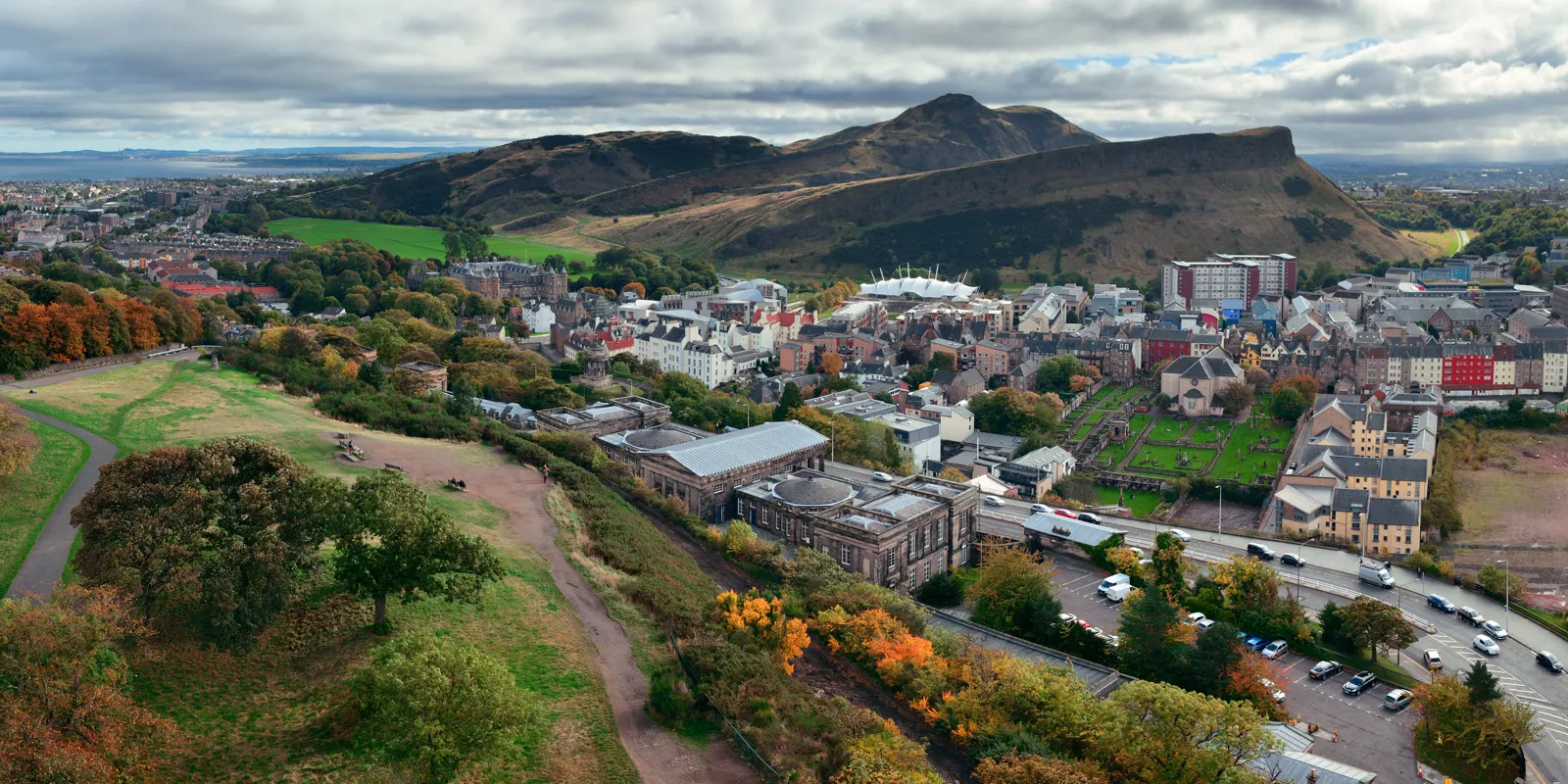
Panorama of Edinburgh from Calton Hill
Edinburgh
The capital deserves at least two days. Its medieval Old Town and Georgian New Town are jointly listed as World Heritage. The castle dominates the city from its volcanic rock; it is linked to the Palace of Holyroodhouse by the Royal Mile, the Old Town’s main street. Climb Arthur’s Seat or Calton Hill for the view, visit the National Museum of Scotland (free), and wander through Dean Village and the port district of Leith. The Edinburgh Visitor Levy, a charge on overnight stays, came into effect in 2026 (City of Edinburgh Council).
Glasgow
Scotland’s largest city, Glasgow is a former industrial city turned cultural capital: Kelvingrove Art Gallery and Museum, the Burrell Collection, a medieval cathedral, Charles Rennie Mackintosh architecture and a very active music scene. Merchant City and the West End, around the university, are full of restaurants and pubs. Glasgow is also the gateway to Loch Lomond and the west coast.
Glen Coe and Fort William
Glen Coe is one of the most spectacular valleys in the Highlands, framed by steep mountains and crossed by the A82. A little further north, Fort William, at the foot of Ben Nevis (1,345 m, or 4,413 ft, the highest peak in the UK), is a base for hiking. From there, the railway to Mallaig crosses the Glenfinnan Viaduct; in summer, a tourist steam train runs on it.
The Isle of Skye
Linked to the mainland by a bridge, Skye is Scotland’s most visited island: the rock pinnacles of the Old Man of Storr, the landscapes of the Quiraing, the Fairy Pools at the foot of the Cuillin, Neist Point lighthouse and the colorful harbor of Portree. It is very busy in summer and accommodation is limited: book early, and start your hikes early to find a parking space.
Inverness and Loch Ness
The capital of the Highlands, Inverness is a small, convenient base. Loch Ness stretches southwest along the Great Glen; the ruins of Urquhart Castle, on its shore, are the most visited site. East of Inverness, the Culloden battlefield recalls the last Jacobite battle of 1746. Inverness is also the starting point of the northern scenic route, the North Coast 500. South of Inverness, Loch Ness and its surroundings can be explored on a cruise or by the road along the shore.
The Cairngorms and Speyside
Cairngorms National Park, the largest in the UK, combines mountains, pine forests and lochs, with Aviemore as its main base. To the north, the Spey valley has a high concentration of whisky distilleries, several of which offer tours. In winter, the Cairngorms have one of Scotland’s few ski areas.
Stirling, St Andrews and Fife
Between Edinburgh and the Highlands, Stirling has a royal castle and the Wallace Monument. On the Fife coast, St Andrews is home to Scotland’s oldest university, its cathedral ruins and famous golf courses; the small fishing harbors of the East Neuk round off a day nicely.
The Outer Hebrides and Orkney
For travelers with more time: the islands of Lewis and Harris, in the Outer Hebrides, offer vast white sand beaches and the Callanish standing stones; Orkney, to the north, preserves Neolithic sites listed as World Heritage, such as the village of Skara Brae. They are reached by ferry or plane.
Things to do in Scotland: 10 experiences not to miss
To sum up what to see and do in Scotland on a first trip, here are the experiences covered above, to tick off according to your interests:
Walk Edinburgh’s Royal Mile, from the castle to Holyroodhouse, then climb Arthur’s Seat or Calton Hill
Visit the free National Museum of Scotland in Edinburgh and Kelvingrove in Glasgow
Drive through Glen Coe on the A82
See the Glenfinnan Viaduct on the Fort William – Mallaig line
Hike on the Isle of Skye: Old Man of Storr, Quiraing, Fairy Pools
Follow Loch Ness to the ruins of Urquhart Castle
Discover the Culloden battlefield, near Inverness
Tour a whisky distillery in Speyside
Explore Cairngorms National Park from Aviemore
Take the ferry to the Outer Hebrides or Orkney if you have more time
Itinerary ideas: a road trip in Scotland
7 to 10 days: Edinburgh and the Highlands
Days 1 to 3: Edinburgh (castle, Royal Mile, Arthur’s Seat, Leith)
Day 4: Stirling then Glen Coe, overnight in Glen Coe or Fort William
Days 5 to 7: Isle of Skye (Portree, Storr, Quiraing, Fairy Pools)
Day 8: Eilean Donan Castle, then Loch Ness to Inverness
Days 9 and 10: the Cairngorms or Speyside distilleries, back to Edinburgh
2 weeks: a grand tour of Scotland
Days 1 to 3: Edinburgh
Day 4: St Andrews and Fife
Days 5 and 6: the Cairngorms and Speyside
Days 7 and 8: Inverness, Culloden and Loch Ness
Days 9 to 11: Isle of Skye
Day 12: Glen Coe and Fort William
Day 13: Loch Lomond then Glasgow
Day 14: Glasgow (museums, West End), departure
Budget for a trip to Scotland
Scotland is an expensive destination, especially for accommodation in summer and in Edinburgh in August. Indicative amounts per person per day, excluding international flights (converted from our euro estimates at roughly €1 = £0.84, ECB rate of 23 October 2026):
Item
Budget
Comfort
Accommodation (youth hostel or based on a shared double room)
roughly £30–45
roughly £75–125
Meals
roughly £20–30 (pubs, cafés, supermarkets)
roughly £40–65
Transport (bus, train, shared car rental)
roughly £15–20
roughly £25–35
Activities and sightseeing
roughly £5–10
roughly £15–25
Total per day
roughly £65–100
roughly £150–235
Indicative estimates, varying with the season. Allow considerably more in August in Edinburgh and in summer on Skye.
Several major national museums, including the National Museum of Scotland and Kelvingrove, are free. Castles and distillery tours charge admission. To track your spending in pounds, use our currency converter.
Getting around Scotland
Car: the freest way to explore the Highlands and islands. Traffic drives on the left, and pedestrians do not have right of way (U.S. Department of State, travel.state.gov, last updated August 11, 2025); in remote areas, many roads are single-track with passing places: do not park in them. Scotland’s drink-drive limit is 50 mg of alcohol per 100 ml of blood, different from the rest of the UK (mygov.scot). US drivers should check on GOV.UK whether their license is valid in the UK (U.S. Department of State).
Train: the network links Edinburgh, Glasgow, Stirling, Perth, Aberdeen and Inverness, and serves the western Highlands (Fort William, Mallaig, Kyle of Lochalsh). Trains between Edinburgh and Glasgow are frequent.
Bus: intercity coaches serve most towns and part of the Highlands and Skye at moderate prices, with sometimes infrequent services out of season.
Ferries: essential for the western islands (Mull, the Outer Hebrides) and the northern isles. In summer, book ahead if you are traveling with a car, and allow for cancellations in bad weather.
In Edinburgh: the center is best explored on foot; a tram links the airport with the city center.
Where to stay in Scotland
In Edinburgh, the Old Town and New Town let you do everything on foot; Leith and the residential districts to the south are often a little cheaper. In Glasgow, stay in the center or the West End. In the Highlands, convenient bases are Fort William, Inverness, Aviemore and Portree on Skye.
Options range from youth hostels to B&Bs and guesthouses, very common in the countryside, plus rental cottages and castle hotels. In rural areas and on the islands, rooms are limited and some places close in winter: in summer, book several months ahead. In August, Edinburgh accommodation is at its most expensive.
Mistakes to avoid on a trip to Scotland
Traveling from the US without an ETA: it is required before travel for stays of up to 6 months.
Booking too late for summer: on Skye, in rural areas and in Edinburgh in August, accommodation is limited and goes months in advance.
Parking in passing places: these spaces on single-track roads are only for letting traffic pass.
Forgetting that traffic drives on the left, and that Scotland’s drink-drive limit differs from the rest of the UK.
Underestimating mountain weather: it changes very quickly, even in summer; take warm and waterproof clothing.
Forgetting midge repellent between May and October in the west.
Forgetting a plug adapter if you are coming from the US (type G sockets).
Not checking your phone plan: roaming charges may apply depending on your provider.
Entry requirements for Scotland
Scotland is part of the United Kingdom, so UK entry rules apply. Entry requirements checked on 24 October 2026; check them again before you travel.
US citizens
According to the U.S. Department of State (travel.state.gov, last updated August 11, 2025), all US citizens traveling to the UK for tourism, family visits, business meetings or short-term study for 6 months or less must have an Electronic Travel Authorisation (ETA) before travel.
According to GOV.UK (apply for an ETA, read on 24 October 2026), an ETA costs £20 and lets you visit the UK for up to 6 months; apply only through the official GOV.UK service and avoid imitation websites.
Your passport must be valid for the entire length of your stay; US passport holders can use the ePassport gates on arrival (U.S. Department of State).
UK citizens
Travel from elsewhere in the UK to Scotland is domestic travel: there are no entry formalities.
Health and safety
Health insurance: the State Department encourages US citizens to buy medical evacuation insurance; check that your policy covers you in the UK. Take out a travel insurance policy covering medical costs.
Crime: violent crime and property crime are rare, but be aware of pickpocketing and phone snatching; only use licensed taxis or pre-booked car services (U.S. Department of State).
Mountains: the weather changes very quickly in the Highlands, even in summer: go equipped (warm and waterproof clothing, map, water) and check the forecast before a hike. Protect yourself against ticks and midges.
Pedestrians: many US pedestrians are injured because they forget traffic comes from the right: look both ways before crossing (U.S. Department of State).
Emergencies: 999.
Practical tips for Scotland
Money: the pound sterling. Check your bank’s foreign transaction fees before you leave.
Internet: mobile coverage is weak or absent in some Highland valleys and on the islands. US travelers should check their provider’s roaming rates; an eSIM is a simple alternative.
Electricity: Scotland uses type G plugs on a standard UK 230 V supply (VisitScotland): bring an adapter from the US.
Etiquette: in pubs, you order and pay at the bar. Always queue. Scots do not like being called « English ».
Nature: access to the outdoors is very open in Scotland, but comes with rules of respect: close gates, keep dogs on a lead near livestock and leave no litter.
Midges: from about May to October, especially in the west, bring a suitable repellent.
Who is Scotland for?
Our view by traveler profile, based on the information in this guide (places, budget, seasons).
Profile
Our view
Why
Couples
Well suited
Castles, countryside B&Bs, the landscapes of Skye and Glen Coe.
Families
Well suited
Free national museums, Edinburgh Castle; changeable weather even in summer.
Budget travelers
With reservations
Roughly £65–100 a day; youth hostels, pubs and free museums help.
Nature and hiking
Very well suited
The Highlands, the Isle of Skye, the Cairngorms, the Hebrides.
Culture and history
Very well suited
Edinburgh, Stirling, Culloden, St Andrews.
Whisky
Well suited
Speyside distilleries, paid tours.
Sun and beach
Poorly suited
A cool, changeable climate; the Hebridean beaches are better for looking at than swimming.
Frequently asked questions
Do I need a visa or ETA for Scotland?
US citizens do not need a visa for tourism stays of up to 6 months, but they must get a UK Electronic Travel Authorisation (ETA) before travel (travel.state.gov, August 11, 2025); it costs £20 (GOV.UK). UK citizens have no formalities, as it is domestic travel. Checked on 24 October 2026.
What is the best time to visit Scotland?
May, June and September: long days, fairly good weather, fewer crowds and fewer midges than in July–August. August is the month of the Edinburgh festivals, but also the most expensive.
How much does a trip to Scotland cost?
Excluding flights, allow roughly £65–100 per person per day on a budget, and £150–235 in comfort. Accommodation is the biggest expense, especially in summer and during the Edinburgh festivals.
How many days do you need in Scotland?
A week to ten days lets you see Edinburgh, Glen Coe, Skye and Loch Ness. Two weeks leaves time to add Glasgow, St Andrews, the Cairngorms and Speyside.
Do you need a car in Scotland?
Not for Edinburgh, Glasgow and Inverness, which are well connected by train. For the Highlands and Skye, a car gives much more freedom. Remember that traffic drives on the left and many rural roads are single-track.
What are the downsides of a trip to Scotland?
The main ones: changeable, rainy weather, especially in the west; expensive accommodation (particularly in Edinburgh in August and on Skye in summer); midges from May to October in the west; and driving on the left on rural roads that are often single-track.
Is Scotland worth visiting?
Yes if you love big landscapes, hiking, castles and cities steeped in history: Scotland brings together Edinburgh, Glasgow, the Highlands and the islands. It is less suited if you are looking for sun and heat.
Transparency: this page contains affiliate links, labelled as such. If you book through them we may earn a commission at no extra cost to you; it does not influence our content or recommendations. How we fund the site.