This Iceland travel guide is built around the Ring Road: the Golden Circle and the south coast in 7 to 10 days, the full loop of the island in two weeks from May to September, with a budget of roughly ISK 14,000–20,000 per person per day on a budget trip. On an island barely larger than Portugal, Iceland packs active volcanoes, glaciers, waterfalls, lava fields and hot springs. It is mainly explored by car, along the Ring Road. It is an expensive destination where the weather sets the programme: this guide gathers the essentials to plan your stay. If you are hesitating with Scandinavia, our Iceland or Norway comparison looks at daylight, northern lights and climate.
To locate the cities, regions, relief, national parks and airports, see our map of Iceland.
Time zoneUTC+0 all year, no daylight saving time: same time as London in winter, 1 hour behind in summer; 4 to 5 hours ahead of New York
AirportsKeflavík International (KEF), about 50 km (31 mi) from ReykjavíkDomestic flights from Reykjavík City Airport
EntrySchengen area: no visa for UK citizens for up to 90 days in any 180-day period; US citizens need a passport valid 3 months beyond their stay · travel.state.gov · GOV.UKEU Entry/Exit System (EES): fingerprints and photo at the border
Electricitycheck voltage and plug types before you go · plugsReference: IEC World Plugs
The best time runs from June to August: afternoon temperatures around 13 to 15 °C (55 to 59 °F), days of nearly 20 hours and Highland tracks open. It is also the most expensive and busiest season. May and September are good compromises. For the northern lights, you need dark nights: in practice from September to March, with short days (about 4 hours of daylight in December in Reykjavík) and more unsettled weather. All the details, month by month and with data from the Icelandic Met Office, are in our article on the best time to visit Iceland. For the shoulder season, with dark nights returning, our page on Iceland in September covers the weather, roads and chances of seeing the aurora.
What to see in Iceland: the highlights
Reykjavík
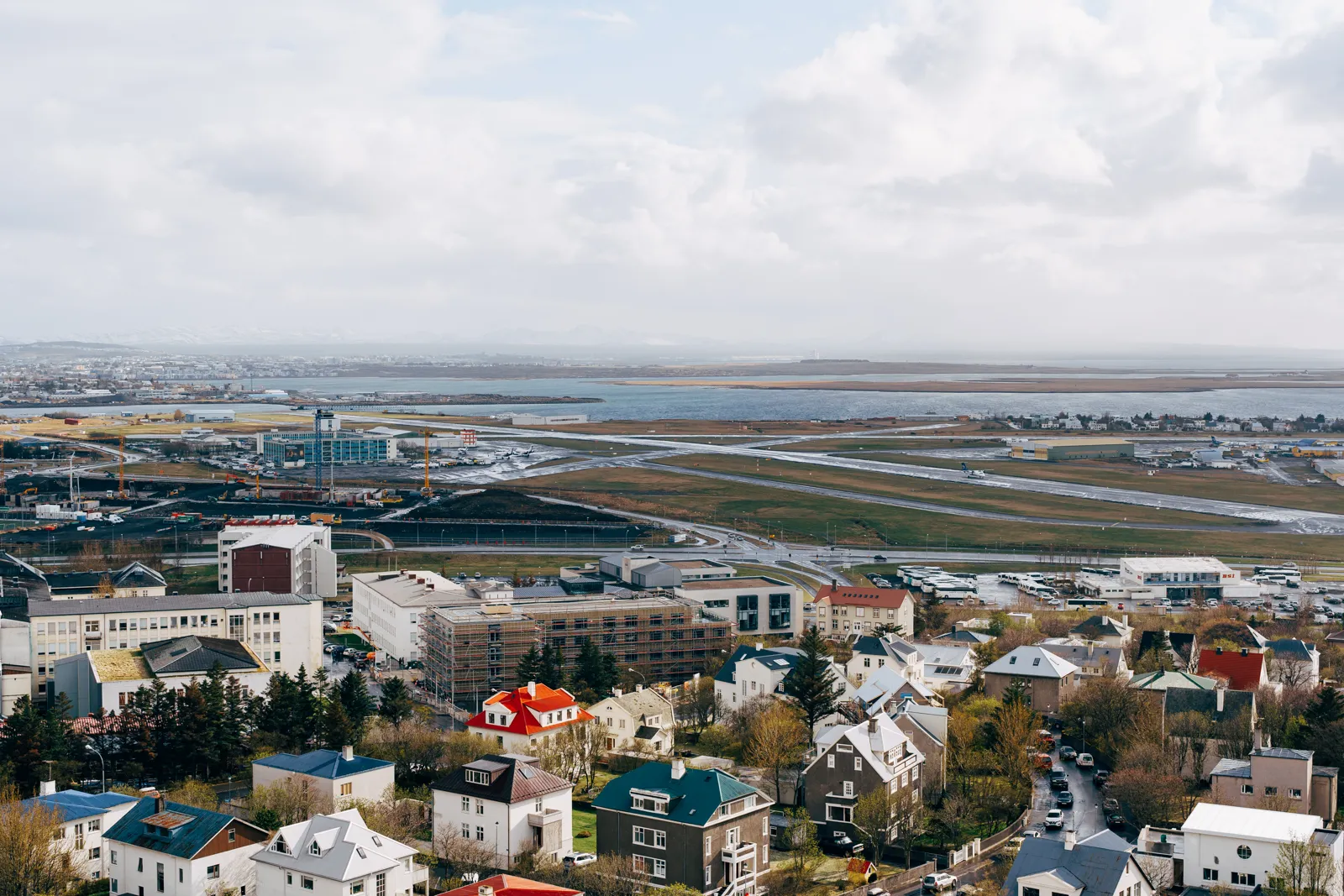
Aerial view of central Reykjavík and its colourful houses
The capital is home to about a third of the country’s population. It can be explored on foot in one or two days: Hallgrímskirkja church and the view from its tower, the Harpa concert hall on the harbour, Laugavegur street, the National Museum and the neighbourhood geothermal pools, very popular with locals. It is the ideal base for day trips and northern lights tours in winter.
The Golden Circle
This loop of about 300 km (186 mi) from Reykjavík links three sites: Þingvellir National Park, a World Heritage Site, where you walk between the North American and Eurasian tectonic plates; the Geysir geothermal area, where the Strokkur geyser erupts every few minutes; and Gullfoss waterfall. It can be done in a day, all year round.
The south coast: from Seljalandsfoss to Vík
Following Route 1 east, you pass the waterfalls of Seljalandsfoss (which you can walk behind) and Skógafoss, then the black sand beach of Reynisfjara, near Vík. Take care at Reynisfjara: the waves are very dangerous, so stay well back from the water. GOV.UK notes that going too close to the ocean, cliff edges and hot springs are common causes of accidents in Iceland.
Vatnajökull and Jökulsárlón
Iceland’s largest glacier dominates the south-east. At Skaftafell, trails lead to Svartifoss waterfall and the glacier tongues. Further on, the Jökulsárlón glacier lagoon and the nearby « Diamond Beach », strewn with blocks of ice, are among the most photographed sites in the country. Glacier hikes and ice caves (in winter) are only done with a guide.
The Snæfellsnes Peninsula
About two hours north of Reykjavík, this peninsula sums up Iceland in miniature: the Snæfellsjökull glacier-volcano, cliffs, beaches, fishing villages and the much-photographed Kirkjufell mountain. Allow one or two days.
Akureyri and Lake Mývatn
Akureyri, the main town in the north, is a good stop at the head of its fjord. About an hour’s drive away, the Lake Mývatn area combines pseudo-craters, the Dimmuborgir lava fields, the Hverir geothermal area and natural baths. Further east, Dettifoss is one of the most powerful waterfalls in Europe. Húsavík, on the coast, is a well-known base for whale watching.
The Eastfjords and the Westfjords
Less visited, these two regions offer winding coastal roads and isolated villages. The Westfjords (Vestfirðir), with Dynjandi waterfall and the Látrabjarg cliffs, take time and are mainly visited in summer.
The Highlands
The desert-like interior is only accessible in summer via the F-roads. Landmannalaugar, with its colourful rhyolite mountains and hot springs, is the starting point of the famous Laugavegur trek to Þórsmörk. A 4×4 or a Highland bus is essential.
Itinerary ideas for Iceland
7 to 10 days: Reykjavík, the Golden Circle and the south coast
Days 1 and 2: Reykjavík
Day 3: the Golden Circle (Þingvellir, Geysir, Gullfoss)
Days 4 and 5: the south coast, Seljalandsfoss, Skógafoss, Vík
Days 6 and 7: Skaftafell and Jökulsárlón, then gradually back west
Days 8 to 10 (optional): the Snæfellsnes Peninsula
2 weeks: around the island on Route 1 (preferably May to September)
Days 1 and 2: Reykjavík and the Golden Circle
Days 3 to 5: the south coast to Jökulsárlón
Days 6 and 7: the Eastfjords
Days 8 to 10: Mývatn, Dettifoss, Húsavík and Akureyri
Days 11 and 12: the Snæfellsnes Peninsula
Days 13 and 14: back to Reykjavík, a geothermal soak before your flight
For that geothermal soak before your flight home, our guide to visiting the Blue Lagoon covers tickets, opening hours and access from the airport.
Route 1 is about 1,300 km (808 mi) long. In winter, it is better to skip the full loop and focus on the south-west and the south coast.
Iceland: who is it for?
Our verdict depending on how you like to travel, based on the information in this guide:
Profile
Our verdict
Why
Nature and road trips
✅ Ideal
The Golden Circle, the south coast, glaciers and Route 1, about 1,300 km (808 mi), from May to September for the full loop.
Hiking
✅ Yes
Landmannalaugar and the Laugavegur, Skaftafell; the Highlands are only accessible in summer.
Couples
✅ Yes
Northern lights in winter, midnight sun in summer, hot springs.
Families
⚠️ Possible
Waterfalls are easy to reach, but distances are long and great care is needed at Reynisfjara and on glaciers.
Tight budget
❌ Difficult
One of Europe’s most expensive destinations: roughly ISK 14,000–20,000 per person per day on a budget trip.
Beach and sea swimming
❌ No
Black sand beaches to admire from a distance; swimming happens in the hot springs.
Budget for a trip to Iceland
Iceland is one of Europe’s most expensive destinations: accommodation, car hire and restaurants weigh heavily. Approximate amounts per person per day, excluding international flights, converted into krónur at the European Central Bank rate of 23 October 2026 (€1 = ISK 136.20) and rounded:
Item
Tight budget
Comfortable
Accommodation (based on a shared double room, or camping in summer)
about ISK 4,000–9,500
about ISK 16,000–27,000
Meals
about ISK 3,500–5,500 (supermarket, simple dishes)
about ISK 9,500–16,000
Transport (shared car hire, fuel)
about ISK 4,000–7,000
about ISK 8,000–14,000
Activities and sightseeing
about ISK 1,500–4,000
about ISK 7,000–14,000
Total per day
about ISK 14,000–20,000
about ISK 34,000–54,000
Rough estimates that vary with the season. Prices peak from June to August.
To cut costs: shop at discount supermarkets, fill your water bottle from the tap and share the car. Many natural sites are free, but car parks increasingly charge a fee.
Getting around Iceland
Rental car: the most practical way to get out of Reykjavík. Traffic drives on the right. A standard car is enough for Route 1 in summer, but the State Department notes that less than a third of the road network is paved and that many roads outside the capital are impassable in winter (October to April), with many one-lane bridges (travel.state.gov, last updated May 14, 2026). GOV.UK warns that strong winds can throw sand or ash and damage rental cars in ways not covered by insurance, and that UK photocard licences can be used for up to 30 days (updated 11 August 2026): check your insurance carefully.
F-roads: many Highland tracks are only open for a short part of the summer and some require four-wheel drive; cross rivers slowly, as their levels can change within the same day. Off-road driving is strictly controlled (GOV.UK).
Winter driving: short days, ice and strong wind. Check road conditions every day on road.is and alerts on safetravel.is, as the State Department recommends, and do not hesitate to postpone a journey.
Organised tours: from Reykjavík, they cover the Golden Circle, the south coast, the northern lights and the glaciers. A good option in winter if you do not want to drive.
Bus: the public bus network exists but is infrequent outside the Reykjavík area. In summer, dedicated buses serve the Highlands.
Plane: domestic flights link Reykjavík with Akureyri and other towns, useful in winter.
Getting there
Almost all international flights land at Keflavík International Airport (KEF), on the Reykjanes Peninsula, about 50 km (31 mi) from Reykjavík. Check current routes from your home airport with the airlines and the airport.
Where to stay in Iceland
In Reykjavík, the centre around Laugavegur and the harbour lets you do everything on foot. Elsewhere, accommodation consists of guesthouses, farm hotels, hostels, cabins and a few hotels, often isolated along Route 1. Along the south coast and around Mývatn, accommodation is scarce compared with demand: in summer, book several months ahead.
Camping is a budget option from June to August, at official campsites. Wild camping in a tent or van is tightly regulated: check the local rules before you go.
Entry requirements for Iceland, health and safety
US citizens: Iceland is in the Schengen area. Your passport should be valid at least three months beyond your period of stay, and you need sufficient proof of funds and a return ticket (U.S. Department of State, travel.state.gov, last updated May 14, 2026).
UK citizens: no visa for up to 90 days in any 180-day period as a tourist. Your passport must have been issued less than 10 years before the day you arrive and be valid at least 3 months after the day you plan to leave the Schengen area. The EU Entry/Exit System (EES) is being implemented: fingerprints and a photo may be taken at your first entry, free of charge (GOV.UK, updated 11 August 2026).
Health: for vaccines, GOV.UK refers to TravelHealthPro and travel.state.gov advises being up to date on CDC-recommended vaccinations. UK travellers can use a GHIC or EHIC for state healthcare. The State Department notes that healthcare in rural areas may be limited and that non-residents bear all costs of transfers between hospitals: take out insurance covering medical costs and evacuation.
Safety: crime levels are low, though petty theft can occur, particularly around bars in downtown Reykjavík (GOV.UK). The main risks are natural: GOV.UK reports a series of volcanic eruptions on the Reykjanes Peninsula since December 2023 and considers further eruptions likely; the State Department also lists extreme weather, earthquakes, avalanches and landslides. Follow the authorities’ advice and check safetravel.is.
Nature: use a guide for glaciers, stay on marked paths in geothermal areas, beware of the waves at Reynisfjara, and leave your travel plans with Safe Travel Iceland. Emergency number: 112.
Practical tips for Iceland
Money: check your bank’s fees on payments in krónur; most hospitals and clinics accept credit cards (travel.state.gov). Our currency converter helps you estimate your spending.
Mobile data: coverage is good in inhabited areas and along Route 1, weaker in the Highlands. An eSIM or local SIM is useful to follow the weather and road conditions in real time. Roaming or eSIM: our Iceland eSIM page helps you decide.
Clothing: layer up, even in summer: technical base layers, fleece, waterproof jacket and trousers, hat and gloves. Bring a swimsuit for pools and hot springs.
Pools: a full shower without a swimsuit is required before entering the pools.
Respect nature: do not walk on moss, which takes decades to grow back, never drive off-road and do not build cairns.
Tipping: service is included; a tip is not expected.
Mistakes to avoid on a trip to Iceland
Underestimating distances: Route 1 is about 1,300 km (808 mi). In winter, skip the full loop and focus on the south-west and the south coast.
Taking an F-road in a standard car: some Highland roads require four-wheel drive, and river levels can rise quickly.
Setting off without checking the weather and roads: check road.is and safetravel.is every day, especially in winter.
Overlooking rental insurance: sand and ash damage may not be covered.
Walking on moss or driving off-road: off-road driving is strictly controlled and moss takes decades to grow back.
Going near the waves at Reynisfjara or onto a glacier alone: keep away from the water and use a guide for glaciers.
Buying bottled water: fill your bottle from the tap.
Not for a short tourist stay as a UK citizen: up to 90 days in any 180-day period in the Schengen area (GOV.UK). US citizens need a passport valid at least three months beyond their stay, proof of funds and a return ticket (travel.state.gov). Check both sites before you leave.
How much does a week in Iceland cost?
Excluding flights, allow roughly ISK 14,000–20,000 per person per day on a budget trip (camping or hostels, supermarket food, shared car) and ISK 34,000–54,000 for a comfortable one. Summer is the most expensive season.
When is the best time to visit Iceland?
June to August for mild weather, very long days and access to the Highlands. September to March for the northern lights, with short days and more unsettled weather.
How many days do you need to visit Iceland?
One week lets you see Reykjavík, the Golden Circle and the south coast as far as Jökulsárlón. It takes about two weeks to drive around the island on Route 1 without rushing.
Can you visit Iceland without a car?
Yes for Reykjavík and its surroundings, thanks to the many organised tours. To go around the island or visit the north, a car remains by far the most practical option, as buses are infrequent.
What budget for 10 days in Iceland?
Based on our daily ranges, allow roughly ISK 136,000–204,000 per person on a budget trip and ISK 340,000–545,000 for a comfortable one, excluding international flights. Prices peak from June to August; sharing the car and shopping at supermarkets cut the bill significantly.
What to see in Iceland in a week?
Reykjavík, the Golden Circle (Þingvellir, Geysir, Gullfoss), then the south coast from Seljalandsfoss and Skógafoss to Vík, and if possible Skaftafell and the Jökulsárlón glacier lagoon. The full loop of the island takes more like two weeks.
Transparency: this page contains affiliate links, labelled as such. If you book through them we may earn a commission at no extra cost to you; it does not influence our content or recommendations. How we fund the site.