This Finland travel guide introduces a country of forests and lakes, with a modern capital on the Baltic and, in the north, Lapland, its snowy winters and northern lights. Sparsely populated, safe and well organised, Finland is easy to visit, but it is expensive. This guide helps you choose between summer and winter, between the south and the north, and plan your itinerary: what to see, how many days to allow and what budget to expect.
To locate the cities, regions, relief, national parks and airports, see our map of Finland.
Finland at a glance
CapitalHelsinki
LanguagesFinnish and Swedish (official languages)Sámi languages in northern Lapland; English is very widely spoken
Time zoneUTC+2, UTC+3 in summer: 2 hours ahead of London, 7 hours ahead of New York
AirportsHelsinki (HEL), Rovaniemi (RVN), Kittilä (KTT), Ivalo (IVL)Lapland is usually reached via Helsinki
EntrySchengen area: no visa for UK citizens for up to 90 days in any 180-day period; US citizens need a passport valid 3 months beyond their stay · travel.state.gov · GOV.UKEU Entry/Exit System (EES): fingerprints and photo at the border
Electricitycheck voltage and plug types before you go · plugsReference: IEC World Plugs
There are two Finlands. For Helsinki, the Lakeland and the archipelago, the best time is June to August: average afternoon highs of 18.8 to 21.9 °C (66 to 71 °F) in Helsinki, very long days and life outdoors. For Lapland, go from December to March, ideally late February to March, for snow, winter activities and the northern lights, with an average afternoon high of −7.3 °C (19 °F) in January in Rovaniemi according to the FMI. Spring and autumn are transition seasons, except for ruska, the autumn colours of Lapland in September. All the details are in our article on the best time to visit Lapland.
Month
Helsinki (high / low)
Rovaniemi (high / low)
January
-0.7 (31) / -5.6 (22)
-7.3 (19) / -13.5 (8)
April
8.1 (47) / 1.1 (34)
4.1 (39) / -3.4 (26)
July
21.9 (71) / 14.5 (58)
20.1 (68) / 11.8 (53)
October
9.2 (49) / 4.2 (40)
3.1 (38) / -1.3 (30)
Average temperatures in °C (°F). Helsinki: 1991-2020 normals from the Finnish Meteorological Institute (FMI), Helsinki Kaisaniemi station. Rovaniemi: 1991-2020 normals from the Finnish Meteorological Institute (FMI, Ilmatieteen laitos), Rovaniemi Airport station.
What to see in Finland: the highlights
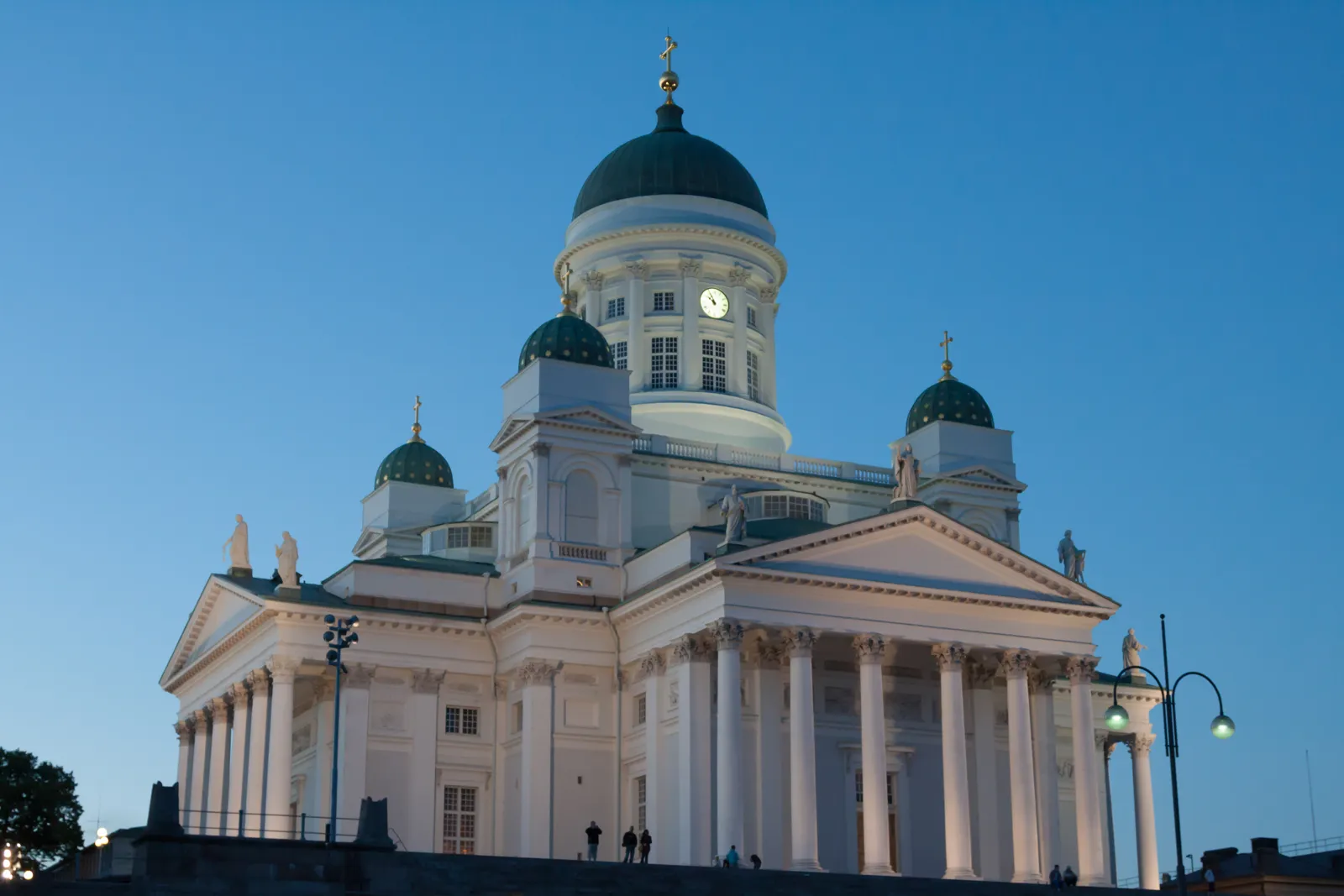
Helsinki and its cathedral in summer
Helsinki
The capital is explored on foot and by tram in 2 to 3 days. Around Senate Square, the white Lutheran cathedral dominates the neoclassical centre, while the Orthodox Uspenski Cathedral recalls the Russian period. Stroll along the Esplanadi, through the Market Square and the market halls, then discover Finnish design in the Design District. The Temppeliaukio rock church, Oodi library and the Kiasma museum of contemporary art showcase the city’s modern architecture. Public saunas, some by the sea, are part of the visit.
Suomenlinna fortress
About fifteen minutes by ferry from the Market Square, the sea fortress of Suomenlinna, built in the 18th century across several islands, is a UNESCO World Heritage Site. Walk among ramparts, cannons, museums and small beaches. The ferry is part of Helsinki’s public transport network. Allow half a day.
Porvoo
About 50 km (31 mi) east of Helsinki, Porvoo is one of the oldest towns in the country. Its colourful wooden houses, red riverside storehouses and cathedral make it a very easy day trip from the capital, by bus or, in summer, by boat.
Turku and the archipelago
A former capital, Turku is Finland’s oldest city, with a medieval castle, a cathedral and lively quays along the Aura River. It is the gateway to the archipelago, thousands of islands linked by bridges and ferries, explored by bike or car in summer. Further out, the Åland Islands form a Swedish-speaking autonomous region. By some definitions, this Archipelago Sea has around 50,000 islands, often tiny, making it one of the largest archipelagos in the world by number of islands.
Tampere
Between two lakes, Tampere is a former industrial city whose brick factories have been turned into museums, restaurants and cultural venues. It has a Moomin museum dedicated to Tove Jansson’s characters, public saunas and an observation tower. It is a good stop between Helsinki and the Lakeland or Lapland.
The Lakeland: Saimaa and Savonlinna
East-central Finland is a maze of lakes, islands and forests. Lake Saimaa, the largest in the country, is home to a rare freshwater seal. Savonlinna is known for its medieval Olavinlinna Castle, set on an island, which hosts an opera festival every summer. People come here for canoeing, lake cruises, hiking, and to stay in a lakeside cabin with a sauna.
Lapland
North of the Arctic Circle, Lapland is the most visited region in winter: Santa Claus Village in Rovaniemi, husky sledding, snowmobiling, the ski resorts of Levi and Saariselkä, Sámi culture in Inari and the northern lights from late August to early April. In summer, it is explored under the midnight sun, in national parks set up for hiking. GOV.UK points out that emergency medical assistance and search and rescue are limited in remote Arctic areas. Our Finnish Lapland guide covers bases, activities and itineraries.
North Karelia and Koli National Park
Near the eastern border, Koli National Park offers one of the country’s most famous views: wooded hills above Lake Pielinen. The region is good for hiking in summer and cross-country skiing in winter. Note that, according to the UK FCDO, all crossing points on the land border between Finland and Russia remain closed until further notice, and access to areas close to the border is controlled, with a border zone permit required (GOV.UK, updated 11 August 2026).
The Finnish sauna
The sauna is part of everyday life in Finland: Finnish sauna culture was inscribed on UNESCO’s Intangible Cultural Heritage list on 17 December 2020. For a traveller, the simplest experience is a public sauna in Helsinki or Tampere, or a lakeside cabin with a sauna. Shower before going in; depending on the place, people go in naked (single-sex saunas) or in a swimsuit.
Itinerary ideas for Finland
8 days in summer: Helsinki and the Lakeland
Days 1 to 3: Helsinki, Suomenlinna, and a day in Porvoo
Day 4: train to Tampere
Days 5 and 6: the Lakeland (Savonlinna, Lake Saimaa), a night in a cabin with a sauna
Days 7 and 8: back to Helsinki, with a possible stop in Lappeenranta
10 days in winter: Helsinki and Lapland
Days 1 and 2: Helsinki
Night 2: night train to Rovaniemi
Days 3 to 6: Rovaniemi, Santa Claus Village, reindeer, huskies, northern lights
Days 7 to 9: Saariselkä or Levi, cross-country skiing, snowshoeing, northern lights
Day 10: fly home via Helsinki
2 weeks in summer: the grand tour
Days 1 to 3: Helsinki and Porvoo
Days 4 and 5: Turku and the archipelago
Days 6 and 7: Tampere
Days 8 to 10: the Lakeland, Savonlinna and Koli
Days 11 to 14: fly or take the train to Rovaniemi, hiking under the midnight sun in Lapland
Finland is long: it takes about twelve hours by night train from Helsinki to Rovaniemi, or a flight of about 1 h 20. For a first trip, choose between the south in summer and Lapland in winter.
Budget for a trip to Finland
Finland is one of Europe’s expensive countries, especially for restaurants and alcohol. Approximate amounts per person per day, excluding international flights:
Item
Tight budget
Comfortable
Accommodation (based on a shared double room)
about €40–70 (hostels, simple cabins)
about €90–180
Meals
about €30–45
about €60–110
Transport
about €10–25
about €25–60
Activities and sightseeing
about €10–20
about €25–50
Total per day
about €90–160
about €200–400
Rough estimates for Helsinki and the south. In Lapland in winter, add the cost of guided activities, often €100 to more than €250 per outing, and Christmas-season accommodation.
To cut costs: eat out at lunchtime, when the lunch menu (lounas) is much cheaper than in the evening, shop at supermarkets, buy train tickets in advance and make the most of free access to nature.
Finland: who is it for?
Our verdicts depending on how you like to travel, based on the places, conditions and budget ranges in this guide:
Winter and northern lights: ideal in Lapland from December to March: Santa Claus Village in Rovaniemi, huskies, snowmobiling, skiing in Levi or Saariselkä, northern lights from late August to early April.
Nature and lakes: a very good choice in summer: the Lakeland around Saimaa and Savonlinna, canoeing, a cabin with a sauna, Koli National Park, hiking under the midnight sun in Lapland.
Families: yes: Lapland in winter for the reindeer and Santa Claus Village, the Moomin museum in Tampere, the small beaches of Suomenlinna in summer. Guided winter activities weigh heavily on the budget.
Couples: yes: a lakeside cabin, glass igloos in Lapland (book very early), the wooden houses of Porvoo.
City break: a good choice: Helsinki can be seen in 2 to 3 days, with the UNESCO-listed Suomenlinna fortress and its public saunas.
Tight budget: difficult: roughly €90–160 per person per day in the south, more in Lapland in winter. The lunch menu (lounas), supermarket shopping and free access to nature help.
Getting around Finland
Train: the network of the national operator VR links Helsinki with the main cities (Turku, Tampere, the Lakeland, Oulu) and Lapland, with night trains to Rovaniemi and Kolari.
Plane: useful to save time to Lapland (Rovaniemi, Kittilä, Ivalo) and Oulu.
Bus:long-distance buses complement the train, especially in the Lakeland and north of Rovaniemi.
Car: practical in the Lakeland and Lapland, on quiet roads. A valid US driver’s licence may be used while visiting, with a minimum age of 18; vehicles must have snow tyres from December through February, and at night drivers must watch for moose on major roads (U.S. Department of State, travel.state.gov, last updated May 14, 2026). UK drivers need a UK licence; rental companies may require a year of driving experience, a minimum age or an International Driving Permit. The drink-drive limit is significantly lower than in England (GOV.UK, updated 11 August 2026). Also watch out for reindeer.
Urban transport: Helsinki has an efficient network of trams, metro, buses, commuter trains and ferries, with tickets available on an app.
Getting there
Finland’s main international airport is Helsinki (HEL). Rovaniemi, Kittilä and Ivalo in Lapland are mostly reached via Helsinki. Check current routes from your home airport with the airlines and the airports.
Where to stay in Finland
In Helsinki, stay in the centre (Kluuvi, Kamppi, Punavuori) to do everything on foot and by tram. In the Lakeland, Finland is best experienced in a wooden lakeside cabin with a sauna, rented for a few nights; Finns book them in large numbers in July. In Lapland, choose between hotels in Rovaniemi, cabins in the resorts (Levi, Saariselkä, Ylläs) and glass igloos, which are expensive and booked very early for winter. In the national parks, open wilderness huts let hikers break their journey.
Entry requirements for Finland, health and safety
US citizens: Finland is in the Schengen area. Your passport should be valid for at least three months beyond your period of stay, and you need sufficient proof of funds and a return ticket; students staying more than 90 days must apply for a residence permit (U.S. Department of State, travel.state.gov, last updated May 14, 2026).
UK citizens: no visa for up to 90 days in any 180-day period as a tourist. Your passport must have been issued less than 10 years before the day you arrive and be valid at least 3 months after the day you plan to leave the Schengen area. You may be asked for proof of accommodation, a return ticket and proof of sufficient funds. Minors travelling with an adult who is not their parent or guardian need a letter of consent. The EU Entry/Exit System (EES) is being implemented: fingerprints and a photo may be taken at your first entry, free of charge (GOV.UK, updated 11 August 2026).
Russian border: the UK FCDO advises against all travel to Russia; all land border crossing points between Finland and Russia remain closed until further notice. GOV.UK also notes that some Ukrainian drones aimed at Russia have crossed into Finnish territory: follow official guidance.
Health: GOV.UK refers to TravelHealthPro for vaccines and lists insect bites and ticks among health risks: protect yourself on summer hikes and check your skin afterwards. The State Department advises being up to date on CDC-recommended vaccinations. UK travellers need a GHIC or EHIC for state healthcare; whatever your nationality, take out travel insurance covering medical costs. Emergency number: 112.
Safety: according to the State Department, Finland has a low crime rate and violent crime is uncommon; the most common threat is petty crime such as pickpocketing, which GOV.UK says may target tourists in crowded areas in the tourist season. In winter, wear footwear suited to snow and ice.
Outdoors: before hiking, check the weather, avoid going alone and leave your route with someone; in remote Arctic areas, rescue services are limited (GOV.UK).
Practical tips for Finland
Money: the euro; check your bank’s foreign transaction fees before you leave. Our currency converter is handy if you combine Finland with Sweden or Norway.
Mobile data: coverage is excellent in towns, weaker or absent in remote parts of Lapland and the national parks. Check your home carrier’s roaming charges; an eSIM is a simple way to get local data.
Emergencies: the emergency number is 112 (ambulance, fire, police).
Etiquette: Finns value punctuality and discretion; silences are not rude. Shower before entering a sauna. Tipping is not expected.
Drugs: illegal drugs, including cannabis, are prohibited even in small quantities, with severe penalties (GOV.UK).
Read also
For the north, our page on the best time to visit Lapland compares the northern lights season, snow and the September ruska, and our Finnish Lapland guide presents bases and activities. If you are unsure where to see the northern lights, our Tromsø guide presents the Norwegian alternative. And for a year-end trip, our selection of where to go in December compares Lapland with other winter ideas.
Frequently asked questions
Do I need a visa to visit Finland?
Not for a short tourist stay as a UK citizen: up to 90 days in any 180-day period in the Schengen area (GOV.UK). US citizens need a passport valid at least three months beyond their stay, proof of funds and a return ticket (travel.state.gov). Check both sites before you leave.
When is the best time to visit Finland?
June to August for Helsinki, the Lakeland and the archipelago; December to March for Lapland, winter and the northern lights, ideally late February and March. September is worth considering for the autumn colours in Lapland.
How many days do you need to visit Finland?
One week lets you discover Helsinki and the Lakeland, or Helsinki and a base in Lapland. With two weeks, you can combine the south, the Lakeland and Lapland in summer.
Is Finland expensive?
Yes, it is one of Europe’s expensive countries. Allow roughly €90–160 per person per day on a budget trip and €200–400 for a comfortable one. In Lapland in winter, guided activities push the budget up sharply.
Where can you see the northern lights in Finland?
In Lapland, from late August to early April, on clear nights: around Rovaniemi, Levi, Saariselkä or Inari. They can also be seen, more rarely, in the centre and south of the country during strong solar storms.
What should you see in Finland on a first trip?
In summer: Helsinki and Suomenlinna fortress, Porvoo, Turku and its archipelago, Tampere and the Lakeland around Savonlinna and Lake Saimaa. In winter: Lapland, with Rovaniemi, Levi, Saariselkä and Inari. Koli National Park rounds off a nature trip.
Which itinerary should you follow in Finland?
In 8 days in summer: Helsinki, Porvoo, Tampere and the Lakeland. In 10 days in winter: Helsinki, then the night train to Rovaniemi and a second base in Saariselkä or Levi. In 2 weeks in summer: Helsinki, Turku, Tampere, the Lakeland and then Lapland under the midnight sun.
What to do in Finland in winter?
Head to Lapland from December to March: Santa Claus Village in Rovaniemi, reindeer and huskies, cross-country skiing and snowshoeing in Levi or Saariselkä, northern lights and sauna. Helsinki combines easily, with the night train to Rovaniemi.
What to do in Finland in summer?
Make the most of the very long days between Helsinki, Suomenlinna and Porvoo, Turku and its archipelago, Tampere and the Lakeland (Savonlinna, Saimaa), with nights in a cabin with a sauna. In Lapland, summer is the season for hiking under the midnight sun.
What to see in Finland in a weekend?
Helsinki and Suomenlinna fortress, reached by ferry, with a sauna; with an extra day, the small town of Porvoo.
Climate normals: 1991-2020 normals from the Finnish Meteorological Institute (FMI), Helsinki Kaisaniemi station; 1991-2020 normals from the Finnish Meteorological Institute (FMI, Ilmatieteen laitos), Rovaniemi Airport station
Wikipedia (« Finnish sauna » and « Archipelago Sea » articles), checked on 5 October 2026
Discover our other destinations in Europe, including our guides to Sweden, Norway and Denmark, and to Iceland, another northern lights destination.
Transparency: this page contains affiliate links, labelled as such. If you book through them we may earn a commission at no extra cost to you; it does not influence our content or recommendations. How we fund the site.