Stockholm and its islands, the fishing villages of the west coast, forests and lakes as far as the eye can see, then Lapland with its northern lights and midnight sun: Sweden offers very different trips depending on the season. It suits a weekend in Stockholm as well as a road trip of several weeks. This Sweden travel guide gathers the essentials for planning your trip: what to see and do, itineraries, budget and getting around.
To locate cities, regions, terrain, national parks and airports, see our map of Sweden.
Sweden at a glance
CapitalStockholm
LanguageSwedish; English is very widely spoken
Currencythe Swedish krona (SEK) · currenciesThe euro is not the official currency
Time zoneUTC+1 (UTC+2 in summer)1 h ahead of London and 6 h ahead of New York
AirportsStockholm Arlanda (ARN), Gothenburg Landvetter (GOT) · detailsCheck current routes with the airlines
EntryUS and UK: visa-free up to 90 days in any 180 days (Schengen rules) · travel.state.gov · GOV.UK
Electricitycheck the plug type with your adapter supplier · plugs
For Stockholm, the west coast and the lakes, the best period is late May to early September. June, July and August are the mildest months (21 to 24 °C, 70 to 75 °F, in the afternoon in Stockholm) with endless days, but also the most expensive. For Lapland, two options: December to March for snow and the northern lights, mid-June to August for the midnight sun and hiking. November is the least attractive month, gray and often snowless in the south. All the details, month by month and region by region, are in our article best time to visit Sweden.
What to see and do in Sweden: the highlights
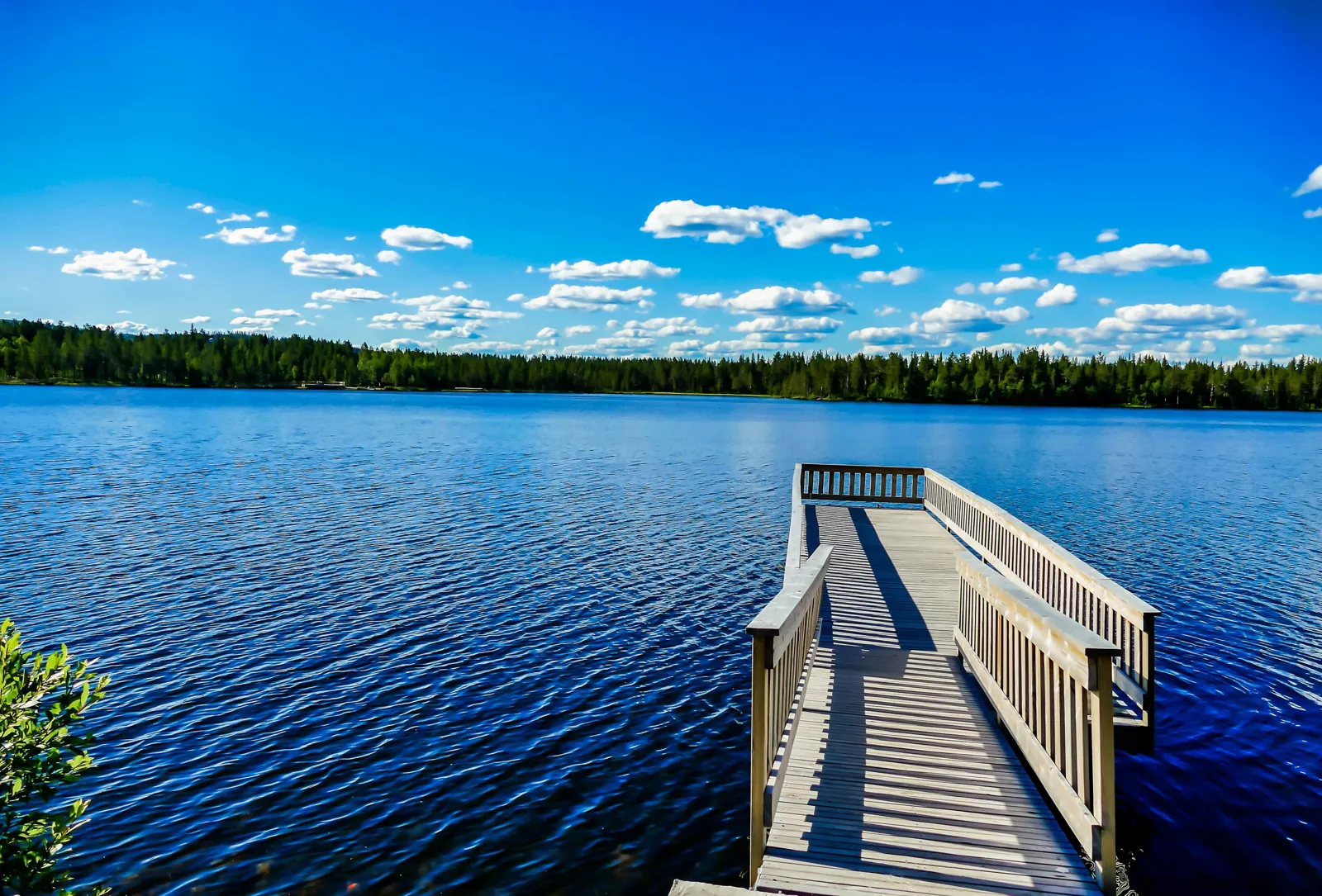
Wooden jetty on a forest-lined lake in Sweden
Stockholm
Built on fourteen islands between Lake Mälaren and the Baltic Sea, the capital is explored on foot and by boat. Gamla Stan, the old town, packs in medieval lanes, Stortorget square, the cathedral and the Royal Palace. On the island of Djurgården, the Vasa Museum displays a 17th-century warship that sank on its maiden voyage and is remarkably well preserved; next door, Skansen is an open-air museum of traditional Swedish homes. City Hall, where the Nobel banquet is held, the Södermalm district and its viewpoints, and the metro stations decorated by artists complete the visit. Drottningholm Palace, home of the royal family and a UNESCO World Heritage Site, is reached by boat in summer.
The Stockholm archipelago
Thousands of islands and islets stretch east of the capital. Vaxholm, with its fortress, is about an hour away by boat. Further out, Sandhamn, Grinda or Utö offer swimming, hiking and small harbors. Waxholmsbolaget boats serve many islands, with far more frequent services in summer.
Uppsala
Less than an hour by train north of Stockholm, Uppsala is the country’s fourth city and home to its oldest university. Its Gothic cathedral is the largest in Scandinavia. The royal burial mounds of Gamla Uppsala, linked to the kings of the pre-Viking era, are a few kilometers away. The student atmosphere peaks on Walpurgis Night, 30 April.
Gothenburg and the west coast archipelago
Sweden’s second city, Gothenburg is a lively port with its canals, the Haga district and its cafés, and the Liseberg amusement park. The car-free islands of its southern archipelago are reached by tram and ferry. To the north, the Bohuslän coast lines up fishing villages with colorful houses and pink granite islands, such as Marstrand, Smögen or Fjällbacka. The Tanum rock carvings, a World Heritage Site, are in the same region.
Malmö and Skåne
Linked to Copenhagen by the Öresund Bridge, Malmö has a pleasant old town around Stortorget and a modern district dominated by the twisting Turning Torso tower. Skåne, the southernmost region, is a land of fields, castles and coastline. Lund, a university town, has a fine Romanesque cathedral, and Ystad, a small half-timbered town, was the setting for Henning Mankell’s crime novels. If Malmö appeals, the neighboring Danish capital deserves its own trip: our Copenhagen travel guide covers its neighborhoods and sights.
Gotland and Visby
The largest island in the Baltic is reached by ferry or plane. Visby, its main town, is surrounded by almost intact medieval walls and is a UNESCO World Heritage Site. The island, flat and sunny in summer, is easy to explore by bike, between medieval churches, beaches and limestone formations sculpted by the sea.
Dalarna and Lake Siljan
In the center of the country, Dalarna is the land of red houses, small painted wooden horses and Midsummer traditions. The villages around Lake Siljan, such as Rättvik, Mora or Leksand, make a good base in summer. The mining town of Falun, with its great copper mine listed as a World Heritage Site, is nearby.
The High Coast (Höga Kusten)
On the Gulf of Bothnia, between Härnösand and Örnsköldsvik, the High Coast has been a UNESCO World Heritage Site since 2000 (together with the Finnish Kvarken archipelago since 2006). Since the end of the last ice age, the land has risen by about 285 meters (935 ft), the highest known isostatic uplift, hence its cliffs and raised ancient shorelines. The Höga Kusten-leden trail crosses it over about 135 km (84 mi), and Skuleskogen National Park is one of its most visited sites.
Kalmar and the island of Öland
On the southeast coast, Kalmar is dominated by its castle, whose origins go back to the 12th century and where the Kalmar Union between Denmark, Norway and Sweden was founded in 1397; the Vasa kings turned it into a Renaissance palace in the 16th century. Opposite, a bridge of about 6 km (4 mi) links the town to Öland, the country’s second-largest island, known for its windmills, beaches and the farming landscapes of the south of the island. If you are hesitating with the neighboring country, our comparison Norway or Sweden helps you choose by nature, cities and budget.
Swedish Lapland
North of the Arctic Circle, Lapland is the land of the Sámi, an Indigenous people of reindeer herders. Kiruna, a mining town, is the gateway. Nearby, Jukkasjärvi hosts the Icehotel, rebuilt every winter. Abisko National Park, further northwest, is known for watching the northern lights and marks the start of the Kungsleden, the country’s most famous hiking trail. Jokkmokk, further south, is a center of Sámi culture. The Laponian Area, a World Heritage Site, groups several national parks. If you are weighing it against the Finnish side, see our guide to Finnish Lapland. Lapland’s national parks have very marked seasons: check the best time to visit Lapland before choosing.
Itinerary ideas for Sweden
7 to 10 days: Stockholm, Uppsala and the west coast
Days 1 to 3: Stockholm (Gamla Stan, the Vasa Museum, Skansen, Södermalm)
Day 4: a trip into the archipelago (Vaxholm or Grinda)
Day 5: Uppsala, or Drottningholm Palace by boat
Day 6: train to Gothenburg
Days 7 and 8: Gothenburg and its southern archipelago
Days 9 and 10: the Bohuslän coast (Marstrand, Smögen, Fjällbacka) or south to Malmö
2 weeks: from the south to Lapland
Days 1 and 2: Malmö and Lund
Days 3 and 4: Gothenburg
Day 5: across to the great lakes region (Vättern, Gränna)
Days 6 to 8: Stockholm and its archipelago
Days 9 and 10: Dalarna and Lake Siljan, or Uppsala
Days 11 to 14: flight or night train to Kiruna, then Abisko and Jukkasjärvi
The big cities of the south are easily linked by train. A car is useful for the west coast, Dalarna and the countryside. For Lapland, a flight or the night train from Stockholm avoids a very long drive.
Who is Sweden for?
Our verdict by traveler profile, based on the information in this guide:
Profile
Our verdict
Why
Nature
✅ Ideal
Archipelagos, forests, lakes and Lapland; the right of public access lets you enjoy nature widely.
Families
✅ Yes
Liseberg amusement park in Gothenburg, the car-free islands of the southern archipelago, Gotland by bike.
Couples
✅ Yes
The islands of the Stockholm archipelago, the Bohuslän coast, Visby and its walls.
Northern lights
✅ Yes
Lapland in winter, around Kiruna; dog sledding, snowmobiling and aurora tours weigh heavily on the budget, though.
Culture
✅ Yes
Gamla Stan in Stockholm, Uppsala, Visby and the High Coast on the UNESCO list, Kalmar Castle.
Budget travelers
⚠️ Difficult
An expensive destination: roughly SEK 890–1,340 per person per day on a budget; lunch menus, supermarkets and camping keep the bill down.
Budget for a trip to Sweden
Sweden is an expensive destination, especially for accommodation, eating out and alcohol. Activities in Lapland (dog sledding, snowmobiling, aurora tours) weigh heavily on a winter budget. Indicative amounts per person per day, excluding international travel (converted from our euro estimates at the ECB rate of 23 October 2026, €1 = SEK 11.131):
roughly SEK 330–450 (supermarkets, « dagens lunch » set lunch)
roughly SEK 670–1,110
Transport (train, bus, ferry)
roughly SEK 110–220
roughly SEK 220–330
Sightseeing and activities
roughly SEK 110–170
roughly SEK 220–450 (much more for activities in Lapland)
Total per day
roughly SEK 890–1,340
roughly SEK 2,000–3,120
Indicative estimates, varying with the season, the region and the krona exchange rate.
To cut costs: take advantage of the set lunch (« dagens lunch »), offered at a fixed price on weekdays in many restaurants, shop at supermarkets and book trains well in advance. The right of public access (« allemansrätten ») lets you enjoy nature widely, under conditions: check the rules before pitching a tent.
Getting around Sweden
Train: SJ and other operators link Stockholm, Gothenburg, Malmö and many towns. Night trains serve the north of the country, as far as Kiruna and Abisko.
Plane: useful for Lapland (Kiruna, Luleå) and Gotland, given the distances.
Getting around Stockholm: metro, commuter trains, trams, buses and ferries are integrated in the same network (SL). Public transport is the recommended way to travel in the larger cities, and it is considered safe; taxis are more expensive than in major US cities (U.S. Department of State).
Car: practical for the west coast, Dalarna and the countryside. Watch out for elk and reindeer, especially at dawn and dusk. According to the U.S. Department of State (travel.state.gov, last updated July 2, 2026), headlights must be on at all times, the maximum speed limit is 120 km/h (75 mph), the blood alcohol limit is 0.02%, much lower than in the US, and rural gas stations can be far apart, some unattended and requiring a chip card. Winter tires are compulsory from 1 December to 31 March (GOV.UK, updated 11 August 2026; travel.state.gov).
Driving licence: a valid US licence can be used while visiting (travel.state.gov); UK drivers need their UK licence (GOV.UK).
Ferry and boat: essential for the Stockholm archipelago and Gotland. Book in high season if you travel with a car.
Where to stay in Sweden
In Stockholm, staying in Norrmalm, near the central station, or in Gamla Stan lets you do everything on foot or by public transport, but it is expensive. Södermalm has a more local atmosphere, with many cafés and restaurants. In Gothenburg, the center and the Haga district are convenient.
Outside the cities, choices include well-kept youth hostels (vandrarhem), guesthouses, cabins and holiday homes (stugor) to rent and many campsites with cabins. In Lapland, lodges, mountain huts and the Icehotel in Jukkasjärvi complete the options. In summer, book the islands and the west coast well in advance; in winter, do the same for Lapland.
Entry requirements for Sweden
US citizens: according to the U.S. Department of State (travel.state.gov, last updated July 2, 2026), Sweden is part of the Schengen area: your passport should be valid for at least three months beyond your stay, and you will need proof of sufficient funds and a return ticket. Under Schengen rules, short tourist stays are visa-free for up to 90 days.
UK citizens: according to the UK FCDO (GOV.UK foreign travel advice, updated 11 August 2026), you can travel without a visa for up to 90 days in any 180-day period. Your passport must have been issued less than 10 years before you arrive and expire at least 3 months after the day you plan to leave the Schengen area. At the border you may need to show a return ticket, proof of accommodation, proof of travel insurance and enough money. Under the EU Entry/Exit System (EES), you may need to register your fingerprints and photo.
Border controls: controls are in place for travelers arriving from Denmark via the Öresund crossing and on ferries from Denmark and Germany (GOV.UK). Carry a consent letter for children aged 17 and under traveling without a parent.
Customs: you cannot bring meat, milk or products containing them into the EU, and you must declare cash of €10,000 or more (GOV.UK). For the return, check your home country’s allowances (e.g. CBP in the US, HMRC in the UK). Entry requirements checked on 24 October 2026; check them again before you travel.
Health and safety in Sweden
Health: the UK FCDO (GOV.UK, updated 11 August 2026) advises checking vaccine recommendations at least 8 weeks before your trip and flags biting insects and ticks; UK travelers need a GHIC or EHIC for medically necessary state healthcare, which does not replace travel insurance. According to the U.S. Department of State, medical care is comparable to US standards, but non-residents pay their medical costs in full: take insurance covering medical evacuation. For non-emergencies, go to a local clinic (« Vårdcentral ») with your passport. Emergency number: 112, with assistance in English.
Safety: according to the UK FCDO (GOV.UK, updated 11 August 2026), terrorists are likely to try to carry out attacks in Sweden, and the authorities have disrupted several planned attacks. Pickpockets target tourists in the big cities, and gang-related crime, including shootings and explosions, has been reported in Malmö, Stockholm and Gothenburg. The U.S. Department of State warns of thieves in hotel breakfast rooms and lobbies.
Drugs: all illegal drugs, including cannabis and CBD products, are strictly prohibited, with jail sentences of up to 10 years (GOV.UK; U.S. Department of State).
Arctic and nature: parts of Sweden lie within the Arctic Circle, in very remote areas where emergency medical assistance and search and rescue are limited (GOV.UK). On hikes, check the weather, tell someone your route and don’t set off alone.
Practical tips for Sweden
Money: the currency is the Swedish krona. Many shops, cafés and restaurants do not accept cash, so bring a debit or credit card (GOV.UK). Our currency converter helps you estimate prices.
Internet: check your provider’s roaming charges before you leave. Coverage is very good in cities but weak or absent in some mountain and forest areas of the north.
Language: almost all Swedes speak English. « Hej » (hello) and « tack » (thank you) are appreciated.
Etiquette: take your shoes off when entering someone’s home. « Fika », a coffee break with a pastry, is a daily ritual.
Sweden’s 15 UNESCO World Heritage Sites
Sweden has 15 properties on the World Heritage List. Several combine easily with the stops in this guide:
Around Stockholm: the Royal Domain of Drottningholm (1991), the Skogskyrkogården cemetery (1994), Birka and Hovgården, Viking sites on Lake Mälaren (1993)
Gotland and Öland: the Hanseatic Town of Visby (1995) and the Agricultural Landscape of Southern Öland (2000)
The north: the Laponian Area (1996, a mixed natural and cultural property), Gammelstad Church Town in Luleå (1996), the High Coast / Kvarken Archipelago (2000, 2006)
The center: the Mining Area of the Great Copper Mountain in Falun (2001), Engelsberg Ironworks (1993), the Decorated Farmhouses of Hälsingland (2012)
The south and west: the Naval Port of Karlskrona (1998), the Rock Carvings in Tanum (1994), the Grimeton Radio Station in Varberg (2004)
Transboundary property: the Struve Geodetic Arc (2005)
Not for a short stay if you are a US or British citizen: Sweden is in the Schengen area, with visa-free stays of up to 90 days in any 180 days (GOV.UK; travel.state.gov). Your passport must be valid at least three months beyond your stay. Checked on 24 October 2026.
Can you pay in euros in Sweden?
No, the currency is the Swedish krona. Many shops, cafés and restaurants do not even accept cash (GOV.UK): use a debit or credit card.
How many days do you need in Stockholm?
Three days let you see the essentials: Gamla Stan, the Vasa Museum, Skansen and Södermalm. Add a day for a trip into the archipelago and another for Uppsala or Drottningholm.
Is Sweden expensive?
Yes, it is one of the most expensive destinations in Europe, especially for accommodation, restaurants and alcohol. Excluding international travel, allow roughly SEK 890–1,340 per person per day on a budget, and roughly SEK 2,000–3,120 in comfort, more in Lapland in winter with activities.
Where can you see the northern lights in Sweden?
In Swedish Lapland, north of the Arctic Circle: Abisko, Kiruna and Jokkmokk are the most common bases. The season runs from about late September to March. You need a dark night and a clear sky, with no guarantee of a sighting.
What to do in Sweden in a week?
In 7 days, focus on one region: Stockholm and its archipelago with a day in Uppsala, or Stockholm then Gothenburg and the west coast islands by train. Keep Swedish Lapland or the High Coast for a second trip or a two-week stay.
How many UNESCO sites are there in Sweden?
Fifteen: thirteen cultural properties (including Visby, Drottningholm, Birka, Falun and Gammelstad), one natural property (the High Coast / Kvarken Archipelago) and one mixed property, the Laponian Area.
Our sources
Entry, health and safety information read on 24 October 2026: U.S. Department of State, Sweden country information (travel.state.gov, last updated July 2, 2026), and UK FCDO, foreign travel advice for Sweden (GOV.UK, updated 11 August 2026)
UNESCO World Heritage Centre: Sweden page, list of the 15 inscribed properties (checked in October 2026)
Swedish Meteorological and Hydrological Institute (SMHI): climate normals for Stockholm and Gothenburg, averages for Kiruna
Wikipedia (High Coast, Kalmar Castle and Öland articles), checked on 5 October 2026
European Central Bank, euro reference rates of 23 October 2026 (budget conversions)
Transparency: this page contains affiliate links, labelled as such. If you book through them we may earn a commission at no extra cost to you; it does not influence our content or recommendations. How we fund the site.