A trip to Denmark means Copenhagen and its design, Renaissance castles, Viking sites, the long beaches of Jutland and hundreds of islands linked by bridges and ferries: Denmark is easy to explore by bike, train or car. It works as well for a weekend in Copenhagen as for a one- or two-week road trip. This Denmark travel guide brings together the essentials: what to see and do, road trip itineraries, budget and transport.
To locate cities, regions, terrain, national parks and airports, see our map of Denmark.
Denmark at a glance
CapitalCopenhagen
LanguageDanish; English is very widely spoken
Currencythe Danish krone (DKK) · currenciesThe euro is not the official currency
Time zoneUTC+1 (Central European Time)1 h ahead of London and 6 h ahead of New York
AirportsCopenhagen (CPH), plus Billund, Aarhus and AalborgCheck current routes with the airlines
The best period runs from May to September. June, July and August are the mildest months (19 to 23 °C, or 66 to 73 °F, in the afternoon in Copenhagen), with 16 to 17 hours of daylight, but also the busiest and most expensive. May, June and September offer the best compromise. From November to February, it is gray, damp and dark, but the Christmas atmosphere and « hygge » have their charm, and prices drop outside the holidays. All the details, month by month and region by region, are in our article best time to visit Denmark.
What to see and do in Denmark: the highlights
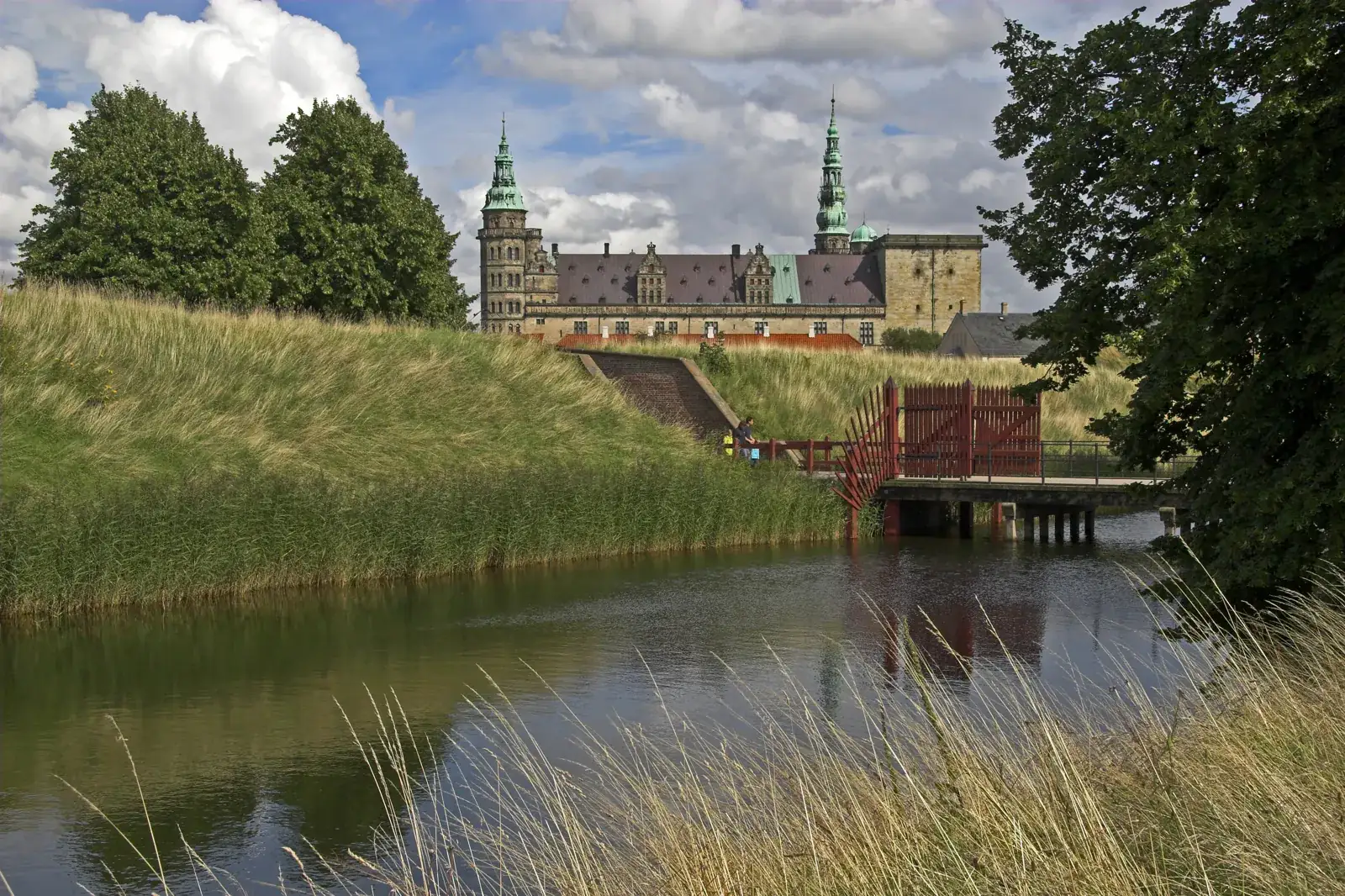
Kronborg Castle in Helsingør, Denmark
Copenhagen
The capital accounts for a large share of the sights. Nyhavn harbor and its colorful houses, Amalienborg Palace, home of the royal family, Rosenborg Castle, which houses the crown jewels, and Christiansborg Palace, seat of Parliament, can all be explored on foot. Tivoli, one of the oldest amusement parks in the world, opened in 1843, is right in the center. The Christianshavn district, its canals and the Church of Our Saviour with its spiral spire are worth a stroll. The Freetown of Christiania is there too: take extra care, particularly late at night (UK FCDO). The main museums are the Ny Carlsberg Glyptotek, the National Museum and the SMK (National Gallery of Denmark). The Little Mermaid, on the waterfront, is more modest than her reputation.
North Zealand: Helsingør and the Louisiana Museum
Less than an hour by train from Copenhagen, Helsingør is home to Kronborg Castle, a UNESCO World Heritage Site that inspired Hamlet’s Elsinore. It controlled the Øresund strait, facing Sweden. On the same coastal line, the Louisiana Museum in Humlebæk combines modern art, architecture and a sculpture garden open to the sea. Frederiksborg Castle, in Hillerød, completes the day. The view across the Øresund makes you want to cross: if you continue to Malmö, check the best time to visit Sweden to align both stops.
Roskilde
About 30 km (19 mi) west of Copenhagen, Roskilde has a cathedral listed as World Heritage, the burial place of Denmark’s kings and queens. Its Viking Ship Museum displays five 11th-century ships recovered from the fjord. Every summer, the town hosts one of the biggest music festivals in Europe.
Odense and Funen
The country’s third city, Odense is the birthplace of Hans Christian Andersen, to whom a museum is devoted. The rest of Funen is best explored by car or bike: moated Egeskov Castle and the South Funen Archipelago, with the small port towns of Ærøskøbing and Svendborg, are the best-known stops.
Aarhus
Denmark’s second city, on the east coast of Jutland, Aarhus is a lively student town. The ARoS art museum is recognizable by the circular rainbow-colored walkway on its roof. Den Gamle By, an open-air museum, recreates a Danish town in different eras. Moesgaard Museum, to the south, covers prehistory and the Viking Age.
Ribe, Jelling and southern Jutland
Ribe is considered the oldest town in the country, with a center of half-timbered houses and a Romanesque cathedral. Nearby, the Wadden Sea coast is listed as World Heritage for its mudflats. In Jelling, the 10th-century rune stones and royal burial mounds, also World Heritage, are seen as Denmark’s birth certificate. Billund, in central Jutland, is the home of Lego: Legoland and the Lego House draw families.
Skagen and northern Jutland
At the country’s northern tip, Grenen marks the meeting of the Skagerrak and the Kattegat: you can watch the waves of the two seas cross. The small town of Skagen, with its yellow houses, attracted a colony of painters in the 19th century, whose works are shown at the Skagen Museum. Nearby are the Råbjerg Mile migrating dune and the sand-buried church, Den Tilsandede Kirke.
Bornholm and Møn
Isolated in the Baltic Sea, the island of Bornholm, reached by ferry or plane, stands out for its rocky coasts, fine sandy beaches and fortified round churches. Closer to Copenhagen, south of Zealand, the island of Møn is known for its white chalk cliffs, Møns Klint, plunging into the sea.
Itinerary ideas: a road trip in Denmark
7 to 10 days: Copenhagen and Zealand
Days 1 to 3: Copenhagen (Nyhavn, Amalienborg, Rosenborg, Christianshavn, Tivoli, museums)
Day 4: Helsingør (Kronborg) and the Louisiana Museum
Day 5: Frederiksborg Castle in Hillerød
Day 6: Roskilde (cathedral, Viking Ship Museum)
Days 7 and 8: Møns Klint cliffs and southern Zealand
Days 9 and 10: back to Copenhagen, with an optional trip to Malmö, Sweden, over the Øresund Bridge
2 weeks: from the islands to Jutland
Days 1 to 3: Copenhagen
Day 4: Helsingør and Louisiana
Day 5: Roskilde, then on to Funen
Days 6 and 7: Odense, Egeskov and the South Funen Archipelago
Day 8: Ribe and the Wadden Sea
Day 9: Jelling and Billund (Legoland in season)
Days 10 and 11: Aarhus
Days 12 and 13: Skagen and Grenen
Day 14: back to Copenhagen by train, or a domestic flight from Aalborg
The main cities are easy to reach by train. A car or a bike is useful for Funen, the west coast of Jutland and the small islands.
Road trip by car: the most flexible way to string together Funen, the west coast of Jutland and Skagen. Budget for the Great Belt (Storebælt) Bridge toll (and the Øresund Bridge if you go via Sweden), book ferries to the islands in summer, and in Copenhagen leave the car for the metro, the S-train or a bike.
Budget for a trip to Denmark
Denmark is one of the most expensive countries in Europe, especially for eating out and accommodation. Copenhagen is more expensive than the rest of the country, but the gap is smaller than in other countries. Indicative amounts per person per day, excluding travel to Denmark (converted from our euro estimates at roughly €1 = DKK 7.47, ECB rate of 23 October 2026):
roughly DKK 220–340 (supermarkets, bakeries, street food)
roughly DKK 520–820
Transport (train, bus, bike rental)
roughly DKK 70–150
roughly DKK 150–220
Sightseeing and activities
roughly DKK 70–110
roughly DKK 150–220
Total per day
roughly DKK 670–970
roughly DKK 1,490–2,240
Indicative estimates, varying with the season and the city.
To cut costs: eat out at lunch rather than dinner, make the most of food halls and covered markets, shop at supermarkets and get around by bike. In Copenhagen, the Copenhagen Card bundles entry to many museums and public transport: compare its price with the visits you plan.
Getting around Denmark
Getting there: Copenhagen Airport is the main gateway; trains also run from Germany. Following the introduction of the EES, you may experience delays at passport control at Copenhagen Airport on flights to or from non-Schengen countries, including the UK (UK FCDO, GOV.UK, updated 11 August 2026).
Train: the national operator DSB links Copenhagen, Odense, Aarhus, Aalborg and most towns. The Great Belt Bridge carries trains from Zealand to Funen without changing.
Bike: the king of transport, with a very dense network of bike lanes in town and country. Bicycles have the right of way, and many accidents happen when pedestrians or vehicles fail to give way to them (U.S. Department of State, travel.state.gov, last updated October 22, 2026): check bike lanes before crossing or turning, and do not walk on them.
Copenhagen transport: a driverless metro, suburban trains (S-tog), buses and harbor buses serve the whole city and the airport.
Car: useful for the west coast, Funen and the small islands. The Great Belt Bridge and the Øresund Bridge to Sweden are tolled. Roads are of high quality; speed limits are 50 km/h (31 mph) in urban areas, 80 km/h (50 mph) on open roads and 130 km/h (81 mph) on expressways. A US license is accepted for up to 90 days (U.S. Department of State), and a UK photocard licence is valid (UK FCDO).
Ferry: Danish ferries are reliable and widely used in summer; they serve Bornholm, the South Funen islands and many others. Book in high season if you are traveling with a car.
Where to stay in Denmark
In Copenhagen, staying in the center (Indre By) or near Nyhavn lets you do everything on foot, but it is the most expensive. The Vesterbro, Nørrebro and Østerbro districts, well served by transport, have a more local feel. The UK FCDO advises taking extra care in Christiania and Nørrebro, particularly late at night, after instances of gang violence.
Outside the capital, the choice includes hotels, well-run youth hostels, B&Bs and above all holiday houses (« sommerhus ») rented by the week, very common on the coasts. The many well-equipped campsites often have cabins. For July, book these rentals several months ahead.
Entry requirements for Denmark
Denmark is in the Schengen area. Entry requirements checked on 24 October 2026; check them again before you travel.
US citizens
According to the U.S. Department of State (travel.state.gov, last updated October 22, 2026), you may enter Denmark for up to 90 days for tourism without a visa.
Your passport must be valid for at least three months after the date you intend to leave the Schengen area; the State Department recommends six months’ validity on entry.
The Faroe Islands are not part of the Schengen area, but you can visit for up to 90 days for tourism without a visa.
UK citizens
According to the UK FCDO (GOV.UK, updated 11 August 2026), you can travel without a visa to the Schengen area, including Denmark, for up to 90 days in any 180-day period.
Your passport must have been issued less than 10 years before you arrive and be valid for at least 3 months after you plan to leave the Schengen area. You may need to show a return or onward ticket.
The EU Entry/Exit System (EES) is being rolled out: you may have to register your fingerprints and photo at the border.
Greenland and the Faroe Islands are not in the EU; you do not need a visa to visit them as a tourist.
Health and safety
Health: UK travelers need a GHIC or EHIC for medically necessary state healthcare (UK FCDO). Medical facilities are excellent; for non-life-threatening emergencies, call the medical helpline (1813 in greater Copenhagen), which will arrange an appointment at an emergency room or clinic (U.S. Department of State).
Crime: crime levels are generally low, but pickpockets and bag snatchers operate in crowded areas, mainly in Copenhagen: the central station, Nørreport station, Strøget, Christiania, Nyhavn and Kongens Nytorv (UK FCDO). Organized crime groups operate in and around Copenhagen, and police may set up stop-and-search zones (U.S. Department of State).
Terrorism: attacks in Denmark cannot be ruled out (UK FCDO).
Whale products: importing whale products from Greenland or the Faroe Islands into the UK or EU is illegal (UK FCDO).
Emergencies: 112.
Practical tips for Denmark
Money: the currency is the Danish krone. Declare cash of €10,000 or more on arrival (UK FCDO). Our currency converter helps you estimate prices.
Internet: check your provider’s roaming rates before you leave, including for the Faroe Islands and Greenland; an eSIM can be a cheaper option. Wi-Fi is available almost everywhere.
Language: almost all Danes speak English. « Hej » (hello) and « tak » (thank you) are appreciated.
Etiquette: punctuality matters. Bike lanes are for bikes only: do not walk on them.
Meal times: Danes eat dinner early, often around 6 to 7 p.m. Many shops close early on Saturdays and some on Sundays.
Who is Denmark for?
Our view by traveler profile, based on the information in this guide (places, budget, seasons).
Profile
Our view
Why
Couples
Well suited
Nyhavn and Copenhagen, Renaissance castles, the light of Skagen.
Families
Very well suited
Legoland in Billund in season, Tivoli, Jutland beaches, holiday houses by the week.
Budget travelers
With reservations
One of the most expensive countries in Europe: roughly DKK 670–970 a day with hostels, campsites and a bike.
Culture
Very well suited
Kronborg, Frederiksborg, the Roskilde Viking ships, the Louisiana and ARoS museums.
Nature and cycling
Well suited
Funen, the Møns Klint cliffs, Bornholm, the Wadden Sea.
Frequently asked questions
Do I need a visa for Denmark?
Not for a short stay if you are a US or British citizen: up to 90 days without a visa (travel.state.gov, October 22, 2026; GOV.UK, 11 August 2026). Your passport must be valid at least three months after you leave the Schengen area; the State Department recommends six months. Checked on 24 October 2026.
Can you pay in euros in Denmark?
The official currency is the Danish krone, not the euro. Plan to pay in kroner, by card or in cash.
How many days do you need in Copenhagen?
Three days let you see the essentials of the capital. Add a day for Helsingør and the Louisiana Museum, and another for Roskilde.
Is Denmark expensive?
Yes, it is one of the most expensive countries in Europe. Excluding travel, allow roughly DKK 670–970 per person per day on a budget, and DKK 1,490–2,240 in comfort.
What is the best time to visit Denmark?
May to September, with June as the most balanced month. July and August are the warmest but also the busiest. December draws visitors for the Christmas markets.
What to do in Denmark?
Explore Copenhagen (Nyhavn, Tivoli, Rosenborg, Christianshavn), Kronborg Castle in Helsingør and the Louisiana Museum, Roskilde’s cathedral and Viking Ship Museum, Odense and Egeskov Castle on Funen, Aarhus (ARoS, Den Gamle By), Ribe and Jelling, Grenen at Skagen, the Møns Klint cliffs and the island of Bornholm.
What to do in Denmark with kids?
Tivoli in Copenhagen, Legoland and the Lego House in Billund, the Den Gamle By open-air museum in Aarhus, the Hans Christian Andersen museum in Odense, the Roskilde Viking ships and the Jutland beaches in summer. Check opening dates: Legoland only operates in season.
What itinerary for a road trip in Denmark?
In 7 to 10 days, Copenhagen and Zealand (Helsingør, Hillerød, Roskilde, Møns Klint). In 2 weeks, add Funen (Odense, Egeskov, the southern archipelago), then Jutland: Ribe, Jelling and Billund, Aarhus and Skagen.
Entry, health, safety and driving information read on 24 October 2026: U.S. Department of State, Denmark country information (travel.state.gov, last updated October 22, 2026), and UK FCDO, foreign travel advice for Denmark (GOV.UK, updated 11 August 2026)
Danish Meteorological Institute (DMI): climate normals for the Copenhagen Airport, Aarhus Airport and Skagen stations
European Central Bank: euro reference rates of 23 October 2026 (EUR/DKK), for the budget conversion
Transparency: this page contains affiliate links, labelled as such. If you book through them we may earn a commission at no extra cost to you; it does not influence our content or recommendations. How we fund the site.