This Spain travel guide is for a first trip: focus on Madrid, Barcelona and the Andalusian trio of Seville, Córdoba and Granada, ideally in spring or autumn. The country combines great art cities, the Moorish heritage of Andalusia, thousands of kilometres of coastline and two archipelagos. In the eurozone and the Schengen area, with no visa needed for short tourist stays by US or UK citizens, it works as well for a weekend as for a long tour. This guide gathers the essentials to plan your trip to Spain.
To locate the cities, regions, relief, national parks and airports, see our map of Spain.
Spain at a glance
CapitalMadrid
LanguagesSpanish (Castilian)Catalan, Basque and Galician are also official in their regions
EntrySchengen area: no visa for UK citizens for up to 90 days in any 180-day period; US citizens need a passport valid 3 months beyond their stay · travel.state.gov · GOV.UKEU Entry/Exit System (EES): fingerprints and photo at the border
Electricitycheck voltage and plug types before you go · plugsReference: IEC World Plugs
The best time runs from April to June and from September to October: fine weather without extremes in most regions. Summer is ideal for the beach and for the north, but the interior and Andalusia are very hot (average highs of 36 °C (97 °F) in Seville in July and August). Autumn brings sometimes violent storms to the Mediterranean coast, and winter is cold in Madrid but mild in the south. All the details, region by region and month by month, are in our article on the best time to visit Spain.
What to see in Spain: the highlights
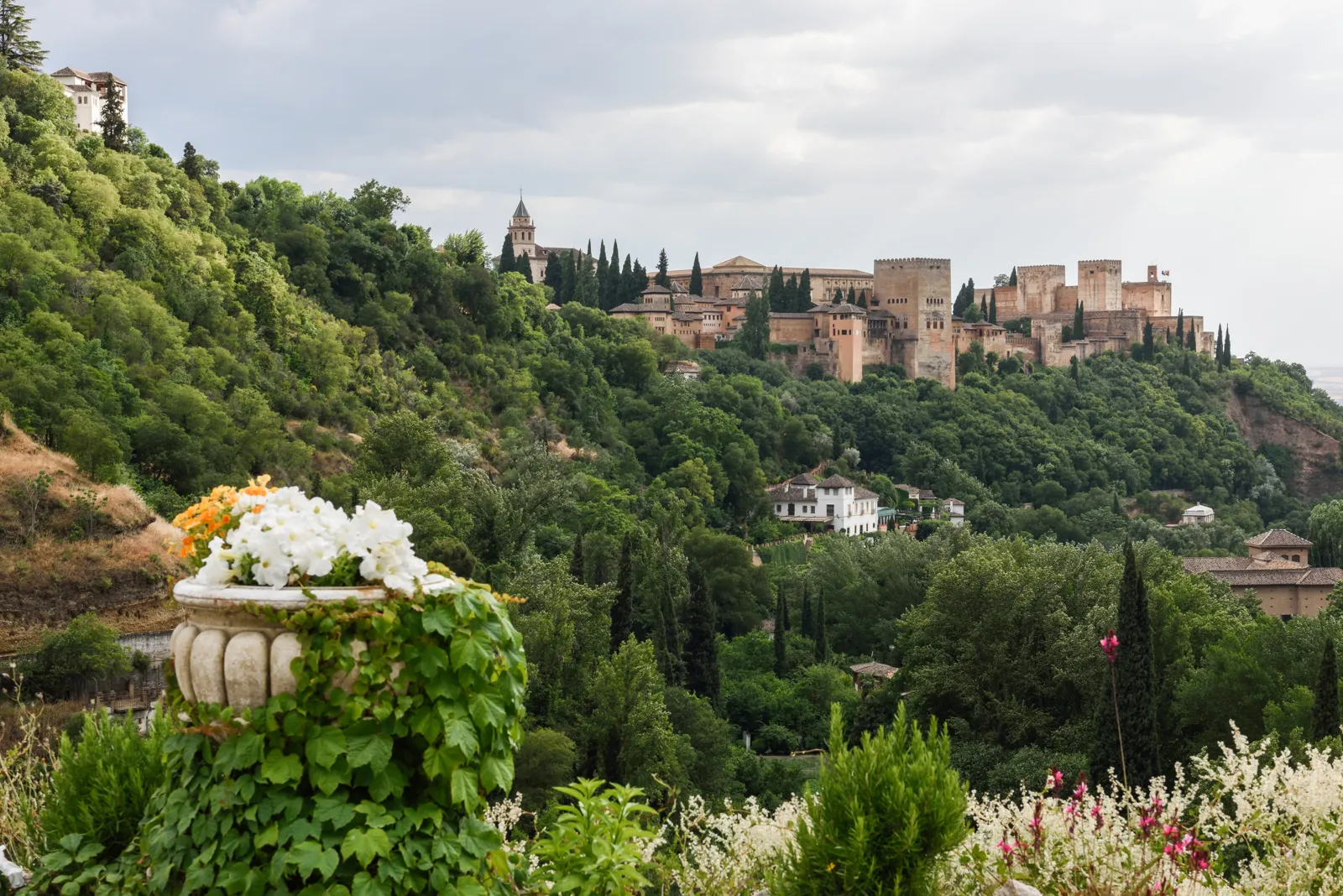
The Alhambra in Granada seen from the Sacromonte district
Madrid
Allow two to three days for the capital. The « Golden Triangle of Art » brings together the Prado, the Reina Sofía (home to Picasso’s Guernica) and the Thyssen-Bornemisza museum. Add the Royal Palace, Plaza Mayor, Retiro Park and the La Latina and Malasaña districts for tapas bars. Toledo and Segovia, both World Heritage-listed, are easy day trips by train. See our Madrid guide. Between cold winters and hot summers, the Madrid weather month by month page also helps you time the Toledo and Segovia trips.
Barcelona
Barcelona combines modernista architecture and beaches. The Sagrada Família, Park Güell, Casa Batlló and La Pedrera showcase Gaudí’s work; the Gothic Quarter, El Born and La Rambla form the historic heart. Book the most popular monuments in advance. The Costa Brava to the north and Montserrat inland make good day trips. Details in our Barcelona guide. To avoid the crowds at the Sagrada Família and on La Rambla, check the best time to visit Barcelona before booking.
Seville, Córdoba and Granada
These three cities hold the legacy of Al-Andalus. In Seville: the cathedral and the Giralda, the Alcázar, the Santa Cruz quarter and Plaza de España. In Córdoba: the Mosque-Cathedral. In Granada: the Alhambra, whose tickets are limited and often booked well in advance, and the Albaicín district. They are linked by train, bus or car. To go further, see our Andalusia guide. Alhambra bookings, the Albaicín, trains between the cities: for things to do in Seville before Granada, see our guide.
Valencia
Spain’s third city, Valencia pairs a lively historic centre with the City of Arts and Sciences, the Turia Gardens laid out in the old riverbed, and city beaches. It is the home of paella and is also known for the Fallas festival in mid-March. City of Arts and Sciences, Turia Gardens, Fallas in March: our Valencia travel guide covers these visits and the best time to go.
The Balearic Islands: Mallorca, Menorca, Ibiza
Mallorca, the largest, has coves, Palma Cathedral and the Serra de Tramuntana, a World Heritage-listed mountain range popular with hikers. Menorca is quieter and less developed; Ibiza, known for its nightlife, also has a fortified old town and peaceful beaches in the north. The islands are very busy in July and August. See our Balearic Islands guide. These islands are best enjoyed in June or September: see the best time to visit the Balearics.
The Basque Country and the north coast
Bilbao is known for the Guggenheim Museum, San Sebastián for La Concha Bay and its pintxos bars. Further west, Cantabria and Asturias (Picos de Europa) offer mountains and wild beaches, followed by Galicia and Santiago de Compostela, the end point of the famous pilgrimage. It is the coolest region in summer.
The Costa del Sol and Málaga
Málaga, Picasso’s birthplace, has a museum dedicated to him, a Moorish fortress (the Alcazaba) and a lively centre. The nearby coast (Marbella, Nerja) is Andalusia’s main beach area. Ronda, perched above its gorge, is a classic day trip from the coast. Alcazaba, lively centre, Ronda as a day trip: our Málaga travel guide helps you make the city your Andalusian base.
The white villages and the province of Cádiz
Between Ronda and the Atlantic coast, the White Villages route crosses the province of Cádiz: Arcos de la Frontera, Grazalema, Zahara de la Sierra and Setenil de las Bodegas, with whitewashed houses clinging to cliffs or tucked into valleys. The route is done by car over two or three days and combines with Seville, Ronda or the Cádiz coast.
National parks and mountains
Spain has 16 national parks. Among hikers’ favourites: the Picos de Europa (Asturias, Cantabria, León), the country’s first protected area in 1918; Ordesa y Monte Perdido in the Aragonese Pyrenees (province of Huesca); the Sierra Nevada above Granada; Doñana and its wetlands, between Huelva, Seville and Cádiz; and Teide on Tenerife, the most visited national park in the country. Also in the Pyrenees, the small neighbouring principality has its own guide: visiting Andorra.
The Canary Islands
Off the coast of Africa, the archipelago (Tenerife, Gran Canaria, Lanzarote, Fuerteventura, La Palma…) stands out for its volcanic landscapes and mild climate all year round. See our Canary Islands guide and our Tenerife guide.
Where to go in Spain depending on your trip
Your trip
Where to go
Best time
First trip, heritage
Madrid, Toledo, Seville, Córdoba, Granada
April–June, September–October
Weekend or city break
Barcelona, Madrid, Valencia, Seville, Bilbao
all year (avoid summer in Seville)
Beach
Balearics, Costa Brava, Costa del Sol
June to September
Winter sun
Canary Islands
all year
Nature and hiking
Picos de Europa, Aragonese Pyrenees, Sierra Nevada, Serra de Tramuntana
Days 1 to 3: Madrid (Prado, Royal Palace, Retiro), day trip to Toledo
Days 4 and 5: train to Seville
Day 6: Córdoba (Mosque-Cathedral)
Days 7 and 8: Granada (Alhambra, Albaicín)
Days 9 and 10: Málaga, then fly home from Málaga
2 weeks: from Barcelona to Andalusia
Days 1 to 4: Barcelona, day trip to Montserrat or the Costa Brava
Days 5 and 6: Valencia
Days 7 to 9: Madrid and Toledo or Segovia
Days 10 and 11: Seville
Day 12: Córdoba
Days 13 and 14: Granada, fly home from Granada or Málaga
Spain road trip: Andalusia by car (8 to 10 days)
Days 1 to 3: Seville on foot, then pick up the car as you leave (no need for it in the city)
Days 4 and 5: the White Villages route (Arcos de la Frontera, Grazalema, Zahara de la Sierra)
Day 6: Ronda
Days 7 and 8: Granada (Alhambra, Albaicín)
Days 9 and 10: Málaga and the Costa del Sol, return the car and fly home
Variation: add a day in Córdoba between Seville and Granada.
In summer, swap Andalusia for the north coast: Bilbao, San Sebastián, Cantabria, Asturias and Santiago de Compostela.
Budget for a trip to Spain
Meal prices are moderate by Western European standards; accommodation is more expensive in Barcelona, Madrid and the Balearics in summer. Approximate amounts per person per day, excluding international flights:
Item
Tight budget
Comfortable
Accommodation (based on a shared double room)
about €25–45
about €70–140
Meals
about €20–30 (menu del día, tapas)
about €40–60
Transport (bus, train, metro)
about €10–20
about €20–40
Activities and sightseeing
about €5–15
about €15–35
Total per day
about €60–90
about €140–230
Rough estimates that vary with the season and city. Expect to pay considerably more in the Balearics in August and during major festivals.
The menu del día (starter, main course, dessert and a drink) served at lunchtime on weekdays is the cheapest way to eat well. The major monuments (Alhambra, Sagrada Família, the Alcázar in Seville) charge admission; some museums have free time slots, to be checked on their websites.
Getting around Spain
Train: the high-speed network links Madrid with Barcelona, Seville, Córdoba, Málaga, Valencia and many other cities. It is often the fastest way between major cities; book ahead for the best fares.
Bus: a large network of intercity coaches serves mid-sized towns and villages at moderate prices.
Plane: useful for the Balearics, the Canary Islands and long distances (Barcelona–Seville, for example).
Car: ideal for rural Andalusia, the north coast and the islands. The U.S. Department of State says US drivers must obtain an International Driving Permit before arriving and must have one to rent a car (travel.state.gov, last updated August 11, 2025); UK photocard licences can be used in Spain (GOV.UK, updated 12 August 2026). GOV.UK warns that « highway pirates » target foreign-registered and hire cars, flagging drivers down on the pretext of a problem with the car: if you decide to stop, do so in a lit public area such as a service station, and leave nothing visible in the vehicle.
In town: metro in Madrid, Barcelona, Valencia, Seville, Bilbao and Málaga; historic centres are best explored on foot. Only use licensed taxis: GOV.UK notes fines of up to €600 for passengers of unlicensed services.
Ferries: the Balearics are linked to the mainland and to each other by boat.
Getting there
Spain’s main international airports are Madrid (MAD) and Barcelona (BCN), followed by Málaga (AGP), Seville (SVQ), Valencia (VLC), Palma de Mallorca (PMI) and the Canary Islands airports. Check current routes from your home airport with the airlines and the airports.
Where to stay in Spain
In Madrid, the central districts (Sol, Las Letras, La Latina) let you do everything on foot. In Barcelona, the Gothic Quarter, El Born and the Eixample are convenient. In Seville, stay in the Santa Cruz quarter or the historic centre. In beach areas, choose between lively towns and quieter villages, which are often poorly served without a car.
Options range from hostels and small guesthouses (hostales) to boutique hotels and paradores, state-run hotels many of which occupy historic buildings. In July and August on the coasts and during major festivals, book several months ahead.
Entry requirements for Spain, health and safety
US citizens: Schengen rules apply. Your passport should be valid for at least 3 months beyond your period of stay (6 months recommended), and you need sufficient proof of funds and a return ticket. Students and athletes must have a visa to take part in study or sports programmes (U.S. Department of State, travel.state.gov, last updated August 11, 2025).
UK citizens: no visa for up to 90 days in any 180-day period as a tourist. Your passport must have been issued less than 10 years before the day you arrive and be valid at least 3 months after the day you plan to leave the Schengen area. At the border you may be asked for a return ticket, proof of travel insurance, sufficient funds and accommodation details. The EU Entry/Exit System (EES) is being implemented: fingerprints and a photo may be taken at your first entry, free of charge (GOV.UK, updated 12 August 2026).
Lost passport: according to GOV.UK, you cannot use a police report to leave Spain: you must get a new passport or an emergency travel document.
Health: for vaccines, GOV.UK refers to TravelHealthPro’s Spain guide and lists dengue and biting insects and ticks among health risks. UK travellers need a GHIC or EHIC for medically necessary state healthcare, which is not a substitute for travel insurance; whatever your nationality, take out insurance covering medical costs. Emergency number: 112.
Safety: the U.S. Department of State notes that pickpocketing and theft are very common, especially at tourist spots, airports, train stations and beach destinations, and that car break-ins are frequent. The UK FCDO considers that terrorists are likely to try to carry out attacks in Spain: stay alert in crowded places. The Spanish police AlertCops app lets you contact the police discreetly (GOV.UK, updated 12 August 2026).
Weather and nature: GOV.UK warns of extreme heat in summer, frequent summer wildfires (causing one, even accidentally, is a criminal offence) and flash floods; follow warnings from the Spanish Met Office (AEMET). People drown every year: some beaches have strong undercurrents, and a red flag means you must not enter the water.
Practical tips for Spain
Money: the euro. Cards are widely accepted; GOV.UK notes you may be asked for photo ID when paying by card. Check the fees shown before withdrawing cash.
Mobile data: check your home carrier’s roaming charges before you leave; an eSIM is a simple way to get local data.
Meal times: lunch is around 2 pm and dinner rarely before 9 pm. Some shops close in the early afternoon, especially in the south and in small towns.
Tipping: not compulsory; leaving a few coins or rounding up the bill is common.
ID: you must show photo ID if asked by the police (GOV.UK); the State Department advises carrying a copy of your passport’s bio page and leaving the original somewhere secure, though you will need it to check in to hotels. Most cities ban drinking alcohol in the street outside registered bars and cafés (travel.state.gov).
Regional languages: in Catalonia, the Basque Country, Galicia and the Balearics, signs are often bilingual.
Not for a short tourist stay as a UK citizen: up to 90 days in any 180-day period, with a passport valid at least 3 months after you leave the Schengen area (GOV.UK). US citizens need a passport valid at least 3 months beyond their stay, proof of funds and a return ticket (travel.state.gov). Check both sites before you leave.
When is the best time to visit Spain?
April to June and September to October: fine weather without extremes in most regions. In July and August, choose the coasts or the north, as the interior and Andalusia are very hot.
How much does a week in Spain cost?
Excluding flights, allow roughly €60–90 per person per day on a budget trip and €140–230 for a comfortable one. Prices rise in summer on the coasts, in the Balearics and during major festivals.
How many days do you need to visit Spain?
One week lets you discover Madrid and Andalusia, or Barcelona and Valencia. Two weeks give you time to cross the country from Barcelona to Granada, or to combine cities with a few days at the beach.
Which region should you choose for a first trip to Spain?
Andalusia (Seville, Córdoba, Granada) for heritage, Madrid for museums, Barcelona for architecture and the beach, the north coast for nature and food in summer.
Where to go in Spain with children?
The Balearics and the Canary Islands for beaches and a mild climate, Valencia for the City of Arts and Sciences and its city beaches, Barcelona to combine sightseeing and swimming. In July and August, avoid the interior and Andalusia, which are very hot.
Do you need to rent a car to visit Spain?
Not for the big cities, which are well linked by high-speed train and where parking is difficult. A car becomes useful for the white villages of Andalusia, the north coast, the national parks and the islands. US drivers need an International Driving Permit (travel.state.gov).
On the Costa Daurada, our guide to visiting PortAventura covers prices, opening hours and minimum heights for the rides.
Transparency: this page contains affiliate links, labelled as such. If you book through them we may earn a commission at no extra cost to you; it does not influence our content or recommendations. How we fund the site.