
Visiting Toulouse, the « Pink City », means strolling between the Place du Capitole, the Basilica of Saint-Sernin and the Jacobins convent, walking along the Garonne at sunset and then the Canal du Midi, and spending a day on aviation and space. Allow 2 days for the centre, 3 days with the Cité de l’Espace or Aeroscopia. The best times: April-June and September-October.
The pink brick of its façades gives the city its nickname. Two of its monuments (the Basilica of Saint-Sernin and the Hôtel-Dieu Saint-Jacques) are on the World Heritage List as part of the Routes of Santiago de Compostela, as is the Canal du Midi. This guide offers 1-, 2- and 3-day itineraries, where to stay, and the month-by-month climate compared with Paris, based on Météo-France. For the mountains, our guide to the Cirque de Gavarnie in the Pyrenees covers the hike and access by season. At the foot of the Pyrenees, our page Lourdes: sanctuary and excursions helps plan a trip south.

Our travel deals for Toulouse
Affiliate links: we earn a commission, at no extra cost to you.
 FlightsKiwi.comCompare flights and airline combinations to Toulouse.Compare flights

Toulouse at a glance
- Airport Toulouse-Blagnac (TLS), north-west of the city, linked to the centre by tram and shuttle bus
- By train TGV high-speed trains to Toulouse-Matabiau station
- Ideal length 2 days for the centre, 3 days with aviation
- Best time April-June and September-October
- Entry Schengen rules for France; see entry requirements
- Public transport 2 metro lines (A and B), tram, buses, bike sharing
- Currency the euro (€)
- Time zone UTC+1, UTC+2 in summer: 1 hour ahead of London, 6 hours ahead of New York
Things to do in Toulouse: the highlights
The Place du Capitole
The heart of the city, the Place du Capitole is lined by the long 18th-century façade of the Capitole, which houses the city hall and the Théâtre du Capitole. Inside, the Salle des Illustres and its large painted decorations can be visited free of charge (except during ceremonies). Under the arcades, a series of paintings traces the history of the city; the Occitan cross is set into the paving of the square. In the neighbouring Tarn, Albi and its Sainte-Cécile Cathedral make a day trip by train.
The Basilica of Saint-Sernin
An 11th-century Romanesque building, Saint-Sernin is one of the largest Romanesque churches in the Western world and a major stop on the Way of St James, listed as World Heritage on that basis. Its octagonal brick bell tower dominates the district. On Sunday mornings, a flea market sets up around the basilica. The Musée Saint-Raymond, the archaeology museum, is right next door.
The Jacobins convent
Founded by the Dominicans in the 13th and 14th centuries, the Jacobins convent is famous for its « palm tree » vault, a single pillar from which the ribs radiate. It holds the relics of St Thomas Aquinas. The quiet, shaded cloister is accessible with a ticket.
The Hôtel d’Assézat and the mansions
Toulouse’s Renaissance wealth came from pastel (woad), a dye plant that produced a prized blue. Merchants built grand town houses, including the Hôtel d’Assézat, a Renaissance residence that houses the Fondation Bemberg (paintings and objets d’art). The Hôtel de Bernuy and the Hôtel de Pierre can be discovered while strolling through the Saint-Étienne district and around Rue de la Dalbade. In the Aveyron, the Millau Viaduct has its own page with its official figures, the toll and the viaduct rest area.
The Garonne, the Pont Neuf and La Daurade
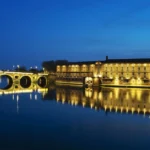
The quays of the Garonne, from La Daurade to the Prairie des Filtres, are where locals meet at sunset. The brick Pont Neuf links the right bank with the Saint-Cyprien district, home to the Hôtel-Dieu Saint-Jacques and the dome of La Grave. Les Abattoirs, the museum of modern and contemporary art, is housed in the city’s former slaughterhouses.
The Canal du Midi and the gardens
A World Heritage Site, the Canal du Midi, dug under Louis XIV by Pierre-Paul Riquet, links Toulouse with the Mediterranean. Its tree-lined banks can be explored on foot or by bike from the Port de l’Embouchure or the Port Saint-Sauveur. In the centre, the Jardin des Plantes, the Grand Rond and the Jardin Royal form a set of connected parks, and the Pierre-Baudis Japanese garden is at Compans-Caffarelli.
The Cité de l’Espace
Opened in 1997 east of the city, the Cité de l’Espace features a full-size replica of the Ariane 5 rocket, modules of the Mir space station, a planetarium and many interactive areas. Allow a full day with children. It is reached by bus from the metro; book during school holidays.
In Toulouse, our page on visiting the Cité de l’Espace gives opening hours, tickets and public transport access.
Aeroscopia, L’Envol des Pionniers and the Halle de la Machine
Toulouse is Europe’s aerospace capital. In Blagnac, the Aeroscopia museum (opened in 2015) displays some thirty historic aircraft in a huge hangar, including Concorde. Tours of Airbus industrial sites are offered by Let’s Visit Airbus, by reservation and with ID. In the Montaudran district, L’Envol des Pionniers tells the story of the Aéropostale airmail service, and the Halle de la Machine (opened in 2018) brings the giant Minotaur to life.
The Victor-Hugo market and Toulouse cuisine
The Victor-Hugo covered market, with its restaurants upstairs, is the place to taste Toulouse sausage, cassoulet, confit and foie gras. The Carmes market is smaller and more local. Toulouse violets turn up as sweets and liqueur.
Itinerary: Toulouse in 1, 2 or 3 days
| Length | Programme | Key point |
|---|---|---|
| 1 day | The Capitole and Salle des Illustres, Saint-Sernin, the Jacobins, lunch at the Victor-Hugo market, the Hôtel d’Assézat, sunset on the quays of La Daurade | Everything is on foot in the historic centre |
| 2 days | Day 1 as above; day 2: Saint-Étienne district and cathedral, Jardin des Plantes, Saint-Cyprien and Les Abattoirs, a walk along the Canal du Midi | The ideal pace for a first visit |
| 3 days | Days 1 and 2; day 3: Cité de l’Espace, or Aeroscopia and an Airbus tour in Blagnac, or the Halle de la Machine and L’Envol des Pionniers | Book the Airbus tours and the Cité de l’Espace |
Toulouse combines well with the medieval walled town of Carcassonne, on the same railway line, or with Montpellier for a trip around Occitanie.
When to go to Toulouse
April-June and September-October are the best times to visit Toulouse: 17.6 to 25.7 °C (64 to 78 °F) in the afternoon in spring, 24.8 °C (77 °F) in September. Summer is hot and dry: the Toulouse-Blagnac station records on average 11.5 days above 30 °C (86 °F) in July and 11.3 in August, against 5.5 and 5.0 in Paris. Winter is mild but grey, with frequent morning frosts (8.2 frost days in January). May is the wettest month (73.6 mm / 2.9 in).
| Month | High | Low | Rain | Rain days | Sun / day | Sun vs Paris | Verdict |
|---|---|---|---|---|---|---|---|
| January | 9.7 °C (49 °F) | 2.9 °C (37 °F) | 52.5 mm (2.1 in) | 9.2 | 2.9 h | +1.0 h | ⚠️ Cool, morning frosts |
| February | 11.2 °C (52 °F) | 3.1 °C (38 °F) | 37.2 mm (1.5 in) | 7.8 | 4.2 h | +1.2 h | ⚠️ Cool, drier |
| March | 15.0 °C (59 °F) | 5.5 °C (42 °F) | 45.3 mm (1.8 in) | 8.2 | 5.7 h | +1.3 h | ⚠️ Changeable spring |
| April | 17.6 °C (64 °F) | 7.9 °C (46 °F) | 65.2 mm (2.6 in) | 9.3 | 6.3 h | +0.4 h | ✅ Mild, ideal for walking |
| May | 21.4 °C (71 °F) | 11.4 °C (53 °F) | 73.6 mm (2.9 in) | 9.9 | 6.8 h | +0.4 h | ✅ Pleasant, a few storms |
| June | 25.7 °C (78 °F) | 15.0 °C (59 °F) | 64.2 mm (2.5 in) | 7.1 | 7.7 h | +0.9 h | ✅ Long sunny days, the Garonne |
| July | 28.2 °C (83 °F) | 17.0 °C (63 °F) | 40.1 mm (1.6 in) | 5.7 | 8.3 h | +1.2 h | ⚠️ Hot, 11 days > 30 °C |
| August | 28.5 °C (83 °F) | 17.1 °C (63 °F) | 44.6 mm (1.8 in) | 5.9 | 7.9 h | +1.0 h | ⚠️ Hot, quieter city |
| September | 24.8 °C (77 °F) | 13.9 °C (57 °F) | 45.7 mm (1.8 in) | 6.6 | 7.0 h | +1.2 h | ✅ Ideal, still warm |
| October | 19.7 °C (67 °F) | 10.9 °C (52 °F) | 54.3 mm (2.1 in) | 7.5 | 5.0 h | +1.2 h | ✅ Mild and sunny |
| November | 13.5 °C (56 °F) | 6.3 °C (43 °F) | 55.0 mm (2.2 in) | 10.0 | 3.3 h | +1.0 h | ⚠️ Grey, more rain |
| December | 10.4 °C (51 °F) | 3.6 °C (38 °F) | 49.3 mm (1.9 in) | 8.7 | 2.9 h | +1.1 h | ⚠️ Cool, Christmas lights |
Is the Pink City sunnier than Paris?
Yes: 2,075 hours of sunshine a year at Toulouse-Blagnac, against 1,717 at Paris-Montsouris, about 358 hours more according to our calculations based on Météo-France. The gap is widest in February-March (+1.2 and +1.3 hours a day) and then in September-October (+1.2 hours); it is small in April-May. The shoulder season is Toulouse’s best card. It rains almost as much as in Paris over the year (627 mm / 24.7 in against 634 mm / 25.0 in), but with fewer rain days in summer.
| Indicator (annual average) | Toulouse-Blagnac | Paris-Montsouris |
|---|---|---|
| Hours of sunshine | 2,075 | 1,717 |
| Days with at least 1 mm of rain | 96 | 109 |
| Days above 30 °C (86 °F) | 33 | 14 |
| Frost days (minimum ≤ 0 °C / 32 °F) | 27 | 21 |
To compare with other cities, see our ranking of the sunniest cities in France.
Where to stay in Toulouse
| Area | Best for | Strengths |
|---|---|---|
| Capitole, Saint-Sernin | First visit | Everything on foot, metro, restaurants |
| Carmes, Saint-Étienne | Charm, couples | Lanes, mansions, the Carmes market |
| Saint-Cyprien | A more local stay | Left bank, Les Abattoirs, slightly lower prices |
| Matabiau, Canal du Midi | Arriving by train | Practical, close to the canal; less lively |
| Compans-Caffarelli | A practical stay | Japanese garden, metro line B, access to the airport |
Getting around Toulouse
- On foot: the historic centre (Capitole, Saint-Sernin, Jacobins, Carmes, quays) is walkable.
- Metro: two driverless lines, A and B, crossing at Jean-Jaurès; Matabiau station is on line A.
- Tram and shuttle: the tram serves Blagnac and the airport; an airport shuttle bus also runs to the centre.
- Bike: bike sharing, and a cycle path along the Canal du Midi.
- Car: unnecessary in the centre; handy for Albi, Cordes-sur-Ciel or the Lauragais.
Entry requirements, health and safety
- US citizens: no visa for up to 90 days in the Schengen area, including France, for tourism or business; your passport should be valid at least three months beyond your stay, and you may be asked for proof of funds and a return ticket (U.S. Department of State, travel.state.gov, last updated August 11, 2025).
- UK citizens: no visa for up to 90 days in any 180-day period; your passport must have been issued less than 10 years before arrival and be valid at least 3 months after you leave the Schengen area. Under the EU Entry/Exit System (EES), fingerprints and a photo may be taken at your first entry (UK FCDO, GOV.UK, updated 22 October 2026).
- Health: UK travellers need a GHIC or valid EHIC for state healthcare; everyone should have travel insurance covering medical costs. Emergency numbers: 15 (medical), 17 (police), 18 (fire), 112 (European emergency number) (GOV.UK, travel.state.gov).
- Crime: as in any big city, watch your belongings on the metro; the UK FCDO (GOV.UK) advises sensible precautions against street crime and warns that pickpockets can work in gangs.
Practical tips for Toulouse
- Summer: sightsee in the morning and late in the day; churches and museums are cool refuges.
- Museums: check closing days and any ongoing works before you go (the Musée des Augustins has undergone a long renovation).
- Airbus: factory tours require advance booking and ID.
Frequently asked questions
How many days do you need to visit Toulouse?
Two days for the historic centre, the Garonne and the Canal du Midi; three days with the Cité de l’Espace or Aeroscopia.
Why is Toulouse called the Pink City?
Because of the colour of its terracotta bricks, the traditional building material in the Garonne plain, where stone is scarce.
What is the best time to visit Toulouse?
From April to June and from September to October. In July and August, the Toulouse-Blagnac station records about 11 days a month above 30 °C (86 °F) according to Météo-France.
What to do in Toulouse with children?
The Cité de l’Espace, the Halle de la Machine, Aeroscopia, the Natural History Museum and the Jardin des Plantes.
What can you do in Toulouse for free?
The Salle des Illustres in the Capitole, the Basilica of Saint-Sernin, the Garonne quays, the Canal du Midi and the gardens.
Can you visit Toulouse in a weekend?
Yes for the historic centre, but three days are more comfortable if you also want the Cité de l’Espace or the aviation sites.
Our sources
- Météo-France: climate data sheet, 1991-2020 statistics, Toulouse-Blagnac station; and Paris-Montsouris station for comparison (sheets consulted on 21 October 2026)
- Destination de Voyage calculation: hours of sunshine per day and difference with Paris
- Toulouse tourist office (toulouse-tourisme.com): highlights, consulted on 21 October 2026
- Entry requirements, health and safety checked on 26 October 2026: U.S. Department of State, France country information (last updated August 11, 2025) and UK FCDO, GOV.UK foreign travel advice for France (updated 22 October 2026).
- Our methodology
Updated October 2026.
To extend your trip, see our France travel guide, our pages on Carcassonne and the Basque Country, and our other destinations in Europe.