
Entry to the Pantheon in Rome costs €7 since July 1, 2026 (€2 for ages 18–25, free under 18), every day from 9 am to 7 pm, with last entry at 6:30 pm. On the first Sunday of the month, entry is free. The monument is also a basilica, Santa Maria ad Martyres, and Mass remains free to attend. We recorded these rules on the Italian Ministry of Culture website and calculated, for each month, the sun’s height at noon and where the beam of light from the oculus falls.
The Pantheon is on Piazza della Rotonda, between Piazza Navona and the Trevi Fountain. For the rest of your stay, see our Rome travel guide.

Our travel deals for Pantheon
Affiliate links: we earn a commission, at no extra cost to you.
 FlightsKiwi.comCompare flights and airline combinations to Pantheon.Compare flights
- City passGo CityMulti-attraction pass at a fixed price: worth it only if you visit a lot.See passes


Pantheon, Rome: key facts
- Hours: every day 9 am–7 pm, last entry 6:30 pm; ticket offices close at 6 pm; closed on January 1 and December 25 — checked on 16 October 2026 on cultura.gov.it
- Standard price: €7 (recorded on 16 October 2026, subject to change); €2 for ages 18–25; free for under 18s and on the first Sunday of the month — checked on 16 October 2026 on cultura.gov.it
- Booking: advised; official tickets only on the Musei italiani portal or app, or on site at the ticket desks and machines; no “skip-the-line” option
- Time slots: maximum 1,200 people per time slot; the month’s tickets go on sale around the middle of the previous month
- Audio guide: the official audio guide lasts 45 minutes
Tickets: official vs resellers
Since July 3, 2023, the Pantheon has been accessible only with a paid ticket. The Ministry specifies that access is possible only with official tickets from the Musei italiani portal, its app, or bought on site at the ticket desks and automatic machines. The visit is in order of arrival within the chosen time slot, with no “saltafila” (skip-the-line) option. An agreement between the Ministry of Culture and the Diocese of Rome, signed on April 10, 2026, raised the price from €5 to €7 on July 1, 2026; reductions and free admissions are unchanged.
To buy online: create an account on museiitaliani.it, choose the Pantheon, the day, the time and the ticket type (full, reduced, free), then pay via PagoPA. You receive QR codes; keep the payment confirmation if the tickets do not arrive. An account can buy only once per time slot, 25 tickets at most.
The basilica also sells official visits with ticket included on pantheonroma.com: a dramatized audio guide (from €10), guided tours, or the “Cuore di Roma” route with the Trevi Fountain ticket (from €27). Resellers promising “skip-the-line” access are selling a promise the Ministry rules out.
Opening hours, Masses and the first Sunday
The Pantheon opens every day from 9 am to 7 pm; time slots run from 9 am to 6 pm and the ticket offices close at 6 pm. It is closed on January 1 and December 25. Hours may change for religious services: sales stop an hour before each service, during which entry is free and reserved for worship. Mass is at 5 pm on Saturdays and the eve of holidays, at 10:30 am on Sundays and public holidays.
On the first Sunday of the month, free tickets are collected directly at the ticket desks and machines on site; given the crowds, they do not give priority access. School groups from the European Union enter free, without a reservation.
The oculus beam: month-by-month calculation
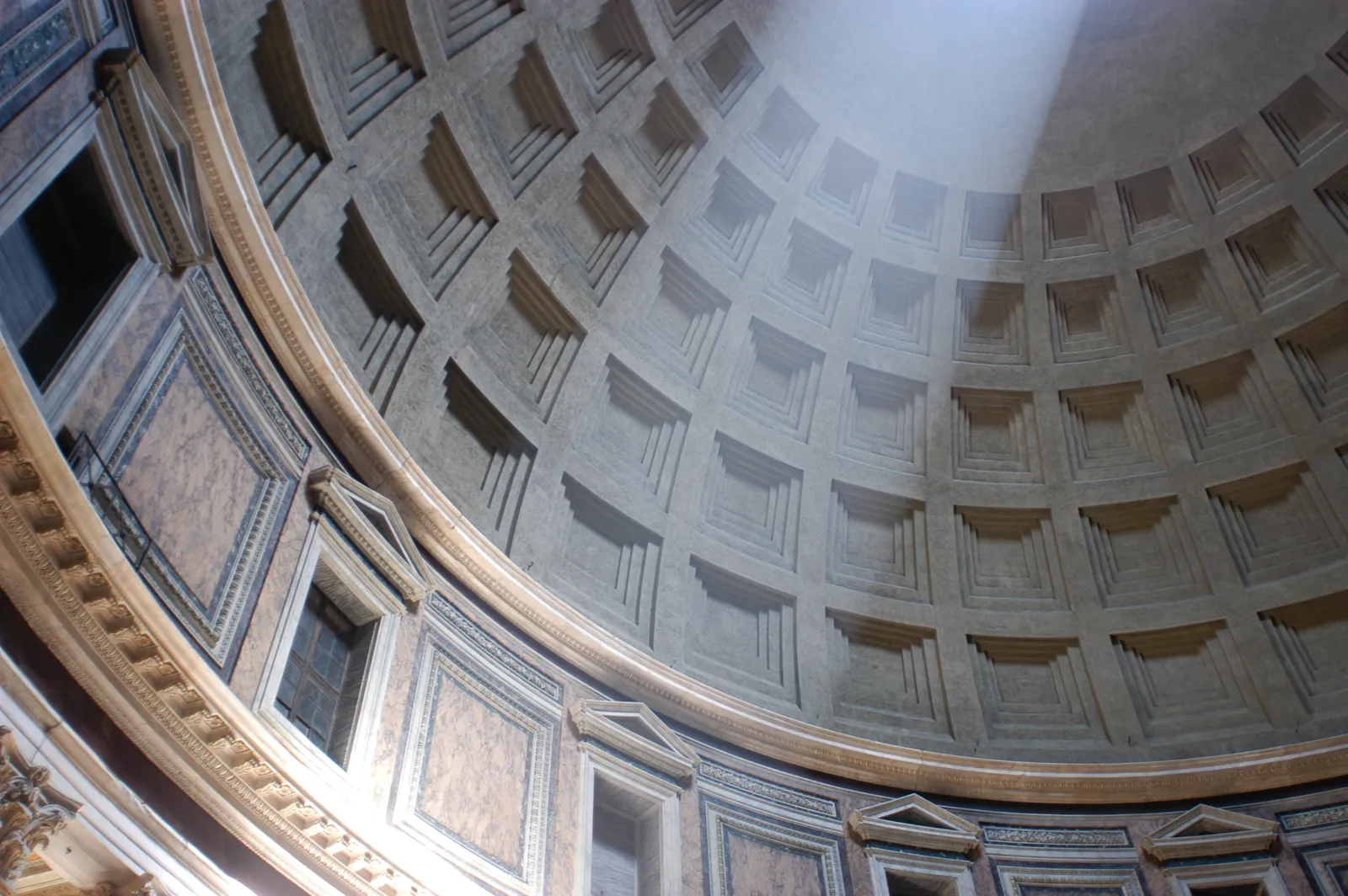
The Pantheon’s dome measures 43.30 m (142 ft) in diameter and the same in height, according to the Ministry; the oculus, the opening at the top, is the only source of natural light. In fine weather, the sun draws a patch of light there that moves through the day and the seasons. At solar noon, the higher the sun, the lower the patch falls towards the floor. The table gives the time of solar noon, the sun’s height and the approximate place where the centre of the beam lands.
| Date (15th) | Solar noon | Sun height | Beam centre at noon | Mean max | Rain |
|---|---|---|---|---|---|
| January | 12:19 | 27.0° | north wall, about 32.3 m (106 ft) high | 12.0 °C (54 °F) | 66 mm (2.6 in) |
| February | 12:24 | 35.4° | north wall, about 27.9 m (92 ft) high | 13.0 °C (55 °F) | 63 mm (2.5 in) |
| March | 12:19 | 46.0° | north wall, about 20.9 m (69 ft) high | 15.8 °C (60 °F) | 59 mm (2.3 in) |
| April | 13:10 | 57.9° | north wall, about 8.8 m (29 ft) high | 18.8 °C (66 °F) | 69 mm (2.7 in) |
| May | 13:06 | 67.0° | floor, 18.4 m (60 ft) from the centre | 22.3 °C (72 °F) | 57 mm (2.2 in) |
| June | 13:10 | 71.4° | floor, 14.6 m (48 ft) from the centre | 28.1 °C (83 °F) | 30 mm (1.2 in) |
| July | 13:15 | 69.6° | floor, 16.1 m (53 ft) from the centre | 31.0 °C (88 °F) | 20 mm (0.8 in) |
| August | 13:14 | 62.1° | north wall, about 2.3 m (8 ft) high | 31.6 °C (89 °F) | 30 mm (1.2 in) |
| September | 13:05 | 51.1° | north wall, about 16.5 m (54 ft) high | 26.7 °C (80 °F) | 65 mm (2.6 in) |
| October | 12:55 | 39.6° | north wall, about 25.4 m (83 ft) high | 22.2 °C (72 °F) | 88 mm (3.5 in) |
| November | 11:54 | 29.6° | north wall, about 31.0 m (102 ft) high | 16.9 °C (62 °F) | 108 mm (4.3 in) |
| December | 12:05 | 24.8° | north wall, about 33.3 m (109 ft) high | 12.7 °C (55 °F) | 98 mm (3.9 in) |
| April 21 (Rome’s birthday) | 13:09 | 60.0° | north wall, about 5.8 m (19 ft) high | — | — |
Reading: from May to July, at noon, the beam’s centre touches the floor, 15–18 m (49–59 ft) from the centre of the rotunda; in April and August, it hits the bottom of the north wall; in December, the sun only climbs to about 24.8° and the patch stays high in the dome. On April 21, the anniversary of Rome’s founding, the sun is at 60.0° at 1:09 pm. The phenomenon is visible only in clear skies: July and August are the driest months (20 and 30 mm, or 0.8 and 1.2 in of rain), November the wettest (108 mm, 4.3 in). On rainy days, water falls through the oculus, which is a spectacle of its own.
Best time to visit
The first slot (9 am) and the end of the day are generally the quietest, but the Ministry publishes no attendance figures: only the cap of 1,200 people per slot is given. The free first Sunday is the busiest. For the oculus beam, aim for a slot around solar noon, between 11:50 am and 1:15 pm depending on the season. Month-by-month climate: the best time to visit Rome.
What to see
- The dome: the largest masonry vault ever built, according to the Ministry, resting on a cylindrical wall more than 6 m (20 ft) thick.
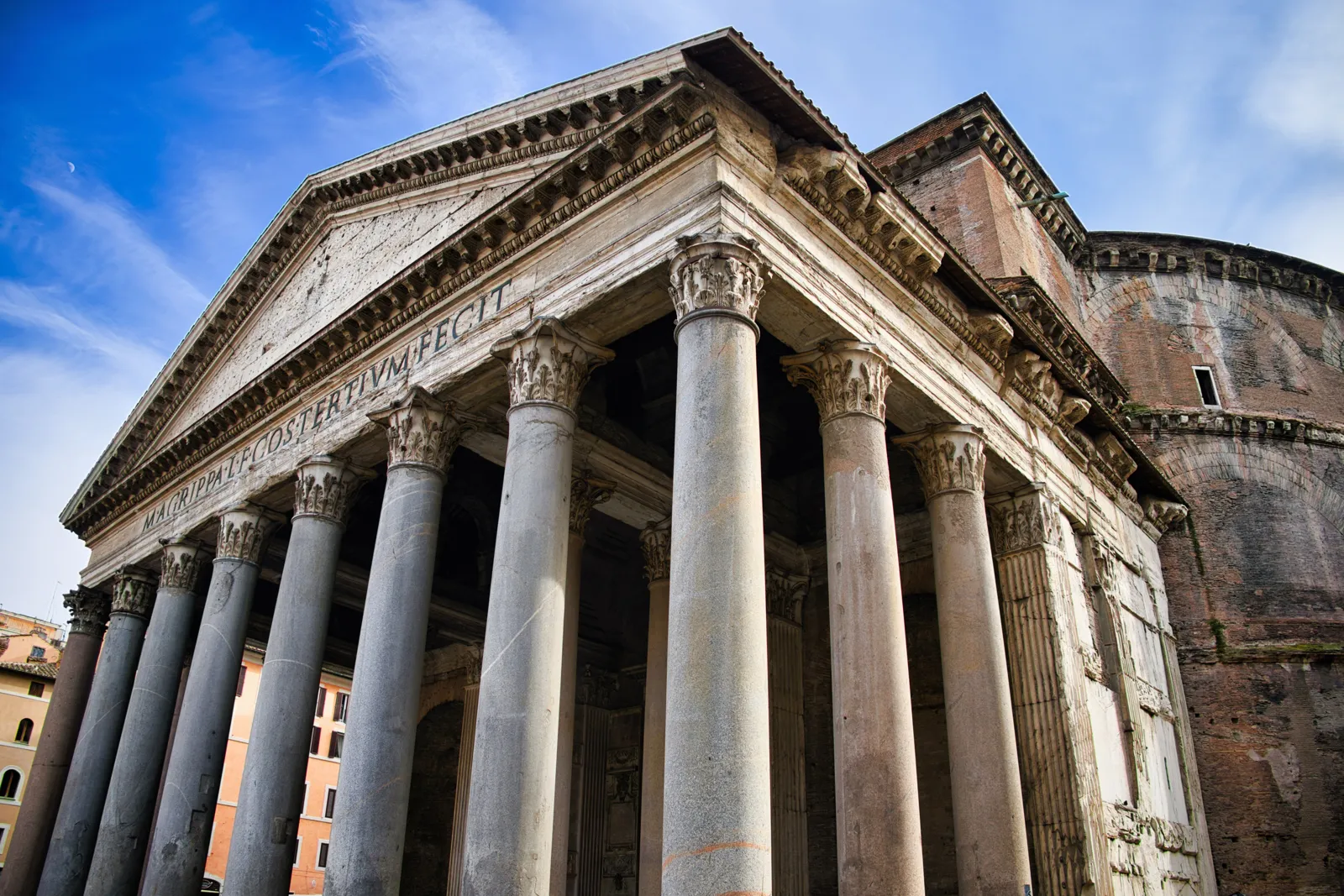
- The portico and Agrippa’s inscription: the first building dates from 27–25 BC; the present forms go back to the reign of Hadrian (AD 118–125).
- The basilica of Santa Maria ad Martyres: the temple became a church in 609, which explains its preservation.
- The tombs: the official audio guide features Raphael and Margherita of Savoy, buried in the Pantheon, as well as Emperor Hadrian and Pope Boniface IV.
Getting there
Piazza della Rotonda. Metro: Barberini (line A), about 700 m (0.4 mi). Bus: lines 30, 40, 62, 64, 81, 87 and 492, Largo di Torre Argentina stop, 400 m (0.2 mi) away (distances given by the basilica’s website). The Trevi Fountain is about 590 m (0.4 mi) as the crow flies, or about 10 minutes on foot (Destination de Voyage calculation, as-the-crow-flies distance between Wikidata coordinates, walking time estimated with a detour factor of 1.3 and a walking speed of 4.5 km/h).
Accessibility
The Ministry’s website mentions a ramp for visitors with disabilities, used in particular as a reception point for school groups. It does not detail other services; for a specific request, the Pantheon answers on +39 06 68300230 (every day, 9 am–6 pm). Dogs are not admitted, except guide dogs and certified assistance animals.
Common mistakes (official rules)
- Coming with bare shoulders, shorts or skirts that are too short, or transparent clothing: staff may refuse entry.
- Paying a reseller for a “skip-the-line”: the Ministry states there is none.
- Arriving late for your slot: punctuality is required.
- Eating, drinking, smoking or talking loudly on the phone: prohibited in the basilica.
- Arriving after 6 pm: the ticket desks are closed, even though last entry is 6:30 pm.
What to see nearby
The Trevi Fountain is a short walk away. Across the Tiber, St Peter’s Basilica and the Vatican Museums; to the south-east, the Colosseum. Our guide to visiting Rome gathers the other sights.
A short history of the Pantheon
A first Pantheon was built on Agrippa’s orders in 27 BC, at the start of Augustus’s reign: his name is still read on the pediment. The building you visit was rebuilt under Emperor Hadrian.
In 608, the Byzantine emperor Phocas gave it to Pope Boniface IV, who converted it into a church, the basilica of Santa Maria ad Martyres. This conversion explains its preservation, rare for a monument of ancient Rome.
Frequently asked questions
How much does it cost to enter the Pantheon in Rome?
€7 since July 1, 2026, €2 for ages 18–25, free for under 18s and on the first Sunday of the month (cultura.gov.it, consulted on 16 October 2026).
Do you need to book the Pantheon?
It is not compulsory: you can buy on site at the ticket desks and machines. Booking on Musei italiani guarantees a slot; there is no skip-the-line.
What are the Pantheon’s opening hours?
Every day from 9 am to 7 pm, last entry 6:30 pm, ticket offices closed at 6 pm. Closed on January 1 and December 25; hours changed during services.
Is the Pantheon free on Sundays?
Only on the first Sunday of the month: free tickets are collected on site. During Mass (Sunday 10:30 am), entry is free for worship.
When can you see the beam of light from the oculus?
In clear skies, around solar noon (between 11:50 am and 1:15 pm depending on the season). From May to July, the beam reaches the floor at noon; in winter, it stays high in the dome (Destination de Voyage calculation).
Who built the Pantheon in Rome?
The first temple was raised on Agrippa’s orders in 27 BC, hence the pediment inscription. The present building, with its dome, was rebuilt under Emperor Hadrian, then converted into a church in the 7th century by Pope Boniface IV.
Our sources
- Italian Ministry of Culture, page Pantheon e Basilica di Santa Maria ad Martyres (cultura.gov.it): prices, hours, access and booking conditions, dress code, dome dimensions, consulted on 16 October 2026
- Basilica di Santa Maria ad Martyres (pantheonroma.com): orari e info, access, official audio-guide offers, consulted on 16 October 2026
- NOAA / WMO: 1991–2020 normals for Rome-Ciampino, taken from our page on the best time to visit Rome
- Astronomical calculations: NOAA solar algorithm, IANA Europe/Rome time zone, Wikidata coordinates (Q99309)
- Wikipedia (fr), article “Panthéon (Rome)” (Agrippa 27 BC, Hadrian’s reconstruction, Phocas’s gift to Boniface IV), consulted on 16 October 2026
- Our methodology
Updated November 2026.