
The British Museum is free: entry to the permanent collection costs nothing, but the museum recommends booking a free timed ticket to get priority entry on busy days. Only temporary exhibitions are charged for. The museum is open every day from 10 am to 5 pm, until 8:30 pm on Fridays, and closes from 24 to 26 December. We took these rules from the official website and used the official visitor figures published by the museum.
The museum is in Bloomsbury, in central London. It combines easily with the other visits in our guide to visiting London.

Our travel deals for British Museum
Affiliate links: we earn a commission, at no extra cost to you.
 FlightsKiwi.comCompare flights and airline combinations to British Museum.Compare flights
- City passGo CityMulti-attraction pass at a fixed price: worth it only if you visit a lot.See passes
- eSIMAiraloData plan to install before you leave (eSIM-compatible phone).See plans



Key facts: British Museum
- Opening hours: every day 10 am–5 pm, Fridays until 8:30 pm; last entry 4:45 pm (8:15 pm on Fridays); closed 24 to 26 December — checked on 16 October 2026 on britishmuseum.org
- Price: permanent collection free; temporary exhibitions charged (price on each exhibition’s page) — checked on 16 October 2026 on britishmuseum.org
- Booking: not compulsory but recommended (free timed ticket, priority entry at busy times); without a booking, entry depends on capacity
- Occasional changes: reduced hours on certain days for events: check the museum’s website for your date
- Suggested time: 2 to 3 hours for the highlights, a full day for a complete tour (Destination de Voyage estimate; the museum has more than 50 galleries)
Tickets: free entry, official booking and resellers
The entry ticket is booked for free on the museum’s website: you choose a date and a time slot, for up to nine people per booking. There are two benefits: you receive useful information before your visit and you get priority entry at busy times. If no slot is available, the museum accepts visitors without a booking every day, sometimes with a longer wait.
Temporary exhibitions are charged and booked on their own pages; an exhibition ticket also gives access to the permanent collection. The « Korea » exhibition (1 October 2026–31 January 2027) is listed as « Adults from £18 », free for under-16s and members. For the Bayeux Tapestry (10 September 2026–11 July 2027), the adult ticket costs £33 at the standard rate, £27 off-peak and £25 « super off-peak »; slots up to 31 December 2026 were sold out, and sales for January to March 2027 were due to open on 21 October 2026 (checked on 18 October 2026 on britishmuseum.org). Members get 10% off in the cafés, restaurants and shops.
Be wary of sites that sell « skip-the-line tickets » for the British Museum: entry is free and so is the official ticket. A paid guided tour can be worthwhile, but it is never an admission fee.
Opening hours and closing days
| Service | Hours |
|---|---|
| Museum and galleries | 10 am–5 pm, Fridays until 8:30 pm (galleries start to clear 10 minutes before closing) |
| Last entry | 4:45 pm; Fridays 8:15 pm |
| Cloakroom | 10 am–5 pm (8:30 pm on Fridays); last drop-off one hour before closing |
| Box Office | 10 am–4:50 pm Monday to Friday, excluding public holidays |
| Annual closure | 24, 25 and 26 December |
The museum warns that it may close galleries without notice and cannot always announce it in advance: if a particular gallery matters to you, check the lists of open galleries and planned closures published on the website.
Best time to visit
The museum’s official annual report (year ended 31 March 2025) gives 6.5 million visitors, making it the UK’s most visited attraction. Spread over 362 opening days, that is an average of about 18,000 visitors a day, and about 2,390 per opening hour (Destination de Voyage calculation, based on 52.5 opening hours a week). The museum does not publish crowd levels by day or hour: these averages do not show the peaks.
On Fridays, opening until 8:30 pm adds 3 hours 30 minutes of visiting time. Booking a late slot on a Friday is the simplest way to avoid late morning, when most groups arrive (the website also advises turning up at your booked time, not before). Because the visit is entirely indoors, the museum is a good option on rainy days, which are frequent from October to December:
| Month | Average high | Rainfall |
|---|---|---|
| January | 8,4 | 59 |
| February | 9,0 | 45 |
| March | 11,7 | 39 |
| April | 15,0 | 42 |
| May | 18,4 | 46 |
| June | 21,6 | 47 |
| July | 23,9 | 46 |
| August | 23,4 | 53 |
| September | 20,2 | 50 |
| October | 15,8 | 65 |
| November | 11,5 | 67 |
| December | 8,8 | 57 |
What to see: a 2-hour route
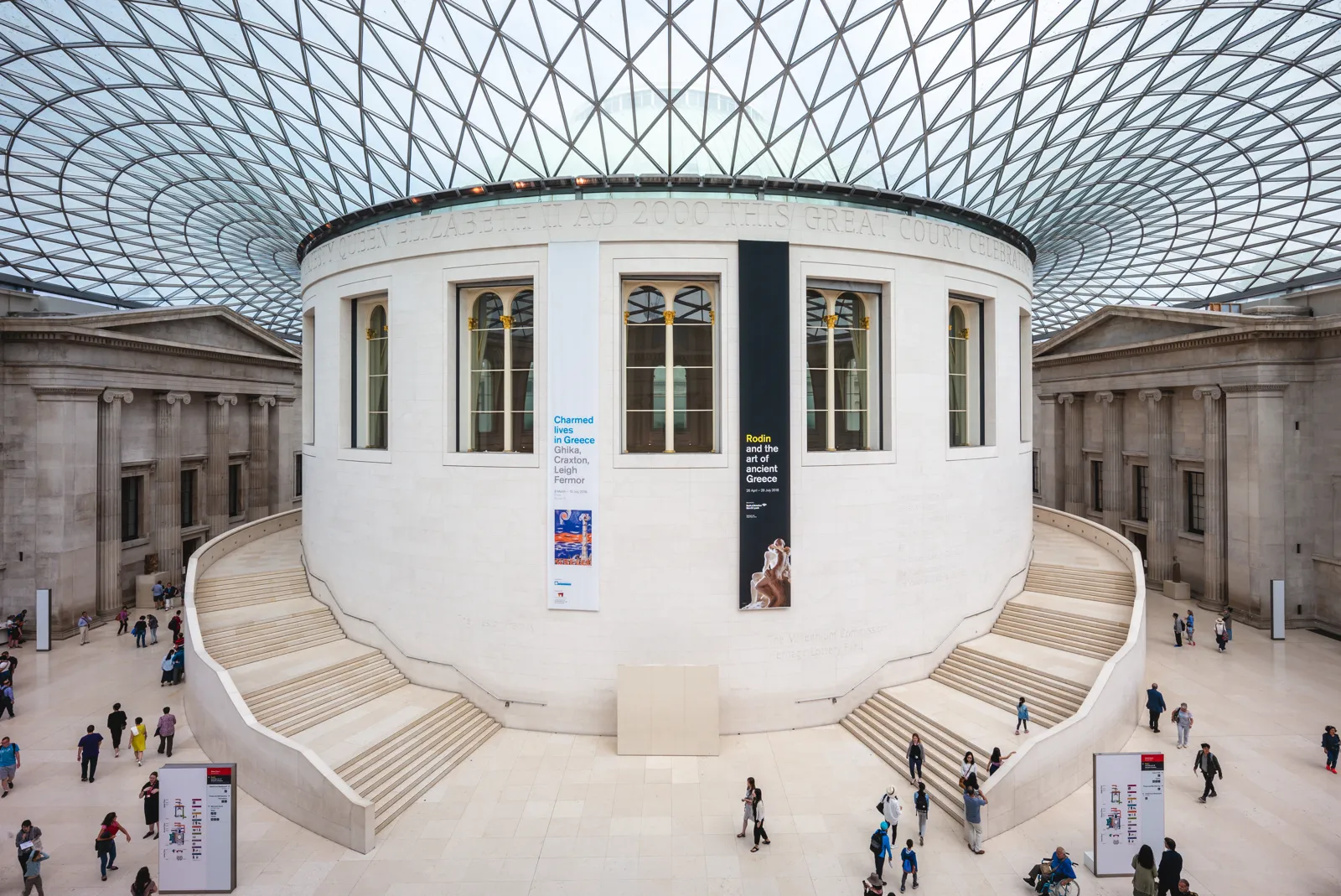
The museum covers « two million years of human history » in more than 50 galleries. Its website highlights the Sutton Hoo ship-burial treasure, the Islamic world collection and the Egyptian mummies. For a first visit of 2 hours, we suggest you:
- enter from Great Russell Street and cross the Great Court, the covered courtyard;
- start with the Egyptian galleries on the ground floor (monumental sculpture);
- continue with Greece and the Near East on the same level;
- go upstairs to the Egyptian mummy galleries;
- finish with Sutton Hoo and medieval Europe, or with the Islamic world collection.
Before you go, check the list of open galleries: some close for works. The museum offers an audio app in several languages (App Store, Google Play) and free themed routes (object trails); family workshops take place at weekends and during school holidays.
Getting there
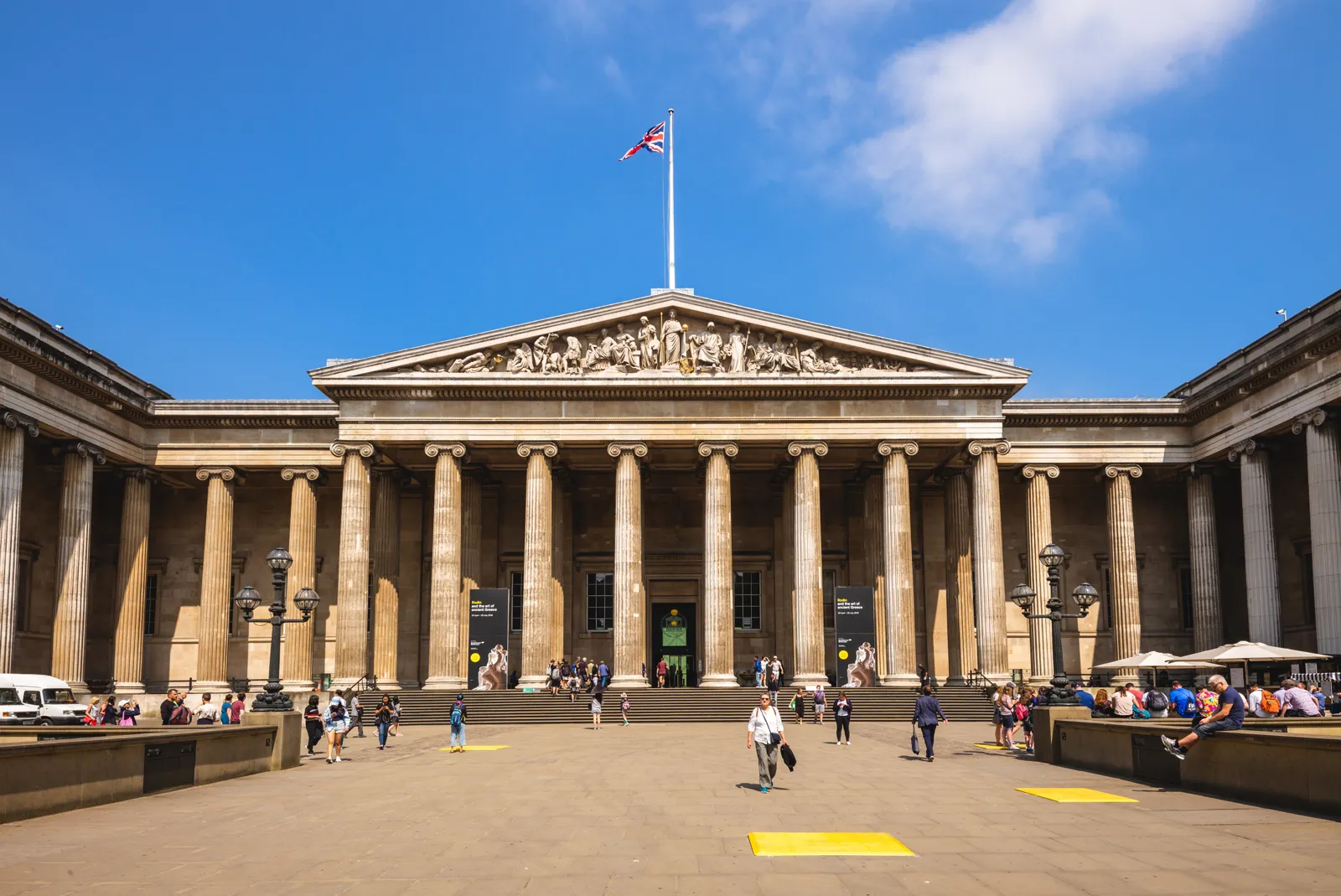
Main entrance: Great Russell Street, London WC1B 3DG. Second entrance: Montague Place, WC1E 7JW. The museum gives these walking times from the nearest Underground stations:
| Station | Walking time (official) |
|---|---|
| Tottenham Court Road | 5 minutes |
| Holborn | 7 minutes |
| Russell Square | 7 minutes |
| Goodge Street | 8 minutes |
Bus: routes 1, 8, 19, 25, 38, 55, 98 and 242 on New Oxford Street; 14, 24, 29, 73, 134 and 390 on Tottenham Court Road / Gower Street; 59, 68, X68, 91, 168 and 188 on Southampton Row. From Big Ben, allow about 2.1 km (1 mi) as the crow flies, or about 36 minutes on foot (Destination de Voyage calculation: straight-line distance between Wikidata coordinates, walking time estimated with a detour factor of 1.3 and a walking speed of 4.5 km (3 mi)/h).
Accessibility and prohibited items
Step-free access is available for visitors with disabilities, members, and people with a pushchair (stroller) or a child under five; uniformed staff can help at the entrance. Details of the services are on the Accessibility page of the website. All bags may be searched. Prohibited items: wheeled suitcases of any size, luggage larger than 40 x 40 x 50 cm (16 x 16 x 20 in) or heavier than 8 kg (18 lb), folding bikes, adult scooters, skateboards and musical instruments. Pushchairs are accepted and can be left in the cloakroom free of charge. For luggage, the museum refers visitors to the left-luggage advice for the main rail stations (Euston, King’s Cross, Charing Cross).
Common mistakes
- Paying for a « ticket » from a reseller: entry is free.
- Turning up with a wheeled suitcase: it will be refused, even a small one.
- Arriving before your time slot: the museum asks you to arrive at your booked time to limit the wait at security.
- Coming on a day with early closing without checking: events sometimes reduce the hours.
- Trying to see everything at once: choose a few galleries.
What to see nearby
The British Museum combines well with a walk towards Covent Garden and then Westminster: Big Ben, Westminster Abbey and Buckingham Palace. To the east, the Tower of London and Tower Bridge take half a day. For more ideas, see our guide to visiting London and our page on the best time to visit London.
A short history of the British Museum
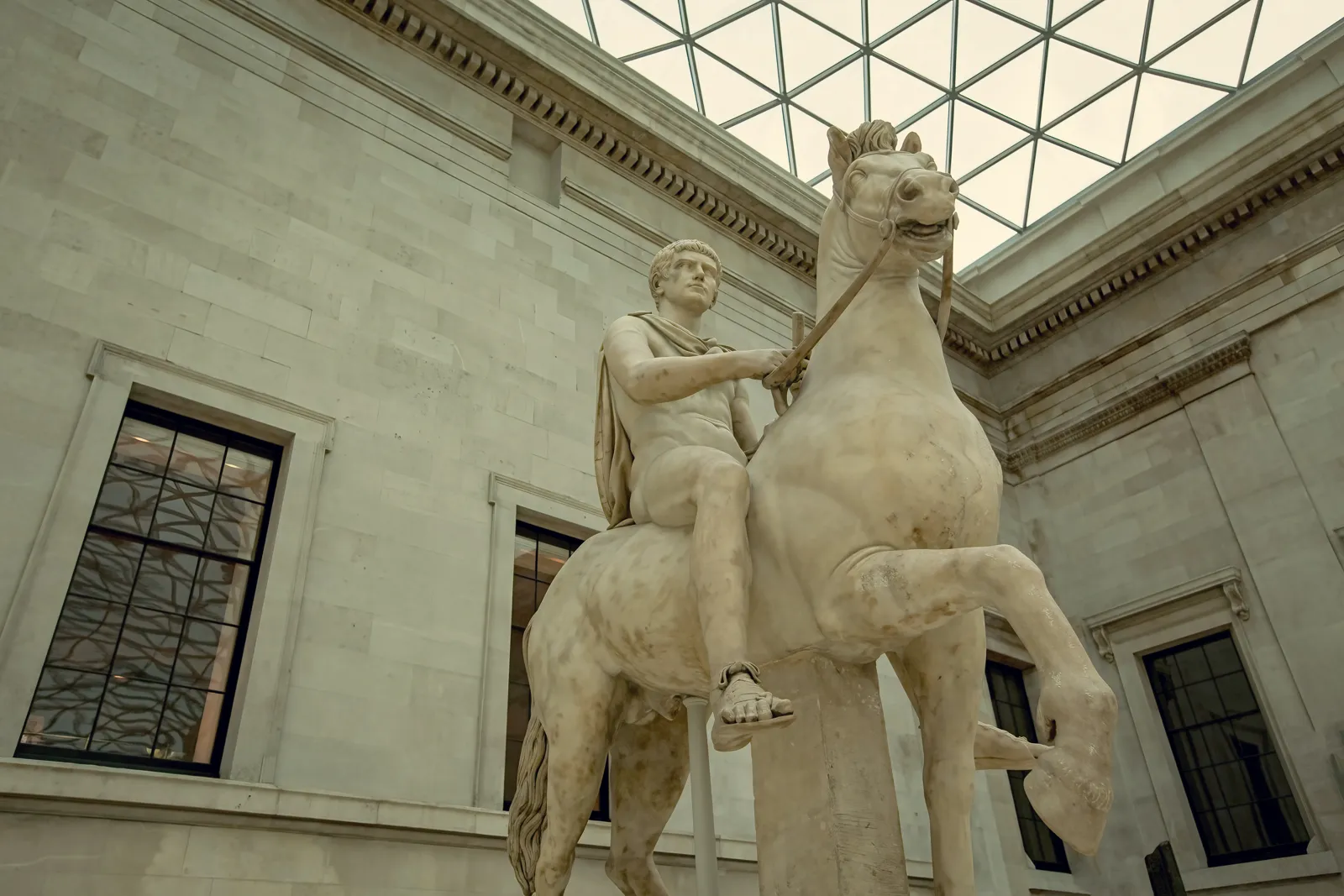
The British Museum was founded in 1753, largely on the basis of the collection of about 71,000 objects bequeathed by the physician and naturalist Hans Sloane. It opened to the public on 15 January 1759 in Montagu House, in Bloomsbury, on the same site as today.
The current neoclassical building, with its colonnade, was designed by Robert Smirke; it gradually replaced Montagu House during the 19th century. The circular Reading Room, in the centre of the Great Court, dates from 1857 (Sidney Smirke).
Frequently asked questions
Is the British Museum free?
Yes, entry to the permanent collection is free. Only temporary exhibitions are charged for (britishmuseum.org, checked on 16 October 2026).
Do you need to book for the British Museum?
It is not compulsory, but the museum recommends booking a free timed ticket: it gives priority entry at busy times. Without a booking, entry depends on capacity.
What are the British Museum’s opening hours?
Every day from 10 am to 5 pm, until 8:30 pm on Fridays; last entry at 4:45 pm (8:15 pm on Fridays). Closed 24 to 26 December.
How long do you need at the British Museum?
Allow 2 to 3 hours for the highlights (Egypt, Greece, Sutton Hoo). The museum has more than 50 galleries: a complete tour takes a full day.
How many visitors does the British Museum get?
6.5 million in the year ended 31 March 2025, according to the museum’s annual report, or about 18,000 visitors per opening day on average (Destination de Voyage calculation).
Who founded the British Museum?
The museum was founded in 1753, on the basis of the collection bequeathed by the physician Hans Sloane, and opened to the public in 1759 in Montagu House, on the current Bloomsbury site.
Our sources
- British Museum (britishmuseum.org): Visit page (opening hours, booking, access, security and prohibited items), consulted on 16 October 2026
- The British Museum, Report and Accounts for the year ended 31 March 2025 (HC 994), published on gov.uk: visitor numbers
- Met Office: 1991–2020 normals for London-Heathrow, taken from our page on the best time to visit London
- Wikidata: coordinates (Q6373, Q42182)
- Wikipedia (French edition), article « British Museum » (foundation 1753, opening 1759, Smirke), consulted on 16 October 2026
- Our methodology
Updated November 2026.