
Things to do in Oxford start with the oldest university city in the English-speaking world: colleges with enclosed quadrangles, the rotunda of the Radcliffe Camera, the Bodleian Library and museums that are mostly free, all in a centre you can explore on foot. What to see in Oxford, how to get there from London, entry requirements now that the UK ETA is in force, and when to go based on official Met Office normals: here are the essentials.
Oxford is the main town of Oxfordshire, at the confluence of the Thames (known here as the Isis) and the Cherwell, northwest of London. Teaching took place here from the late 11th century, and the university grew from 1167, when Henry II banned English students from attending the University of Paris. In 1209, scholars fled the town after a dispute with the townspeople and founded Cambridge. The city had about 165,200 inhabitants in 2023.

Our travel deals for Oxford
Affiliate links: we earn a commission, at no extra cost to you.
 FlightsKiwi.comCompare flights and airline combinations to Oxford.Compare flights
- Tickets and toursTiqetsEntry tickets and guided tours to book online; compare with the official price.See tickets
- eSIMAiraloData plan to install before you leave (eSIM-compatible phone).See plans



Oxford at a glance
- Location southern England, Oxfordshire, northwest of London
- Language English; currency: pound sterling
- Time zone UTC+0 (GMT), UTC+1 in summer (BST); 5 h ahead of New York
- Getting there trains from London (Paddington and Marylebone stations); Oxford station is west of the centre
- Entry US citizens: valid passport and Electronic Travel Authorisation (ETA); UK citizens: no formalities (travel.state.gov, GOV.UK)
- Highlights Christ Church, the Radcliffe Camera, the Bodleian, the Sheldonian, the Ashmolean, the Natural History Museum and Pitt Rivers, the Botanic Garden
- Ideal length 1 to 2 days
What to see in Oxford: the highlights
The colleges and Christ Church
The University of Oxford has no campus: it is made up of independent colleges spread across the centre, each with its chapel, dining hall and quadrangles. The most visited is Christ Church, founded in 1546 by Henry VIII. It has a unique feature: its chapel is also the cathedral of the Diocese of Oxford, and it was the elevation of this chapel to cathedral status, in 1542, that gave Oxford city status. Many colleges open only at certain times, close during exams or services and may charge admission: check each college’s website before you go.
The Radcliffe Camera and the Bodleian Library
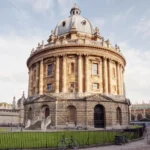
On Radcliffe Square, the Baroque rotunda of the Radcliffe Camera, designed by James Gibbs and built from 1737 to 1749, has become the image of Oxford. It is now a reading room of the Bodleian, not open to the public. The Bodleian itself, founded in 1602 by Sir Thomas Bodley, is one of the oldest libraries in Europe and, with more than 13 million printed items, the second largest in Britain after the British Library.
The Sheldonian Theatre and the Bridge of Sighs
Next door, the Sheldonian Theatre was built from 1664 to 1669 to designs by Christopher Wren. It hosts university ceremonies, concerts and lectures. A few steps away, Hertford Bridge, nicknamed the « Bridge of Sighs », is a covered skyway linking the two parts of Hertford College over New College Lane.
The museums
Most of Oxford’s museums belong to the university and are free. The Ashmolean, on Beaumont Street, is Britain’s first public museum: its first building was put up from 1678 to 1683 to house the cabinet of curiosities given by Elias Ashmole. On Parks Road, the Museum of Natural History is the only way into the Pitt Rivers Museum, founded in 1884, which holds more than 500,000 archaeological and anthropological objects. Check opening hours before your visit.
The Botanic Garden, the Covered Market and punting
On the banks of the Cherwell, the university’s Botanic Garden, founded in 1621 as a physic garden, is the oldest in Britain: more than 5,000 species on 1.8 hectares (4.4 acres). In the centre, the listed Covered Market houses permanent stalls and shops. In summer, punting, in a flat-bottomed boat pushed with a pole, is a tradition on the Isis and the Cherwell.
Nearby: Blenheim Palace
In Woodstock, Oxfordshire, Blenheim Palace, built from 1705 to 1722, is the residence of the Dukes of Marlborough and the birthplace of Winston Churchill. It has been a UNESCO World Heritage Site since 1987. For another major site in southern England, see our page on Stonehenge.
Itinerary: Oxford in 1 or 2 days
| Time | Day 1: colleges and libraries | Day 2: museums and gardens |
|---|---|---|
| Morning | Christ Church and its cathedral | Ashmolean |
| Midday | Covered Market, Carfax Tower | Museum of Natural History and Pitt Rivers |
| Afternoon | Radcliffe Square, the Bodleian, the Sheldonian, the Bridge of Sighs | Botanic Garden, punting on the Cherwell in summer |
| Evening | High Street | Or a trip to Blenheim Palace |
When to go to Oxford
From May to September, when highs exceed 17.7 °C (64 °F) and days are sunniest (up to 6.8 hours of sunshine a day in July). June has the fewest rainy days (8.0). Unlike many cities, summer is no wetter than the rest of the year: rain is spread over all twelve months, peaking in October (73 mm, 2.9 in). Winter is mild but grey: 8.0 °C (46 °F) in the afternoon in January, 2.4 °C (36 °F) at night, and under 2 hours of sunshine a day in December.
| Month | High °C (°F) | Low °C (°F) | Rain mm (in) | Rainy days | Sunshine / day | Verdict |
|---|---|---|---|---|---|---|
| January | 8.0 (46) | 2.4 (36) | 59.6 (2.3) | 12.1 | 2.0 h | ❌ Grey, damp |
| February | 8.6 (47) | 2.3 (36) | 46.8 (1.8) | 9.4 | 2.9 h | ⚠️ Cool |
| March | 11.3 (52) | 3.6 (38) | 43.2 (1.7) | 9.1 | 3.8 h | ⚠️ Cool |
| April | 14.4 (58) | 5.3 (42) | 48.7 (1.9) | 8.9 | 5.5 h | ✅ Spring |
| May | 17.7 (64) | 8.2 (47) | 56.9 (2.2) | 9.6 | 6.5 h | ✅ Pleasant |
| June | 20.7 (69) | 11.1 (52) | 49.7 (2.0) | 8.0 | 6.6 h | ✅ Ideal, least rainy |
| July | 23.1 (74) | 13.1 (56) | 52.5 (2.1) | 8.3 | 6.8 h | ✅ Warmest and sunniest |
| August | 22.5 (72) | 13.0 (55) | 61.7 (2.4) | 9.0 | 6.2 h | ✅ Warm |
| September | 19.4 (67) | 10.7 (51) | 51.9 (2.0) | 8.6 | 4.8 h | ✅ Mild, ideal |
| October | 15.1 (59) | 8.0 (46) | 73.2 (2.9) | 10.9 | 3.6 h | ⚠️ The wettest |
| November | 10.9 (52) | 4.9 (41) | 71.5 (2.8) | 11.3 | 2.4 h | ❌ Grey, damp |
| December | 8.2 (47) | 2.6 (37) | 66.1 (2.6) | 12.2 | 1.9 h | ❌ The darkest |
These normals are slightly cooler in summer than those for London Heathrow used on our United Kingdom page (July: 23.1 °C (74 °F) in Oxford against 23.9 °C (75 °F) at Heathrow, both from the Met Office): these are two different stations, not a contradiction. The Radcliffe Observatory station has the longest continuous series of temperature and rainfall records for a single site in Britain, dating back to 1815.
How many rainy days on a 2-day weekend?
Scaling the average number of rainy days (at least 1 mm) in each month to a two-day stay, you can expect about 0.5 rainy days in June and 0.8 in December. Destination de Voyage calculation from Met Office 1991–2020 normals.
| Month | Rainy days expected over 2 days | Rain in the month |
|---|---|---|
| January | 0.8 | 60 mm (2.4 in) |
| February | 0.7 | 47 mm (1.9 in) |
| March | 0.6 | 43 mm (1.7 in) |
| April | 0.6 | 49 mm (1.9 in) |
| May | 0.6 | 57 mm (2.2 in) |
| June | 0.5 | 50 mm (2.0 in) |
| July | 0.5 | 52 mm (2.0 in) |
| August | 0.6 | 62 mm (2.4 in) |
| September | 0.6 | 52 mm (2.0 in) |
| October | 0.7 | 73 mm (2.9 in) |
| November | 0.8 | 72 mm (2.8 in) |
| December | 0.8 | 66 mm (2.6 in) |
For events and the climate of the capital, see when to go to London.
Getting there and getting around Oxford
- Getting there: most international visitors arrive through London’s airports or St Pancras (Eurostar), then continue to Oxford.
- By train from London: Great Western Railway links London Paddington to Oxford, and Chiltern Railways links London Marylebone to Oxford via Oxford Parkway. Timetables and fares on the operators’ websites.
- Getting around: Oxford station is west of the centre. The centre, around Carfax crossroads, is small and partly pedestrianised: everything can be done on foot.
Where to stay
The historic centre puts you within walking distance of the colleges, museums and the Covered Market. The station area is handy if you arrive by train. Compare offers and book early for summer.
If you… then…: choosing your visit
| If you… | Then… |
|---|---|
| are coming from London for the day | Christ Church, Radcliffe Square, the Bodleian, the Sheldonian and the Covered Market, all on foot |
| love museums | The Ashmolean, then the Museum of Natural History and Pitt Rivers (same entrance) |
| travel in summer | Punting on the Cherwell and the Botanic Garden: June and July are the sunniest months |
| travel in winter | Focus on museums and libraries: December is the darkest month |
| have an extra day | Add Blenheim Palace, in Woodstock |
| are discovering England | Combine with London and our United Kingdom guide |
Entry requirements, health and safety
- US citizens: according to the U.S. Department of State (travel.state.gov, last updated August 11, 2025), all US citizens travelling to the UK for tourism, family visits, business meetings or short-term study of 6 months or less must have an Electronic Travel Authorization (ETA) before travel, and the passport must be valid for the entire stay. According to GOV.UK (Apply for an electronic travel authorisation, read on 26 October 2026), an ETA costs £20 and lets you travel to the UK for up to 6 months; other websites may charge more, so avoid sites that imitate government services. An ETA does not guarantee entry.
- UK citizens: travel within the UK is domestic: no entry formalities apply.
- Health: medical care in the UK is widely available (travel.state.gov). Take out travel insurance covering medical costs; some US-approved medications are controlled in the UK, so carry them in their original packaging with a copy of your prescription (travel.state.gov).
- Safety: violent crime is rare, but watch out for pickpockets and phone snatching (travel.state.gov). Look right before crossing: UK traffic drives on the left. Emergencies: 999.
Frequently asked questions
How many days do you need in Oxford?
One day is enough for Christ Church, Radcliffe Square, the Bodleian and the centre; two days to add the museums, the Botanic Garden or Blenheim Palace.
What is the best time to visit Oxford?
May to September. July is the warmest (23.1 °C, 74 °F) and sunniest month, and June has the fewest rainy days, according to Met Office 1991–2020 normals at the Radcliffe Observatory.
Do you need an ETA to visit Oxford?
US citizens need a valid passport and an Electronic Travel Authorisation (ETA, £20), according to travel.state.gov and GOV.UK. UK citizens need no formalities.
Can you visit Oxford as a day trip from London?
Yes: trains link London Paddington and London Marylebone to Oxford, and the centre is easy to explore on foot.
Are Oxford’s museums free?
Most of Oxford’s museums belong to the university and are free, such as the Ashmolean. Colleges, however, may charge admission: check their websites.
Our sources
- 1991–2020 normals for the Radcliffe Observatory station (Oxford), Met Office: « UK climate averages », Oxford station, and the station’s historic monthly records (oxforddata.txt), consulted on 23 October 2026
- Entry, health and safety information read on 26 October 2026: U.S. Department of State, United Kingdom country information (travel.state.gov, last updated August 11, 2025), and GOV.UK, Apply for an electronic travel authorisation (ETA)
- Wikipedia (English): « Oxford », « University of Oxford », « Christ Church, Oxford », « Radcliffe Camera », « Bodleian Library », « Sheldonian Theatre », « Ashmolean Museum », « Oxford Botanic Garden », « Blenheim Palace », consulted on 23 October 2026
- Destination de Voyage calculations: sunshine per day, rainy days over a 2-day stay
- Our methodology
Updated October 2026.
To extend your trip, see our guides to the United Kingdom and London, our page on time in the UK and our destinations in Europe.