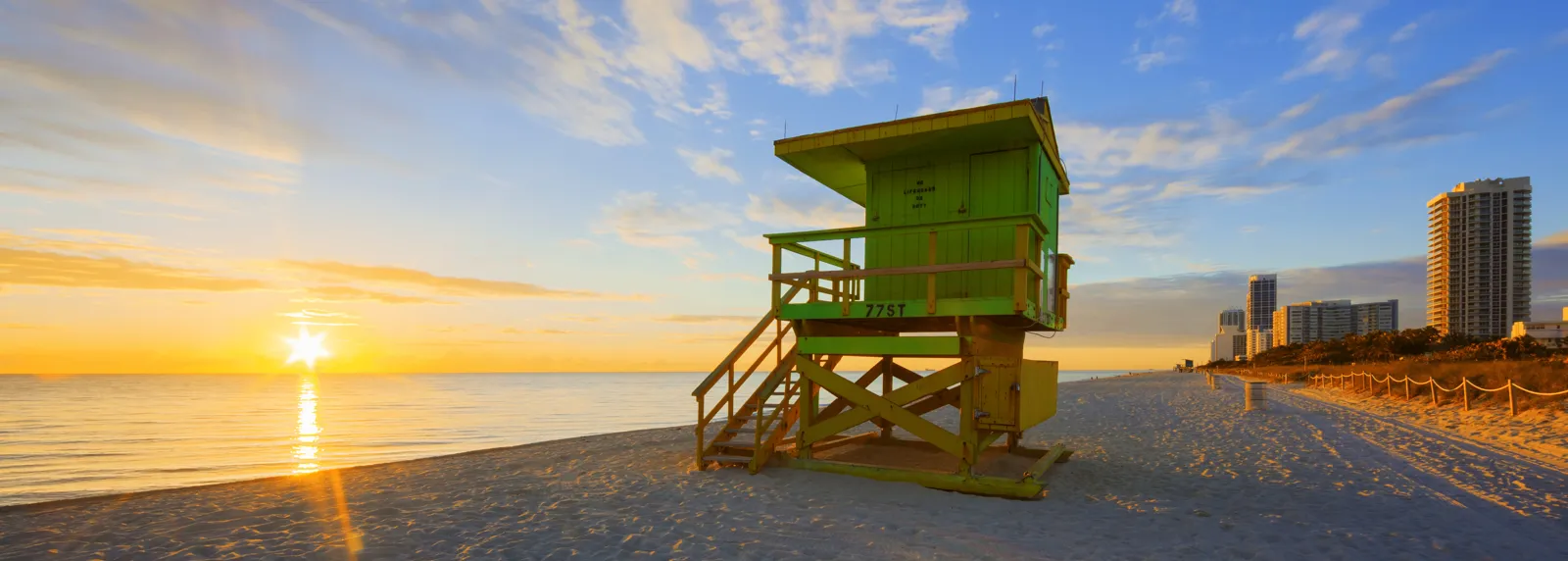
When is the best time to visit Florida? December to April: afternoons reach 24 to 29 °C (75 to 84 °F) in Miami, it rains little and humidity stays bearable. March and April offer the best balance between warmth and dry weather. From June to October, the heat becomes heavy, thunderstorms are almost daily and it is hurricane season.
Florida has two well-marked seasons: a dry, mild season from November to April, and a hot, humid season from May to October, when most of the rain falls. The south (Miami, the Keys, the Everglades) stays warm all year; the center (Orlando) has cool mornings in winter, around 10 °C (50 °F). The official Atlantic hurricane season runs from June to November. To choose your dates, school vacations and theme park prices matter as much as the weather. Here are the benchmarks, based on the official NOAA normals. Our guide to Orlando: parks, budget and where to stay complements them.

Our travel deals for Florida
Affiliate links: we earn a commission, at no extra cost to you.
 FlightsKiwi.comCompare flights and airline combinations to Florida.Compare flights
- eSIMAiraloData plan to install before you leave (eSIM-compatible phone).See plans


When to go to Florida at a glance
- Best times December to April, with an optimum in March–April
- For the Everglades the dry season, December to April, when animals gather around water points and mosquitoes are fewer
- Hottest month August, with an average high of 32.6 °C (91 °F) in Miami
- Driest month January in Miami (46 mm (1.8 in))
- Wettest month June in Miami (267 mm (10.5 in)), followed by September and August
- Hurricanes June to November, with a higher risk from August to October
- Cheapest period late August to early November, outside vacations, accepting the hurricane risk
When to go to Florida by priority
- Best weather: December to April, with April offering the best compromise (about 29 °C (84 °F) in Miami, little rain)
- Cheapest: September and October, at the peak of hurricane season; May, June and November (outside Thanksgiving) remain moderately priced
- Fewest crowds: September and October; avoid March spring break, Easter, Thanksgiving and the holidays
- Events: spring break and the Calle Ocho festival in March, Thanksgiving on the fourth Thursday of November, Art Basel Miami Beach in early December
Florida: the calendar at a glance
✅ Best months: January, February, March, April, November, December
❌ Period to avoid: September
Florida climate: temperatures and rainfall month by month
The table below uses the normals of the Miami International Airport station, representative of South Florida, where most international flights arrive. Orlando and Key West are compared further down.
| Month | Avg. max | Avg. min | Rain | Crowds | Prices | Verdict |
|---|---|---|---|---|---|---|
| January | 24.6 °C (76 °F) | 16.1 °C (61 °F) | 46 mm (1.8 in) | High | High | ✅ Mild and dry, cool nights |
| February | 25.7 °C (78 °F) | 17.3 °C (63 °F) | 55 mm (2.2 in) | High | High | ✅ Dry and sunny, peak season |
| March | 27.0 °C (81 °F) | 18.7 °C (66 °F) | 62 mm (2.4 in) | Very high (spring break) | Very high | ✅ Warm and dry, but very busy |
| April | 28.7 °C (84 °F) | 21.0 °C (70 °F) | 85 mm (3.3 in) | High (Easter) | High | ✅ The best compromise |
| May | 30.4 °C (87 °F) | 23.0 °C (73 °F) | 161 mm (6.3 in) | Moderate | Moderate | ⚠️ Start of the rainy season |
| June | 31.8 °C (89 °F) | 24.6 °C (76 °F) | 267 mm (10.5 in) | Moderate | Moderate | ⚠️ The wettest, start of hurricane season |
| July | 32.6 °C (91 °F) | 25.3 °C (78 °F) | 187 mm (7.4 in) | High (vacations) | High | ⚠️ Hot, heavy, afternoon thunderstorms |
| August | 32.6 °C (91 °F) | 25.4 °C (78 °F) | 243 mm (9.6 in) | High (vacations) | High | ⚠️ The hottest, hurricane risk |
| September | 31.7 °C (89 °F) | 24.9 °C (77 °F) | 260 mm (10.2 in) | Low | Low | ❌ Peak of hurricane season |
| October | 29.9 °C (86 °F) | 23.4 °C (74 °F) | 194 mm (7.6 in) | Low to moderate | Low → moderate | ⚠️ Still humid, hurricanes possible |
| November | 27.4 °C (81 °F) | 20.2 °C (68 °F) | 90 mm (3.5 in) | Moderate (Thanksgiving) | Moderate | ✅ Dry weather returns |
| December | 25.7 °C (78 °F) | 17.9 °C (64 °F) | 62 mm (2.4 in) | High (holidays) | Very high | ✅ Mild and dry, year-end holidays |
Note: according to the same normals, Miami averages 6 to 8 days of rain a month from January to April, compared with 17 to 19 days from June to September. In summer, rain falls mostly as violent but brief thunderstorms in the middle or late afternoon.
Florida’s seasons: pros and cons
Dry season (November to April): the high season
This is the period chosen by most travelers and by people from the northern US escaping winter. In Miami, highs range from 25 °C (77 °F) in January to almost 29 °C (84 °F) in April, with less than 90 mm (3.5 in) of rain a month. Farther north, Orlando is cooler in winter: 22 °C (72 °F) in the afternoon in January, and lows around 10 °C (50 °F). Passing cold snaps can occur in December and January.
- Pros: dry, sunny weather, low humidity, the best period for the Everglades, the Keys and road trips
- Cons: high prices, especially during the holidays and spring break (March), Miami Beach and Keys hotels full early, water a little cool in January for some swimmers
- Our tip: April, after Easter, combines warmth, dry weather and falling crowds
Wet season (May to October): heat, thunderstorms and hurricanes
Highs exceed 31 °C (88 °F) from June to September in Miami and Orlando alike, and humidity makes the heat oppressive. Rainfall exceeds 160 mm (6.3 in) a month from May to October in Miami. Mornings are often fine, then thunderstorms break out in the afternoon. The hurricane season runs from June to November (National Hurricane Center); most days remain storm-free, but a hurricane can disrupt a stay for several days. The UK FCDO (GOV.UK, updated 18 August 2026) advises checking the National Hurricane Center website for the latest forecasts and following the instructions of local authorities, including evacuation orders. For a city stay during this wet season, our Miami travel guide helps plan beaches, neighborhoods and a plan B in case of storms.
- Pros: very warm sea, cheaper hotels outside July–August, cheaper Orlando parks in September
- Cons: humid heat, daily thunderstorms, mosquitoes, risk of hurricanes and flight cancellations, queues at the parks in July–August
- Who is it for? Families tied to school vacations (July–August) and flexible travelers, with suitable cancellation insurance
When to go to Florida by region
Comparison of the official normals for three cities, from the center of the state to the far south:
| Month | Miami | Orlando | Key West |
|---|---|---|---|
| January | 24.6 °C (76 °F) / 46 mm (1.8 in) | 22.1 °C (72 °F) / 63 mm (2.5 in) | 24.3 °C (76 °F) / 46 mm (1.8 in) |
| February | 25.7 °C (78 °F) / 55 mm (2.2 in) | 23.8 °C (75 °F) / 52 mm (2.0 in) | 25.2 °C (77 °F) / 39 mm (1.5 in) |
| March | 27.0 °C (81 °F) / 62 mm (2.4 in) | 26.1 °C (79 °F) / 77 mm (3.0 in) | 26.4 °C (80 °F) / 39 mm (1.5 in) |
| April | 28.7 °C (84 °F) / 85 mm (3.3 in) | 28.7 °C (84 °F) / 66 mm (2.6 in) | 28.1 °C (83 °F) / 53 mm (2.1 in) |
| May | 30.4 °C (87 °F) / 161 mm (6.3 in) | 31.3 °C (88 °F) / 102 mm (4.0 in) | 29.9 °C (86 °F) / 79 mm (3.1 in) |
| June | 31.8 °C (89 °F) / 267 mm (10.5 in) | 32.7 °C (91 °F) / 204 mm (8.0 in) | 31.5 °C (89 °F) / 107 mm (4.2 in) |
| July | 32.6 °C (91 °F) / 187 mm (7.4 in) | 33.3 °C (92 °F) / 189 mm (7.4 in) | 32.3 °C (90 °F) / 92 mm (3.6 in) |
| August | 32.6 °C (91 °F) / 243 mm (9.6 in) | 33.1 °C (92 °F) / 195 mm (7.7 in) | 32.6 °C (91 °F) / 136 mm (5.4 in) |
| September | 31.7 °C (89 °F) / 260 mm (10.2 in) | 32.0 °C (90 °F) / 162 mm (6.4 in) | 31.7 °C (89 °F) / 184 mm (7.2 in) |
| October | 29.9 °C (86 °F) / 194 mm (7.6 in) | 29.3 °C (85 °F) / 88 mm (3.5 in) | 29.9 °C (86 °F) / 144 mm (5.7 in) |
| November | 27.4 °C (81 °F) / 90 mm (3.5 in) | 25.7 °C (78 °F) / 45 mm (1.8 in) | 27.2 °C (81 °F) / 52 mm (2.0 in) |
| December | 25.7 °C (78 °F) / 62 mm (2.4 in) | 23.2 °C (74 °F) / 63 mm (2.5 in) | 25.4 °C (78 °F) / 55 mm (2.2 in) |
Miami and the Gold Coast
Southeast Florida has the mildest winter of the contiguous United States: lows stay above 16 °C (61 °F) on average. The best period runs from December to April. Summer is very humid, with more than 240 mm (9.4 in) of rain in June, August and September.
Orlando and the center
Orlando has cooler winters (about 10 °C (50 °F) at dawn in January) and summers even hotter than Miami (33 °C (91 °F) in July–August). For the theme parks, March–April and October–November offer pleasant temperatures, but school vacations (Easter, Thanksgiving, Christmas) push up crowds and prices. In summer, plan outdoor attractions for the morning: thunderstorms often close outdoor rides in the afternoon.
The Keys and Key West
The Keys are the mildest in winter (lows around 19 °C (66 °F) in January in Key West) and much drier than Miami: about 1,000 mm (39.4 in) a year, against more than 1,700 mm (66.9 in). The dry season, December to April, remains the best. In September and October, at the height of hurricane season, the Keys road can be closed and the islands evacuated in case of an alert.
The Gulf Coast (Tampa, Sarasota, Naples)
The west coast follows the same rhythm as the rest of the peninsula: a dry, sunny season in winter and spring, and frequent summer thunderstorms. Its beaches, known for fine sand and sunsets, are quieter than Miami’s. It is also exposed to hurricanes from the Gulf of Mexico.
Which part of Florida by month?
This table summarizes the best period for each major region, based on the NOAA normals and the detailed advice above.
| Region | Jan | Feb | Mar | Apr | May | June | Jul | August | Sep | Oct | Nov | Dec |
|---|---|---|---|---|---|---|---|---|---|---|---|---|
| Miami and the Gold Coast | ✅ | ✅ | ✅ | ✅ | ⚠️ | ⚠️ | ⚠️ | ⚠️ | ❌ | ⚠️ | ✅ | ✅ |
| Orlando and the center | ⚠️ | ⚠️ | ✅ | ✅ | ⚠️ | ⚠️ | ⚠️ | ⚠️ | ❌ | ✅ | ✅ | ⚠️ |
| The Keys and Key West | ✅ | ✅ | ✅ | ✅ | ⚠️ | ⚠️ | ⚠️ | ⚠️ | ❌ | ❌ | ✅ | ✅ |
| Gulf Coast (Tampa, Sarasota, Naples) | ✅ | ✅ | ✅ | ✅ | ⚠️ | ⚠️ | ⚠️ | ⚠️ | ❌ | ⚠️ | ✅ | ✅ |
Details for the city: when to go to Miami.

When to go to Florida by trip type
| Trip | Best time | Where? |
|---|---|---|
| Beach and relaxing | December to April; May if you can handle the heat | Miami Beach, Fort Lauderdale, Gulf Coast, Keys |
| Theme parks | Late January–February, late April–May, October–November outside school vacations | Orlando |
| Everglades and nature | December to April (dry season) | Everglades National Park, Big Cypress |
| Keys road trip | December to May | US 1 from Miami to Key West |
| Diving and snorkeling | April to June, when the sea is warm and the hurricane risk low | Keys (Key Largo and Looe Key reefs) |
| Budget | September to early November, outside vacations | Everywhere, with suitable insurance |
| Family with school-age children | February or Easter vacations | Orlando and beaches |
Major events in Florida
| Date | Event | Location |
|---|---|---|
| March (dates vary) | Spring break: mass arrival of American students, rising prices and crowds | Beaches of Miami Beach, Fort Lauderdale, Panama City Beach |
| March | Calle Ocho Festival (dates vary) | Little Havana, Miami |
| June to November | Atlantic hurricane season | Whole state |
| Late November | Thanksgiving (fourth Thursday of November) | Whole state, Orlando parks very busy |
| Early December | Art Basel Miami Beach (dates vary) | Miami Beach |
| Late December | Year-end holidays | Orlando parks, Miami |
Florida month by month
January: Mild and dry (25 °C (77 °F) in Miami, 22 °C (72 °F) in Orlando), the driest month in Miami (46 mm (1.8 in)). Cool mornings in the center. A good month for the Everglades.
February: Sunny and dry. A very good month for the Keys and the Everglades; high crowds during school vacations.
March: Warm (27 °C (81 °F)) and dry. Spring break: lively beaches and more expensive hotels. A good month for Orlando outside vacations.
April: The best compromise: 29 °C (84 °F), little rain, warming sea. Check the date of Easter, a period in high demand.
May: Rising heat (30 °C (86 °F)) and the first heavy showers at the end of the month. Falling prices, a good month for diving.
June: The wettest month in Miami (267 mm (10.5 in)). Official start of hurricane season. Afternoon thunderstorms.
July: Very hot and humid (32.6 °C (91 °F)). School vacations: Orlando parks packed. Schedule visits in the morning.
August: The hottest of the year, growing hurricane risk. Very warm sea. Prices stay firm until the school year starts.
September: Peak of hurricane season and 260 mm (10.2 in) of rain in Miami. Lowest prices: only if you are flexible and well insured.
October: Still hot and humid, hurricanes possible. The weather improves at the end of the month, notably in Orlando (88 mm (3.5 in)).
November: Dry weather returns (90 mm (3.5 in) in Miami, 45 mm (1.8 in) in Orlando) along with pleasant temperatures. Thanksgiving pushes prices up.
December: Mild and dry (26 °C (79 °F) in Miami). High season around the holidays: book early.
When to book your trip to Florida
For the year-end holidays, February vacations, spring break and Easter, book flights, car and accommodation 3 to 6 months ahead. Orlando park tickets are often cheaper when bought online before departure, and some dates need to be reserved in advance. In the low season, from late August to early November, prices fall but choose flexible rates because of the hurricane risk. Miami (MIA) and Orlando (MCO) are the main international gateways.
Planning your trip to Florida
- Entry requirements: passport, visa and travel authorization rules depend on your nationality: see our entry requirements for the United States.
- Time difference: most of Florida is on Eastern Time (UTC−5, UTC−4 in summer), the same as New York and, most of the year, 5 hours behind London; the western Panhandle (Pensacola) is on Central Time, one hour behind (details).
- Currency: the US dollar. Displayed prices are before sales tax, added at the register, and a tip is expected in restaurants. To convert, use our currency converter.
- Health: medical care is very expensive: travel insurance covering medical costs and repatriation is strongly recommended.
- Hurricanes: from June to November, follow National Hurricane Center bulletins and the evacuation instructions of the authorities (UK FCDO, GOV.UK, updated 18 August 2026).
To plan your stay, see our Florida travel guide. For other winter sun, compare with when to go to Mexico or when to go to California. To combine Florida with another region, see our United States travel guide and the page when to go to New York. To compare with other destinations, see also our picks for where to go in April.
Frequently asked questions
What is the best month to visit Florida?
April: it is about 29 °C (84 °F) in the afternoon in Miami, it rains little and the spring break crowds have gone (outside Easter). March, February and December are also very good choices, though pricier.
When is hurricane season in Florida?
The Atlantic hurricane season runs from June to November, with a higher risk from August to October. A stay during this period is not necessarily disrupted, but plan flexible bookings and suitable insurance.
Is Florida warm in winter?
In the south, yes: about 25 °C (77 °F) in the afternoon in January in Miami and Key West. Orlando is cooler, with 22 °C (72 °F) in the afternoon and mornings around 10 °C (50 °F). Passing cold snaps are possible.
Can you go to Florida in July or August?
Yes, but it is above 32 °C (90 °F) with high humidity, thunderstorms are daily in the afternoon and it is hurricane season. Orlando’s parks are very busy. Plan outdoor activities for the morning.
When should you go to Florida for the Orlando parks?
From late January to February, from late April to May, and in October–November, avoiding school vacations, Thanksgiving and the year-end holidays. The weather is then pleasant and waits are shorter.
What is the best time for the Everglades?
The dry season, December to April: animals concentrate around water points, mosquitoes are fewer and trails are easier to use.
When should you not go to Florida?
September is the riskiest month: peak of hurricane season and 260 mm (10.2 in) of rain in Miami. June is the wettest (267 mm (10.5 in) in Miami, NOAA normals), and July–August are hot and heavy (32.6 °C (91 °F) in the afternoon) with thunderstorms almost every day. If you go between June and November, choose flexible rates.
Our sources
- Climate normals: 1991–2020 normals from NOAA (National Weather Service): Miami (international airport), Orlando (international airport) and Key West (international airport); values converted to °C and mm
- Hurricane information read on 26 October 2026: UK FCDO, foreign travel advice for the USA (GOV.UK, updated 18 August 2026); National Hurricane Center (NOAA), tropical cyclone climatology
- Our methodology
Updated November 2026.