
In the United States, the UK and the European Union, liquids in carry-on bags generally have to be in containers of 100 ml (3.4 oz) or less, and, where a bag is required, packed together in one transparent resealable plastic bag of up to one liter (about 20 × 20 cm, or quart-size in the US). Medicines and baby food needed for the trip are exempt from this limit. Duty-free purchases travel in a sealed security bag. In checked baggage, the 100 ml limit does not apply. A few airports with new-generation scanners accept up to 2 liters, but this is not the general rule.
This guide details what counts as a liquid, the exceptions, connections and the new scanners, and the mistakes that lead to confiscation. For other regulated items, see our guide to items prohibited on planes.
Liquids on planes: key points
- Containers of 100 ml (3.4 oz) maximum: it is the size of the bottle that counts, not what is left in it.
- US (TSA): a quart-size bag of liquids, aerosols, gels, creams and pastes, each container 3.4 oz (100 ml) or less. UK (GOV.UK): most airports cap containers at 100 ml, and some ask for a 1-liter transparent resealable bag of about 20 cm × 20 cm.
- Exceptions: medications and baby food needed for the trip.
- Duty free: sealed security bag, receipt visible, not to be opened before your final destination.
- In checked baggage: no 100 ml limit, but dangerous goods rules still apply.
The 100 ml rule in detail
United States. According to the TSA (liquids, aerosols and gels rule, checked 12 November 2026), travelers may bring a quart-size bag of liquids, aerosols, gels, creams and pastes through the checkpoint, each container holding 3.4 oz (100 ml) or less; larger containers must go in checked baggage. Keeping the small bag separate from the other carry-on items speeds screening, and any item that alarms requires additional screening.
United Kingdom. According to GOV.UK (hand luggage restrictions, liquids, checked 12 November 2026), most airports cap liquid containers at 100 ml, even if they are only partly full. Some airports allow containers up to 2 liters: check your departure airport. Only some airports ask for liquids in a separate bag; if yours does, use one transparent, resealable plastic bag per person, holding up to 1 liter and measuring about 20 cm × 20 cm, which must seal with the contents inside and not be tied at the top. You cannot carry frozen liquids in your hand luggage.
European Union. Your Europe, the European Commission portal (last checked 16 June 2026, read on 27 October 2026), sums it up: no container may hold more than 100 ml; larger containers must go in the hold.
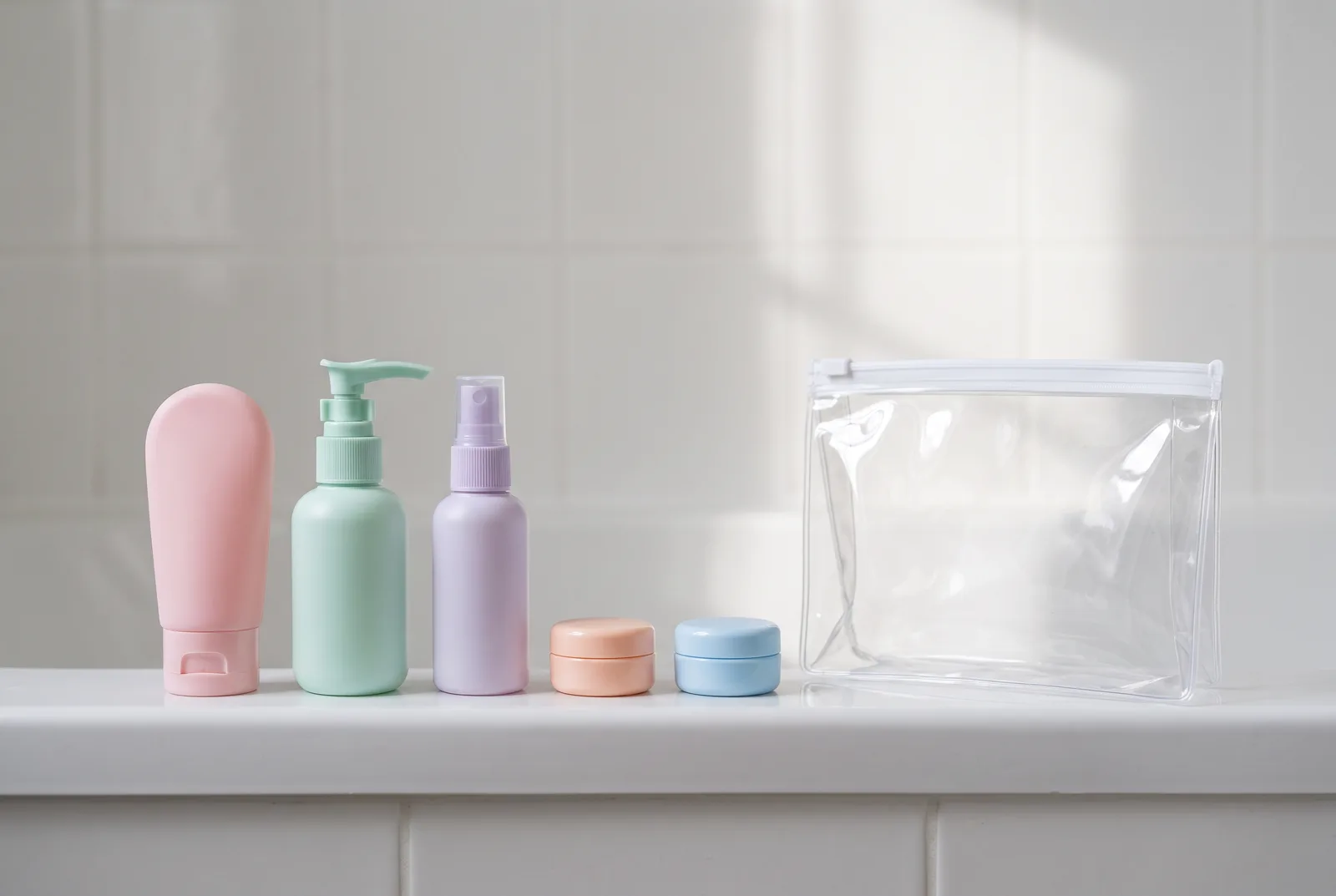
At the security checkpoint, take the bag out of your luggage and put it separately in the tray if the airport asks you to. A half-empty 150 ml bottle will be refused: only the capacity printed on the packaging counts. Aerosols should have their valve protected to prevent accidental spraying.
What counts as a liquid?
The rule covers liquids, gels, pastes, creams and aerosols. In practice, this includes:
- drinks, water, syrups, soups;
- shower gel, shampoo, conditioner, liquid soap;
- creams, lotions, oils, sunscreen;
- toothpaste, mouthwash;
- perfume, spray, gel or roll-on deodorant, hairspray, shaving foam;
- mascara, lip gloss, liquid foundation;
- liquid or pasty foods: jams, honey, sauces, spreads, yogurts, very creamy cheeses.
Solid products (bar soap, solid shampoo, stick deodorant, lipstick, powder makeup) are not affected: it is the easiest way to free up space in the bag.
Exceptions: medication and baby food
The TSA says medications and infant and child nourishments are exempt from the 3.4 oz limit. Your Europe says the volume limit applies neither to medicines nor to baby food. GOV.UK says containers of up to 2 liters are allowed through security at all UK airports if they are for essential medical purposes, special dietary requirements, or are baby food or baby milk.
- Liquid medicines (syrup, insulin, eye drops): keep the prescription in your name with the treatment, as staff may ask you to justify the quantity; bring the amount you need for the trip.
- Baby: milk, jars and water for bottles are allowed if they travel with the child; present them at the checkpoint, as they may be checked.
- Present these items separately rather than in the one-liter bag.
If you are traveling with medication, see also our guides to travel insurance and traveler vaccines.
Duty-free purchases
Liquids bought after the security checkpoint, in an airport shop or on board, are allowed in the cabin if they stay in the sealed security bag given at purchase, with the receipt visible. GOV.UK says the receipt should be sealed inside and visible, and the bag should not be opened until you reach your final destination, as staff may need to open it for screening. Your Europe adds that agents can open it to inspect it; on a connection, ask the staff to put your products in a new sealed bag. The TSA says duty-free liquids over 3.4 oz bought abroad can be carried on when connecting to a U.S.-bound flight only if the retailer sealed them in a transparent tamper-evident bag with no sign of tampering, you have the original receipt, and the purchase was made within 48 hours; items that alarm or cannot be screened are not allowed, and the TSA recommends checked baggage for these items even when sealed. If you go through security again on a connection, an opened bag or a missing receipt may lead to confiscation: shop as close as possible to the end of your journey.
New scanners: the end of the 100 ml limit?
Computed tomography (CT) scanners make it possible to inspect bags without taking liquids out. Where they are installed and used, the limit can be raised: the Swiss Federal Office of Civil Aviation (FOCA) says that at Zurich airport, since 26 June 2026, passengers may take containers of up to 2 liters in the cabin when this equipment is used. But this regime depends on each airport, and even on each security lane. GOV.UK also says some UK airports allow containers up to 2 liters, without naming them.
What this means for you: nothing by default. The TSA page read on 12 November 2026 still gives the 3.4 oz (100 ml) rule, and so do the other official pages read (GOV.UK, Your Europe). Pack your bag as usual, and only count on a higher limit if the official page of your departure airport announces it. On the way back, the departure airport of your return flight sets the rule.
In checked baggage: what remains prohibited
The 100 ml limit applies only to the cabin. In checked baggage you can pack your large bottles, subject to dangerous goods rules: flammable products and other hazardous items are restricted, so see our prohibited items guide. For alcoholic drinks and special products, check your airline’s baggage page. Pack bottles in a leakproof bag to protect your clothes. Our checked baggage guide details the rest.
Checklist before security
- Decant your products into travel bottles of 100 ml (3.4 oz) maximum, marked as such.
- Gather them in one transparent resealable bag (quart-size in the US, up to 1 liter in the UK); check that it closes without forcing.
- Put the bag on top of your carry-on so you can take it out quickly.
- Keep medications (with prescription) and baby food separate.
- Empty your water bottle before security and refill it in the departure area.
- Consider solid versions (soap, shampoo, deodorant) to save space.
Mistakes that lead to confiscation
- A bottle of more than 100 ml, even almost empty.
- A second bag of liquids, or an overfull bag that does not close.
- The jar of jam, honey or fresh cheese forgotten in the carry-on.
- The bottle of water bought before security.
- Duty-free perfume taken out of its sealed bag before a connection.
To size your bag properly, see our guides to carry-on suitcases and what to pack, and our guide to airport transit for connections.
Frequently asked questions
How much liquid can I take in my carry-on?
Containers of 100 ml (3.4 oz) maximum. In the US, in a quart-size bag; in the UK, in a transparent resealable bag of up to 1 liter (about 20 cm × 20 cm) where the airport asks for one.
Is a half-empty 150 ml bottle accepted?
No. It is the bottle’s capacity that counts, not the amount left.
Are liquid medications limited to 100 ml?
No, if they are needed for the trip: the TSA exempts medications, and GOV.UK allows up to 2 liters for essential medical purposes. Present them separately at security.
Can I take baby milk in the cabin?
Yes, in the quantity needed for the trip, if the baby travels with you; it may be checked.
Has the 100 ml rule been scrapped?
Not as a general rule. Some airports with CT scanners accept up to 2 liters (Zurich, according to FOCA; some UK airports, according to GOV.UK), but the TSA and Your Europe pages still give 100 ml.
Can I put liquids in checked baggage?
Yes, with no 100 ml limit, except flammable and dangerous products.
Do toothpaste and deodorant count as liquids?
Yes for toothpaste and for spray, gel or roll-on deodorants; no for solid stick deodorant.
Our sources
- TSA (U.S. Transportation Security Administration), Liquids, Aerosols and Gels Rule, checked 12 November 2026.
- GOV.UK, Hand luggage restrictions: liquids, checked 12 November 2026.
- Your Europe (European Commission), « Baggage restrictions » (last checked 16 June 2026), read on 27 October 2026.
- Swiss Federal Office of Civil Aviation (FOCA), « Liquids », read on 27 October 2026.
- Our methodology
Updated November 2026.