Cotonou is the economic capital and largest city of Benin, between the Atlantic Ocean and Lake Nokoué. Seat of the presidency and most ministries, it is known throughout West Africa for its Dantokpa market and its zemidjans, the motorbike taxis. Visiting Cotonou is above all about soaking up a lively city, seeing the Amazon Monument, the cathedral and the Fondation Zinsou, then heading out to the lake village of Ganvié, Ouidah and Porto-Novo. This guide covers things to do in Cotonou.
It brings together what to see, how to plan your visit, the best season based on official normals, official US and UK safety advice for Cotonou, and our own calculations (sunshine compared with Paris, rainy days over a week, time difference).

Our travel deals for Cotonou
Affiliate links: we earn a commission, at no extra cost to you.
 FlightsKiwi.comCompare flights and airline combinations to Cotonou.Compare flights
- Airport transferKiwitaxiPrivate driver booked in advance at a fixed price.Book a transfer
- eSIMAiraloData plan to install before you leave (eSIM-compatible phone).See plans



Cotonou at a glance
- Status economic capital of Benin (the official capital is Porto-Novo)
- Population 1,228,667 in 2021 (Wikipedia)
- Languages French (official), Fon and other national languages; currency: West African CFA franc (XOF)
- Time zone UTC+1 all year (no daylight saving time): 1 hour ahead of London in winter, same time in summer; 6 hours ahead of New York in winter, 5 in summer
- Entry US and UK citizens need a visa (apply online before travel) and a yellow fever vaccination certificate (travel.state.gov, GOV.UK)
- Straight-line distances Ganvié about 11 km (7 mi), Porto-Novo 24 km (15 mi), Ouidah 38 km (24 mi), Abomey 103 km (64 mi) (Destination de Voyage calculation)
- Best time November to February (dry season), with the harmattan wind in December-January
Safety: according to the UK FCDO (GOV.UK, updated 15 December 2025), street crime, including theft and mugging, is common in Cotonou, and pickpockets often operate in places visited by international travellers; be alert to the risk of carjacking and avoid driving after dark. The FCDO advises against all travel to some northern border areas (see below).
Things to do in Cotonou: the main sights
Dantokpa market
Tokpa, as it is known, is described as the largest open-air market in West Africa: some twenty hectares on the edge of the lagoon. It is the commercial heart of the city: Wikipedia describes it as the hub of informal trade in the sub-region, with around one billion CFA francs changing hands every day. Given the FCDO’s warning about pickpockets in places visited by foreigners, bring few valuables and ideally go with someone who knows the market.
The Amazon Monument
Unveiled on 30 July 2022 by President Patrice Talon, the statue pays tribute to the Amazons of Dahomey. Standing 30 metres (98 ft) tall, made of bronze-clad metal, it weighs 150 tonnes and rises on the Esplanade des Amazones. It depicts a young warrior armed with a rifle and a sabre.
Cathedral of Our Lady of Mercy
The city’s main Catholic church, near the Old Bridge, is recognisable by its burgundy-and-white striped facades. It is the mother church of the Archdiocese of Cotonou, created in 1955.
Fondation Zinsou and the art scene
Founded in Cotonou in 2005, the Fondation Zinsou is devoted to contemporary African art and cultural outreach. The city also has an arts biennial launched in 2009 by artists and associations, and many independent venues. Check current exhibitions and opening hours before you go.
The city and its bridges
Cotonou is built on a sand bar: the lagoon linking Lake Nokoué to the ocean cuts it in two, crossed by several bridges. The autonomous port, Place de l’Étoile Rouge, the commercial districts and the traffic jams of zemidjans are all part of the scene. Coastal erosion has pushed the shoreline east of the city back 400 metres (1,300 ft) in forty years, according to a UNEP project official quoted by Wikipedia.
Ganvié, the lake village
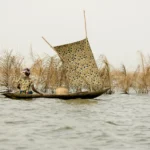
About 11 km (7 mi) north of Cotonou as the crow flies, Ganvié is a village on stilts on Lake Nokoué, in the municipality of Sô-Ava, often nicknamed the « Venice of Africa ». It is said to have been founded in the 16th-17th centuries by the Tofinu, who took refuge on the lake to escape Fon warriors capturing people for the slave trade. It can only be reached by boat: pirogues leave from the Abomey-Calavi landing stage. Agree on the price before setting off and ask before photographing residents.
Ouidah, Porto-Novo and Abomey
Ouidah, to the west, was in the 18th century one of the main places where enslaved people were sold and shipped in the Atlantic slave trade; the Slave Route links several sites tied to this history. A track, the « Route des Pêches », runs along the sea between Cotonou and Ouidah. Porto-Novo, the official capital, lies to the east. Abomey is further inland. For a complete tour of the country, see our Benin guide.
Itinerary: Cotonou in 2 or 3 days
| Day | Plan | Tip |
|---|---|---|
| 1 | Dantokpa in the morning, the cathedral, the Esplanade des Amazones, Fondation Zinsou | Closed bag, few valuables |
| 2 | Ganvié by pirogue from Abomey-Calavi | Leave early, bring a hat and water |
| 3 | Ouidah (Slave Route) or Porto-Novo | Avoid driving at night |
When to go to Cotonou
From November to February, during the dry season: 12 mm (0.5 in) of rain in December and 19 mm (0.7 in) in January, according to the WMO 1991-2020 normals for the Cotonou station. It is hot all year round (28.2 to 32.3 °C / 83 to 90 °F in the afternoon, 24.1 to 26.8 °C / 75 to 80 °F at night). Cotonou has two rainy seasons: the long one, from April to July, peaks in June (333 mm / 13.1 in), and the short one in September-October (165 mm / 6.5 in in October). August is a relative lull (39 mm / 1.5 in). In December-January the harmattan blows, a dry, dust-laden wind.
| Month | High °C (°F) | Low °C (°F) | Rain mm (in) | Rainy days | Sun / day | Difference with Paris | Verdict |
|---|---|---|---|---|---|---|---|
| January | 31.6 (89) | 24.4 (76) | 19 (0.7) | 2.0 | 6.1 h | +4.2 h | ✅ Dry, harmattan |
| February | 32.2 (90) | 26.0 (79) | 38 (1.5) | 3.0 | 6.7 h | +3.7 h | ✅ Dry, hot |
| March | 32.3 (90) | 26.8 (80) | 80 (3.1) | 6.0 | 6.9 h | +2.5 h | ⚠️ Very hot, first rains |
| April | 32.0 (90) | 26.3 (79) | 126 (5.0) | 9.0 | 7.0 h | +1.1 h | ⚠️ Rain increasing |
| May | 31.3 (88) | 25.4 (78) | 213 (8.4) | 14.0 | 6.3 h | −0.1 h | ❌ Long rainy season |
| June | 29.6 (85) | 24.5 (76) | 333 (13.1) | 18.0 | 4.6 h | −2.2 h | ❌ Wettest month |
| July | 28.5 (83) | 24.4 (76) | 135 (5.3) | 11.0 | 4.6 h | −2.6 h | ⚠️ Rain easing |
| August | 28.2 (83) | 24.1 (75) | 39 (1.5) | 9.0 | 4.9 h | −2.1 h | ✅ Relative lull |
| September | 29.0 (84) | 24.3 (76) | 135 (5.3) | 14.0 | 5.2 h | −0.7 h | ⚠️ Short rainy season |
| October | 30.1 (86) | 24.5 (76) | 165 (6.5) | 13.0 | 6.5 h | +2.7 h | ⚠️ Short rainy season |
| November | 31.6 (89) | 25.3 (78) | 44 (1.7) | 5.0 | 7.8 h | +5.4 h | ✅ Dry, very sunny |
| December | 31.9 (89) | 24.9 (77) | 12 (0.5) | 1.0 | 7.1 h | +5.2 h | ✅ Dry, harmattan |
These values match our page on when to go to Benin. In November, Cotonou gets 7.8 hours of sunshine a day against 2.3 in Paris-Montsouris; in June, the cloudiest month, 4.6 h. Destination de Voyage calculation: monthly sunshine ÷ days in the month (WMO normals for Cotonou; Météo-France for Paris, 1991-2020).
Rainy days over a week and daylight
Close to the equator, day length varies little: between 11 h 45 and 12 h 29 depending on the month, with sunset between 6:29 pm and 7:09 pm local time on the 15th of each month. Plan outdoor visits in the morning, before the heat, and don’t count on long summer evenings. Over a week, you can expect on average 0.5 days of rain in January against 4.2 in June.
| Month | Rainy days over 7 days | Sunrise (15th) | Sunset (15th) | Time difference vs London / New York |
|---|---|---|---|---|
| January | 0.5 | 07:05 | 18:53 | +1 h / +6 h |
| February | 0.8 | 07:06 | 19:02 | +1 h / +6 h |
| March | 1.4 | 06:56 | 19:01 | +1 h / +5 h |
| April | 2.1 | 06:42 | 18:58 | none / +5 h |
| May | 3.2 | 06:34 | 18:58 | none / +5 h |
| June | 4.2 | 06:36 | 19:05 | none / +5 h |
| July | 2.5 | 06:42 | 19:09 | none / +5 h |
| August | 2.0 | 06:44 | 19:04 | none / +5 h |
| September | 3.3 | 06:40 | 18:50 | none / +5 h |
| October | 2.9 | 06:36 | 18:35 | none / +5 h |
| November | 1.2 | 06:39 | 18:29 | +1 h / +6 h |
| December | 0.2 | 06:52 | 18:38 | +1 h / +6 h |
Getting there and getting around
- By air: Cotonou’s international airport serves the city. International connections are mostly via European, African or Middle Eastern hubs: check current schedules with the airport and airlines.
- Motorbike taxis (zemidjans): everywhere, but the U.S. Department of State (travel.state.gov, last updated June 4, 2026) warns that travelers using zemidjans, particularly at night, are much more vulnerable to being mugged, assaulted or robbed; U.S. Embassy staff are prohibited from using them. Prefer a car with a driver or a taxi.
- On the road: the UK FCDO advises keeping doors locked and windows closed, avoiding driving after dark and not stopping if people signal you to pull over. Buy fuel only at official service stations: smuggled roadside gasoline is of unreliable quality (U.S. Department of State).
- Ganvié: by boat only, from the Abomey-Calavi landing stage.
Airport transfer and car with driver
For a first arrival, especially at night, book a transfer through your accommodation or a reputable provider. For day trips (Ouidah, Porto-Novo, Abomey), a car with a driver is often simpler and safer than driving yourself; compare offers and check the insurance.
Where to stay
Choose accommodation in a residential area, with arranged transport for evening outings, and avoid walking around at night.
If you… then…: choosing your trip
| If you… | Then… |
|---|---|
| only have one day | Dantokpa in the morning, the Esplanade des Amazones, the cathedral, Fondation Zinsou |
| are interested in the history of the slave trade | Ouidah and the Slave Route |
| want to see life on the lake | Ganvié by pirogue, early in the morning |
| come in June | plan short visits between showers |
| are thinking of swimming | don’t, along this coast: the U.S. Department of State describes dangerous tides, waves and rip currents |
| are planning a tour | Cotonou, Ouidah, Abomey, then the north with a guide, after checking the FCDO’s areas to avoid |
Entry requirements, health and safety
US citizens: according to the U.S. Department of State (travel.state.gov, last updated June 4, 2026), you need a valid passport and a visa; visas are not available on arrival at the airport or at any land or sea border. Benin offers an eVisa to be applied for online between 7 and 90 days before travel. All visitors must be vaccinated against yellow fever and present the WHO yellow card on entry.
UK citizens: according to the UK FCDO (GOV.UK, updated 15 December 2025), you must have a visa: apply online at least 7 days before arrival, and you get the visa when you arrive at Cotonou airport. Your passport must be valid for the duration of your stay, and you must have a yellow fever vaccination certificate.
The two sources describe the visa process slightly differently (US: no visa on arrival; UK: online application, visa issued at Cotonou airport). If in doubt, check with the Embassy of Benin. Entry requirements checked on 26 October 2026; check them again before you travel.
- Areas to avoid: according to the UK FCDO (GOV.UK, updated 15 December 2025), the FCDO advises against all travel to the Parc du W National Park and the Mékrou and Djona hunting zones, the area between the Parc du W and the Niger border, the Pendjari National Park and adjacent hunting grounds, and all other areas within 5 km (3 mi) of the border with Burkina Faso; and against all but essential travel to the rest of the Alibori and Atacora departments and to the area between the RNIE 2 highway (Tchaourou to Malanville) and the Nigerian border.
- Unrest: the FCDO reports an attempted coup on 7 December: avoid demonstrations and large gatherings and follow the instructions of the local authorities.
- Health: risks include yellow fever, malaria and dengue (GOV.UK); the U.S. Department of State states that malaria prophylaxis is recommended for all travelers, even for short stays: see a doctor or travel clinic before you leave. Outside Cotonou, there may be no emergency response (GOV.UK).
- Swimming: swimming conditions along the coast are dangerous because of strong tides, waves and rip currents, and several people drown each year (travel.state.gov).
- Emergencies: fire and ambulance 118, police 117 (GOV.UK).
- See also our guides to travel documents and travel insurance.
Mobile data and money
The currency is the West African CFA franc (XOF). To stay connected, a local SIM card or an eSIM avoids roaming charges: check your phone’s compatibility and the advertised coverage (see our travel eSIM guide). Be wary of unsolicited requests for money.
Frequently asked questions
What is there to see in Cotonou?
Dantokpa market, the Amazon Monument, the Cathedral of Our Lady of Mercy, the Fondation Zinsou, then Ganvié by pirogue and Ouidah on a day trip.
Is Cotonou dangerous?
According to the UK FCDO, street crime, including theft and mugging, is common in Cotonou, and there is a risk of carjacking; avoid driving after dark. The U.S. Department of State warns that motorbike taxis are particularly risky at night.
What is the best time to visit Cotonou?
November to February, during the dry season (12 mm / 0.5 in in December). June is the wettest month (333 mm / 13.1 in), according to the WMO 1991-2020 normals.
Do you need a visa and vaccinations for Cotonou?
Yes: US and UK citizens need a visa, applied for online before travel, and a yellow fever vaccination certificate, according to the U.S. Department of State and the UK FCDO.
How do you get to Ganvié from Cotonou?
By road to the Abomey-Calavi landing stage, then by pirogue or motorboat across Lake Nokoué.
Our sources
- WMO 1991-2020 normals, Cotonou station (WMO 65344), NOAA/NCEI file downloaded on 24 October 2026; Météo-France, Paris-Montsouris climate sheet (1991-2020) for the comparison
- Wikipedia: « Cotonou », « Dantokpa Market », « Ganvié », « Fondation Zinsou », « Ouidah », « Porto-Novo », « Cathedral of Our Lady of Mercy, Cotonou », « Amazon Monument (Benin) », accessed 24 October 2026
- Destination de Voyage calculations: sun per day and difference with Paris, rain over 7 days, sunrise and sunset (NOAA algorithm), time difference (IANA database), straight-line distances
- Entry requirements, health and safety checked on 26 October 2026: U.S. Department of State, Benin country information (last updated June 4, 2026) and UK FCDO, GOV.UK foreign travel advice for Benin (updated 15 December 2025)
- Our methodology
Updated October 2026.
To extend your trip, see our Benin guide, the page on when to go to Benin, our Senegal page and our destinations in Africa.