For a trip to Senegal, allow 7 to 10 days for Dakar, Saint-Louis and the Sine-Saloum, two weeks to head down to Casamance, and roughly US$45–80 per person per day on a budget (excluding flights). This Senegal travel guide covers a country that combines a lively capital, historic towns such as Gorée and Saint-Louis, Atlantic beaches and mangrove-covered deltas. French is the official language and the country is used to welcoming travelers, which makes it a good gateway to West Africa. This guide brings together the essentials for planning your stay. For another French-speaking gateway to West Africa, our guide to traveling to Benin covers Ouidah, Ganvié and itineraries.
To locate cities, regions, terrain, national parks and airports, see our map of Senegal.
⚠️ Safety: some areas call for particular care. According to the UK FCDO (GOV.UK, updated 15 October 2026), take particular care in remote areas near the borders with Mauritania and Mali, where terrorist groups active in Mali have carried out deadly attacks close to the Senegalese border. Casamance has suffered decades of low-intensity separatist violence: be alert for clashes near the Gambian and Guinea-Bissau borders, although the risk is lower in the main tourist areas. The U.S. Department of State (travel.state.gov, last updated December 4, 2025) reports sporadic armed banditry and landmines in remote areas of Casamance off the main roads. Check the latest advice before you leave. Dakar, Saint-Louis, the Petite-Côte and the Sine-Saloum are not covered by these regional warnings.
Senegal at a glance
CapitalDakar
LanguageFrench (official language)Wolof is the most widely spoken language day to day
Currencythe CFA franc (XOF), fixed to the euro · currencies
Time zoneUTC+0 (GMT) all year · detailsSame time as London in winter, 1 h behind in summer; 4 to 5 h ahead of New York
AirportsDakar Blaise Diagne (DSS) · detailsCheck current routes with the airlines
EntryUS: visa-free up to 90 days; UK: visa-free up to 3 months · travel.state.gov · GOV.UK
Electricitycheck voltage and plug types before you go · plugs
The best period is November to May, during the dry season: there is almost no rain and the coast stays mild, around 25 to 30 °C (77 to 86 °F) in the afternoon in Dakar. For a tour that includes the interior or eastern Senegal, aim for December to February, as the east exceeds 40 °C (104 °F) in April and May. The rainy season (hivernage) runs from July to October, peaking in August, especially in Casamance. All the details, region by region and with official climate data, are in our article best time to visit Senegal.
Where to go in Senegal: the highlights
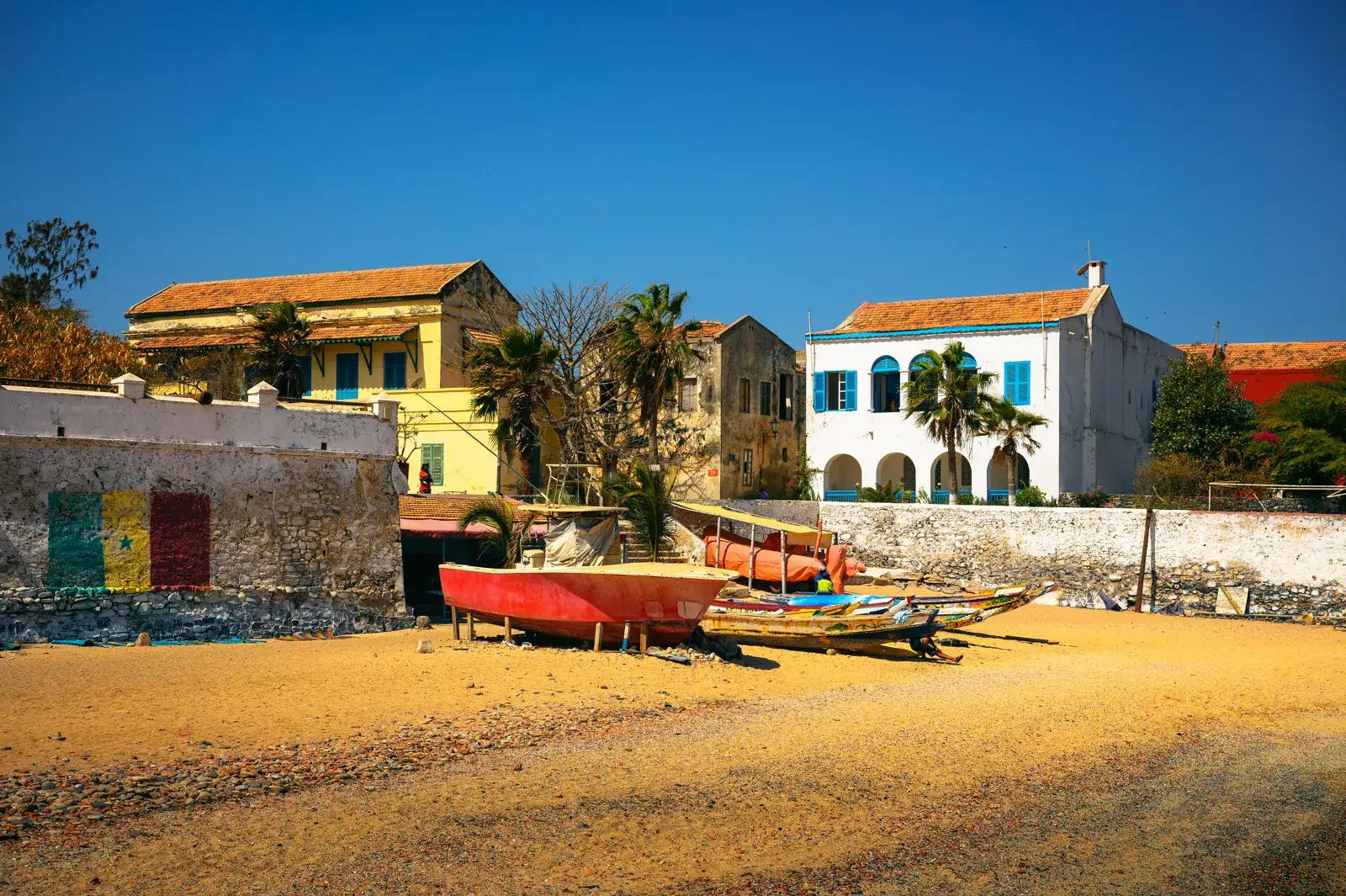
Historic houses on Gorée Island, off Dakar
Dakar and Gorée Island
The capital occupies the Cap-Vert peninsula, the westernmost point of mainland Africa. Allow two or three days for the Museum of Black Civilizations, Kermel market, the beaches and fish restaurants of Ngor and Les Almadies, and the African Renaissance Monument. Some twenty minutes away by ferry, Gorée Island, a UNESCO World Heritage Site, is a place of remembrance of the slave trade, with its House of Slaves and car-free lanes. Ngor Island, just off the coast, is reached by pirogue. The U.S. Department of State reports that robberies occur regularly along the Corniche d’Ouest, an area popular with tourists.
Lac Rose and the Lompoul Desert
About forty kilometers (25 mi) northeast of Dakar, Lake Retba, known as Lac Rose (the Pink Lake), is famous for the pinkish tint given by a micro-alga, more or less visible depending on light and season, and for the salt harvesters who work there. Further north, on the road to Saint-Louis, the Lompoul Desert is a small area of orange dunes where you can sleep in a tent. Avoid walking alone in isolated places after dark.
Northeast of Dakar, our guide to visiting Lac Rose explains its color and the best time of day to see it.
Saint-Louis and the Langue de Barbarie
The former capital of French West Africa, the UNESCO-listed island of Saint-Louis is explored on foot or by horse-drawn carriage: colonial houses with balconies, the Faidherbe Bridge, and the Guet Ndar fishing quarter with its hundreds of painted pirogues. South of the town, Langue de Barbarie National Park protects a narrow strip of sand between the river and the ocean, visited by many birds. Allow about four to five hours’ drive from Dakar.
Djoudj National Bird Sanctuary
About sixty kilometers (37 mi) north of Saint-Louis, in the Senegal River delta, this UNESCO World Heritage park is one of the major wintering grounds for migratory birds from Europe. White pelicans, flamingos and many waterbird species are seen by pirogue, ideally between November and March. The trip is usually a day excursion from Saint-Louis.
The Petite-Côte: Saly, Somone, Popenguine, Joal-Fadiouth
South of Dakar, this stretch of coast has most of the beach resorts. Saly is the best equipped; the Somone lagoon and Popenguine reserve are quieter. At Joal-Fadiouth, a wooden footbridge leads to Fadiouth, an island made of shells with a shared Christian and Muslim cemetery and granaries on stilts. The Bandia reserve, between Dakar and Mbour, has reintroduced giraffes, rhinos and antelopes. After the Petite-Côte and Bandia, our guide to traveling to Dakar helps you plan a few days in the capital.
The Sine-Saloum Delta
A UNESCO World Heritage Site, the Saloum Delta is a maze of bolongs (creeks), mangroves and islands with fishing villages. You get around by pirogue from Ndangane, Palmarin, Toubacouta or Djiffer: the islands of Mar Lodj, shell middens, birdwatching at sunset. There are many campements (simple lodges) and eco-lodges. The Fathala reserve, near the Gambian border, rounds off the visit.
Casamance: Ziguinchor and Cap Skirring
The greenest region of the country, between The Gambia and Guinea-Bissau, is known for its rice paddies, forests, impluvium houses and Diola culture. Ziguinchor is the gateway; Cap Skirring, on the Atlantic, has long sandy beaches. You get there by plane, by the overnight ferry from Dakar or by road. When driving in Casamance, the UK FCDO advises avoiding night travel, sticking to main roads, traveling in convoy if possible and not pulling over if someone tries to flag you down.
Eastern Senegal: Niokolo-Koba and Bassari Country
Niokolo-Koba National Park, a World Heritage Site, is the country’s largest park: savanna, gallery forest along the Gambia River, antelopes, hippos and monkeys, harder to spot than in East African parks. Further southeast, around Kédougou, Bassari Country, also UNESCO-listed, is explored on foot from village to village. It is a remote region (a full day’s drive from Dakar): go between December and February, with a guide, and bear in mind the UK FCDO’s advice to take particular care in remote areas near the Mali border.
Things to do in Senegal: 8 experiences
Cross to Gorée Island from Dakar
Visit the Museum of Black Civilizations and have a fish dinner in Ngor or Les Almadies
See Lac Rose then head to the Lompoul dunes
Explore Saint-Louis on foot or by carriage, as far as the Guet Ndar fishing quarter
Watch migratory birds in Djoudj park
Take a pirogue through the bolongs of the Sine-Saloum
Walk on the shell island of Fadiouth
Discover Diola culture in Casamance, between Ziguinchor and Cap Skirring
Itinerary ideas for Senegal
7 to 10 days: Dakar, Saint-Louis and the Saloum
Days 1 to 3: Dakar, Gorée Island, Ngor
Day 4: Lac Rose, then on to Lompoul for a night in the dunes
Days 5 and 6: Saint-Louis, with a trip to Djoudj (November to March) or the Langue de Barbarie
Days 7 to 10: back south via the Bandia reserve, then the Sine-Saloum Delta (pirogue, campement) and a day or two on the Petite-Côte before your flight home
2 weeks: from the river to Casamance
Days 1 to 3: Dakar and Gorée
Days 4 to 6: Lac Rose, Lompoul and Saint-Louis
Days 7 to 9: Sine-Saloum Delta and Joal-Fadiouth
Days 10 to 14: fly or take the ferry to Ziguinchor, then Lower Casamance and the beaches of Cap Skirring, staying in the main tourist areas and on main roads
December to February variant: replace Casamance with Niokolo-Koba and Bassari Country, with a guide
Who is Senegal for?
Here are our verdicts by profile, based on the stops, budget and conditions presented in this guide to Senegal.
Profile
Our verdict
First trip to Africa
✅ A country used to welcoming travelers, visa-free for US and UK citizens for short stays.
Culture and history
✅ Gorée Island, Saint-Louis, the Museum of Black Civilizations, Diola culture in Casamance.
Nature
✅ Djoudj birds from November to March, pirogue trips in the Sine-Saloum, the Bandia and Fathala reserves.
Beach
✅ The Petite-Côte (Saly, Somone, Popenguine) and Cap Skirring.
Families
✅ The Bandia reserve, well-equipped resorts in Saly; choose guarded accommodation.
Budget travelers
⚠️ Not especially cheap: roughly US$45–80 per day, with a car and driver the biggest cost.
Budget for a trip to Senegal
Senegal is not a particularly cheap destination for travelers: good-quality accommodation and car hire with a driver weigh heavily on the budget, while local food remains affordable. Indicative amounts per person per day, excluding international flights (converted from our euro estimates at the ECB rate of 23 October 2026, €1 = US$1.12):
Item
Budget
Comfort
Accommodation (based on a shared double room)
roughly US$17–40 (hostel, simple campement)
roughly US$65–170
Meals
roughly US$9–17 (street eateries, local dishes)
roughly US$30–55
Transport
roughly US$6–17 (sept-place taxis, buses)
roughly US$30–65 (shared car with driver)
Activities and sightseeing
roughly US$6–17
roughly US$20–55
Total per day
roughly US$45–80
roughly US$135–280
Indicative estimates, varying by season and region. Prices are higher in Dakar, on the Petite-Côte and in Cap Skirring, and over the year-end holidays.
A pirogue trip in the Saloum, an outing to Djoudj or a guided reserve visit are often negotiated locally or through your accommodation. Always ask for the total price, transport included, before setting off.
Getting around Senegal
Car with driver: the most practical option for a tour. The UK FCDO (GOV.UK, updated 15 October 2026) notes that driving standards are poor, speeding is common and driving after dark is more dangerous because of unlit roads and vehicles without lights.
Sept-place taxis and minibuses: shared transport between towns, leaving from bus stations. Cheap but often uncomfortable. The U.S. Department of State advises US citizens to avoid motorbikes, van taxis (cars rapides) and public transport.
Train and bus in Dakar: the TER links central Dakar with its suburbs and Diamniadio, and bus rapid transit (BRT) lines serve the capital.
Taxis: regulated taxis are safer; agree the fare before the trip. Ride-hailing apps such as Heetch are available, with the fixed fare paid in cash (U.S. Department of State).
Plane: there are few domestic flights; Ziguinchor and Cap Skirring are the main domestic destinations.
Boat: ferry to Gorée, pirogues in the Saloum and to Ngor, overnight ferry between Dakar and Ziguinchor (check schedules locally).
Driving yourself: traffic drives on the right (U.S. Department of State). UK drivers can use their UK licence for up to 6 months; a 1968 International Driving Permit can help as a translation (UK FCDO). Carry your licence, insurance, registration and ID. After an accident, call the police on 17 and do not move the car until they arrive.
Blaise Diagne International Airport is in Diass, about 45 km (28 mi) from central Dakar: allow time for the transfer, and arrive in daylight if you are going straight on to the Petite-Côte or Saint-Louis. The UK FCDO warns of bogus taxi drivers at the airport: pre-arrange transport with your accommodation or an authorized operator.
Where to stay in Senegal
In Dakar, the Plateau is convenient for the center and the Gorée ferry, Ngor and Les Almadies for the sea and restaurants, Mermoz and Ouakam for quieter residential areas. Spending a night on Gorée Island, once the day visitors have left, is also possible. In Saint-Louis, stay on the island itself, where you can do everything on foot.
On the Petite-Côte, Saly has the large hotels, while Somone, Ngaparou and Popenguine are quieter. In the Sine-Saloum and Casamance, accommodation is mostly campements and eco-lodges, some only reachable by pirogue. The UK FCDO reports that hotels used by foreigners in Dakar have been robbed at gunpoint: choose guarded accommodation and use the hotel safe. In high season, book ahead.
Mistakes to avoid in Senegal
Touring in the middle of the rainy season: in August, sticky heat and difficult tracks, especially in Casamance.
Neglecting malaria prevention: malaria is present according to the U.S. Department of State; see your doctor.
Ignoring regional advice: take particular care near the Mali and Mauritania borders and in the border areas of Casamance (UK FCDO).
Booking late for the holidays: late December is the most expensive period.
Entry requirements for Senegal
US citizens
According to the U.S. Department of State (travel.state.gov, last updated December 4, 2025), US citizens do not need a visa for stays of up to 90 days. You need a passport with at least six months’ validity and an International Certificate of Vaccination (yellow card) showing yellow fever vaccination.
UK citizens
According to the UK FCDO (GOV.UK foreign travel advice, updated 15 October 2026), you can visit without a visa for up to 3 months, but you must show evidence of return or onward travel and proof of arranged accommodation, or you may be refused entry. Your passport must be valid for at least 6 months after arrival. A yellow fever certificate is required if you arrive from, or have transited through the airport of, a country with a risk of transmission.
The two sources differ on yellow fever: the U.S. Department of State lists the yellow card among entry requirements for all, while the UK FCDO requires it only for arrivals from risk countries. In case of doubt, check with the Embassy of Senegal. Entry requirements checked on 24 October 2026.
Health and safety
Health: the U.S. Department of State lists malaria, typhoid, yellow fever, Zika, meningococcal meningitis, rabies and dengue among diseases present; the UK FCDO (GOV.UK, updated 15 October 2026) advises checking vaccine recommendations at least 8 weeks before travel. See a doctor or travel clinic about malaria prevention and protect yourself from mosquitoes. Tap water is not drinkable (U.S. Department of State).
Medical care: facilities in Dakar are reasonable but limited elsewhere (UK FCDO). Insurance covering medical treatment and repatriation is essential.
Safety: robbery, burglary and assault have become more common in Dakar, sometimes with weapons, and pickpocketing and bag-snatching are increasing (UK FCDO). Avoid carrying large sums or valuables, be careful after nightfall and keep a copy of your passport and entry stamp separately. Demonstrations can turn violent and sometimes block the airport road.
Sea: rip currents can occur anywhere on the coast; do not swim alone, especially on isolated beaches (U.S. Department of State).
Laws: drug penalties are severe, with up to 20 years for trafficking. Same-sex sexual acts are illegal and the law is enforced; on 30 March 2026, Senegal raised prison sentences for same-sex relations to 5 to 10 years (UK FCDO). LGBT+ travelers should bear this in mind.
Emergencies: police 17, ambulance 15, fire 18; 123 for the gendarmerie in the countryside (UK FCDO).
Practical tips for Senegal
Money: Senegal’s economy runs mainly on cash and credit cards are not widely accepted (U.S. Department of State). Dakar has ATMs that accept foreign cards, but there are few elsewhere, withdrawal limits can be low and ATMs regularly run out of money; upmarket establishments usually take foreign cards, and mobile payment apps such as Orange Money and Wave are widely used (UK FCDO). Use ATMs or reputable exchange bureaus to avoid fake notes. Our currency converter helps you estimate your spending.
Internet: a local SIM card or an eSIM is handy for maps and transport apps.
Teranga: hospitality is a central value. Take time for greetings before asking anything: it is the basis of politeness.
Dress and religion: Senegal is a predominantly Muslim country: dress and behave modestly in public, especially during Ramadan or in religious areas; western holiday clothing is more accepted in the main tourist areas (UK FCDO).
ID: the law requires everyone to carry valid ID; the authorities do not accept a certified copy of a passport (U.S. Department of State).
Photos: always ask people’s permission before photographing them, and avoid official buildings.
Bargaining: customary in markets and with taxis, always in good humor.
Food: try thieboudienne (fish and rice, the national dish), yassa (chicken or fish marinated with onions and lemon), mafé (peanut sauce) and bissap and bouye (baobab fruit) juices. Drink bottled water and wash your hands often.
No, not for a short stay: US citizens can stay up to 90 days without a visa (travel.state.gov, last updated December 4, 2025), and British citizens up to 3 months, with proof of onward travel and accommodation (GOV.UK, updated 15 October 2026). Your passport must be valid for 6 months. Checked on 24 October 2026.
Is Senegal safe for tourists?
The main tourist areas (Dakar, Saint-Louis, the Petite-Côte, the Sine-Saloum, Cap Skirring) can be visited with the usual precautions against theft, which is increasing in Dakar. The UK FCDO advises particular care near the Mali and Mauritania borders and alertness in the border areas of Casamance.
Which vaccines do I need for Senegal?
The U.S. Department of State lists a yellow fever card among entry requirements; the UK FCDO requires it if you arrive from a country at risk. Malaria prevention is advisable: see your doctor or a travel clinic at least 8 weeks before departure.
How much does a week in Senegal cost?
Excluding international flights, allow roughly US$45–80 per person per day on a budget, and US$135–280 in comfort, with a car and driver. The year-end holidays and beach resorts push the bill up.
What is the best time to visit Senegal?
November to May, during the dry season. December to February is ideal for combining the coast and the interior. The rainy season, from July to October, brings humid heat and storms, especially in Casamance.
What should I see on a first trip to Senegal?
Dakar and Gorée Island, Lac Rose, Saint-Louis and Djoudj park, then the Sine-Saloum Delta. With two weeks, add Casamance (Ziguinchor, Cap Skirring).
How many days do you need in Senegal?
Seven to ten days are enough for Dakar, Saint-Louis and the Sine-Saloum. Allow two weeks to head down to Casamance.
Our sources
Entry, health and safety information read on 24 October 2026: U.S. Department of State, Senegal country information (travel.state.gov, last updated December 4, 2025), and UK FCDO, foreign travel advice for Senegal (GOV.UK, updated 15 October 2026)
Agence nationale de l’aviation civile et de la météorologie du Sénégal (ANACIM), 1991–2020 climate normals (via the World Meteorological Organization, NOAA archive)
UNESCO World Heritage List: sites in Senegal (Gorée Island, Island of Saint-Louis, Djoudj, Niokolo-Koba, Saloum Delta, Bassari Country)
European Central Bank, euro reference exchange rates of 23 October 2026 (budget conversion)
Discover our other destinations in Africa, such as neighboring Cape Verde.
Transparency: this page contains affiliate links, labelled as such. If you book through them we may earn a commission at no extra cost to you; it does not influence our content or recommendations. How we fund the site.