Looking for things to do in Nairobi? Go on a first safari in Nairobi National Park, right on the edge of the city, get close to the giraffes at the Giraffe Centre and the orphaned baby elephants of the Sheldrick Wildlife Trust, visit the Karen Blixen house and the National Museum, then browse the Maasai Market. Nairobi is above all the gateway to safaris in Kenya: allow 1 to 2 days there, before or after the bush. The best times are June to September and January to February, during the dry seasons. The electronic travel authorization (eTA) required before boarding is explained in our Kenya visa page.
The capital of Kenya, at about 1,600 m (5,250 ft), Nairobi has a mild climate all year, far from the image of a stifling equatorial city. It is also a large metropolis where safety needs attention: this guide sets out the official UK and US travel advice for the city, along with the highlights, the month-by-month climate and a decision tree for fitting Nairobi into your safari itinerary.

Our travel deals for Nairobi
Affiliate links: we earn a commission, at no extra cost to you.
 FlightsKiwi.comCompare flights and airline combinations to Nairobi.Compare flights
- eSIMAiraloData plan to install before you leave (eSIM-compatible phone).See plans


Nairobi at a glance
- Country Kenya (capital), at about 1,600 m (5,250 ft)
- Language Swahili and English
- Currency Kenyan shilling (KES) · currencies
- Time zone UTC+3, no daylight saving · details3 h ahead of London and 8 h ahead of New York in winterLocal time now: –:–
- Airports Nairobi Jomo Kenyatta International (NBO); Wilson Airport for domestic flightsCheck current routes with the airlines
- Entry US and UK: electronic travel authorization (eTA) before departure, plus mandatory Kenyan travel health insurance · travel.state.gov · GOV.UK
- Health yellow fever certificate if arriving from a country with transmission risk · details
- Electricity 240 V, type G (British) plugs: UK plugs fit, US travelers need an adapter · plugsCIA World Factbook, Kenya travel facts
- Ideal length 1 to 2 days, before or after a safari
- Budget see our budget section
Things to do in Nairobi: the highlights
Nairobi National Park
It is one of the few national parks in the world on the doorstep of a capital city: giraffes, zebras, buffalo, lions and black rhinos roam the savanna with skyscrapers in the background. A half-day game drive (preferably early in the morning) is enough for a first encounter. Entry is paid electronically to the Kenya Wildlife Service.
The Sheldrick Wildlife Trust elephant orphanage
On the edge of the park, this organization takes in orphaned baby elephants, often victims of poaching, before releasing them back into the wild. A short daily visit lets you watch the young elephants being fed; the time slot is limited and booking is advised.
The Giraffe Centre
In the Langata district, the Giraffe Centre protects the Rothschild giraffe. From a raised platform you feed the giraffes at head height. A small adjoining forest reserve can be explored on foot.
The Karen Blixen house
In the district that bears her name, the farm of the author of Out of Africa has become a museum: a colonial house, period furniture and a garden at the foot of the Ngong Hills. The visit is guided and lasts about an hour.
The National Museum and downtown
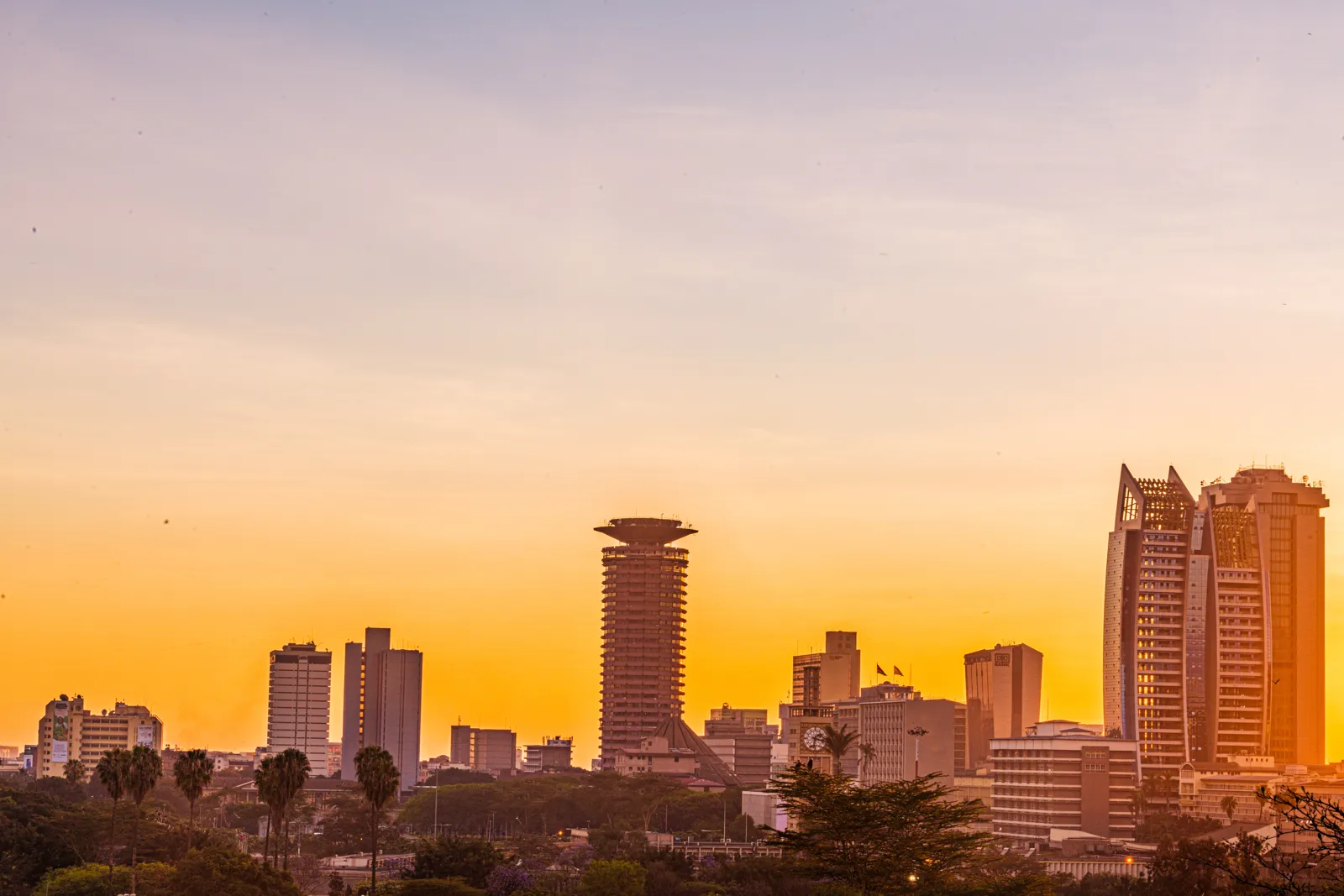
The Nairobi National Museum covers the prehistory of East Africa, the cultures of the country and a bird gallery, surrounded by a botanical garden. Downtown, the Jamia Mosque with its silver domes, the City Market and the roof of the Kenyatta International Convention Centre (KICC), with a view over the whole city, are best seen with a guide or by ride-hailing car: the UK FCDO lists the Central Business District among the higher-risk areas for crime.
The Maasai Market and Bomas of Kenya
The Maasai Market is held in a different place in the city each day: beaded jewelry, fabrics, carvings, baskets; bargaining is expected. Bomas of Kenya, in Langata, presents reconstructions of traditional homesteads and dance performances by the country’s different peoples.
Karura Forest
North of the city, this protected urban forest is crisscrossed with marked trails for walking, cycling or running, with a waterfall and caves. It is one of the few walks in Nairobi we can recommend, in daylight.
Itinerary: Nairobi in 1 or 2 days
- Day 1, morning: a game drive in Nairobi National Park at sunrise
- Day 1, late morning: the Sheldrick Wildlife Trust elephant orphanage (booked time slot)
- Day 1, afternoon: the Giraffe Centre, then the Karen Blixen house
- Day 2: the National Museum, the Maasai Market, the view from the KICC; or Karura Forest; back at the hotel before dark
Nairobi in your safari: a decision tree
- Your flight lands in the evening? → stay in Nairobi, in Karen or near the airport; for the airport transfer, the UK FCDO recommends using the Mombasa Road or the Nairobi Expressway, as the risk of carjacking is higher on the old airport road (Airport South Road) and Jogoo Road.
- You have half a day on arrival? → the Giraffe Centre and the elephant orphanage, both southwest of the city, on the way to the parks.
- You are heading straight to the Maasai Mara? → leave early in the morning (by road or by light aircraft from Wilson Airport); visit Nairobi on the way back instead.
- Your return flight leaves late in the evening? → that is the best time for Nairobi National Park or the Karen Blixen house, followed by a direct transfer to the airport.
- Torn between Kenya and Tanzania? → see our Kenya or Tanzania comparison and our guide to safaris in Africa.
Nairobi, a high-altitude equatorial city: light and temperatures in figures
At 1° south of the equator, Nairobi has almost identical days all year, while the altitude cools the nights. We calculated the length of the day, the sunset time and the gap between day and night temperatures, month by month.
| Month | Daylight in Nairobi | Sunset | Day/night range °C (°F) |
|---|---|---|---|
| January | 12 h 11 min | 6:47 pm | 12.8 (23 °F) |
| February | 12 h 09 min | 6:51 pm | 13.3 (24 °F) |
| March | 12 h 07 min | 6:45 pm | 12.9 (23 °F) |
| April | 12 h 05 min | 6:35 pm | 10.8 (19 °F) |
| May | 12 h 04 min | 6:30 pm | 10.1 (18 °F) |
| June | 12 h 03 min | 6:34 pm | 10.6 (19 °F) |
| July | 12 h 03 min | 6:40 pm | 11.7 (21 °F) |
| August | 12 h 04 min | 6:39 pm | 11.6 (21 °F) |
| September | 12 h 06 min | 6:31 pm | 13.4 (24 °F) |
| October | 12 h 08 min | 6:22 pm | 12.6 (23 °F) |
| November | 12 h 10 min | 6:22 pm | 9.9 (18 °F) |
| December | 12 h 12 min | 6:33 pm | 11 (20 °F) |
- The sun sets between 6:22 pm and 6:51 pm all year: plan to be back by nightfall, as the safety advice on traveling after dark applies early.
- The day lasts about 12 hours in every season, from 12 h 03 min to 12 h 12 min.
- Nights are cool: an average low of 11.9 °C (53 °F) in July, with a day/night range of more than 10 °C (18 °F). Bring a fleece for dawn game drives.
When to go to Nairobi
The best times are the two dry seasons: June to September, the coolest (a high of 23.6 °C / 75 °F in July) and driest (11 mm / 0.4 in in July), which coincides with the Great Migration in the Maasai Mara; and January to February, warmer and sunnier. The « long rains » fall from March to May (April: 130 mm / 5.1 in) and the « short rains » in November-December (November: 131 mm / 5.2 in, 14 rainy days). Showers are often concentrated late in the day.
| Month | High °C (°F) | Low °C (°F) | Rain mm (in) | Rainy days | Per 7 days | Sunshine (h) | Crowds | Prices | Verdict |
|---|---|---|---|---|---|---|---|---|---|
| January | 26.9 (80 °F) | 14.1 (57 °F) | 58 (2.3 in) | 4.4 | 1.0 | 282 | High | High | ✅ Dry and sunny |
| February | 27.4 (81 °F) | 14.1 (57 °F) | 36 (1.4 in) | 3.5 | 0.9 | 266 | Medium | Medium | ✅ Dry, the warmest |
| March | 28 (82 °F) | 15.1 (59 °F) | 75 (3.0 in) | 7.1 | 1.6 | 264 | Medium | Medium | ⚠️ Start of the long rains |
| April | 26.2 (79 °F) | 15.4 (60 °F) | 130 (5.1 in) | 10.7 | 2.5 | 204 | Low | Low | ❌ Long rains |
| May | 24.9 (77 °F) | 14.8 (59 °F) | 109 (4.3 in) | 8.9 | 2.0 | 180 | Low | Low | ⚠️ Rains |
| June | 23.7 (75 °F) | 13.1 (56 °F) | 29 (1.1 in) | 3.6 | 0.8 | 159 | Medium | Medium | ✅ Cool dry season |
| July | 23.6 (74 °F) | 11.9 (53 °F) | 11 (0.4 in) | 1.8 | 0.4 | 124 | Very high | High | ✅ Dry, cool, migration |
| August | 24.1 (75 °F) | 12.5 (54 °F) | 18 (0.7 in) | 2.2 | 0.5 | 124 | Very high | High | ✅ Dry, migration |
| September | 26.3 (79 °F) | 12.9 (55 °F) | 17 (0.7 in) | 2.3 | 0.5 | 168 | High | High | ✅ Dry |
| October | 26.9 (80 °F) | 14.3 (58 °F) | 50 (2.0 in) | 6.4 | 1.4 | 214 | Medium | Medium | ⚠️ Rains return |
| November | 25.3 (78 °F) | 15.4 (60 °F) | 131 (5.2 in) | 13.8 | 3.2 | 204 | Low | Low | ❌ Short rains |
| December | 25.8 (78 °F) | 14.8 (59 °F) | 85 (3.3 in) | 7.3 | 1.6 | 254 | High | High | ⚠️ Easing rains, holidays |
For the parks (Maasai Mara, Amboseli, the coast), see best time to visit Kenya.
Budget for visiting Nairobi
| Item (per person per day) | Tight budget | Comfort |
|---|---|---|
| Accommodation (based on a shared double room) | about US$20 to 45 (guesthouse, simple hotel) | about US$90 to 225 (hotel or lodge in Karen) |
| Meals | about US$10 to 25 | about US$35 to 65 |
| Transportation | about US$10 to 20 (ride-hailing) | about US$35 to 55 (driver for the day) |
| Sightseeing | about US$15 to 30 | about US$65 to 110 (game drive in the national park) |
| Total | roughly US$55 to 90 | roughly US$170 to 340 |
Getting around Nairobi
- From Jomo Kenyatta Airport: about fifteen kilometers (9 mi) from the center; official taxis, ride-hailing or a transfer arranged by your hotel. Traffic can be very heavy. The UK FCDO advises using the Mombasa Road or the Nairobi Expressway.
- In the city: use ride-hailing cars and booked taxis. The U.S. Department of State reports that matatus (minibuses) tend to be targeted by criminals and cause many accidents, and that U.S. government personnel are prohibited from using them; it also reports robberies of people using off-the-street taxis.
- On foot: in daylight only and in busy areas; the UK FCDO advises against walking alone in isolated areas, even in daylight.
- To the parks: a 4×4 with a driver-guide, or domestic flights from Wilson Airport to the Maasai Mara and other reserves.
Where to stay in Nairobi
| District | Best for | Strengths |
|---|---|---|
| Karen and Langata | Before or after a safari | Green, close to the Giraffe Centre, the orphanage and the park |
| Westlands | City life, restaurants | Hotels, malls, nightlife |
| Near the airport | Short stopover | Convenient for an early or late flight |
| Kilimani and Lavington | Longer stays | Residential, quieter |
Entry requirements, health and safety
- US citizens: according to the U.S. Department of State (travel.state.gov, last updated July 30, 2026), all visitors need an electronic travel authorization before entering Kenya, and a passport with at least two blank pages and six months’ validity. Carry proof of yellow fever vaccination if arriving from an endemic country, or you may be denied entry.
- UK citizens: according to the UK FCDO (GOV.UK, updated 16 October 2026), you must apply online for an electronic travel authorization before you travel, ideally at least 2 weeks ahead; your passport must be valid for at least 6 months after arrival with 2 blank pages. Since 5 October 2026, most visitors staying less than 12 months must also buy Kenyan government travel health insurance, as part of the eTA application (valid 90 days); foreign travel insurance does not replace it. A yellow fever certificate is required if you come from a country with a transmission risk.
- Health: the UK FCDO reports confirmed Ebola cases in Kenya, with enhanced screening for travelers arriving from Uganda, Ethiopia and the DRC, and lists malaria and dengue among the health risks; check TravelHealthPro (UK) or the CDC (US) at least 8 weeks before your trip. The U.S. Department of State says medical services are adequate in Nairobi for most conditions. See our guide to travel vaccines.
- Safety in Nairobi: the UK FCDO reports frequent violent crime (mugging, armed robbery, carjacking), particularly in large cities, and higher risks in Eastleigh, the Central Business District, Mathare, Kibera and slum areas; protests are common in Nairobi and can turn violent. It also warns of a terrorist threat, citing the 2019 attack on the 14 Riverside hotel and commercial complex in Nairobi, and a high threat of kidnapping of westerners across Kenya. The U.S. Department of State notes that violent street crime against Westerners occurs even in seemingly safe areas of Nairobi, including in daylight.
- Elsewhere in Kenya: the UK FCDO advises against all travel to areas near the Somali border (including Mandera County and Lamu County except Lamu and Manda islands) and against all but essential travel to Garissa Town and parts of Tana River County (GOV.UK, updated 16 October 2026).
- Emergencies: 999 (UK FCDO); the U.S. Department of State also gives 112 and 911.
- Insurance: essential, including repatriation, on top of the mandatory Kenyan cover. See our travel insurance guide.
Practical tips for Nairobi
- Money: Kenyan shilling; mobile payment is very widespread and cards are accepted in hotels and malls. Keep small notes for tips.
- Internet: good coverage in the city; a local SIM card or an eSIM, see our eSIM guide.
- Photos: always ask permission before photographing people.
- Food: nyama choma (grilled meat), ugali (maize porridge), sukuma wiki (greens), chapati.
- Time: see our page on the time difference in Kenya.
Frequently asked questions
How many days do you need to visit Nairobi?
One to two days are enough: the national park, the elephant orphanage, the Giraffe Centre, the Karen Blixen house and the National Museum.
Is Nairobi dangerous?
The UK FCDO reports frequent violent crime in large cities and higher risks in Eastleigh, the Central Business District, Mathare and Kibera; the U.S. Department of State notes attacks even in daylight. Get around by ride-hailing car or booked taxi, avoid walking alone in isolated areas and never walk after dark.
What is the best time to visit Nairobi?
June to September and January-February, during the dry seasons. April and November are the wettest months according to the 1991-2020 normals.
Do I need a visa for Kenya?
US and UK citizens need an electronic travel authorization (eTA) before departure and, since 5 October 2026, Kenyan government travel health insurance bought with the application (UK FCDO).
Which airport serves Nairobi?
Jomo Kenyatta International Airport (NBO) for international flights; Wilson Airport handles light aircraft to the Maasai Mara and other reserves. Check current routes with the airlines.
Is it hot in Nairobi?
No, it is mild: 24 to 28 °C (75 to 82 °F) in the afternoon and 12 to 15 °C (54 to 59 °F) at night, thanks to the altitude of 1,600 m (5,250 ft).
Our sources
- Deutscher Wetterdienst (German weather service): 1991-2020 normals for Jomo Kenyatta Airport (sunshine: 1961-1990), via the climate table of the Wikipedia article « Nairobi »
- Destination de Voyage calculation: daylight and sunset (NOAA solar algorithm), day/night range, rainy days per 7 days
- U.S. Department of State, Kenya country information (travel.state.gov, last updated July 30, 2026), and UK FCDO, foreign travel advice for Kenya (GOV.UK, updated 16 October 2026), read on 26 October 2026
- CIA World Factbook, Kenya travel facts (voltage and plug type), checked on 26 October 2026
- European Central Bank, euro reference exchange rates of 23 October 2026 (budget conversion)
- Our methodology
Updated October 2026.
To go further, see our Kenya travel guide, our Tanzania page and our other destinations in Africa.