
Karnak Temple, on the east bank of Luxor, is open every day from 6 am to 5 pm according to the Egyptian Ministry of Tourism and Antiquities. For a foreign visitor, the adult ticket costs 600 Egyptian pounds (EGP) and gives access to the temple and the Karnak Open Air Museum; the Temple of Mut, in the same complex, has its own ticket at 200 EGP. This page details what each ticket covers, the most logical order of visit, sunrise and sunset times month by month and the safety rules to know.
Karnak is the main visit on the east bank. To plan the rest of your stay (west bank, accommodation, transfers), see our guide to visiting Luxor and our page on traveling to Egypt.

Our travel deals for Karnak Temple
Affiliate links: we earn a commission, at no extra cost to you.
 FlightsKiwi.comCompare flights and airline combinations to Karnak Temple.Compare flights
- Tickets and toursTiqetsEntry tickets and guided tours to book online; compare with the official price.See tickets
- eSIMAiraloData plan to install before you leave (eSIM-compatible phone).See plans



Karnak Temple: key facts
- Opening hours: every day, 6 am to 5 pm — checked 27 October 2026 on egymonuments.gov.eg
- Foreign « Karnak Temple » ticket: adult 600 EGP, student 300 EGP; combined ticket for Karnak Temple + Open Air Museum.
- Temple of Mut (within the complex): adult 200 EGP, student 100 EGP, separate ticket.
- Booking: no booking requirement is stated on the official page.
- Where: east bank of Luxor (ancient Thebes), in Upper Egypt.
- Safety: Luxor is among the places the UK FCDO excepts from its Western Desert advice (GOV.UK, updated 4 August 2026; see below).
Karnak in brief: a complex, not a single temple
The ancient Egyptians called the site Ipet-Sut, « the most select of places ». According to the ministry’s page, Karnak is in fact a group of temples and chapels organized into several zones: the Precinct of Amun, the largest, where the cult of Amun of Thebes took place; the Precinct of Mut, his consort, to the south; the Precinct of Montu to the north; and, to the east, the temple of Akhenaten dedicated to the Aten. The priesthood of Amun was extremely wealthy and politically powerful.
The great temple of Amun follows an east-west axis, like most Egyptian temples, which echoed the sun’s path. A particularity noted by the ministry: it also has a north-south axis, facing Luxor Temple, to which it was linked by an avenue lined with sphinxes, used during one of the great festivals of ancient Egypt.
Tickets: what each ticket covers
| Ticket (foreign visitors) | Adult | Student | What it covers |
|---|---|---|---|
| Karnak Temple (combined ticket) | 600 EGP | 300 EGP | Karnak Temple and the Karnak Open Air Museum |
| Temple of Mut | 200 EGP | 100 EGP | Precinct of Mut, south of the complex |
Two points to remember. First, the main ticket includes the Open Air Museum: there is no need to buy another ticket inside for that part. Second, the Temple of Mut is not included: decide before you reach the ticket desk whether you want to see it. The official page mentions no child rate: ask at the ticket office if you travel with family.
Official ticket or reseller?
Many platforms sell « skip-the-line tickets » or guided visits of Karnak, sometimes with hotel transfer or combined with Luxor Temple. Before paying, check three things: whether the price really includes the official entry ticket (600 EGP on the date of our check) or only the guide; whether the Temple of Mut is included; and the cancellation terms. Sites that still show 200 or 220 EGP are using old prices: the only reference is the ministry’s page.
Opening hours and best time to visit
The official page gives the same range for every day of the week: 6 am to 5 pm. As the site is largely open-air, light and heat set the rhythm of the visit. The table below gives sunrise and sunset at Karnak on the 15th of each month: it shows, for example, how long you have between opening and closing with the sun high or low.
| Month | Sunrise | Sunset | Day length |
|---|---|---|---|
| January | 6:37 am | 5:19 pm | 10 h 42 min |
| February | 6:24 am | 5:42 pm | 11 h 18 min |
| March | 5:59 am | 5:58 pm | 11 h 59 min |
| April | 5:26 am | 6:12 pm | 12 h 45 min |
| May | 6:04 am | 7:27 pm | 13 h 24 min |
| June | 5:57 am | 7:41 pm | 13 h 44 min |
| July | 6:07 am | 7:43 pm | 13 h 36 min |
| August | 6:22 am | 7:25 pm | 13 h 03 min |
| September | 6:35 am | 6:54 pm | 12 h 19 min |
| October | 6:47 am | 6:22 pm | 11 h 34 min |
| November | 6:06 am | 5:00 pm | 10 h 54 min |
| December | 6:27 am | 5:00 pm | 10 h 33 min |
What the figures show: in December, the sun rises around 6:27 am and sets around 5:00 pm, right at the 5 pm closing; arriving at opening lets you enjoy the low light on the columns. In June, the sun is already up at opening and it is light well after closing: the first hours are then the most pleasant for walking. For month-by-month climate, see our page on the best time to visit Egypt.
What to see: suggested route
The Precinct of Amun holds most of the highlights. A logical route follows the main axis, from west to east:
- The avenue of sphinxes and the first pylon: this is the entrance to the great temple of Amun, on the east-west axis.
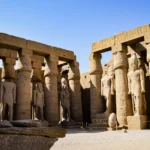
- The great hypostyle hall: according to the ministry, a « forest » of 134 columns 15 meters (49 ft) high, of which the 12 central columns reach 21 meters (69 ft). It may have been begun under Amenhotep III, but most of the construction and all of the decoration date from Seti I and his son Ramesses II (19th dynasty).
- The obelisks: the largest, raised by Hatshepsut, measures nearly 30 meters (98 ft) and weighs more than 300 tonnes.
- The Akh-menu: at the eastern end, the temple of Thutmose III dedicated to various deities, to his royal predecessors and to his own cult.
- The Open Air Museum: included in the main ticket.
- The Temple of Mut (optional): to the south, with its separate ticket.
The official page does not publish a recommended visit time. Allow half a day if you want to see the Precinct of Amun and the Open Air Museum without rushing, more if you add Mut: this is a common-sense estimate, not an official figure.
Karnak and Luxor Temple
Karnak and Luxor Temple were linked by the processional avenue of sphinxes described by the ministry. Both are easy to visit on the same day on the east bank; the west bank (Valley of the Kings, funerary temples) needs a day of its own. Our Luxor page gives an overview, and our page on Nile cruises explains how Karnak fits into itineraries between Luxor and Aswan.
Getting there, transport and organization
Karnak is on the east bank, in the Luxor urban area. The official page does not detail how to get there; visitors generally come by taxi or with a guide. For taxis, agree the fare with the driver before you set off. If you book a guided visit, a transfer or a cruise that includes Karnak, compare the site’s official program (hours, tickets) with what the organizer promises.
Tours, transfers and eSIM
For mobile internet, our travel eSIM guide explains how to check your phone’s compatibility. For entering the country, see entry requirements for Egypt.
Safety: what the US and UK governments say
According to the UK FCDO (GOV.UK, updated 4 August 2026, read 26 October 2026), the FCDO advises against all but essential travel to the area west of the Nile Valley and Nile Delta, with an exception that expressly includes Luxor, Qina, Aswan, Abu Simbel and the Valley of the Kings. The FCDO also says terrorist attacks could be indiscriminate, including in places visited by foreign nationals, and advises vigilance in crowds. According to the U.S. State Department (travel.state.gov, last updated August 11, 2025, read 26 October 2026), travelers should stay alert throughout the country due to the threat of terrorism and exercise caution in crowds and in isolated sections of temples and pyramids.
Two rules concern a visit to Karnak directly. The State Department says it is illegal to photograph police stations, military barracks and certain other sensitive public buildings, and that visitors may not bring drones or satellite phones into Egypt, which will be taken and not returned; the FCDO likewise says officials are likely to confiscate satellite phones unless you have prior clearance. For travel between cities, the FCDO says not to drive outside main cities and resorts at night.
Common mistakes to avoid
- Relying on an old price: the 200 or 220 EGP still shown on some sites no longer matches the official 600 EGP rate.
- Assuming the whole complex is included: the Temple of Mut has its own ticket.
- Arriving in the late afternoon: the site closes at 5 pm according to the official page.
- Bringing a drone: visitors may not bring drones into Egypt, and the equipment can be confiscated.
- Photographing police or military at entrance checks: this is not allowed.
What to see nearby
- Luxor: Luxor Temple, the west bank, trip planning.
- Abu Simbel: the temples of Ramesses II, farther south.
- Nile cruise: the classic itinerary between Luxor and Aswan.
- Giza pyramids: the country’s other must-see.
Frequently asked questions
What are Karnak Temple’s opening hours?
Every day from 6 am to 5 pm, according to the Egyptian Ministry of Tourism and Antiquities page consulted on 27 October 2026.
How much does Karnak Temple cost?
600 EGP for a foreign adult and 300 EGP for a student; the ticket covers Karnak Temple and the Open Air Museum.
Is the Temple of Mut included in the ticket?
No. A separate ticket is needed: 200 EGP adult, 100 EGP student for foreign visitors.
How many columns are in the hypostyle hall?
134 columns 15 meters (49 ft) high, of which the 12 central columns are 21 meters (69 ft), according to the ministry.
Is Karnak safe to visit?
The UK FCDO (GOV.UK, updated 4 August 2026) lists Luxor among the places excepted from its advice against all but essential travel to the Western Desert, but both the FCDO and the U.S. State Department (travel.state.gov, last updated August 11, 2025) point to a terrorism threat in Egypt and advise vigilance. Photography and drone rules apply. Check the latest advice before you go.
Our sources
- Egyptian Ministry of Tourism and Antiquities: « Karnak » page (hours, prices, description), egymonuments.gov.eg, consulted on 27 October 2026
- UK FCDO, Egypt travel advice (GOV.UK, updated 4 August 2026), consulted on 26 October 2026
- U.S. Department of State, Egypt travel advisory (travel.state.gov, last updated August 11, 2025), consulted on 26 October 2026
- Site coordinates: Wikipedia, « Karnak » article
- Sunrise, sunset and day length: Destination de Voyage calculation, NOAA solar algorithm, Africa/Cairo time zone, coordinates of Karnak Temple (Wikipedia), on the 15th of each month (year 2027)
- Our methodology
Updated November 2026. Prices, hours and access rules may change: check the official website before you go.