Things to do in Luxor means exploring ancient Thebes, the religious capital of ancient Egypt: the temples of Karnak and Luxor on the east bank of the Nile, the Valley of the Kings and the Theban Necropolis on the west bank. What to see in Luxor, how to organise your visit and when to go to avoid the furnace: here are the essentials, checked against the official US and UK travel advice and the official climate normals.
On the east bank of the Nile in Upper Egypt, Luxor lies about 700 km (435 mi) south of Cairo and about 300 km (186 mi) north of Aswan. The ruins of the Karnak and Luxor temples stand in the heart of the modern city, hence its nickname of « the world’s greatest open-air museum ». The city lives mainly from tourism. For a beach stay, our guide to Marsa Alam, on the Red Sea shows another side of Egypt.

Our travel deals for Luxor
Affiliate links: we earn a commission, at no extra cost to you.
 FlightsKiwi.comCompare flights and airline combinations to Luxor.Compare flights
- Airport transferKiwitaxiPrivate driver booked in advance at a fixed price.Book a transfer
- Tickets and toursTiqetsEntry tickets and guided tours to book online; compare with the official price.See tickets
- eSIMAiraloData plan to install before you leave (eSIM-compatible phone).See plans




Luxor at a glance
- Location Upper Egypt, on the Nile, about 700 km (435 mi) south of Cairo
- Must-sees Karnak Temple, Luxor Temple and the Avenue of Sphinxes, the Valley of the Kings, the Valley of the Queens, the Theban Necropolis
- Airports Luxor International (LXR); start or end point of many Nile cruisesCheck current routes with the airlines
- Entry US and UK: visa required (e-visa or visa on arrival); Luxor is among the areas excepted from the FCDO’s Western Desert advice · US: travel.state.gov · UK: GOV.UK
- Currency the Egyptian pound (EGP) · currency converter
- Ideal length 2 to 3 days
What to see in Luxor: the highlights
Karnak Temple
The great Temple of Amun at Karnak, in the north of ancient Thebes, was the most important temple in Egypt until the end of Antiquity. It is a vast complex, best visited early in the morning, before the heat. Discoveries are still being made there: in April 2018, a sanctuary dedicated to Osiris dating from the 25th Dynasty was unearthed.
Luxor Temple and the Avenue of Sphinxes
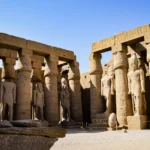
In the city centre, the Temple of Amun at Luxor was built in the 14th century BC. It is linked to Karnak by a dromos, a long avenue lined with sphinxes. This is where the god’s statue was carried from Karnak during the Opet Festival, the great religious festival of Thebes.
The Valley of the Kings
On the west bank of the Nile, opposite the city, the Theban Necropolis includes the Valley of the Kings, where the tombs of the New Kingdom pharaohs were dug. The site is in the middle of the desert: set off early and bring water and a hat.
The Valley of the Queens and the west bank
Also on the west bank, the Valley of the Queens and the mortuary temples of the Theban Necropolis complete the visit. Allow a full day for the west bank. Cruise boat landing stages line the western bank, and a road bridge links the two banks about 10 km (6 mi) to the south-west.
The Luxor Museum
In town, the Luxor Museum displays pieces from the Theban sites. A good stop during the hottest hours; check the opening hours.
Hot air balloons
Luxor is known for its hot air balloon flights over the west bank. The UK FCDO advises speaking to your tour company before booking a flight, noting that some UK tour operators have stopped selling balloon flights because they have not been able to verify safety standards (GOV.UK, updated 4 August 2026). Check that your insurance covers the activity.
Itinerary: Luxor in 2 or 3 days
| Day | Morning (before the heat) | Afternoon | Evening |
|---|---|---|---|
| 1 | Karnak Temple | Rest, then the Luxor Museum | Luxor Temple and the Avenue of Sphinxes |
| 2 | West bank: Valley of the Kings | Valley of the Queens and mortuary temples | Back to the east bank |
| 3 (optional) | Hot air balloon at sunrise | More of Karnak or the west bank | Along the Nile |
East bank or west bank: where to start?
| If you… | Then… |
|---|---|
| only have one day | Karnak in the morning, Luxor Temple late in the day (east bank, in town) |
| want the pharaohs’ tombs | devote a day to the west bank, setting off very early |
| are traveling from May to September | sightsee only at dawn and late in the day; stay in the shade between noon and 4 pm |
| are on a Nile cruise | check which sites are included before adding visits |
| are coming from the Red Sea | avoid driving at night: the UK FCDO advises against driving outside main cities and resorts at night |
Luxor combines well with Cairo and its pyramids, or with a beach stay in Hurghada. See our Egypt travel guide.
When to go to Luxor
From November to February, when average highs stay between 22.8 °C (73 °F) and 29.1 °C (84 °F). March and October are already hot (29.7 °C (85 °F) and 35.5 °C (96 °F)) but still manageable if you sightsee early. From June to August, the average high exceeds 41 °C (106 °F) and nights stay around 26 °C (79 °F): sightseeing becomes gruelling. It practically never rains: under 9 mm (0.4 in) a year. In winter, nights are cool (7.1 °C (45 °F) in January): bring a sweater for dawn starts.
| Month | High | Low | Rain | Verdict |
|---|---|---|---|---|
| January | 22.8 °C (73 °F) | 7.1 °C (45 °F) | 2.8 mm (0.1 in) | ✅ Mild by day, cool nights |
| February | 25.3 °C (78 °F) | 8.9 °C (48 °F) | 0.4 mm (0.0 in) | ✅ Ideal for the temples |
| March | 29.7 °C (85 °F) | 12.8 °C (55 °F) | 1.7 mm (0.1 in) | ✅ Hot in the afternoon |
| April | 35.0 °C (95 °F) | 17.5 °C (64 °F) | 0.3 mm (0.0 in) | ⚠️ Strong heat |
| May | 39.1 °C (102 °F) | 22.1 °C (72 °F) | 0.8 mm (0.0 in) | ⚠️ Close to 40 °C (104 °F) |
| June | 41.2 °C (106 °F) | 25.0 °C (77 °F) | 0.0 mm (0.0 in) | ❌ Extreme heat |
| July | 41.4 °C (107 °F) | 25.7 °C (78 °F) | 0.0 mm (0.0 in) | ❌ Hottest month |
| August | 41.2 °C (106 °F) | 25.6 °C (78 °F) | 0.1 mm (0.0 in) | ❌ Extreme heat |
| September | 39.3 °C (103 °F) | 23.3 °C (74 °F) | 0.5 mm (0.0 in) | ⚠️ Still very hot |
| October | 35.5 °C (96 °F) | 19.6 °C (67 °F) | 1.1 mm (0.0 in) | ⚠️ Hot, nicer late in the month |
| November | 29.1 °C (84 °F) | 13.4 °C (56 °F) | 0.5 mm (0.0 in) | ✅ Excellent |
| December | 24.2 °C (76 °F) | 8.6 °C (47 °F) | 0.0 mm (0.0 in) | ✅ Mild and dry |
How big is the day-night gap in Luxor?
We calculated, month by month, the gap between the average high and the average low in Luxor. It is largest in April (17.5 °C, or 32 °F): desert conditions mean winter nights are cool even when the days are mild.
| Month | High in Luxor | Day-night gap in Luxor |
|---|---|---|
| January | 22.8 °C (73 °F) | 15.7 °C (28 °F) |
| February | 25.3 °C (78 °F) | 16.4 °C (30 °F) |
| March | 29.7 °C (85 °F) | 16.9 °C (30 °F) |
| April | 35.0 °C (95 °F) | 17.5 °C (32 °F) |
| May | 39.1 °C (102 °F) | 17.0 °C (31 °F) |
| June | 41.2 °C (106 °F) | 16.2 °C (29 °F) |
| July | 41.4 °C (107 °F) | 15.7 °C (28 °F) |
| August | 41.2 °C (106 °F) | 15.6 °C (28 °F) |
| September | 39.3 °C (103 °F) | 16.0 °C (29 °F) |
| October | 35.5 °C (96 °F) | 15.9 °C (29 °F) |
| November | 29.1 °C (84 °F) | 15.7 °C (28 °F) |
| December | 24.2 °C (76 °F) | 15.6 °C (28 °F) |
To compare with Cairo, Aswan and the Red Sea, see when to go to Egypt.
Getting there and getting around
- By air: Luxor has an international airport. Routes, nonstop or with connections, vary by season: check with the airlines.
- By cruise: Luxor is a start or end point for Nile cruises to Aswan.
- By road: the UK FCDO advises against driving outside main cities and resorts at night (GOV.UK, updated 4 August 2026). The U.S. Department of State considers public buses, microbuses and trains unsafe, and notes that hospitals in Luxor are good (travel.state.gov, last updated August 11, 2025).
- Taxis: agree the fare in advance; ride-hailing apps are an alternative where available.
Where to stay
The east bank, in town, puts you close to the Karnak and Luxor temples, restaurants and the museum. The west bank is quieter and close to the Theban Necropolis. On a cruise, you sleep on board.
Entry requirements, health and safety
US citizens
- According to the U.S. Department of State (travel.state.gov, last updated August 11, 2025), US citizens need a visa. You can apply for an e-visa before travel on the Egyptian government’s official website (some unofficial sites charge double), or get a renewable single-entry 30-day tourist visa on arrival at Egyptian airports for about $25 in cash (US dollars); a multiple-entry visa costs about $60.
- Travelers arriving from a yellow fever-infected area must show proof of vaccination. Keep prescription medicines in their original packaging with a doctor’s letter (travel.state.gov).
UK citizens
- According to the UK FCDO (GOV.UK foreign travel advice, updated 4 August 2026), British passport holders normally need a visa. Tourist e-visas bought online in advance are valid for up to 3 months; a visa on arrival costs 30 US dollars (cash only) at kiosks before immigration and is valid for up to 30 days. You do not need to buy a visa from an agent.
- Your passport must have an expiry date at least 6 months after the date you arrive and at least one blank page (GOV.UK).
The two sources give different visa-on-arrival prices (about $25 for travel.state.gov, 30 US dollars for GOV.UK): check with the Egyptian embassy before you travel. Entry requirements checked on 26 October 2026. More details in our guide Egypt visa.
Health and safety
- Safety: the UK FCDO’s advice against all but essential travel to most of the Western Desert makes an exception for Luxor, Qina, the Valley of the Kings, Aswan and Abu Simbel (GOV.UK, updated 4 August 2026). Both the FCDO and the U.S. Department of State warn of a terrorist threat in Egypt: avoid demonstrations and gatherings.
- Photos and drones: according to GOV.UK, do not import or use drones without prior permission from the Egyptian Ministry of Defence; the U.S. Department of State says drones brought into Egypt are confiscated. Do not photograph police stations, military barracks or sensitive buildings.
- Health: check vaccine recommendations at least 8 weeks before your trip (TravelHealthPro, cited by GOV.UK). In summer, protect yourself from the heat and drink plenty of water.
- Emergencies: ambulance 123, police 122, tourist police 126 to report a crime (GOV.UK, updated 4 August 2026).
- Insurance: see our travel insurance guide; make sure it covers the activities you plan and repatriation.
Frequently asked questions
How many days do you need to visit Luxor?
Two days: one for the east bank (Karnak, Luxor Temple), one for the west bank (Valley of the Kings, Valley of the Queens). Three days to add a balloon flight and the museum.
What is the best time to visit Luxor?
November to February, with 22.8 to 29.1 °C (73 to 84 °F) in the afternoon according to the WMO 1991-2020 normals. Avoid June to August, at over 41 °C (106 °F).
Is it safe to visit Luxor?
Luxor is not in an area the UK FCDO advises against: its Western Desert advice explicitly excepts Luxor, the Valley of the Kings and Aswan (GOV.UK, updated 4 August 2026). Both the FCDO and the U.S. Department of State warn of a terrorist threat in Egypt, so follow their general advice.
Do you need a visa for Luxor?
Yes. US and UK citizens need a visa for Egypt: an e-visa bought online in advance or a visa on arrival paid in US dollars. UK travelers need a passport valid at least 6 months after arrival.
What is there to see on Luxor’s west bank?
The Theban Necropolis: the Valley of the Kings, the Valley of the Queens and the mortuary temples.
Our sources
- World Meteorological Organization, 1991-2020 normals for Luxor (Egyptian Meteorological Authority), published by NOAA, via the Wikipedia climate box (article « Luxor »), checked on 23 October 2026
- Entry, health and safety information read on 26 October 2026: U.S. Department of State, Egypt country information (travel.state.gov, last updated August 11, 2025), and UK FCDO, foreign travel advice for Egypt (GOV.UK, updated 4 August 2026)
- Wikipedia: « Louxor » (fr) and « Luxor » (en), checked on 23 October 2026
- Destination de Voyage calculations and summaries: day-night gap, east bank / west bank grid
- Our methodology
Updated October 2026.
To extend your trip, see our Egypt travel guide and our destinations in Africa.