Cairo and Giza: the UK FCDO and the U.S. Department of State do not advise against travel to Cairo; both warn of a terrorist threat in the country, so stay alert at busy sites and avoid gatherings and demonstrations
Advised against by the FCDO: all travel to North Sinai and within 20 km (12 mi) of the Libyan border; all but essential travel to the northern part of South Sinai, the Ismailiyah Governorate east of the Suez Canal and most of the Western Desert (GOV.UK, updated 4 August 2026)
U.S. Department of State: avoid the northern and middle Sinai, all border areas and parts of the Western Desert; crime levels in Cairo are described as moderate (travel.state.gov, last updated August 11, 2025)
A Cairo travel guide almost always starts with the pyramids of Giza, on the edge of the city. But the Egyptian capital, the largest metropolis in the Arab world, is also worth visiting for its museums, including the Grand Egyptian Museum, for Islamic Cairo and its medieval mosques, for Saladin’s Citadel, the Khan el-Khalili souk and Coptic Cairo. What to do in Cairo in two, three or four days, when to go according to the official normals, where to stay and how much to budget: this guide covers the essentials.
Cairo at a glance
CountryEgypt, the capital, on the Nile at the tip of the Delta
The best times to visit Cairo are October to April, especially October-November and March-April: 24 to 30 °C (75 to 86 °F) in the afternoon, mild nights and almost always dry skies. The heart of winter (December to February) is still pleasant for sightseeing, around 19 to 20 °C (66 to 68 °F) by day, but nights drop to around 10 °C (50 °F). From June to September, the heat tops 33 °C (91 °F) in the afternoon and nights stay warm.
It almost never rains: under 30 mm (1.2 in) a year, with a few showers in winter. The main hazard is the khamsin, a hot, sand-laden wind that can blow in spring. Air pollution and traffic weigh more on comfort than the weather; the U.S. Department of State notes that air pollution can be a significant problem.
When to go to Cairo: key points
Best times: October-November and March-April
For a tour with Luxor and Aswan: November to February, when Upper Egypt is most bearable
Avoid if you dislike heat: June to August, 35 °C (95 °F) on average in the afternoon
Coolest month: January, 18.9 °C (66 °F) by day and 10.1 °C (50 °F) at night
Rain: virtually none from April to October; at most 6 mm (0.2 in) in March
During Ramadan: reduced site hours, lively evenings
Cairo climate month by month
Month
High
Low
Rain
Crowds
Prices
Verdict
January
18.9 °C (66 °F)
10.1 °C (50 °F)
4.8 mm (0.2 in)
High (early January)
High
✅ Mild, ideal for sightseeing
February
20.5 °C (69 °F)
11.0 °C (52 °F)
3.8 mm (0.1 in)
High (winter holidays)
High
✅ Mild, sunny
March
23.8 °C (75 °F)
13.2 °C (56 °F)
6.3 mm (0.2 in)
Medium
Medium
✅ Pleasant, khamsin possible
April
28.1 °C (83 °F)
15.9 °C (61 °F)
1.3 mm (0.1 in)
High (Easter)
High
✅ Warm but pleasant
May
32.2 °C (90 °F)
19.3 °C (67 °F)
0.2 mm (0.0 in)
Medium
Medium
⚠️ Hot, sandstorms possible
June
34.6 °C (94 °F)
22.2 °C (72 °F)
0.0 mm (0.0 in)
Low
Low
❌ Very hot
July
35.0 °C (95 °F)
23.8 °C (75 °F)
0.0 mm (0.0 in)
Medium
Medium
❌ Hottest
August
34.9 °C (95 °F)
24.3 °C (76 °F)
0.0 mm (0.0 in)
Medium
Medium
❌ Very hot and muggy
September
33.4 °C (92 °F)
22.7 °C (73 °F)
0.0 mm (0.0 in)
Low
Low
⚠️ Still hot
October
30.0 °C (86 °F)
20.0 °C (68 °F)
0.7 mm (0.0 in)
High (autumn holidays)
High
✅ One of the best months
November
24.9 °C (77 °F)
15.6 °C (60 °F)
4.3 mm (0.2 in)
High
High
✅ One of the best months
December
20.5 °C (69 °F)
11.7 °C (53 °F)
3.4 mm (0.1 in)
High (festive season)
High
✅ Mild, cool nights
Temperatures and rainfall: 1991-2020 normals for the Cairo International Airport station, Egyptian Meteorological Authority, published by the World Meteorological Organization (NOAA archive). Crowds and prices: estimate based on European school holidays and Egypt’s high season.
Cairo season by season
Winter (December to February): 19 to 20 °C (66 to 68 °F) in the afternoon, 10 to 12 °C (50 to 54 °F) at night, a few showers. High season: sites and hotels are busier, especially over the holidays and in February. Bring a sweater for early starts at Giza.
Spring (March to May): 24 °C (75 °F) in March, 28 °C (82 °F) in April, 32 °C (90 °F) in May. March and April are excellent; the khamsin can spoil a few days. High demand over Easter.
Summer (June to September): 33 to 35 °C (91 to 95 °F) by day, 22 to 24 °C (72 to 75 °F) at night, humid and polluted air. Visit sites at opening time and save museums and souks for the hottest hours. Lower prices, except in July-August.
Autumn (October-November): 30 °C (86 °F) in October, 25 °C (77 °F) in November. The best window to combine Cairo, a Nile cruise and the still-warm Red Sea.
Cairo month by month
January: 19 °C (66 °F) by day, 10 °C (50 °F) at night: the coolest month. Excellent for walking; crowds in the first week. Coptic Christmas on 7 January.
February: 20 °C (68 °F), very pleasant. Winter school holidays fill up tours: book early.
March: 24 °C (75 °F), one of the best months. The first khamsin episodes are possible.
April: 28 °C (82 °F), still pleasant in the morning. In high demand over the Easter holidays.
May: 32 °C (90 °F), the heat sets in. Sightsee early in the morning.
June: 35 °C (95 °F), dry, then muggy heat. Fewer people and lower prices.
July: 35 °C (95 °F), the hottest month along with August. Favour air-conditioned museums.
August: 35 °C (95 °F), nights at 24 °C (75 °F). High demand linked to the summer holidays.
September: 33 °C (91 °F), still hot, but quiet with low prices.
October: 30 °C (86 °F), pleasant conditions return; high demand during the autumn holidays.
November: 25 °C (77 °F), one of the best months. The start of the high season.
December: 20 °C (68 °F) by day, 12 °C (54 °F) at night. Very busy around the holidays.
For Luxor, Aswan and the Red Sea, see our article on when to go to Egypt, which compares the regions.
Things to do in Cairo: the highlights
The pyramids of Giza and the Sphinx
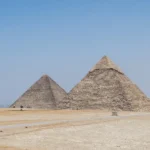
On the Giza plateau, about 20 km (12 mi) from the centre, stand the pyramids of Khufu, Khafre and Menkaure and the Sphinx. The Pyramid of Khufu is the only one of the Seven Wonders of the Ancient World still standing. The site is part of the UNESCO-listed « Memphis and its Necropolis ». Arrive at opening time for the light and the cool. Entering some pyramids requires an extra ticket. Around the site, camel drivers and vendors are persistent: agree any price before getting on a camel or into a carriage.
The Grand Egyptian Museum
Opened next to the Giza plateau, the Grand Egyptian Museum (GEM) is devoted to ancient Egypt: a grand staircase lined with statues, the colossus of Ramses II in the hall and the collection of Tutankhamun’s treasure, shown in full. Allow at least half a day. Book tickets online on the official website and combine the visit with the pyramids.
The Egyptian Museum in Tahrir Square and the Museum of Civilization
The historic museum on Tahrir Square, opened in 1902, holds a very rich collection of statues, sarcophagi and everyday objects in an older setting. To the south, in Fustat, the National Museum of Egyptian Civilization (NMEC) displays the royal mummies in a dedicated gallery, along with an overview of the country’s history from prehistory to the present day.
Islamic Cairo and al-Muizz Street
Historic Cairo, a UNESCO World Heritage Site, brings together hundreds of medieval monuments. Al-Muizz li-Din Allah Street lines up Fatimid and Mamluk mosques, madrasas, bathhouses and palaces, from Bab al-Futuh to Bab Zuweila, whose minarets you can climb. Nearby, al-Azhar Mosque, founded in the 10th century, is also one of the oldest universities in the world. Covering clothing is required; women must cover their hair in mosques.
Khan el-Khalili
This great souk, in place since the 14th century, sells spices, lamps, jewellery, textiles and souvenirs. El Fishawy café, open since the 18th century, is a classic stop. Haggling is the rule. The area is very lively in the evening, especially during Ramadan: keep your valuables safe.
Saladin’s Citadel
Built in the 12th century on a hill, the Citadel overlooks the city. Inside are the Mosque of Muhammad Ali, known as the Alabaster Mosque, with its Ottoman-inspired domes, and several museums. On a clear day, the view reaches the pyramids. Below, the Mosque-Madrasa of Sultan Hassan and the Mosque of Ibn Tulun, one of the oldest in Cairo, are worth the detour.
Coptic Cairo
In the Fustat district, on the site of the Roman fortress of Babylon, you will find the Hanging Church (al-Muallaqa), the Church of St Sergius, linked by tradition to the Holy Family’s flight into Egypt, the Ben Ezra Synagogue and the Coptic Museum. The area is compact and can be explored on foot in two or three hours; it is reached by metro (Mar Girgis station).
Saqqara, Memphis and Dahshur
About 30 km (19 mi) to the south, the necropolis of Saqqara holds the Step Pyramid of Djoser, the oldest in Egypt, and decorated mastabas. The remains of Memphis, the ancient capital, and the pyramids of Dahshur, including the Bent Pyramid and the Red Pyramid, can be combined in the same day, with far fewer people than at Giza. A car with driver is the simplest option.
The Nile, Zamalek and Downtown
A felucca ride at sunset offers a break from the traffic. Zamalek island, greener and calmer, has embassies, cafés and galleries; the Cairo Tower offers a panoramic view. Downtown, around Tahrir Square, still has many buildings from the late 19th and early 20th centuries.
Itineraries
Cairo in 3 days
Day 1: the pyramids of Giza and the Sphinx at opening time, then the Grand Egyptian Museum
Day 2: Coptic Cairo in the morning, Saladin’s Citadel, the mosques of Sultan Hassan and Ibn Tulun, then Khan el-Khalili and al-Muizz Street in the evening
Day 3: Saqqara, Memphis and Dahshur; a felucca on the Nile on the way back
One to two weeks in Egypt
Days 1 to 3: Cairo and Giza
Days 4 to 7: flight or night train to Luxor or Aswan, Nile cruise between the two
Days 8 to 10: Hurghada and the Red Sea, or back to Cairo for the Museum of Civilization and Zamalek
Here is our view by traveler profile, based on the stops, budget and conditions covered in this guide to Cairo.
Profile
Our view
Culture and history
✅ The pyramids of Giza, the Grand Egyptian Museum, Islamic Cairo, Coptic Cairo and Saqqara: the main reason for the trip.
Couples
✅ A felucca on the Nile at sunset, Zamalek cafés, hotels overlooking the Giza plateau or the river.
Families
⚠️ Pyramids and museums make an impression on children, but the traffic, the heat from June to September and the hassle around sites require planning.
Tight budget
✅ Cheap accommodation and meals (roughly US$45 to 80 per person per day); entry fees to the major sites weigh on the budget.
Beach
❌ No beach in Cairo: combine with Hurghada and the Red Sea on a one- to two-week tour.
Independent travelers
⚠️ The metro and ride-hailing apps make the city accessible, but driving is not for the inexperienced.
Budget for visiting Cairo
Accommodation and meals are cheap, but entry fees to the major sites, charged in hard currency for foreigners, weigh on the budget. Rough amounts per person per day, excluding flights:
Item
Tight budget
Comfort
Accommodation (sharing a double room)
roughly US$17 to 34
roughly US$55 to 125
Meals
roughly US$9 to 17
roughly US$28 to 45
Local transport (metro, ride-hailing)
roughly US$2 to 6
roughly US$11 to 22
Sightseeing (entry fees, guide)
roughly US$17 to 28
roughly US$28 to 45
Total per day
roughly US$45 to 80
roughly US$125 to 225
Rough estimates, highly variable with the Egyptian pound exchange rate and site prices, which are revised regularly; converted from our euro estimates at the European Central Bank reference rate of 23 October 2026 (EUR/USD).
To keep costs down: group nearby sites on the same day, use the metro and ride-hailing apps, eat in koshari and ful restaurants, and travel in May, June or September. Ride-hailing apps are among the practical tools in Cairo: our selection of travel apps also covers maps and translation.
Getting there and getting around Cairo
By air: Cairo International Airport is about 20 km (12 mi) north-east of the centre. Allow 45 minutes to over an hour depending on traffic; ride-hailing or a hotel transfer.
Metro: three lines, simple and very cheap, handy for the centre, Coptic Cairo and Giza city. The U.S. Department of State notes that the metro has separate cars for women, which may reduce the risk of harassment.
Ride-hailing: Uber and Careem are widely used and avoid haggling with taxis.
Taxis: agree the fare before getting in if the meter does not work.
To Luxor and Aswan: domestic flights, day trains or a sleeper night train.
Car: the U.S. Department of State describes driving in Cairo as very challenging for foreigners, with most traffic lights not working; the UK FCDO advises against driving outside main cities and resorts at night.
Where to stay in Cairo
Giza, near the pyramids: hotels and guesthouses overlooking the plateau, handy for Giza and the Grand Museum, but far from the historic centre
Zamalek: a quiet, green district on a Nile island, with cafés and restaurants; a good compromise for a first stay
Downtown: budget hotels and historic addresses, close to the metro and the Tahrir museum; lively and noisy
Nile Corniche (Garden City): large international hotels with river views
Near the airport (Heliopolis, New Cairo): useful for a late arrival or an early departure
Entry requirements, health and safety
US citizens
According to the U.S. Department of State (travel.state.gov, last updated August 11, 2025), US citizens need a visa. You can apply for an e-visa before travel on the Egyptian government’s official website (some unofficial sites charge double), or get a renewable single-entry 30-day tourist visa on arrival at Egyptian airports for about $25 in cash (US dollars); a multiple-entry visa costs about $60.
Travelers arriving from a yellow fever-infected area must show proof of vaccination. Keep prescription medicines in their original packaging with a doctor’s letter (travel.state.gov).
UK citizens
According to the UK FCDO (GOV.UK foreign travel advice, updated 4 August 2026), British passport holders normally need a visa. Tourist e-visas bought online in advance are valid for up to 3 months; a visa on arrival costs 30 US dollars (cash only) at kiosks before immigration and is valid for up to 30 days. You do not need to buy a visa from an agent.
Your passport must have an expiry date at least 6 months after the date you arrive and at least one blank page (GOV.UK).
The two sources give different visa-on-arrival prices (about $25 for travel.state.gov, 30 US dollars for GOV.UK): check with the Egyptian embassy before you travel. Entry requirements checked on 26 October 2026. More details in our guide Egypt visa.
Health and safety
Health: according to the UK FCDO, check vaccine recommendations at least 8 weeks before your trip (TravelHealthPro). The U.S. Department of State asks travelers to be up to date on CDC-recommended vaccinations and warns against drinking untreated water or swimming in the Nile (risk of schistosomiasis). Heat and pollution can affect vulnerable people.
Safety: both the UK FCDO and the U.S. Department of State warn of a terrorist threat in Egypt; stay alert at busy sites and avoid gatherings and demonstrations. Be cautious with touts and aggressive vendors at tourist sites, which mostly have tourist police (travel.state.gov).
Photos: it is illegal to photograph police stations, military barracks and certain other sensitive public buildings (travel.state.gov); according to GOV.UK, you must get an Egyptian citizen’s permission before taking their photo, and photographing children is prohibited.
Emergencies: ambulance 123, police 122, tourist police 126 to report a crime (GOV.UK, updated 4 August 2026).
Insurance: see our travel insurance guide; make sure it covers the activities you plan and repatriation.
Practical tips for Cairo
Money: ATMs are plentiful; keep small notes for tips (baksheesh), expected everywhere. Our currency converter helps you follow the Egyptian pound.
Hassle: at Giza and in the souks, firmly but politely decline unwanted offers; always agree the price before a service.
Dress: shoulders and knees covered in the city, a headscarf for women in mosques.
Timing: visit outdoor sites early in the morning; on Fridays, some mosques close to visitors during prayers.
Crossing the street: traffic is heavy and pedestrian crossings rarely respected; the U.S. Department of State advises care on busy streets such as the Corniche. Cross with locals.
Internet: a local SIM card or an eSIM is handy for ride-hailing and navigation.
October-November and March-April: 24 to 30 °C (75 to 86 °F) in the afternoon and no rain. Winter is mild by day but cool at night; from June to September, it is over 33 °C (91 °F).
How many days do you need to visit Cairo?
Three days let you see Giza and the Grand Egyptian Museum, Islamic Cairo, the Citadel, Coptic Cairo and Saqqara. Add a day for the Museum of Civilization and Zamalek.
What can you do in Cairo in 2 days?
One day for the pyramids of Giza and the Grand Egyptian Museum, another for the Citadel, Islamic Cairo and Khan el-Khalili.
Do you need a visa to visit Cairo?
Yes. US and UK citizens need a visa: an e-visa bought online in advance or a visa on arrival paid in US dollars (about $25 according to travel.state.gov, 30 US dollars according to GOV.UK). UK travelers need a passport valid at least 6 months after arrival.
Is it safe to visit Cairo?
Neither the UK FCDO nor the U.S. Department of State advises against travel to Cairo, but both warn of a terrorist threat in Egypt: stay alert at busy sites and avoid gatherings. The areas they advise against, such as North Sinai and the border areas, are far from the capital.
How do you get from Cairo to Luxor?
By domestic flight, day train or sleeper night train. Many travelers then continue with a Nile cruise to Aswan. Our guide to Luxor, its temples and the Valley of the Kings helps you plan this stage.
Our sources
Entry, health and safety information read on 26 October 2026: U.S. Department of State, Egypt country information (travel.state.gov, last updated August 11, 2025), and UK FCDO, foreign travel advice for Egypt (GOV.UK, updated 4 August 2026)
Climate data: 1991-2020 normals for the Cairo International Airport station, Egyptian Meteorological Authority, published by the World Meteorological Organization (NOAA archive)
European Central Bank, euro reference rates of 23 October 2026 (EUR/USD), for the budget conversion


 FlightsKiwi.comCompare flights and airline combinations to Cairo.Compare flights