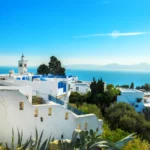
Tunis brings together in one city three visits that are often made separately: the World Heritage-listed medina, the ruins of Carthage and the white-and-blue village of Sidi Bou Saïd, all linked by the small TGM suburban railway. For all the things to do in Tunis, allow 2 to 3 days, ideally from April to June or from mid-September to October.
This guide covers the highlights, a day-by-day plan, the month-by-month climate (official normals) and a calculation specific to this page: the number of rainy days to expect during a one-week stay, month by month.

Our travel deals for Tunis
Affiliate links: we earn a commission, at no extra cost to you.
 Learn the languageTargumiLearn a few words of Tunisian Arabic before you go — 30% off via our link.See the course
- FlightsKiwi.comCompare flights and airline combinations to Tunis.Compare flights
- Airport transferKiwitaxiPrivate driver booked in advance at a fixed price.Book a transfer
- eSIMAiraloData plan to install before you leave (eSIM-compatible phone).See plans




Tunis at a glance
- Country Tunisia, of which it is the capital; on the Gulf of Tunis
- Languages Arabic; French is widely spoken. To learn a few words before you go, try Targumi’s online Tunisian Arabic lessons with native teachers (30% off via our link).
- Currency the Tunisian dinar (TND)
- Time zone UTC+1 all year (Tunisia does not use daylight saving): 1 h ahead of London in winter, same time in summer — see time difference in Tunisia
- Airport Tunis-Carthage (TUN); check current routes with the airport and the airlines
- Entry US and UK citizens: visa-free for up to 90 days (travel.state.gov, GOV.UK)
- Safety the UK FCDO says terrorists are likely to try to carry out attacks in Tunisia; Tunis is not in an area it advises against (GOV.UK, updated 24 July 2026)
Things to do in Tunis: the highlights
The medina of Tunis
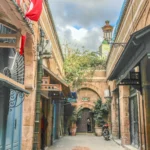
Listed as a UNESCO World Heritage Site in 1979, the medina stretches between the Porte de France (Bab el Bhar) and the Kasbah. You explore it on foot through a network of specialised souks (chechia caps, perfumes, fabrics) around the Zitouna mosque, the city’s great mosque. Look out too for the Tourbet el Bey mausoleum, burial place of the Husainid beys, and the palaces turned into museums or restaurants, such as Dar Ben Abdallah. The souks are quieter in the morning; many shops close in the late afternoon.
The Bardo National Museum
Housed in a former beylical palace west of the centre, the Bardo holds one of the world’s largest collections of Roman mosaics, taken from the country’s ancient sites (including the famous Virgil mosaic). The museum was closed for a long time before reopening in 2023: check opening days and times before you go.
Carthage
The archaeological site of Carthage, also listed by UNESCO in 1979, is spread over several points in a residential suburb: the Antonine Baths by the sea, Byrsa hill with its museum and view over the gulf, the Punic ports, the tophet, the Roman villas and the amphitheatre. Ask on site about the ticket covering the different sites. Several TGM stations serve the area.
Sidi Bou Saïd
Perched on the cliff above the gulf, this village of white walls and blue doors is the most photographed walk in the region. Walk up from the TGM station to the Café des Délices, visit the Ennejma Ezzahra palace (former home of Baron d’Erlanger, devoted to music), then walk down to the marina. Come early in the morning or late in the day, when it is coolest.
Avenue Habib Bourguiba and the modern city
Between the Porte de France and the Lake of Tunis, this broad tree-lined avenue is lined with cafés, hotels and colonial-era buildings, including St Vincent de Paul Cathedral and the Art Nouveau municipal theatre. It is the convenient starting point for the medina.
La Goulette and La Marsa
On the TGM line, La Goulette is the port of Tunis, known for its fish restaurants; La Marsa, at the northern terminus, has a seafront promenade and a busy beach in summer. These are the two easiest seaside escapes from the centre.
Itinerary: Tunis in 2 or 3 days
- Day 1 – Medina: Porte de France, the souks, the Zitouna mosque (access depends on the times and rules of the site), Tourbet el Bey, lunch in the medina; end the day on Avenue Habib Bourguiba.
- Day 2 – Carthage and Sidi Bou Saïd: TGM to Carthage (Byrsa, Antonine Baths), then Sidi Bou Saïd for sunset.
- Day 3 – Bardo and the seaside: the Bardo museum in the morning, then La Goulette or La Marsa in the afternoon.
Tunis combines easily with the coast: the resort of Hammamet on Cap Bon, or the island of Djerba in the south. For an overview of the country, see our Tunisia travel guide.
When to go to Tunis
The best periods are April to June and mid-September to October: 22 to 31 °C (72 to 88 °F) in the afternoon according to the INM normals, little rain and long days. In July and August, average highs exceed 34 °C (93 °F) at Tunis-Carthage: sightsee early in the morning and keep the afternoon for the beach. From November to March it is mild (16 to 22 °C / 61 to 72 °F in the afternoon) but this is the rainy season, with about 8 days of rain a month in December and January.
| Month | Avg max | Avg min | Rain | Rain days | Sunshine (h) | Verdict |
|---|---|---|---|---|---|---|
| January | 16.4 °C (62 °F) | 8.2 °C (47 °F) | 58.9 mm (2.3 in) | 8.4 | 164 | ⚠️ Mild, rainy |
| February | 16.8 °C (62 °F) | 8.1 °C (47 °F) | 54.9 mm (2.2 in) | 8.0 | 177 | ⚠️ Mild, rainy |
| March | 19.4 °C (67 °F) | 9.8 °C (50 °F) | 45.8 mm (1.8 in) | 6.3 | 220 | ✅ Cool, pleasant |
| April | 22.3 °C (72 °F) | 12.1 °C (54 °F) | 37.9 mm (1.5 in) | 5.7 | 236 | ✅ Ideal for sightseeing |
| May | 26.5 °C (80 °F) | 15.4 °C (60 °F) | 22.4 mm (0.9 in) | 3.7 | 291 | ✅ Ideal, sea warming up |
| June | 31.0 °C (88 °F) | 19.3 °C (67 °F) | 12.8 mm (0.5 in) | 1.5 | 317 | ✅ Hot, swimming |
| July | 34.0 °C (93 °F) | 22.1 °C (72 °F) | 4.4 mm (0.2 in) | 0.5 | 355 | ⚠️ Very hot |
| August | 34.5 °C (94 °F) | 22.9 °C (73 °F) | 14.5 mm (0.6 in) | 1.7 | 327 | ⚠️ Very hot |
| September | 30.5 °C (87 °F) | 20.7 °C (69 °F) | 58.2 mm (2.3 in) | 5.0 | 251 | ✅ Warm sea, heat easing |
| October | 26.7 °C (80 °F) | 17.3 °C (63 °F) | 54.7 mm (2.2 in) | 5.8 | 221 | ✅ Pleasant |
| November | 21.5 °C (71 °F) | 12.8 °C (55 °F) | 53.1 mm (2.1 in) | 6.8 | 175 | ⚠️ Autumn rain |
| December | 17.6 °C (64 °F) | 9.4 °C (49 °F) | 68.1 mm (2.7 in) | 8.3 | 158 | ⚠️ Cool, wettest month |
How many rainy days in a week in Tunis?
The normals give a number of rainy days per month, which says little for a short stay. We have scaled it down to a week and added the sunset time, useful for planning Sidi Bou Saïd at the end of the day.
North of Carthage, our guide to visiting Sidi Bou Saïd covers the palace, TGM access and sunset.
| Month | Expected rainy days in 7 days | Sunrise | Sunset | Day length |
|---|---|---|---|---|
| January | 1.9 | 07:31 | 17:26 | 9h55 |
| February | 2.0 | 07:07 | 17:59 | 10h52 |
| March | 1.4 | 06:30 | 18:26 | 11h56 |
| April | 1.3 | 05:45 | 18:53 | 13h08 |
| May | 0.8 | 05:11 | 19:19 | 14h08 |
| June | 0.3 | 04:59 | 19:39 | 14h40 |
| July | 0.1 | 05:12 | 19:38 | 14h26 |
| August | 0.4 | 05:36 | 19:10 | 13h34 |
| September | 1.2 | 06:01 | 18:27 | 12h26 |
| October | 1.3 | 06:26 | 17:43 | 11h16 |
| November | 1.6 | 06:57 | 17:10 | 10h13 |
| December | 1.9 | 07:24 | 17:04 | 9h39 |
- From June to August, less than half a day of rain per week: rain is not a factor.
- From November to February, expect 1.5 to 2 days of rain per week: keep an indoor visit (the Bardo, the medina palaces) in reserve.
- In June, the sun sets around 19:39: the days are longest for combining Carthage and Sidi Bou Saïd.
To compare with Djerba or the east coast, see the best time to visit Tunisia.
Getting around Tunis
- On foot in the medina and the centre (Avenue Habib Bourguiba).
- TGM: the Tunis-Goulette-Marsa light railway leaves from Tunis Marine station, at the end of Avenue Habib Bourguiba, and serves La Goulette, Carthage, Sidi Bou Saïd and La Marsa: the simplest way to reach the coastal sights.
- Light metro: the city’s tram network serves, among other places, the Bardo.
- Taxis: yellow metered taxis; ask for the meter to be switched on.
- Public transport safety: the U.S. Department of State advises caution on trains, buses and louages (shared minibuses), which may be overcrowded and poorly maintained (travel.state.gov, last updated June 4, 2026).
Tunis-Carthage airport transfer: bus, taxi and private transfer
Tunis-Carthage airport is close to the city centre. The website of the airport operator (OACA) did not respond when we checked on 26 October 2026, so we have not reproduced fares or timetables: confirm them at the airport information desk.
City bus
A city bus links the airport with Tunis Marine (TGM station). It is the cheapest option, less practical with large suitcases or a late arrival.
Taxi
Yellow taxis are metered. Insist that the meter is switched on at the start of the ride.
Booking a transfer in Tunis
A private transfer booked in advance (a driver waiting on arrival, a price fixed at booking) makes most sense for a late arrival, bulky luggage, a family trip with young children or a group sharing the cost. It is also the simplest option if you are heading straight to Hammamet, Nabeul or Sousse. Before booking, check what the price includes (tolls, luggage, waiting if your flight is late), the exact meeting point in the terminal, the cancellation terms and the name of the company that actually provides the ride.
Where to stay in Tunis
| Area | For whom? | Strengths |
|---|---|---|
| Medina (restored dars) | Couples, heritage lovers | Traditional architecture, the souks on your doorstep |
| City centre (Avenue Habib Bourguiba) | First visit, tight budget | Convenient for the medina and Tunis Marine TGM station |
| Sidi Bou Saïd | A quiet stay | View over the gulf, peaceful evenings once the day-trippers have left |
| La Marsa, Gammarth | A beach stay | Beach, restaurants; La Marsa is the TGM terminus |
Hotel tax: according to the UK FCDO, a hotel tax is payable on arrival: 8 Tunisian dinars per person per night in 3-star hotels and 12 dinars in 4- and 5-star hotels, for a maximum of ten nights (GOV.UK, updated 24 July 2026).
Entry requirements, health and safety
US citizens
According to the U.S. Department of State (travel.state.gov, last updated June 4, 2026), a valid passport is required and no visa is needed for stays of up to 90 days.
UK citizens
According to the UK FCDO (GOV.UK foreign travel advice, updated 24 July 2026), you can visit without a visa for up to 90 days; make sure your passport is stamped. Your passport should be valid for the duration of your stay, and border officials may ask for a return ticket and proof of accommodation.
- See also our passport guide.
- Health: check vaccine recommendations at least 8 weeks before travel (GOV.UK). There is no free medical care for visitors; take out insurance covering medical costs and repatriation. In many areas tap water is not drinkable (U.S. Department of State).
- Security: the UK FCDO (GOV.UK, updated 24 July 2026) says terrorists are likely to try to carry out attacks in Tunisia; past attacks include the Bardo Museum in March 2015 and a suicide bombing targeting a police patrol in Tunis in 2020. A state of emergency has been in place since 2015 and security forces are visible in many places. Avoid demonstrations and follow the instructions of the authorities.
- Harassment: the U.S. Department of State reports an increase in harassment and assaults against women in Tunis.
- The areas the FCDO advises against (border areas with Algeria and Libya, mountains in western Tunisia) are far from Tunis; check them if you extend your trip.
- Emergency numbers: ambulance 190, police 197, fire 198 (GOV.UK).
Read also our travel insurance guide.
Practical tips for Tunis
- Money: Tunisia has strict currency controls; you may need to declare foreign currency on arrival, keep exchange receipts, and you cannot take dinars out of the country (UK FCDO).
- Dress: dress modestly when visiting religious sites (GOV.UK); cover shoulders and knees in the medina.
- Friday: the day of the main weekly prayer; the pace of the medina changes around midday.
- Souks: haggling is normal in craft shops.
Frequently asked questions
How many days do you need to visit Tunis?
Two days are enough for the medina, Carthage and Sidi Bou Saïd; add a third day for the Bardo museum and the seaside at La Goulette or La Marsa.
How do I get from Tunis to Sidi Bou Saïd and Carthage?
With the TGM, the light railway that leaves from Tunis Marine station and serves La Goulette, Carthage, Sidi Bou Saïd and La Marsa.
When is the best time to visit Tunis?
From April to June and from mid-September to October: pleasant temperatures (22 to 31 °C / 72 to 88 °F in the afternoon) and little rain according to the INM 1991-2020 normals.
Do I need a visa to visit Tunis?
No, for US and UK citizens staying up to 90 days: a valid passport is required (U.S. Department of State, last updated June 4, 2026; UK FCDO, updated 24 July 2026).
Is Tunis safe for tourists?
Tunis is not in an area where the UK FCDO advises against travel, but the FCDO says terrorists are likely to try to carry out attacks in Tunisia (GOV.UK, updated 24 July 2026). Stay alert in crowded places, avoid demonstrations and follow the authorities’ instructions.
Our sources
- Institut National de la Météorologie (Tunisia): 1991-2020 normals, Tunis-Carthage station, via the Wikipedia article « Tunis »
- Destination de Voyage calculation: rainy days over 7 days, sunrise and sunset, day length (NOAA solar algorithm)
- Entry, health and safety information read on 26 October 2026: U.S. Department of State, Tunisia country information (travel.state.gov, last updated June 4, 2026), and UK FCDO, foreign travel advice for Tunisia (GOV.UK, updated 24 July 2026)
- Our methodology
Updated October 2026.
To extend your trip, see our Tunisia guide and our other destinations in Africa.