Sidi Bou Saïd is a white and blue village perched on a cliff above the Gulf of Tunis, north of Carthage. It is a UNESCO World Heritage Site. Walking around the village is free; the main paid visit, Baron d’Erlanger’s Ennejma Ezzahra palace, costs 10 dinars and is closed on Mondays, according to its official website. This page brings together the history of the village, the palace’s official opening hours, how to get there on the TGM from Tunis, sunset time month by month and official safety information.
Sidi Bou Saïd is most often visited from the capital: see our guide to visiting Tunis, our page on the best time to visit Tunisia for the month-by-month climate, and our Tunisia travel guide. For passports and visas, see entry requirements for Tunisia.

Our travel deals for Sidi Bou Saïd
Affiliate links: we earn a commission, at no extra cost to you.
 FlightsKiwi.comCompare flights and airline combinations to Sidi Bou Saïd.Compare flights
- eSIMAiraloData plan to install before you leave (eSIM-compatible phone).See plans


Sidi Bou Saïd: the essentials
- Village: free access, sloping pedestrian lanes; UNESCO World Heritage Site (« Village of Sidi Bou Saïd »)
- Ennejma Ezzahra palace (CMAM): open every day except Mondays and public holidays; 1 September to 30 June 9 am–1 pm and 2 pm–5 pm (ticket office closes at 4:30 pm); 1 July to 31 August and during Ramadan 9 am–3:30 pm (ticket office closes at 3 pm) — checked 24 October 2026 on cmam.tn
- Palace entry: 10 dinars full price, 5 dinars reduced rate; free for accompanied children under 12
- Getting there: TGM suburban train line between Tunis and La Marsa, Sidi Bou Saïd station
- Safety: see the UK FCDO notes below; the areas it advises against travel to are in the west and south of the country
A protected village since 1915
The village grew up around the tomb of Abu Said Khalaf al-Beji, known as Sidi Bou Saïd, a Sufi master who died in 1231 and had retired to the hill overlooking Cape Carthage. UNESCO’s description sums up what gives it value: a village « perched on a promontory overlooking the Mediterranean Sea », developed around the burial place of a Sufi saint, with « a recognisable aesthetic created by emblematic colours ». According to Wikipedia, the World Heritage listing was made official on 25 July 2026.
The famous white and blue pairing has a precise history: a decree of 28 August 1915 imposed these colours, dear to Baron Rodolphe d’Erlanger, and banned any haphazard construction on the promontory. Until 1825 the village was closed to non-Muslims; it then attracted writers and painters, from Chateaubriand to Paul Klee and August Macke, as well as Simone de Beauvoir and Michel Foucault, who wrote The Archaeology of Knowledge there, Wikipedia reports.
What to see in Sidi Bou Saïd
The Ennejma Ezzahra palace
This is the essential visit. Baron d’Erlanger, an Orientalist painter and a great connoisseur of Arab music, had it built between 1911 and 1922, bringing in craftsmen from Tunisia, Morocco and, it is said, Egypt for the marble, carved stucco and sculpted wood. The palace, of about 3,300 m² (35,521 sq ft), was acquired by the Tunisian state and listed in 1989; it now houses the Centre for Arab and Mediterranean Music (CMAM), with a permanent exhibition of musical instruments and gardens (checked 24 October 2026 on cmam.tn). Good to know: photography inside the palace requires special authorisation from the administration.
| Period | Opening hours | Ticket office closes |
|---|---|---|
| 1 September – 30 June | 9 am–1 pm and 2 pm–5 pm | 4:30 pm |
| 1 July – 31 August | 9 am–3:30 pm | 3 pm |
| Ramadan | 9 am–3:30 pm | 3 pm |
Entry fees: 10 dinars full price, 5 dinars reduced rate. Free for accompanied children under 12, disabled visitors and companions of severely disabled visitors, ICOM members, visitors of Tunisian nationality on the first Sunday of the month, and all visitors on 18 May, International Museum Day.
The lanes, houses and doors
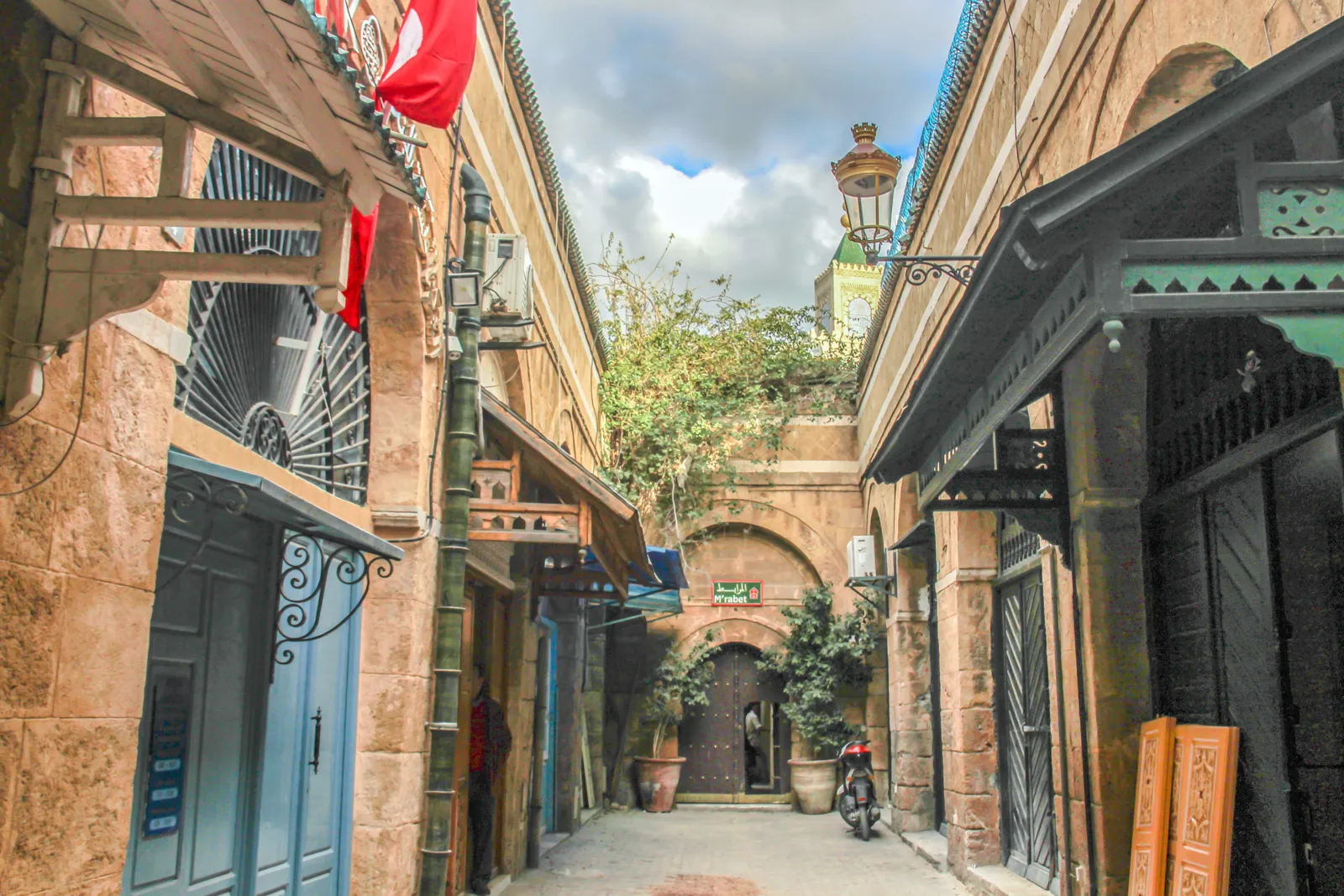
The houses combine Arab and Andalusian architecture: dazzling white facades, studded blue doors and, inside, patios, columns and colourful ceramics. Wikipedia lists several historic residences, including Dar Lasram, founded in 1831, and the Naceur Bey palace; most are private and can be seen from the street. The municipal gallery and several art galleries, including the Ammar-Farhat gallery, also dot the village.
Cafés with a view
The Café des Nattes (Café Halia), in the centre of the village, occupies the former entrance of the mosque and used to host malouf evenings. Further down, the Café de Sidi Chaabane has a view over the Gulf of Tunis. The marina, built after 1963, is at the foot of the cliff.
The zawiya and religious life
The present mosque and the saint’s zawiya date from the 18th century. Set on fire in January 2013, the zawiya was subsequently restored. Veneration of the saint remains alive: an annual Sufi festival, the kharja, brings together brotherhoods from all over Tunisia. Respect places of worship, which are not visitor sites.
Sunset at Sidi Bou Saïd: the month-by-month calculation
The village’s cafés and viewpoints are very popular at the end of the day. The table gives, for the 15th of each month, sunrise and sunset, as well as the closing time of the Ennejma Ezzahra ticket office: enough to plan the palace in the afternoon, then sunset.
| Month | Sunrise | Sunset | Day length | Ennejma Ezzahra ticket office |
|---|---|---|---|---|
| January | 7:30 am | 5:25 pm | 9 h 55 min | 4:30 pm |
| February | 7:07 am | 5:58 pm | 10 h 51 min | 4:30 pm |
| March | 6:30 am | 6:25 pm | 11 h 55 min | 4:30 pm |
| April | 5:45 am | 6:52 pm | 13 h 08 min | 4:30 pm |
| May | 5:11 am | 7:19 pm | 14 h 08 min | 4:30 pm |
| June | 4:58 am | 7:39 pm | 14 h 41 min | 4:30 pm |
| July | 5:10 am | 7:37 pm | 14 h 27 min | 3 pm |
| August | 5:35 am | 7:10 pm | 13 h 35 min | 3 pm |
| September | 6:00 am | 6:26 pm | 12 h 26 min | 4:30 pm |
| October | 6:25 am | 5:42 pm | 11 h 17 min | 4:30 pm |
| November | 6:56 am | 5:09 pm | 10 h 13 min | 4:30 pm |
| December | 7:23 am | 5:03 pm | 9 h 39 min | 4:30 pm |
In winter, the sun sets shortly after 5 pm: visit the palace in the morning. In summer, it sets around 7:40 pm and the palace closes as early as 3:30 pm: do the visit early, have lunch, then come back to the village at the end of the day.
Getting to Sidi Bou Saïd
The simplest way is the TGM, the suburban train line linking Tunis to La Marsa and serving Sidi Bou Saïd, according to Wikipedia. The network is run by Transtu, which publishes the 2026–2027 winter timetables and the TGM fares on its official website (as images). From the station, you walk up to the village. You can also come by taxi or car, but the heart of the village is covered on foot. We give no journey time, for lack of a readable official source.
Excursion or independent visit?
Sidi Bou Saïd is perfectly easy to visit on your own. Organised excursions from Tunis or the beach resorts often combine it with Carthage and the medina of Tunis. Before booking, check the time actually spent in the village, whether entry to Ennejma Ezzahra is included (closed on Mondays), the guide’s language and the cancellation terms.
Safety: what the UK FCDO says
The UK Foreign, Commonwealth & Development Office (FCDO), in its Tunisia travel advice (GOV.UK, updated 24 July 2026, text read on 26 October 2026), advises against all travel, or against all but essential travel, to areas of western Tunisia along the Algerian border and of southern Tunisia along the Libyan border, because of cross-border terrorist activity. Sidi Bou Saïd, on the Gulf of Tunis, is not among the areas it lists. The same advice says that terrorists are likely to try to carry out attacks in Tunisia, so stay aware of your surroundings. Check the current advice before you travel: UK FCDO, Tunisia.
Common mistakes at Sidi Bou Saïd
- Coming on a Monday for Ennejma Ezzahra: the palace is closed, as it is on public holidays.
- Arriving after 3 pm in July–August: the ticket office closes at 3 pm.
- Photographing the inside of the palace without authorisation from the administration.
- Wearing slippery shoes: the lanes are cobbled and sloping.
- Entering a house or a place of worship as if it were a museum: most residences are private.
What to see nearby
The village combines with the capital: our guide to visiting Tunis presents the medina and surroundings. For the seaside part of your trip, see our guides to Hammamet and Djerba, our comparison Djerba or Hammamet and, if you are still undecided on the destination, Morocco or Tunisia.
Frequently asked questions
Do you have to pay to visit Sidi Bou Saïd?
No, walking around the village is free. The Ennejma Ezzahra palace is paid: 10 dinars full price, 5 dinars reduced rate, according to the CMAM website consulted on 24 October 2026.
What are the opening hours of Ennejma Ezzahra?
Closed on Mondays and public holidays. From 1 September to 30 June, 9 am–1 pm and 2 pm–5 pm; in July–August and during Ramadan, 9 am–3:30 pm.
How do you get to Sidi Bou Saïd from Tunis?
By TGM, the suburban train between Tunis and La Marsa, which serves Sidi Bou Saïd station; or by taxi.
Why is Sidi Bou Saïd white and blue?
A decree of 28 August 1915 imposed these colours and protected the promontory against haphazard construction.
Is Sidi Bou Saïd a UNESCO site?
Yes, the « Village of Sidi Bou Saïd » is on the World Heritage List; the listing dates from July 2026 according to Wikipedia.
Is it safe to visit Sidi Bou Saïd?
The UK FCDO advises against travel to border areas in the west and south of Tunisia, not to the Gulf of Tunis area, but notes that terrorist attacks are likely to be attempted in the country: stay aware of your surroundings (GOV.UK, updated 24 July 2026).
Our sources
- UNESCO World Heritage Centre: « Village of Sidi Bou Saïd » (property description), consulted on 24 October 2026
- Centre for Arab and Mediterranean Music (cmam.tn, Ministry of Cultural Affairs): « Tarifs et horaire » and « Le palais » pages, consulted on 24 October 2026
- UK Foreign, Commonwealth & Development Office (FCDO), Tunisia travel advice, Warnings and insurance and Safety and security (GOV.UK, updated 24 July 2026), text downloaded on 26 October 2026
- Transtu (TGM operator), official website, consulted on 24 October 2026
- Wikipedia, « Sidi Bou Saïd » article (history, 1915 decree, cafés, transport, listing date), consulted on 24 October 2026
- Astronomical calculations: NOAA solar algorithm, applied by Destination de Voyage to the coordinates of Sidi Bou Saïd (Wikipedia) (15th of each month, year 2027, unobstructed horizon)
- Our methodology
Updated November 2026.