
Choose Morocco for variety: the medinas of Marrakech and Fez, the Atlas mountains and Toubkal, the Erg Chebbi dunes, Atlantic cities. Choose Tunisia for a shorter, cheaper beach and ancient-sites trip: Carthage, El Jem, Dougga, Hammamet, Sousse or Djerba. Note the official security advice: the UK FCDO advises against travel to some border areas of Tunisia, and the U.S. State Department rates both countries Level 2 (exercise increased caution).
Morocco or Tunisia? Both North African countries are visa-free for a short stay for US and UK citizens and require a passport. They share the same best seasons (spring and autumn), listed medinas and resort hotels on the coast. They differ in size and landscapes: Morocco combines mountains, desert and two coastlines; Tunisia, smaller, relies on its Mediterranean beaches, Roman sites and southern oases. This comparison uses only the data published in our guides to Morocco and Tunisia, with official entry and safety information read on 12 November 2026.
Morocco or Tunisia: the essentials
- Varied landscapes and hiking: Morocco (Atlas, Toubkal at 4,167 m / 13,671 ft, Dadès and Todra gorges, Erg Chebbi)
- Ancient sites: Tunisia (Carthage, El Jem, Dougga, Kerkouane)
- Budget (roughly, converted from euro estimates): Tunisia, about US$35-55 a day on a tight budget, against US$45-80 in Morocco
- Summer beach: Tunisia (Mediterranean); in Morocco, the Atlantic coast is mild but swimming needs care
- Safety: both are U.S. State Department Level 2; the UK FCDO advises against all travel to some border areas of Tunisia (see below)
- Entry: passport required in both; visa-free up to 90 days for UK and US citizens
Morocco or Tunisia: criteria compared
| Criterion | Morocco | Tunisia | Advantage |
|---|---|---|---|
| Best time | March to May and late September to November | April to June and September-October; desert from October to April | Tie |
| July climate | 37.7 °C (100 °F) high in Marrakech; about 22 °C (72 °F) in Essaouira | 34.0 °C (93 °F) high in Tunis | Depends on the region |
| January climate | 19.1 °C (66 °F) in Marrakech, cold nights | 16.4 °C (62 °F) in Tunis, sometimes rainy | Morocco |
| Entry (UK citizens) | Passport expiring at least 3 months after arrival; visa-free up to 90 days for tourism | Passport valid for the duration of your stay; visa-free up to 90 days | Tie |
| Entry (US citizens) | Valid passport with at least one blank page; no visa under 90 days | Valid passport; no visa for stays up to 90 days | Tie |
| Budget per day (small budget / comfort) | Roughly US$45-80 / 145-280 | Roughly US$35-55 / 100-180 | Tunisia |
| Medinas | Marrakech, Fez, Essaouira, Chefchaouen | Tunis, Sousse, Kairouan | Morocco |
| Ancient sites | Volubilis | Carthage, El Jem, Dougga, Kerkouane | Tunisia |
| Desert | Erg Chebbi (Merzouga), Erg Chigaga | Tozeur, Nefta, Douz, Chott el Djerid (some southern areas are off limits per the FCDO) | Morocco |
| Beaches | Agadir, Taghazout, Essaouira; strong currents on the Atlantic | Hammamet, Sousse, Monastir, Mahdia, Djerba | Tunisia |
| Official safety advice | U.S. Level 2 (terrorism); FCDO says terrorists are likely to try to carry out attacks | U.S. Level 2; FCDO advises against all travel to some western and southern border areas and all but essential travel to others; state of emergency since 2015 | Morocco |
Safety and entry requirements
Morocco. According to the UK FCDO (GOV.UK, updated 19 August 2026), terrorists are likely to try to carry out attacks in Morocco, including in places visited by foreign nationals; protests can occur without warning in large cities, and the land and sea borders with Algeria are closed. The U.S. State Department lists Morocco at Level 2: Exercise Increased Caution, due to terrorism (travel advisories, read 26 October 2026). UK citizens: passport with an expiry date at least 3 months after arrival, visa-free up to 90 days for tourism; a drone needs permission from the Directorate General for Civil Aviation or you risk fines and confiscation (FCDO). US citizens: a valid passport with at least one blank page; no visa for visits under 90 days (travel.state.gov, last updated July 30, 2026).
Tunisia. According to the UK FCDO (GOV.UK, updated 24 July 2026), a formal state of emergency has been in place since 2015. The FCDO advises against all travel to the Chaambi Mountains National Park, the military operations zones of Mount Salloum, Mount Sammamma and Mount Mghila, the militarised zone south of El Borma and Dhehiba, the area within 20 km (12 mi) of the Libyan border north of Dhehiba, and the town of Ben Guerdane; it advises against all but essential travel to other western and southern border areas. The U.S. State Department lists Tunisia at Level 2: Exercise Increased Caution (read 26 October 2026). UK citizens: passport valid for the duration of the stay, visa-free up to 90 days. US citizens: a valid passport, no visa for stays up to 90 days (travel.state.gov, last updated June 4, 2026).
Read both countries’ current advice just before departure: it can change at short notice. See also Morocco entry requirements and Tunisia entry requirements.
Climate: two hot summers, different coasts
| Month | Marrakech: high / rain | Tunis: high / rain |
|---|---|---|
| January | 19.1 °C (66 °F) / 25 mm (1.0 in) | 16.4 °C (62 °F) / 59 mm (2.3 in) |
| April | 25.7 °C (78 °F) / 26 mm (1.0 in) | 22.3 °C (72 °F) / 38 mm (1.5 in) |
| July | 37.7 °C (100 °F) / 2 mm (0.1 in) | 34.0 °C (93 °F) / 4 mm (0.2 in) |
| August | 37.4 °C (99 °F) / 5 mm (0.2 in) | 34.5 °C (94 °F) / 15 mm (0.6 in) |
| October | 28.5 °C (83 °F) / 19 mm (0.7 in) | 26.7 °C (80 °F) / 55 mm (2.2 in) |
| December | 20.1 °C (68 °F) / 24 mm (0.9 in) | 17.6 °C (64 °F) / 68 mm (2.7 in) |
Marrakech, inland, is hotter and drier than Tunis: nearly 38 °C (100 °F) in July-August, which is why these months are classed as a period to avoid for inland Morocco. The Moroccan Atlantic coast stays mild in summer, around 22 °C (72 °F) in Essaouira, but swimming there calls for great caution (currents, tides, beaches rarely supervised). In Tunisia, July-August is the high season for Mediterranean beaches, hot and expensive. In winter, Marrakech is sunny by day and cold at night, Tunis cooler and wetter; the desert is visited from October to April in both countries. Details: when to go to Morocco and when to go to Tunisia.
What to see: imperial cities and desert, or Carthage and the Mediterranean
Morocco
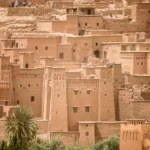
Morocco suits a weekend in Marrakech as well as a two-week circuit. Marrakech and its listed medina, Jemaa el-Fnaa square, the souks, the Bahia Palace and the Majorelle Garden; Fez el-Bali, its tanneries and madrasas; Meknes and the Roman site of Volubilis; Chefchaouen and its blue walls; Rabat and the Hassan II Mosque in Casablanca. The south is the major asset: the Tizi n’Tichka pass, the UNESCO-listed ksar of Aït Ben Haddou, the Dadès and Todra gorges, a night in a bivouac in the Erg Chebbi, at least three days round trip from Marrakech. Add Toubkal from Imlil and Essaouira on the Atlantic.
Tunisia
Tunisia packs its sites into a smaller territory. Tunis, its listed medina and the Bardo Museum with its Roman mosaics; Carthage and Sidi Bou Said, linked by the TGM train; Kairouan, a holy city, and the Roman amphitheatre of El Jem, both listed and easy from Sousse; Dougga as an excursion from Tunis. On the coast, Hammamet and Cap Bon (Kerkouane), Sousse, Monastir and Mahdia, then Djerba, the largest island in North Africa. In the south, Tozeur, Nefta, the Chott el Djerid and Matmata, from October to April, staying out of the areas the FCDO advises against.
Budget: Tunisia is cheaper
| Item (per person per day) | Morocco | Tunisia |
|---|---|---|
| Accommodation, small budget / comfort | Roughly US$15-35 / 65-145 | Roughly US$15-30 / 50-100 |
| Meals | Roughly US$10-25 / 35-65 | Roughly US$10-15 / 20-45 |
| Transport | Roughly US$5-15 / 30-55 | Roughly US$5-10 / 15-35 |
| Activities and visits | Roughly US$5-10 / 20-45 | Roughly US$5-10 / 10-30 |
| Total | Roughly US$45-80 / 145-280 | Roughly US$35-55 / 100-180 |
Tunisia is cheaper on every item, and its all-inclusive resort hotels are often the most economical formula for a beach stay outside July-August. In Morocco, a multi-day desert excursion is often the main expense of a circuit, and the boutique riads of Marrakech can be pricey. In both countries, souks are paid in cash and bargaining is customary, with courtesy.
Morocco or Tunisia by traveler profile
| Profile | Verdict | Why |
|---|---|---|
| Circuit and scenery | Morocco | Atlas, southern valleys, dunes, two coastlines |
| Beach | Tunisia | Hammamet, the Sahel and Djerba, from June to September |
| Families | Tunisia | Our guide highlights all-inclusive resort hotels |
| Culture and history | Tie | Imperial medinas and Volubilis; or Carthage, El Jem, Dougga, Kairouan |
| Small budget | Tunisia | Roughly US$35-55 a day outside July-August |
| Desert | Morocco | Erg Chebbi and Erg Chigaga by bivouac; in Tunisia, part of the south is off limits |
| Hiking | Morocco | Toubkal, High Atlas, Talassemtane park |
| Weekend | Morocco | Marrakech in two or three days |
| Wellness | Tunisia | Thalassotherapy in Hammamet, Monastir or Djerba, outside summer |
Families
Tunisia is the simplest for a family coming for the beach: coastal resort hotels, no long road trips. Morocco suits a stay in Marrakech or Agadir, but the desert circuit involves long drives, not recommended in high summer. Whichever you choose, check current official advice for the areas you plan to visit.
Culture lovers
A tie, with two styles. Morocco has the liveliest medinas (Fez, Marrakech) and the earthen architecture of the south. Tunisia has the edge for antiquity: Carthage, the amphitheatre of El Jem, Dougga and the Bardo mosaic collection. Visit in spring or autumn, as summer heat makes the sites tiring.
Women travelers
Both of our guides note that solo women may be the object of insistent attention or harassment. Dress modestly in the medinas, prefer official taxis and recommended accommodation, and avoid isolated places at night.
Why not both?
Our guides do not describe a link between Morocco and Tunisia, and a combined trip has little appeal for a stay of one or two weeks. It is better to choose one country per trip: Morocco for a circuit (Marrakech, desert and ocean in 7 to 10 days), Tunisia for a beach and ancient-sites stay. To go further: our guide to Marrakech and our guide to Djerba.
Frequently asked questions
Morocco or Tunisia for a beach holiday?
Tunisia, generally: Mediterranean beaches at Hammamet, the Sahel and Djerba, all-inclusive resort hotels and a lower budget. In Morocco, the Atlantic coast (Agadir, Essaouira, Taghazout) is cooler and swimming calls for great caution.
Which is cheaper?
Tunisia: roughly US$35-55 a day per person on a tight budget according to our guide, against US$45-80 in Morocco, excluding flights (converted from euro estimates).
Which is safer?
Both are Level 2 (Exercise Increased Caution) on the U.S. State Department scale. The UK FCDO says terrorists are likely to try to carry out attacks in Morocco; for Tunisia it advises against all travel to some border areas and notes a state of emergency since 2015. Check the current advice before you travel.
Do I need a passport?
Yes, for both countries. UK citizens: in Morocco the passport must expire at least 3 months after arrival; in Tunisia it should be valid for the duration of the stay. US citizens: a valid passport (with at least one blank page for Morocco). Both are visa-free up to 90 days for tourism.
What is the best time to go?
Spring and autumn: March to May and late September to November in Morocco, April to June and September-October in Tunisia. July-August is very hot in Marrakech (nearly 38 °C / 100 °F) and is the high season for Tunisian beaches.
Where can I see the desert?
In Morocco, in the Erg Chebbi near Merzouga, with a night in a bivouac, or the Erg Chigaga. In Tunisia, at Tozeur, Nefta and Douz, from October to April, staying out of the areas the UK FCDO advises against.
Our sources
- Our published guides, the source of all data on this page unless stated otherwise: Morocco, when to go to Morocco, Tunisia, when to go to Tunisia
- Climate: Moroccan General Directorate of Meteorology (via the WMO) and Tunisian National Institute of Meteorology, as cited in those guides
- Entry and safety, read on 26 October 2026: UK FCDO, Morocco travel advice (GOV.UK, updated 19 August 2026) and Tunisia travel advice (GOV.UK, updated 24 July 2026); U.S. Department of State, Morocco country information (last updated July 30, 2026) and Tunisia country information (last updated June 4, 2026), and the travel advisories feed on travel.state.gov
- Euro budget estimates converted at the European Central Bank reference rate of 23 October 2026 (€1 = US$1.1193)
- Our methodology
More contests await in our destination comparisons.
Updated November 2026.