Phnom Penh, the capital of Cambodia, sits where the Mekong meets the Tonlé Sap. Visiting Phnom Penh takes two to three days: the Royal Palace and the Silver Pagoda, the National Museum, the markets and the riverside, then the two Khmer Rouge memorial sites, Tuol Sleng (S-21) and Choeung Ek, inscribed as UNESCO World Heritage in 2025. Here are the things to do in Phnom Penh, official opening hours and prices, getting in from the new airport, the climate month by month and the safety advice of the US and UK governments.
Phnom Penh is the arrival point for many trips: see also our Cambodia travel guide, our page on visiting Angkor and our calendar of the best time to visit Cambodia.

Our travel deals for Phnom Penh
Affiliate links: we earn a commission, at no extra cost to you.
 FlightsKiwi.comCompare flights and airline combinations to Phnom Penh.Compare flights
- Airport transferKiwitaxiPrivate driver booked in advance at a fixed price.Book a transfer
- Tickets and toursTiqetsEntry tickets and guided tours to book online; compare with the official price.See tickets
- eSIMAiraloData plan to install before you leave (eSIM-compatible phone).See plans




Phnom Penh: the essentials
- Visa: required for US and UK citizens (e-visa or visa on arrival); free e-Arrival Card for air arrivals (travel.state.gov, last updated June 4, 2026; GOV.UK, updated 19 March 2026)
- Tuol Sleng (S-21): daily, 8:00 am to 5:00 pm; US$5 adults, US$3 ages 10 to 17, audio guide US$5 (checked 26 October 2026 on tuolsleng.gov.kh)
- Airport: Techo International Airport (KTI), south of the city, in service since 9 September 2025
- Currency: riel (KHR); the US dollar is widely used
- Best time: November to February (dry season, slightly less hot)
- Safety: beware of bag snatching, especially on the riverfront and in tuk-tuks (UK FCDO)
Things to do in Phnom Penh: the highlights
The Royal Palace and the Silver Pagoda
The king’s residence lines the Tonlé Sap riverfront. Part of the compound is open to visitors, including the Throne Hall and the Silver Pagoda (Wat Preah Keo), named after its floor of silver tiles. It is an official and religious site: wear clothes that cover your shoulders and knees, and check opening times on site, as access may be restricted during ceremonies.
The National Museum of Cambodia
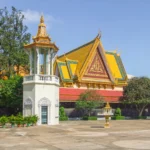
Right next to the palace, in a red terracotta Khmer-style building arranged around a garden, the National Museum holds one of the main collections of Khmer sculpture, from the pre-Angkor periods to Angkor. It is good preparation for the temples: go before Siem Reap. We could not read current opening hours and prices on an official website, so check on site.
Tuol Sleng (S-21) Genocide Museum
A former high school turned by the Khmer Rouge into a detention and torture center, S-21 prison is now a museum. Of the roughly 20,000 people held there, only about a dozen survivors are known. The site is part of the “Cambodian Memorial Sites” inscribed as UNESCO World Heritage in 2025. It is open daily, public holidays included, from 8:00 am to 5:00 pm; entry costs US$5 for international adults (18 and over) and US$3 for ages 10 to 17 (with ID), and the audio guide US$5 for non-Cambodian visitors (checked 26 October 2026 on tuolsleng.gov.kh). Allow time and calm: the visit is harrowing, and the audio guide helps you understand it.
Choeung Ek Genocidal Center
South of the city, Choeung Ek is the best known of the “killing fields”: prisoners from S-21 were executed there. A memorial stupa holds the skulls of victims. It belongs to the same group inscribed by UNESCO in 2025. Most visitors combine Tuol Sleng in the morning with Choeung Ek afterwards, by tuk-tuk or car with driver. The website that presented itself as official no longer shows reliable information: check hours and prices on site or with your accommodation.
Wat Phnom and Wat Ounalom
Wat Phnom, on a small wooded hill north of the center, is the temple that gave the city its name. Further south, on the riverfront, Wat Ounalom is one of the capital’s main Buddhist monasteries. Dress modestly and remove your shoes in the shrines.
The markets: Central, Russian and night market
The Central Market (Phsar Thmey), under its large yellow Art Deco dome, gathers jewelry, fabrics and food stalls. The Russian Market (Tuol Tom Poung), further south, is known for crafts and clothing. In the evening, a night market sets up near the riverside. Come in the morning to avoid the heat.
Sisowath Quay and the Mekong
Sisowath Quay runs along the Tonlé Sap, facing the Chroy Changvar peninsula: an evening stroll, restaurants and boat departures. Sunset cruises head up to the confluence with the Mekong. Further north, the island of Koh Dach, known for silk weaving, can be explored by bike or on a half-day trip.
Booking tours: official or reseller?
Tuol Sleng sells tickets at the entrance, at the price above. Agencies and platforms offer guided tours (Tuol Sleng and Choeung Ek in a half day, a Mekong cruise, Koh Dach): check whether entry fees are included, the guide’s language and the type of transport. The UK FCDO advises choosing tuk-tuks with metal grills on the back and sides, which offer some protection against bag snatching.
Itinerary: Phnom Penh in two or three days
- Day 1: Royal Palace and Silver Pagoda in the morning, National Museum, Central Market, Sisowath Quay at sunset.
- Day 2: Tuol Sleng at opening time, then Choeung Ek; a quiet afternoon at the Russian Market.
- Day 3: Wat Phnom and Wat Ounalom, then Koh Dach or a Mekong cruise.
- Next: Siem Reap and Angkor, or Kampot and Kep to the south (see our Cambodia guide).
When to go to Phnom Penh: climate month by month
Phnom Penh has a tropical climate with two seasons: a dry season from November to April, with the peak heat in April, and a rainy season from May to October, peaking in September and October. The table gives the official normals of Cambodia’s Ministry of Water Resources and Meteorology (MOWRAM) and, as our own calculation, the average rain over a one-week stay.
| Month | Max | Min | Rainfall | Rain over 7 days | Sunset on the 15th | Verdict |
|---|---|---|---|---|---|---|
| January | 31.2 °C (88 °F) | 21.5 °C (71 °F) | 20 mm (0.8 in) | 5 mm (0.2 in) | 17:55 | ✅ Dry, most pleasant |
| February | 32.7 °C (91 °F) | 22.5 °C (72 °F) | 3 mm (0.1 in) | 1 mm (0.0 in) | 18:07 | ✅ Driest |
| March | 34.5 °C (94 °F) | 24.2 °C (76 °F) | 63 mm (2.5 in) | 14 mm (0.6 in) | 18:10 | ⚠️ Heat building |
| April | 34.9 °C (95 °F) | 25.4 °C (78 °F) | 54 mm (2.1 in) | 13 mm (0.5 in) | 18:11 | ⚠️ Hottest |
| May | 34.3 °C (94 °F) | 25.4 °C (78 °F) | 117 mm (4.6 in) | 26 mm (1.0 in) | 18:16 | ⚠️ Hot, first rains |
| June | 33.1 °C (92 °F) | 25.3 °C (78 °F) | 138 mm (5.4 in) | 32 mm (1.3 in) | 18:24 | ⚠️ Rainy season |
| July | 32.4 °C (90 °F) | 24.7 °C (76 °F) | 149 mm (5.9 in) | 34 mm (1.3 in) | 18:28 | ⚠️ Frequent showers |
| August | 32.2 °C (90 °F) | 25.0 °C (77 °F) | 153 mm (6.0 in) | 35 mm (1.4 in) | 18:20 | ⚠️ Frequent showers |
| September | 31.7 °C (89 °F) | 24.1 °C (75 °F) | 253 mm (10.0 in) | 59 mm (2.3 in) | 18:01 | ❌ Wettest |
| October | 30.8 °C (87 °F) | 23.9 °C (75 °F) | 242 mm (9.5 in) | 55 mm (2.2 in) | 17:42 | ❌ Very rainy |
| November | 30.4 °C (87 °F) | 22.8 °C (73 °F) | 94 mm (3.7 in) | 22 mm (0.9 in) | 17:32 | ✅ End of the rains |
| December | 30.2 °C (86 °F) | 21.4 °C (71 °F) | 29 mm (1.1 in) | 7 mm (0.3 in) | 17:38 | ✅ Dry and less hot |
How to read it: February is the driest month (3 mm, or 0.1 in) and December-January the least hot (30 to 31 °C, or 86 to 88 °F, in the afternoon and 21 °C, or 70 °F, at night). April averages more than 34 °C (93 °F). In September, about 59 mm (2.3 in) falls in a single week, more than December, January and February combined. This close to the equator, the sun sets between 17:32 and 18:28 all year: plan outdoor visits early in the morning. The UK FCDO (GOV.UK, updated 19 March 2026) lists malaria and dengue among the health risks in Cambodia and notes that poor drainage floods roads in Phnom Penh during the monsoon, including on the way to the airport; see our dengue guide.
Getting to Phnom Penh and getting around
Techo International Airport
Since 9 September 2025, commercial flights have used Techo International Airport (KTI), south of Phnom Penh, which replaced the old Phnom Penh International Airport, according to the airport’s official website (techoairport.com.kh). Plan a road transfer: ask your accommodation about official shuttles and taxis. There are no nonstop flights from North America or the UK; most travelers connect through a major Asian hub.
Airport transfer
For a first night, a transfer booked in advance (taxi or shuttle with driver) saves negotiating on arrival. Compare the price offered by your hotel, the official airport counters and transfer platforms, and make sure the price is fixed before you set off.
Getting around the city
The center is easy to get around by tuk-tuk or with ride-hailing apps, which show the fare before the trip. The U.S. Department of State (travel.state.gov, last updated June 4, 2026) advises against moto-taxis for safety reasons and warns that belongings are easily stolen in tuk-tuks and cyclos; the UK FCDO recommends carrying bags on the side furthest from the road. For Siem Reap or Kampot, buses, taxis and domestic flights leave from the capital.
Where to stay in Phnom Penh
Sisowath Quay and the streets around the Royal Palace are the most convenient for sightseeing on foot. BKK1 (Boeung Keng Kang), south of the Independence Monument, has a concentration of hotels, cafés and restaurants in a more residential setting; Tuol Tom Poung, around the Russian Market, is more local. Check for air conditioning and a pool if you come between March and May.
If you… then…
| If you… | Then… |
|---|---|
| Only have two days | Palace, National Museum and riverside on day one; Tuol Sleng and Choeung Ek on day two |
| Are traveling with children | The memorial sites are harrowing: Tuol Sleng offers a reduced rate for ages 10 to 17, but prepare them or adapt the plan |
| Struggle with heat | Come from November to February and visit early in the morning; avoid April |
| Go out at night | Prefer a car (ride-hailing) to a tuk-tuk and keep your belongings out of sight |
| Are continuing to Angkor | Visit the National Museum before you leave, then take a bus or flight to Siem Reap |
| Arrive at night | Book your transfer from Techo airport before you travel |
Entry requirements, health and safety
US citizens: according to the U.S. Department of State (travel.state.gov, last updated June 4, 2026), you need a valid passport and a Cambodian visa (tourist visas are valid for one month), obtained online, from the Cambodian Embassy in Washington, DC, or on arrival at Phnom Penh and Siem Reap airports and major border crossings. Your passport must be valid for at least six months beyond your date of entry.
UK citizens: according to the UK FCDO (GOV.UK, updated 19 March 2026), you need a visa (30 days for tourism): an e-visa at least 4 days in advance or a visa on arrival, paid in US dollars. Your passport must be valid for at least 6 months from arrival and undamaged. Arriving by air at Phnom Penh, Siem Reap or Sihanoukville, you must submit the free e-Arrival Card within 7 days before arrival. More in our Cambodia visa guide.
Safety: the UK FCDO names the riverfront and BKK areas of Phnom Penh as petty crime hotspots, with bag snatchings by thieves on motorbikes, often causing injury. The U.S. Department of State asks travelers to be particularly vigilant at tourist sites in Phnom Penh and to avoid crowded riverfront areas during the November Water Festival, when millions of people come to the capital. The FCDO advises against all but essential travel to within 20 km (12 mi) of the land border with Thailand; Phnom Penh is far from that zone. Emergencies: 117 for the police, 119 for an ambulance (UK FCDO). The U.S. Department of State notes that Phnom Penh has a limited number of internationally run clinics providing basic care.
Practical tips for Phnom Penh
- Money: according to the U.S. Department of State, the US dollar is widely used alongside the riel and torn or stained bills are not accepted: bring small notes in good condition. It also reports fake US$50 and US$100 bills from some ATMs, so check your cash in front of the machine. Our currency converter gives the day’s rate.
- Time difference: Cambodia is on UTC+7, 7 hours ahead of London and 12 hours ahead of New York in winter (see time difference with Cambodia).
- Dress: shoulders and knees covered at the Royal Palace and in temples; light cotton clothing for the heat.
- Mobile data: a local SIM or an eSIM makes ride-hailing and navigation easier (see our eSIM guide).
Frequently asked questions
How many days do you need to visit Phnom Penh?
Two days are enough for the Royal Palace, the National Museum, Tuol Sleng and Choeung Ek; three days let you add the markets, Koh Dach and a Mekong cruise.
How much is entry to Tuol Sleng (S-21)?
US$5 for international adults, US$3 for ages 10 to 17, and US$5 for the audio guide for non-Cambodian visitors; open daily from 8:00 am to 5:00 pm (official website, checked 26 October 2026).
What is Phnom Penh’s new airport?
Techo International Airport (KTI), south of the capital, which took over commercial flights from the old airport on 9 September 2025.
What is the best time to visit Phnom Penh?
November to February: dry season and slightly lower temperatures. April is the hottest month, September and October the wettest.
Is Phnom Penh dangerous?
The UK FCDO names the riverfront and BKK areas as petty crime hotspots, with bag snatchings by thieves on motorbikes; keep bags out of sight, carry them away from the road and take extra care at night.
Do you need a visa for Phnom Penh?
Yes, US and UK citizens need a visa for Cambodia: an e-visa or a visa on arrival. Air arrivals must also submit the free e-Arrival Card within 7 days before arrival (GOV.UK).
Our sources
- Entry, health and safety information read on 26 October 2026: U.S. Department of State, Cambodia country information (travel.state.gov, last updated June 4, 2026), and UK FCDO, foreign travel advice for Cambodia (GOV.UK, updated 19 March 2026)
- Tuol Sleng Genocide Museum (tuolsleng.gov.kh): opening hours and prices, checked 26 October 2026
- Techo International Airport (techoairport.com.kh): start of commercial operations on 9 September 2025, checked 26 October 2026
- World Meteorological Organization, World Weather Information Service: MOWRAM 1982-2024 normals, Phnom Penh-Pochentong station
- Wikipedia articles “Phnom Penh” and “Tuol Sleng Genocide Museum” (2025 UNESCO inscription)
- Astronomical calculations: NOAA solar algorithm, applied by Destination de Voyage (15th of each month, year 2027)
- Our methodology
Updated October 2026.
Prices and opening hours may change: check the official websites before you go.