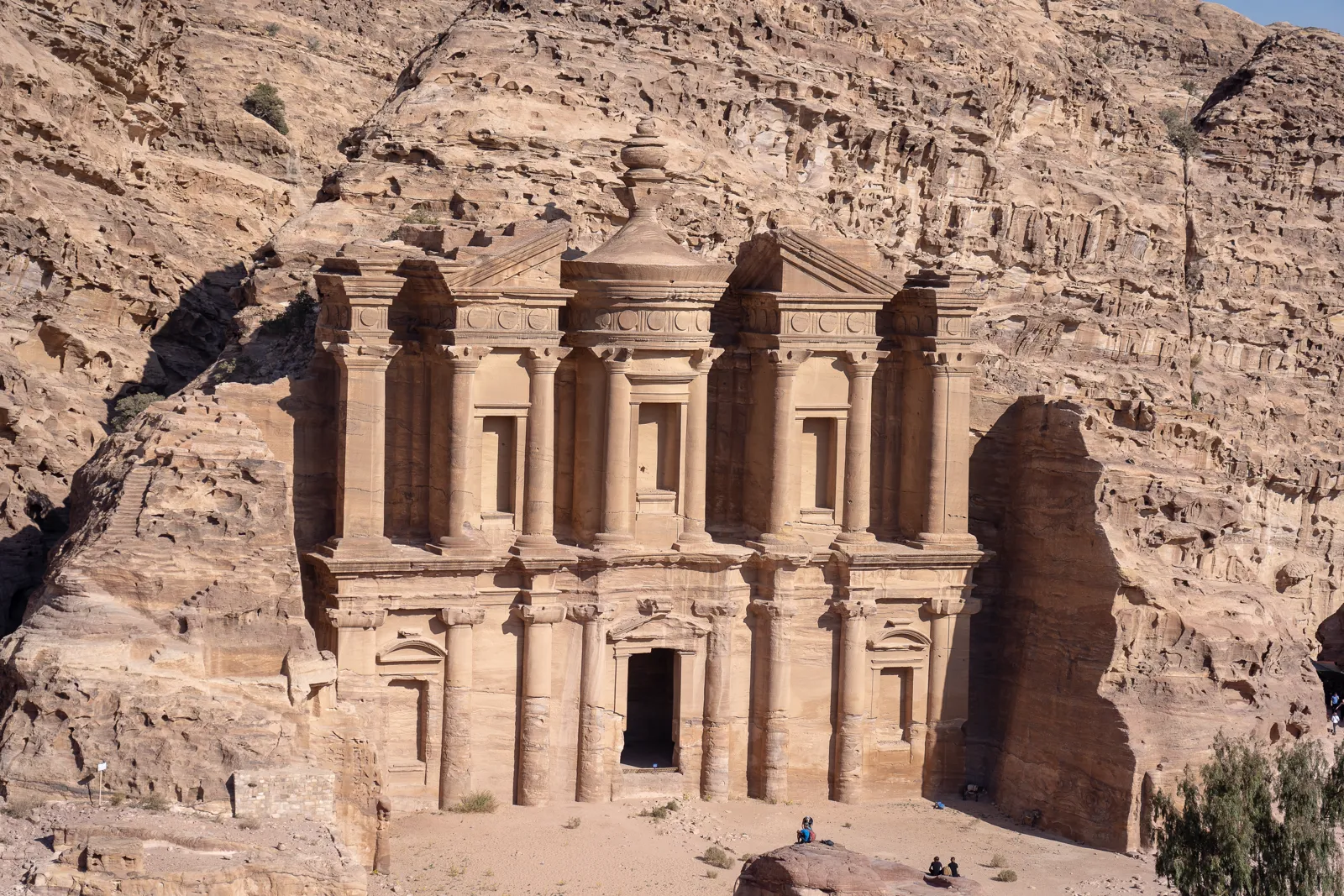
Visiting Angkor means exploring the former capital of the Khmer Empire: more than 50 temples covered by the pass, in a park of forest and rice paddies north of Siem Reap. Angkor Wat at sunrise, the faces of the Bayon, the roots of Ta Prohm, then more distant temples such as Banteay Srei or Beng Mealea. This guide helps you choose your Angkor Pass, plan a 1- to 3-day itinerary, decide when to go and work out how to get around. For entry into the country, see our page on Cambodia visas: e-visa or visa on arrival.
⚠️ Safety (UK FCDO, GOV.UK, updated 19 March 2026). After heavy fighting along parts of the Thailand-Cambodia border in 2025, a ceasefire was signed on 27 December, but the situation remains tense. The FCDO advises against all but essential travel to within 20 km (12 mi) of the land border with Thailand; some border temples, including Preah Vihear, are closed, and land crossings with Thailand remain suspended. Siem Reap and the Angkor park are outside this zone. For the remote northern temples (Koh Ker, Banteay Chhmar), check the latest GOV.UK travel advice before you go.

Our travel deals for Angkor
Affiliate links: we earn a commission, at no extra cost to you.
 FlightsKiwi.comCompare flights and airline combinations to Angkor.Compare flights
- eSIMAiraloData plan to install before you leave (eSIM-compatible phone).See plans


Angkor at a glance
- Location north of Siem Reap, in northwestern CambodiaAngkor Wat is a few kilometers from the town center
- Airports Siem Reap–Angkor (SAI), about 40 km (25 mi) east of Angkor Watno nonstop flights from the US or the UK; connect via an Asian hub · details
- Angkor Pass US$37 for 1 day, US$62 for 3 days(valid 7 days), US$72 for 7 days (valid 30 days)
- Opening hours entry from 5:00 am to 6:30 pm
- Ideal length 2 to 3 days of temples
- Best time November to February (dry season, bearable heat)
- Entry US and UK: visa required (e-visa or visa on arrival), e-Arrival Card for air arrivals · US: travel.state.gov · UK: GOV.UK
- Time zone UTC+7, no daylight saving · details7 h ahead of London and 12 h ahead of New York in winterLocal time now: –:–
- Currency riel (KHR); the US dollar is widely used · currencies
- Budget see our budget section
Angkor Pass: official prices and where to buy
Entry to the Angkor Archaeological Park requires a named pass, sold by Angkor Enterprise, the public body that runs ticketing. It is checked at the entrance to every major temple, so keep it on you all day.
| Pass | Price | Validity |
|---|---|---|
| Angkor, 1 day | US$37 | The chosen day |
| Angkor, 3 days | US$62 | 3 days to use within 7 days |
| Angkor, 7 days | US$72 | 7 days to use within 30 days |
| Koh Ker, 1 day | US$15 | Separate ticket |
| Beng Mealea, 1 day | US$10 | Separate ticket |
| Kbal Spean, 1 day | US$5 | Separate ticket |
- Where to buy: online on the official Angkor Enterprise website or its “Angkor Pass” app, or at the official ticket office in Siem Reap. Avoid unofficial resellers.
- Which one: the 1-day pass is enough for the three main temples; the 3-day pass is the most popular and lets you spread visits over a week, with breaks during the hottest hours.
- Sunrise: entry opens at 5:00 am; for Angkor Wat at dawn, leave Siem Reap before 5:30 am.
- Dress code: according to the UK FCDO (GOV.UK, updated 19 March 2026), you may be refused entry to religious sites, including Angkor Wat, in skirts or shorts above the knee; cover your shoulders.
Things to do in Angkor: the must-see temples
Angkor Wat
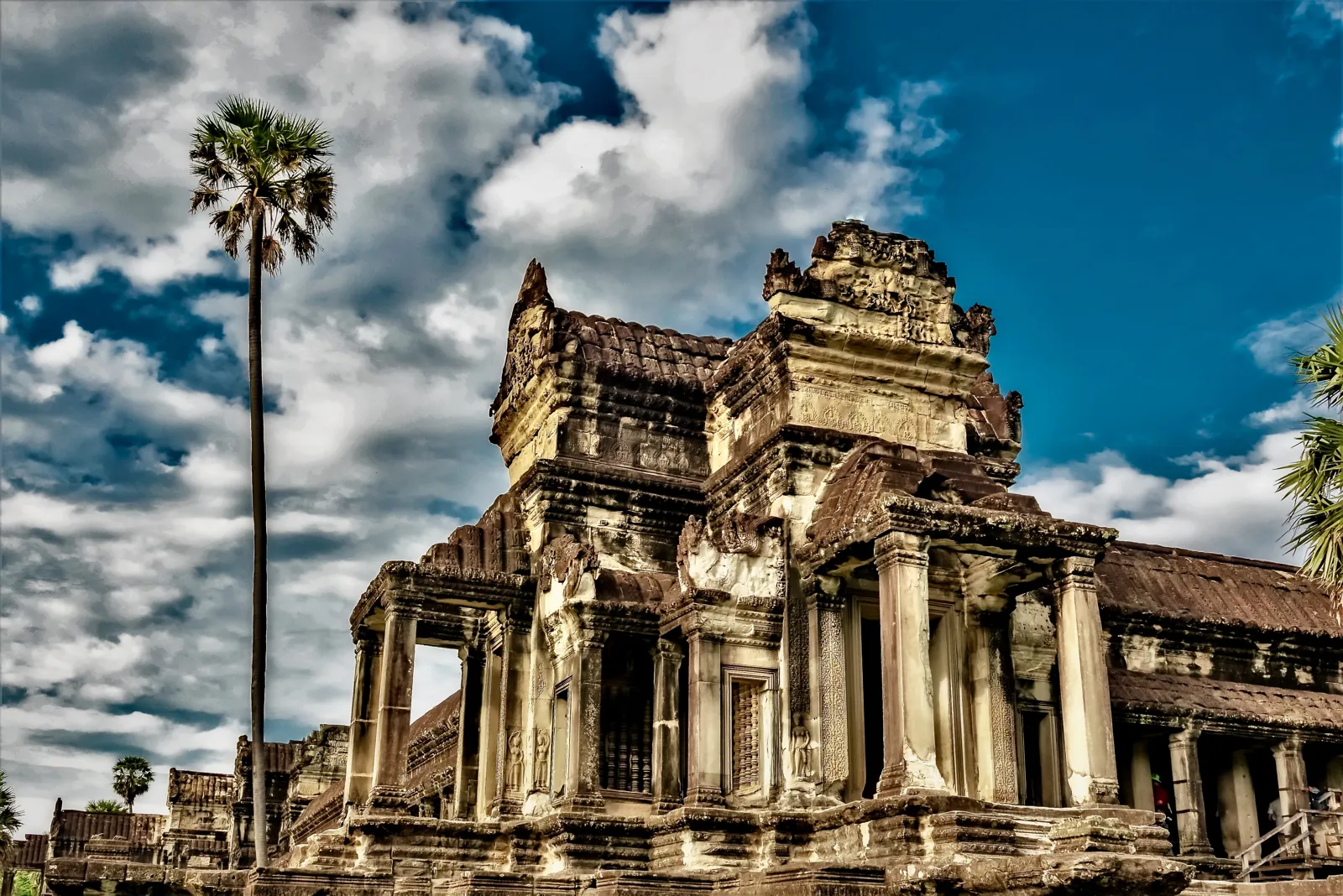
Built in the 12th century, Angkor Wat is, according to Angkor Enterprise, the largest religious monument in the world. You enter along a causeway over the moat, then walk through the bas-relief galleries (the Churning of the Ocean of Milk, the Battle of Kurukshetra) before climbing to the sanctuary towers. Sunrise behind the towers, seen from the ponds, draws crowds: for a quieter visit, explore the interior right afterwards, when the groups head off for breakfast.
Angkor Thom and the Bayon
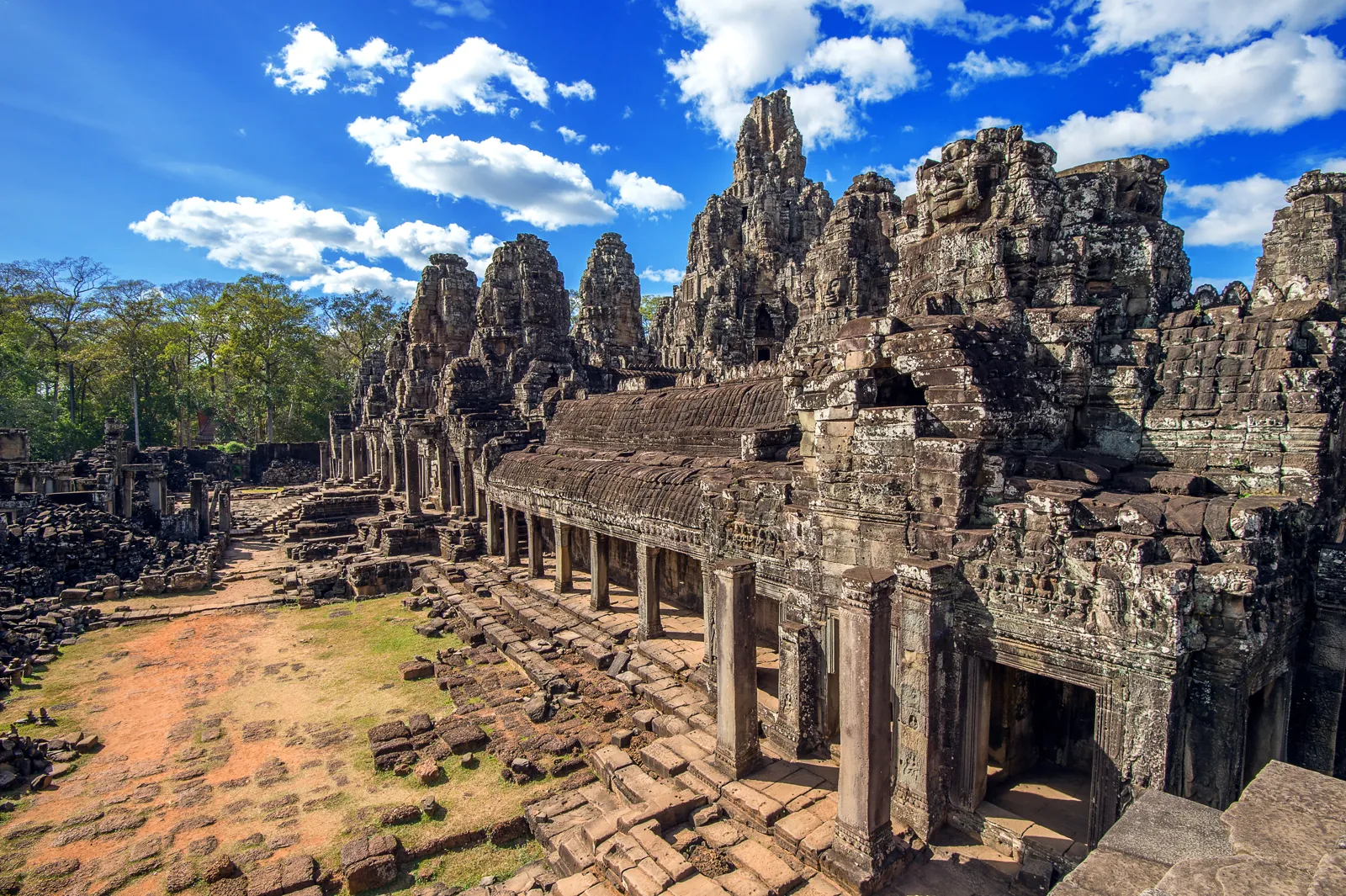
Angkor Thom is a fortified city of nearly 10 km2 (4 sq mi), entered through monumental gates, including the South Gate, lined with statues of gods and demons. At its center, the Bayon has dozens of towers carved with smiling faces. Nearby: the Baphuon, a restored temple-mountain, the Terrace of the Elephants and the Terrace of the Leper King.
Ta Prohm
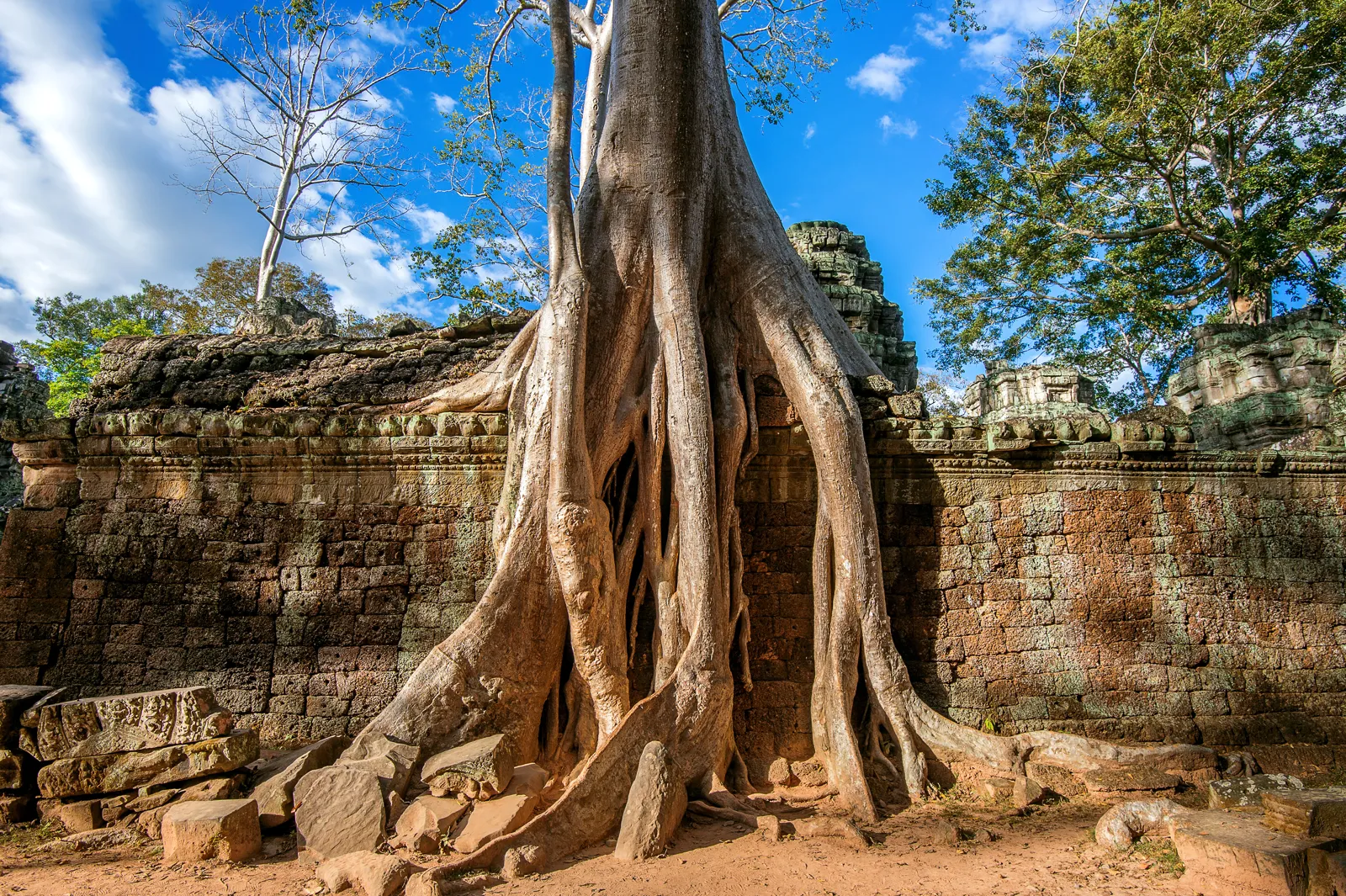
Left partly as the explorers found it, Ta Prohm is overrun by silk-cotton and fig trees whose roots grip the walls. It is one of the most photographed temples and is often packed by mid-morning: come at opening time or late in the afternoon.
The Small Circuit and the Grand Circuit
The Small Circuit (about 17 km, or 11 mi) links Angkor Wat, Angkor Thom, Ta Prohm and Banteay Kdei with the Srah Srang reservoir. The Grand Circuit (about 26 km, or 16 mi) adds Preah Khan, a vast temple with long corridors, Neak Pean, a shrine in the middle of a pool, Ta Som, the East Mebon and Pre Rup, popular at sunset.
Phnom Bakheng
This late 9th-century temple-mountain overlooks the plain. It is known for sunset views over Angkor Wat and the rice paddies; access to the top is controlled and visitor numbers may be limited at the end of the day.
Banteay Srei
About 25 km (16 mi) northeast of the main group, this small 10th-century temple dedicated to Shiva is famous for its very fine carvings in pink sandstone. It is included in the Angkor Pass. It is often combined with Kbal Spean, the “River of a Thousand Lingas”, whose riverbed is carved (separate ticket), at the end of a short forest walk.
Beng Mealea and Koh Ker
About 60 km (37 mi) to the east, Beng Mealea is a large collapsed temple overgrown by vegetation, explored on wooden walkways. Koh Ker, further north, was briefly the capital in the 10th century and has a seven-tiered pyramid. Both sites have their own ticket. For Koh Ker, check the UK FCDO advice first (see the warning at the top of the page).
Tonlé Sap Lake
South of Siem Reap, Cambodia’s great lake is lined with stilt and floating villages, such as Chong Kneas, reached by boat. The water level varies greatly with the seasons: highest at the end of the rainy season, low at the end of the dry season.
Itinerary: Angkor in 1 to 3 days
- Day 1: sunrise at Angkor Wat, visit of Angkor Wat, then Angkor Thom (South Gate, Bayon, Baphuon, terraces); a break in the heat of the day, and Ta Prohm in the late afternoon
- Day 2: Grand Circuit: Preah Khan, Neak Pean, Ta Som, East Mebon, then sunset at Pre Rup
- Day 3: Banteay Srei and Kbal Spean in the morning, or Beng Mealea; back via Banteay Samré; evening in central Siem Reap
With only one day, focus on Angkor Wat, the Bayon and Ta Prohm. To continue to Phnom Penh, Kampot or the coast, see our Cambodia travel guide.
Getting around the temples
- Tuk-tuk with driver: the most common option; hired by the day, with a higher rate for the Grand Circuit, sunrise or the remote temples. Agree on the route and price the day before.
- Car with driver: more comfortable and air-conditioned, recommended for Banteay Srei, Beng Mealea or Koh Ker, and in the hot season.
- Bicycle: doable on the Small Circuit for fit travelers in the dry season; the terrain is flat but it is hot.
- Electric scooter: available to rent in Siem Reap. The U.S. Department of State (travel.state.gov, last updated June 4, 2026) advises against moto-taxis for safety reasons and warns that belongings are easily stolen in tuk-tuks.
- From the airport: Siem Reap–Angkor International Airport is about 40 km (25 mi) from Angkor Wat; plan on a shuttle, taxi or hotel transfer.
- Flights: most travelers from North America or Europe connect through a major Asian hub; check current routes with the airlines.
- From Phnom Penh: bus or minibus to Siem Reap, or a domestic flight.
When to go to Angkor
The best time to visit Angkor is November to February: this is the dry season, with less than 10 mm (0.4 in) of rain a month from December to February in Siem Reap and mornings around 20 °C (68 °F). It is also high season, so get to the temples early. March to May are the hottest months (about 35 °C, or 95 °F, in the afternoon). From June to October, the monsoon brings regular storms, very green landscapes and fewer visitors.
| Month | Max | Min | Rain | Crowds | Prices | Verdict |
|---|---|---|---|---|---|---|
| January | 30.9 °C (88 °F) | 20.0 °C (68 °F) | 4 mm (0.2 in) | High | High | ✅ Dry, cool mornings: ideal |
| February | 32.3 °C (90 °F) | 21.3 °C (70 °F) | 4 mm (0.2 in) | High | High | ✅ Dry and sunny |
| March | 34.6 °C (94 °F) | 22.6 °C (73 °F) | 41 mm (1.6 in) | Medium | Medium | ⚠️ Heat building, temples early |
| April | 34.8 °C (95 °F) | 23.9 °C (75 °F) | 48 mm (1.9 in) | Medium (Khmer New Year) | Medium | ⚠️ Very hot, first storms |
| May | 35.3 °C (96 °F) | 24.6 °C (76 °F) | 143 mm (5.6 in) | Low | Low | ⚠️ Hottest, rains arrive |
| June | 32.7 °C (91 °F) | 25.1 °C (77 °F) | 195 mm (7.7 in) | Low | Low | ⚠️ Green season, frequent showers |
| July | 32.8 °C (91 °F) | 23.7 °C (75 °F) | 170 mm (6.7 in) | Medium (holidays) | Medium | ⚠️ Rainy, moats and paddies full |
| August | 31.8 °C (89 °F) | 24.8 °C (77 °F) | 170 mm (6.7 in) | Medium (holidays) | Medium | ⚠️ Rainy, prices still low |
| September | 31.9 °C (89 °F) | 24.6 °C (76 °F) | 305 mm (12.0 in) | Low | Low | ❌ Wettest, muddy paths |
| October | 31.3 °C (88 °F) | 22.4 °C (72 °F) | 227 mm (8.9 in) | Low | Low | ⚠️ Still very rainy |
| November | 31.6 °C (89 °F) | 22.3 °C (72 °F) | 62 mm (2.4 in) | High | High | ✅ Dry again, green landscapes |
| December | 30.7 °C (87 °F) | 20.3 °C (69 °F) | 7 mm (0.3 in) | Very high (holidays) | Very high | ✅ Dry and least hot |
- Cool dry season (November-February): the most pleasant for walking around the temples. The downside: crowds at sunrise and peak hotel prices, especially over the holidays.
- Hot season (March-May): strong, humid heat; visit from 5 am to 11 am, then again in the late afternoon. Khmer New Year, in mid-April, is a highlight.
- Rainy season (June-October): showers often fall in the afternoon; moats and ponds fill up and the vegetation is at its greenest. The UK FCDO (GOV.UK) notes that monsoon storms from June to October disrupt and damage roads, and lists malaria and dengue among the health risks in Cambodia.
| Goal | Best time |
|---|---|
| Temples in the best conditions | November to February |
| Sunrise photos with reflections | End of the rainy season and start of the dry season, when the ponds are full |
| Fewer people, lower prices | May to October |
| Tonlé Sap at high water | End of the rainy season |
For the rest of the country, see our page on the best time to visit Cambodia, and to compare, where to go in December or where to go in January.
Budget for visiting Angkor
Siem Reap remains an affordable stop, but the Angkor Pass and transport between the temples add up. Rough amounts per person per day, excluding flights (in US dollars, the currency most prices are quoted in; converted at the European Central Bank rate of 23 October 2026):
| Item | Budget | Comfort |
|---|---|---|
| Accommodation (per person, sharing a double room) | about US$11 to 28 | about US$50 to 125 |
| Meals | about US$11 to 20 | about US$28 to 50 |
| Transport between temples (tuk-tuk or car, per person share) | about US$11 to 22 | about US$22 to 45 |
| Total per day | about US$40 to 65 | about US$100 to 200 |
To save money: share a tuk-tuk between two or three people, choose the 3-day pass rather than two 1-day passes, and eat at the stalls near the temples or at the market rather than on Pub Street.
Who is Angkor for?
Our verdicts by traveler profile, based on the places, conditions and budget ranges in this guide:
- Culture and history: ideal: more than 50 temples covered by the pass, from Angkor Wat to the Bayon, plus the more distant sites of Banteay Srei, Beng Mealea and Koh Ker.
- Photographers: a very good choice: sunrise over Angkor Wat, the roots of Ta Prohm, sunset at Pre Rup or Phnom Bakheng; full ponds at the end of the rainy season give reflections.
- Budget travelers: yes: roughly US$40 to 65 per person per day in Siem Reap, sharing a tuk-tuk and taking the 3-day pass. The Angkor Pass (US$37 to 72) comes on top.
- Couples: yes: hotels with pools on the east bank or in the countryside around Siem Reap, temples early in the morning and late in the day.
- Families: possible if you adapt the pace: a break at the hotel during the hottest hours, an air-conditioned car rather than a bike, and only the major temples with young children. The pass is named, so keep it on you.
- Nature and hiking: as an extra: a short forest walk to Kbal Spean and the stilt villages of Tonlé Sap Lake.
- Beach: no: Siem Reap is inland. For the sea, continue to the Cambodian coast.
Where to stay to visit Angkor
- Central Siem Reap (Old Market, Pub Street): lively, with restaurants and bars within walking distance; noisy at night.
- East bank of the river (Wat Bo): quieter, guesthouses and hotels with pools, a few minutes from the center.
- Angkor road (toward the park): large hotels, as close as possible to the temples for sunrise.
- Countryside around Siem Reap: villas and small quiet hotels; you will need a tuk-tuk.
A pool is a real plus for the midday break in the hot season. From December to February, book early.
Entry requirements, health and safety
US citizens
- According to the U.S. Department of State (travel.state.gov, last updated June 4, 2026), you need a valid passport and a Cambodian visa; tourist visas are valid for one month from the date of entry. You can apply online, at the Cambodian Embassy in Washington, DC, or get a visa on arrival at Phnom Penh and Siem Reap airports and all major border crossings. Your passport must be valid for at least six months beyond your date of entry; fingerprints are collected electronically on arrival.
UK citizens
- According to the UK FCDO (GOV.UK, updated 19 March 2026), you need a visa (30 days for tourism): an e-visa applied for at least 4 days in advance, or a visa on arrival with a photo and payment in US dollars. Your passport must be valid for at least 6 months from arrival and be undamaged. If you arrive by air at Phnom Penh, Siem Reap or Sihanoukville, you must submit the free e-Arrival Card within 7 days before arrival.
- Health: the U.S. Department of State notes that Siem Reap has a limited number of internationally run clinics providing basic care, and that malaria, dengue and tuberculosis are serious health concerns; see a travel health professional before you go and protect yourself against mosquitoes. In an emergency, dial 119 for an ambulance and 117 for the police (UK FCDO).
- Theft: the UK FCDO reports bag snatchings by thieves on motorbikes, including from tourists in tuk-tuks, and sexual assaults on lone women in the Pub Street area of Siem Reap by men posing as motorbike taxi drivers. Keep your bag and phone out of sight and be wary of offers of transport.
- Landmines: the U.S. Department of State says landmines and unexploded ordnance are found in remote rural areas, including Siem Reap province: never walk in forested areas or dry rice paddies without a local guide, and stay on marked paths at isolated sites.
- Insurance: make sure your travel insurance covers medical care and evacuation; see our travel insurance guide.
Practical tips for visiting Angkor
- Pace: the heat wears you out quickly; visit from dawn to late morning, rest, and set off again around 3 pm.
- Water and sun: 2 to 3 liters of water per person per day, a hat, sunscreen and insect repellent.
- Respect the sites: do not touch the bas-reliefs, do not climb on unrestored ruins, and be discreet near monks and places of worship; the UK FCDO advises asking permission before photographing people, especially monks.
- Money: according to the U.S. Department of State, most prices are quoted in US dollars and change is often given in riels; torn or stained dollar bills are not accepted. Keep small notes.
- Guide: an official guide adds a lot to understanding the bas-reliefs; book one through your hotel or an agency in Siem Reap.
- Mobile data: check your home carrier’s roaming charges or buy a local SIM or eSIM.
Further reading
To choose your dates, our page on the best time to visit Cambodia covers the dry season, the hot season and the monsoon across the country. To plan your arrival and early wake-up for sunrise, check the time difference with Cambodia. And to extend your trip beyond the temples, our Cambodia travel guide covers Phnom Penh, Kampot and the coast.
Frequently asked questions
How much does the Angkor Pass cost?
According to Angkor Enterprise (checked 26 October 2026), US$37 for one day, US$62 for three days to use within a week and US$72 for seven days to use within a month. Koh Ker, Beng Mealea and Kbal Spean have separate tickets.
How many days do you need to visit Angkor?
Two to three days let you see Angkor Wat, Angkor Thom, Ta Prohm, the Grand Circuit and Banteay Srei without rushing. One day is enough for the three most famous temples.
What is the best time to visit Angkor?
November to February: dry season, less than 10 mm (0.4 in) of rain a month from December to February and mornings around 20 °C (68 °F) according to the Siem Reap normals. March to May are very hot.
Is it safe to visit Angkor despite the border conflict with Thailand?
Siem Reap and the Angkor park are outside the zone within 20 km (12 mi) of the Thai border where the UK FCDO advises against all but essential travel (GOV.UK, updated 19 March 2026). Check the latest advice before you go, especially for the remote northern temples.
Where can you buy the Angkor Pass?
On the official Angkor Enterprise website or its app, or at the official ticket office in Siem Reap. The pass is named and checked at the temple entrances.
How do you see sunrise at Angkor Wat?
The park opens at 5:00 am. Leave Siem Reap around 5 am with your tuk-tuk, stand near the ponds in front of the temple, then visit the interior right afterwards, when the crowds leave.
Our sources
- Angkor Enterprise, official pass sales website (angkorenterprise.gov.kh, “Available Tickets” page), checked 26 October 2026
- Entry, health and safety information read on 26 October 2026: U.S. Department of State, Cambodia country information (travel.state.gov, last updated June 4, 2026), and UK FCDO, foreign travel advice for Cambodia (GOV.UK, updated 19 March 2026)
- Climate: 1982-2024 normals for the Siem Reap station, Cambodia’s Ministry of Water Resources and Meteorology (MOWRAM), via the World Meteorological Organization’s World Weather Information Service
- European Central Bank: euro reference rates of 23 October 2026 (budget conversion)
- Our methodology
Updated October 2026.
To extend your trip, see our Cambodia travel guide, our guides to Thailand, Bangkok, Vietnam and Laos, and our other destinations in Asia.