Kefalonia is the largest of the Ionian Islands, west of mainland Greece. People come for white-pebble beaches such as Myrtos, its caves (the underground lake of Melissani, Drogarati cave), Mount Ainos and villages such as Assos and Fiskardo. This Kefalonia travel guide starts from one key point: the island is large and mountainous, so allow a week with a car, ideally in May-June or September.
It brings together the highlights, an itinerary, the budget, how to get there and the official climate, with a Destination de Voyage calculation: the number of rainy days to expect over a one-week holiday, month by month.
Our travel deals for Kefalonia
Affiliate links: we earn a commission, at no extra cost to you.
FlightsKiwi.comCompare flights and airline combinations to Kefalonia.
Time zoneUTC+2, UTC+3 in summer: 2 hours ahead of London, 7 hours ahead of New York · detailsLocal time now: –:–
AirportsKefalonia International Airport (EFL), near Argostoli · details
EntrySchengen area: no visa for up to 90 days for US citizens (tourism or business) and UK citizens (in any 180-day period) · US: travel.state.gov · UK: GOV.UK
Electricity230 V / 50 Hz, type F plugs (Visit Greece); US and UK travellers need an adapter, and US devices must accept 230 V · plugs
On the spota hire car is almost essential
What to see in Kefalonia: the highlights
Myrtos beach
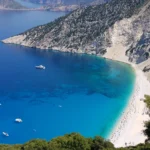
In the north-west, Myrtos is the island’s most photographed beach: an arc of white pebbles at the foot of cliffs, with turquoise water. You reach it by a winding road; the best viewpoint is on the main road above. The seabed drops quickly and the sea can be rough: take care with children. The UK FCDO (updated 11 August 2026) reminds visitors that a red flag means you must not enter the water.
Melissani lake and Drogarati cave
Near Sami, Melissani is a cave whose roof has collapsed: you visit its lake by rowing boat, and the light is best around midday, when the sun shines through the opening (also the busiest time). A few kilometres away, Drogarati cave has a large chamber of stalactites. Both visits fit easily into the same half-day.
Assos and Fiskardo
Assos is a small village on an isthmus, overlooked by a Venetian fortress you can walk up to. Further north, Fiskardo is one of the few villages spared by the 1953 earthquake: its old houses surround a harbour popular with yachts. Both can be combined in a day from Argostoli, with a stop at Myrtos.
Argostoli and the Lixouri peninsula
The main town was rebuilt after 1953: come for Valianou Square, the harbour promenade, the De Bosset bridge and the Agios Theodoros lighthouse. In the morning, loggerhead turtles often come close to the quays where fishermen clean their catch. A ferry links Argostoli to Lixouri on the Paliki peninsula, home to the beaches of Petani and Xi (red-orange sand, gently shelving).
Mount Ainos
Mount Ainos (1,628 m, 5,341 ft), the highest point of the Ionian Islands, is a national park covered by a fir forest unique to the island. A road climbs close to the summit, then waymarked trails let you walk in the cool, with views of Zakynthos and Ithaca on clear days.
Antisamos, Sami and the east coast
From Sami, the ferry port for Ithaca, a road leads to Antisamos bay, surrounded by wooded hills and known as a location for the film Captain Corelli’s Mandolin. Further north, Agia Efimia is a small, quiet harbour that makes a handy base. In season, a ferry also links Kefalonia with Vasiliki on the island of Lefkada.
Agios Gerasimos monastery and the Omala valley
In the Omala valley, the monastery of Agios Gerasimos is dedicated to the island’s patron saint. The valley is also home to robola, the local white wine, which you can taste at nearby wineries. Dress respectfully in the monastery.
Skala and the south-east
In the south-east, Skala is a resort with a long sand-and-pebble beach. The southern beaches (Lourdas, Kaminia, Mounda) are a nesting area for loggerhead turtles: respect the marked zones and do not stay on them at night in summer.
How many days to visit Kefalonia?
3 days: Argostoli, Melissani and Drogarati, Myrtos, Assos and Fiskardo. It is tight: the island is large and the roads are winding.
1 week (recommended): add Lixouri and its beaches, Mount Ainos, Antisamos, Skala and a trip to Ithaca.
10 days or more: combine with Ithaca (a few nights) or Lefkada via the seasonal ferry from Fiskardo.
Itinerary: one week in Kefalonia
Day 1: arrival, Argostoli, sunset at the Agios Theodoros lighthouse
Day 2: ferry to Lixouri, Petani and Xi beaches
Day 3: Melissani, Drogarati, Sami and Antisamos
Day 4: Myrtos, Assos, then Fiskardo
Day 5: day trip to Ithaca from Sami
Day 6: Mount Ainos in the morning, Agios Gerasimos monastery and the Omala wineries
Day 7: Skala and the southern beaches, departure
To compare with the other Ionian islands, see our guides to Corfu and Zakynthos, and our selection of Greek islands.
When to go to Kefalonia
The best times are May-June and September: 23 to 27 °C (73 to 81 °F) in the afternoon, very little rain and fewer people than in high summer. July and August are the driest months (less than one rainy day in July according to the HNMS normals) but also the busiest and most expensive. The season ends in October: from November, Argostoli gets more than 140 mm (5.5 in) of rain a month.
Month
Avg max
Avg min
Rain
Rain days per 7-day stay
Sunset
Verdict
January
14.5 °C (58 °F)
8.5 °C (47 °F)
113.3 mm (4.5 in)
3.2
17:41
❌ Rainy, island asleep
February
14.3 °C (58 °F)
8.3 °C (47 °F)
101.3 mm (4.0 in)
3.4
18:16
❌ Rainy, island asleep
March
16.0 °C (61 °F)
9.3 °C (49 °F)
69.4 mm (2.7 in)
2.4
18:44
⚠️ Cool, still damp
April
18.6 °C (65 °F)
11.3 °C (52 °F)
51.6 mm (2.0 in)
2.1
20:13
⚠️ Mild, cool sea
May
23.0 °C (73 °F)
14.6 °C (58 °F)
17.2 mm (0.7 in)
1.1
20:41
✅ Ideal, nature in bloom
June
26.9 °C (80 °F)
18.3 °C (65 °F)
8.6 mm (0.3 in)
0.4
21:02
✅ Ideal, dry and warm
July
29.3 °C (85 °F)
20.8 °C (69 °F)
6.0 mm (0.2 in)
0.2
21:00
⚠️ Very dry, crowds
August
29.9 °C (86 °F)
21.4 °C (71 °F)
9.4 mm (0.4 in)
0.4
20:32
⚠️ Hot, crowds, high prices
September
26.9 °C (80 °F)
19.0 °C (66 °F)
46.5 mm (1.8 in)
1.3
19:46
✅ Warm sea, fewer people
October
23.2 °C (74 °F)
16.1 °C (61 °F)
94.7 mm (3.7 in)
2.3
19:00
⚠️ Mild, more rain
November
19.0 °C (66 °F)
12.7 °C (55 °F)
147.3 mm (5.8 in)
3.0
17:25
❌ The wettest
December
15.7 °C (60 °F)
9.8 °C (50 °F)
147.0 mm (5.8 in)
3.5
17:18
❌ Rainy, few services
Temperatures and rainfall: 1970-2010 normals from the Hellenic National Meteorological Service (HNMS), Argostoli station (via the Wikipedia article « Argostoli »). Rain days per 7 days: Destination de Voyage calculation = average number of precipitation days in the month × 7 ÷ days in the month. Sunset on the 15th of the month: Destination de Voyage calculation (NOAA solar algorithm, Greek time).
Reading the calculation: over a week in July you can expect less than one day of rain; in December, more than three. For other Greek regions, see the best time to visit Greece.
Budget for Kefalonia
Accommodation and car hire prices rise sharply in July and August: compare rates when you book.
Getting to and around Kefalonia
By air: Kefalonia International Airport is near Argostoli. Routes are largely seasonal; out of season, connect via Athens. Check current routes with the airport and the airlines.
By ferry: links with the mainland and neighbouring islands, some only in season; routes and timetables change every year, so check them with the operators.
By car: the most practical option; the roads are winding, so allow more time than the distance suggests. See the driving rules in the entry section below.
By bus: the KTEL network links Argostoli with the main villages, with few departures outside summer.
Argostoli-Lixouri ferry: saves driving round the gulf.
Where to stay in Kefalonia
Area
Best for
Highlights
Argostoli and Lassi
First stay, no car
Restaurants, buses, Makris and Platis Gialos beaches
Sami and Agia Efimia
Central base
Melissani, Antisamos, ferries to Ithaca
Assos and Fiskardo
Couples, peace and quiet
Characterful villages, north of the island
Lixouri
Small budget, beaches
Petani and Xi, local atmosphere
Skala
Families, beach
Lively resort, sandy beach
Over a week, two bases (one in the south, one in the north) cut down on driving.
Entry requirements, health and safety
US citizens: Greece is in the Schengen area, so you may enter without a visa for up to 90 days for tourism or business. Greek law requires three months of passport validity beyond your departure date, but the State Department recommends at least six months; you must be able to show proof of sufficient funds and a return ticket if asked (U.S. Department of State, travel.state.gov, last updated February 19, 2026).
UK citizens: no visa for up to 90 days in any 180-day period in the Schengen area. Your passport must have been issued less than 10 years before you arrive and be valid for at least 3 months after the day you plan to leave; you may be asked for a return or onward ticket and proof of funds. Greek authorities have indicated they will not collect fingerprints and photos from UK travellers under the EU Entry/Exit System (UK FCDO, GOV.UK, updated 11 August 2026).
Health: according to the UK FCDO (updated 11 August 2026), treatment may be limited on the islands and some islands face serious shortages of ambulances; UK travellers need a GHIC or EHIC for state healthcare, which is not a substitute for travel insurance. The U.S. State Department strongly recommends insurance that covers medical evacuation.
Earthquakes: there is a risk of earthquakes and tremors in Greece (UK FCDO); follow the instructions of the local authorities.
Wildfires: the UK FCDO (updated 11 August 2026) reports a high wildfire risk from April to October; causing a wildfire is a criminal offence in Greece, even if unintentional. Do not light fires or barbecues. The UK FCDO advises enabling emergency alerts on your phone.
Swimming: many organised beaches use flags, and a red flag means you must not enter the water; do not dive into unknown water (UK FCDO, updated 11 August 2026).
Emergencies: call 112 (ambulance, fire, police); for an ambulance you can also dial 166 (UK FCDO). Visit Greece lists the Tourist Police on 1571 (24/7).
Quads and mopeds: helmets are compulsory; UK travellers need a licence with at least category A1 to hire a moped (UK category P is not valid in Greece), and quad biking is excluded from many insurance policies (UK FCDO, updated 11 August 2026). For cars, Greek law requires US visitors to carry a US licence and an International Driving Permit (travel.state.gov).
Book your car early for July-August: the fleet is limited.
Water shoes: most beaches are pebbly.
Melissani: arrive at opening time to avoid the queue, or around midday for the light, accepting the crowds.
Turtles: do not feed or touch them, in the harbour or on the beaches.
Local food: robola wine, meat pie (kreatopita), sugar-coated almonds (mandoles).
Mobile data: check your home carrier’s roaming charges before you go.
Frequently asked questions
How many days do you need to visit Kefalonia?
A week is ideal with a car. In 3 days you will see Argostoli, Melissani, Myrtos, Assos and Fiskardo, but with a lot of driving.
How do you fly to Kefalonia?
Kefalonia International Airport (EFL) is near Argostoli; many routes are seasonal, and out of season you usually connect via Athens. Check current routes with the airport and the airlines.
What is the most beautiful beach in Kefalonia?
Myrtos is the most famous. Antisamos, Petani and Xi are also very popular, each with a different character (pebbles, red sand, wooded bay).
Do you need a car in Kefalonia?
It is strongly recommended: the island is large and buses are infrequent away from the main roads.
Where can you see turtles in Kefalonia?
In Argostoli harbour in the morning, near the fishing boats, and off the southern beaches, a nesting area for loggerhead turtles.
What is the best month for Kefalonia?
June and September: pleasant heat, a good sea and almost no rain according to the HNMS normals, with fewer people than in August.
Our sources
Hellenic National Meteorological Service (HNMS): 1970-2010 normals, Argostoli station, via the Wikipedia article « Argostoli »
Destination de Voyage calculation: rain days over a week, sunset times (NOAA solar algorithm)


 FlightsKiwi.comCompare flights and airline combinations to Kefalonia.Compare flights