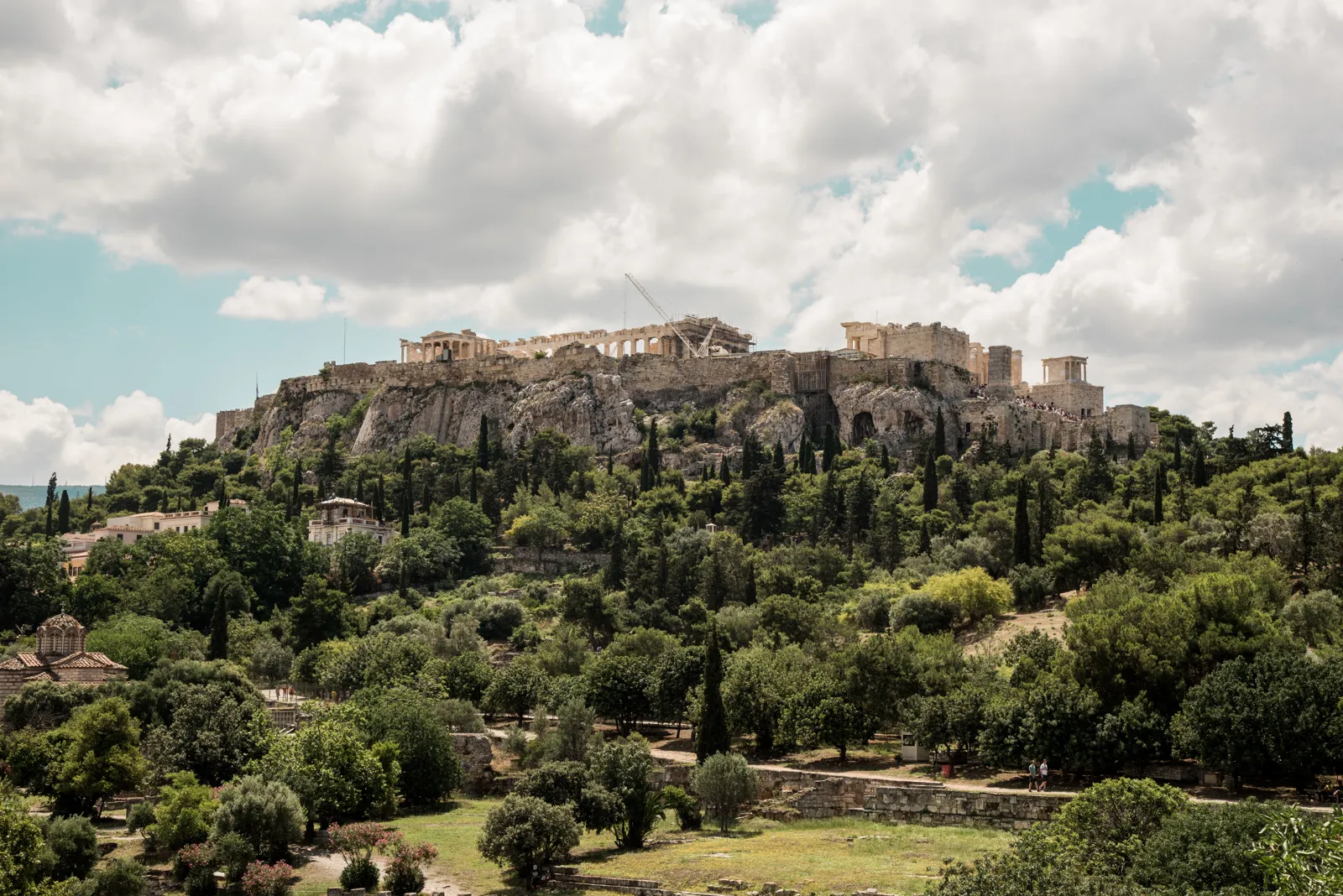
The best time to visit Greece is mid-April to June and September to mid-October: it is already warm, the sea is swimmable for much of these months, and you avoid both the heatwaves and the July–August crowds. Summer remains the main season for the islands, but it is also the most expensive, the hottest and the period with the highest risk of wildfires. Athens and the islands are located on our map of Greece.
Greece has a Mediterranean climate: dry, hot summers and mild, rainy winters. The differences are mainly between the mainland, colder in winter, the Ionian Sea (Corfu), which is much wetter, and the southern Aegean (Crete, Rhodes), the mildest and driest. Here is when to go to Greece depending on climate, region and your plans, based on the climate normals published by the Hellenic National Meteorological Service (HNMS).

Our travel deals for Greece
Affiliate links: we earn a commission, at no extra cost to you.
 FlightsKiwi.comCompare flights and airline combinations to Greece.Compare flights

When to go to Greece at a glance
- Best times mid-April to June and September to mid-October
- For the beach June to September; Crete and Rhodes extend the season into October
- For Athens and the ancient sites April–May and October, when it is below 30 °C (86 °F) in the afternoon
- Best avoided if possible mid-July to late August (heat, crowds, peak prices) and the week of August 15
- In summer the meltem, a north wind, blows across the Aegean and can disrupt ferries
- Best value for money May and late September–October
- Winter mild but rainy, ideal for a weekend in Athens; many island hotels are closed
When to go to Greece by priority
- Best weather: May–June and September to combine sites and swimming; October in Crete and Rhodes
- Cheapest: November to March outside the holidays for Athens and the mainland; May and October for the islands
- Fewest crowds: May and October, when most island hotels are open; June or September for Santorini and Mykonos
- Events: Orthodox Easter (date varies, March to May), Athens and Epidaurus Festival in summer, August 15 (heavy crowds)
Greece: the calendar at a glance
🔎 Month by month: Greece in April · Greece in October
✅ Best months: April, may, June, September, October
Climate in Greece month by month
The table below gives the normals for Athens (coastal Elliniko station), the arrival point for most trips and representative of the mainland and the nearby Cyclades. The islands and the north are detailed further down.
| Month | Avg. max | Avg. min | Rain | Crowds | Prices | Verdict |
|---|---|---|---|---|---|---|
| January | 13.6 °C (56 °F) | 7.0 °C (45 °F) | 48 mm (1.9 in) | Low | Low | ⚠️ Mild but rainy, islands in slow motion |
| February | 14.1 °C (57 °F) | 7.1 °C (45 °F) | 39 mm (1.5 in) | Low | Low | ⚠️ Cool and changeable, carnival at the end of the month in some years |
| March | 15.9 °C (61 °F) | 8.5 °C (47 °F) | 42 mm (1.7 in) | Low | Low | ⚠️ Early spring, sea still cold |
| April | 19.6 °C (67 °F) | 11.5 °C (53 °F) | 26 mm (1.0 in) | Moderate (Easter) | Moderate | ✅ Mild, ideal for Athens and the sites |
| May | 24.4 °C (76 °F) | 15.8 °C (60 °F) | 14 mm (0.6 in) | Moderate | Moderate | ✅ The best compromise |
| June | 29.2 °C (85 °F) | 20.3 °C (69 °F) | 5 mm (0.2 in) | High | High | ✅ Summer without the August crowds |
| July | 32.2 °C (90 °F) | 23.0 °C (73 °F) | 6 mm (0.2 in) | Very high | Very high | ⚠️ Heat, possible heatwaves, meltem |
| August | 32.2 °C (90 °F) | 23.1 °C (74 °F) | 6 mm (0.2 in) | Very high (August 15) | Very high | ⚠️ Hottest and most expensive |
| September | 28.3 °C (83 °F) | 19.6 °C (67 °F) | 12 mm (0.5 in) | High, then moderate | High, then moderate | ✅ Warm sea, crowds falling |
| October | 23.4 °C (74 °F) | 15.7 °C (60 °F) | 46 mm (1.8 in) | Moderate → low | Moderate → low | ✅ Still pleasant, rain returns at the end of the month |
| November | 18.8 °C (66 °F) | 12.0 °C (54 °F) | 60 mm (2.4 in) | Low | Low | ⚠️ Rainy, season over on the islands |
| December | 15.1 °C (59 °F) | 8.8 °C (48 °F) | 62 mm (2.4 in) | Low | Low | ⚠️ The wettest month, good for a city break |
Note: these averages smooth out extremes. In summer, heatwaves can push temperatures far higher (the UK FCDO lists extreme heat among Greece’s natural hazards): plan visits early in the morning or late in the day.
The seasons in Greece: pros and cons
Spring (April to June): the ideal season to combine everything
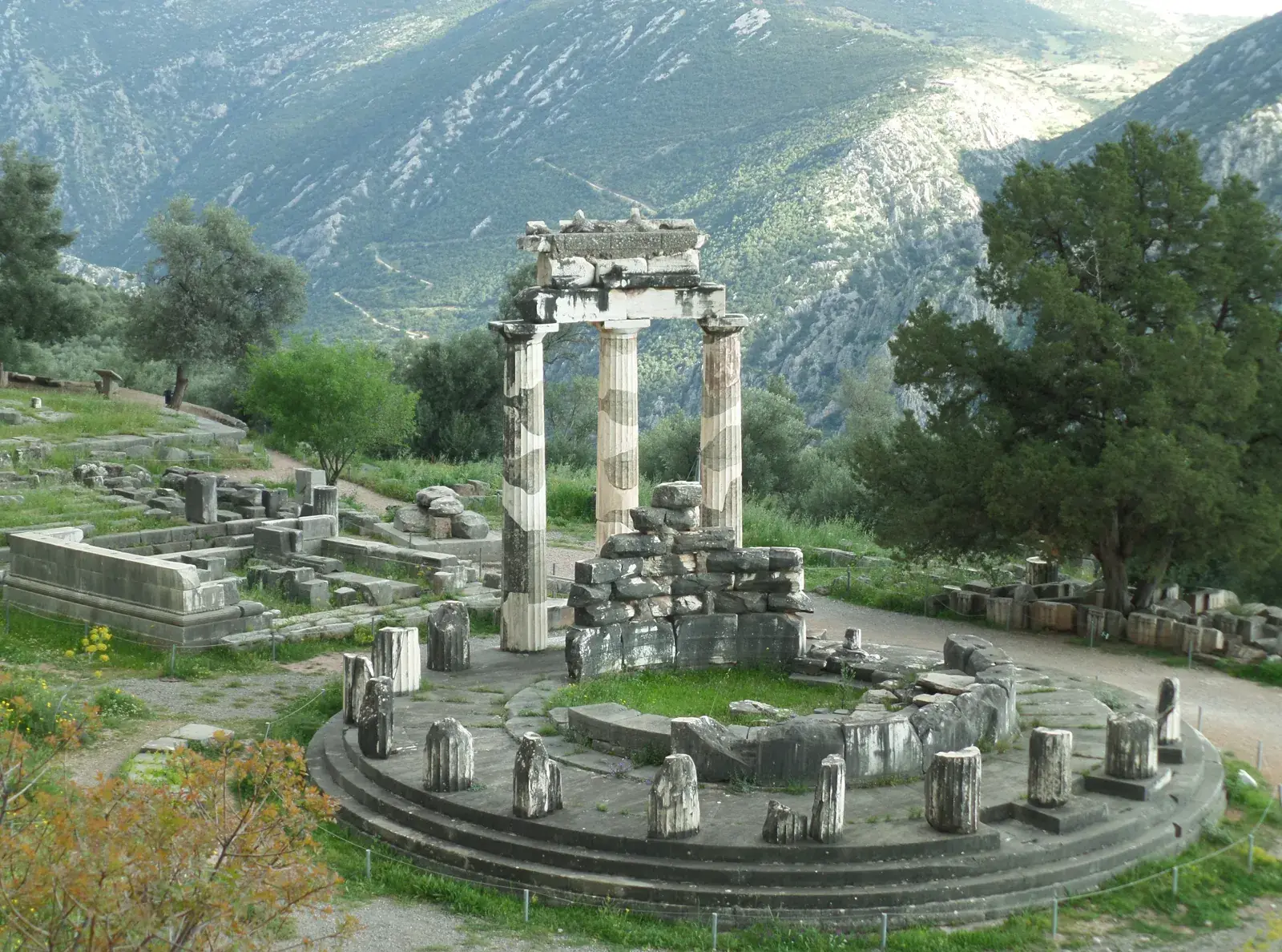
Spring is the most balanced period. In Athens, highs rise from 20 °C (68 °F) in April to 29 °C (84 °F) in June, and it hardly rains from May (14 mm (0.6 in) on average). The hills are still green and the ancient sites can be visited without crushing heat. The sea stays cool in April but becomes pleasant from late May in the south.
- Pros: mild temperatures, flowering nature, prices still reasonable before July, most island hotels open from May
- Cons: sea still cool in April, some ferry connections less frequent than in summer early in the season
- Good to know: Orthodox Easter, the most important festival of the year, falls on a different date each year, sometimes at the same time as Western Easter: a very special atmosphere, but transport and hotels are in high demand that weekend
- Our tip: May and June are the best months for a first trip combining Athens, the Peloponnese and one or two islands
Summer (July–August): high season on the islands

This is the season most travelers aim for: cloudless skies, more than 30 °C (86 °F) everywhere, warm sea. But it is also the peak holiday period in Europe and in Greece: the best-known islands (Santorini, Mykonos) are saturated, and accommodation and ferry prices peak. On the Aegean, the meltem, a dry and sometimes strong north wind, blows mostly in July–August: it cools the air, but stirs up the sea and can delay or cancel ferries and small boats.
- Pros: guaranteed fine weather, nightlife and summer festivals, all ferry connections running
- Cons: heatwaves, crowds, peak prices, high risk of wildfires
- Wildfires: according to the UK FCDO (GOV.UK, updated 11 August 2026), there is a high risk of wildfires during the summer season from April to October; make sure your mobile phone is set to receive emergency alerts, do not light fires, and call 112 if you see one.
- Who is it for? Travelers who want the beach above all and whose dates are fixed by school holidays: book very early and favor the lesser-known islands
Autumn (September–October): warm sea without the crowds
September is often considered the best month for the beach: the sea has stored up the summer’s heat, the air drops below 30 °C (86 °F) in Athens and the crowds fall markedly once the summer holidays end. October remains pleasant, especially in Crete and Rhodes (about 24 to 25 °C (75 to 77 °F) in the afternoon), but the rains return at the end of the month and the islands begin to close. This end of season in Crete and Rhodes is detailed in our page on the weather in Greece in October, island by island.
- Pros: warm sea, falling prices, soft light for sightseeing, grape and olive harvests
- Cons: first storms possible in October, ferry services and accommodation scaling back from mid-October
- Our tip: the second half of September is an excellent compromise for the Cyclades
Winter (November to March): Athens and the mainland
Winter is mild on the coasts (13 to 15 °C (55 to 59 °F) in the afternoon in Athens, 15 °C (59 °F) in Crete), but it is the rainy season: more than 60 mm (2.4 in) a month in Athens in November–December, nearly 190 mm (7.5 in) in Corfu. On the islands, most hotels, restaurants and rental companies close and there are fewer ferries. The north and the mountains have a real winter, with snow at altitude.
- Pros: sites and museums without the crowds, low prices, authentic local life in Athens and Thessaloniki
- Cons: sea too cold for most swimmers, very quiet islands, short days
- Who is it for? A cultural city break in Athens, a tour of the mainland (Delphi, Meteora) or small budgets
When to go to Greece by region
The southern Aegean is the hottest and driest; the Ionian coast, in the west, receives much more rain in autumn and winter. Comparison of the normals of four cities:
| Month | Athens | Heraklion (Crete) | Rhodes | Corfu |
|---|---|---|---|---|
| January | 13.6 °C (56 °F) / 48 mm (1.9 in) | 15.2 °C (59 °F) / 81 mm (3.2 in) | 15.1 °C (59 °F) / 152 mm (6.0 in) | 13.9 °C (57 °F) / 136 mm (5.4 in) |
| February | 14.1 °C (57 °F) / 39 mm (1.5 in) | 15.3 °C (60 °F) / 60 mm (2.4 in) | 15.2 °C (59 °F) / 102 mm (4.0 in) | 14.1 °C (57 °F) / 123 mm (4.8 in) |
| March | 15.9 °C (61 °F) / 42 mm (1.7 in) | 16.8 °C (62 °F) / 49 mm (1.9 in) | 17.0 °C (63 °F) / 69 mm (2.7 in) | 16.0 °C (61 °F) / 100 mm (3.9 in) |
| April | 19.6 °C (67 °F) / 26 mm (1.0 in) | 20.1 °C (68 °F) / 24 mm (0.9 in) | 20.0 °C (68 °F) / 29 mm (1.1 in) | 19.1 °C (66 °F) / 65 mm (2.6 in) |
| May | 24.4 °C (76 °F) / 14 mm (0.6 in) | 24.3 °C (76 °F) / 13 mm (0.5 in) | 24.1 °C (75 °F) / 16 mm (0.6 in) | 24.0 °C (75 °F) / 37 mm (1.5 in) |
| June | 29.2 °C (85 °F) / 5 mm (0.2 in) | 28.5 °C (83 °F) / 4 mm (0.2 in) | 28.3 °C (83 °F) / 2 mm (0.1 in) | 28.2 °C (83 °F) / 16 mm (0.6 in) |
| July | 32.2 °C (90 °F) / 6 mm (0.2 in) | 30.3 °C (87 °F) / 1 mm (0.0 in) | 30.4 °C (87 °F) / 0 mm (0.0 in) | 31.2 °C (88 °F) / 9 mm (0.4 in) |
| August | 32.2 °C (90 °F) / 6 mm (0.2 in) | 30.2 °C (86 °F) / 1 mm (0.0 in) | 30.7 °C (87 °F) / 0 mm (0.0 in) | 31.5 °C (89 °F) / 22 mm (0.9 in) |
| September | 28.3 °C (83 °F) / 12 mm (0.5 in) | 27.5 °C (82 °F) / 18 mm (0.7 in) | 28.1 °C (83 °F) / 6 mm (0.2 in) | 27.5 °C (82 °F) / 88 mm (3.5 in) |
| October | 23.4 °C (74 °F) / 46 mm (1.8 in) | 24.0 °C (75 °F) / 43 mm (1.7 in) | 24.5 °C (76 °F) / 57 mm (2.2 in) | 23.2 °C (74 °F) / 140 mm (5.5 in) |
| November | 18.8 °C (66 °F) / 60 mm (2.4 in) | 20.1 °C (68 °F) / 56 mm (2.2 in) | 20.2 °C (68 °F) / 90 mm (3.5 in) | 18.7 °C (66 °F) / 187 mm (7.4 in) |
| December | 15.1 °C (59 °F) / 62 mm (2.4 in) | 16.7 °C (62 °F) / 82 mm (3.2 in) | 16.7 °C (62 °F) / 153 mm (6.0 in) | 15.2 °C (59 °F) / 190 mm (7.5 in) |
Athens and the mainland (Delphi, Meteora, Peloponnese)
Athens is very hot in July–August (an average high of 32 °C (90 °F), often more in the city). The best windows to visit the Acropolis, Delphi, Olympia or the Peloponnese are April–May and September–October. Meteora and the mountains of the north are cooler: winter there is cold and snow is possible.
Thessaloniki and the north
The north has a more continental climate. In Thessaloniki, average highs barely exceed 11 °C (52 °F) in January and lows fall to around 3 to 4 °C (37 to 39 °F), while highs reach 32 °C (90 °F) in July–August, according to the 1991–2020 normals of the Aristotle University station. Rainfall is moderate all year (25 to 50 mm (1.0 to 2.0 in) a month). May–June and September are the most pleasant for combining the city and the beaches of Halkidiki.
The Cyclades (Santorini, Mykonos, Naxos, Paros)
A dry, sunny climate from May to September, but very exposed to the meltem in July–August: strong wind on the beaches on the north of the islands and sometimes rough seas for crossings. In practice the season runs from May to mid-October; outside it, many businesses are closed. To avoid the crowds in Santorini and Mykonos, aim for June or September. See also when to go to Santorini.
Crete and the Dodecanese (Rhodes, Kos)
These are the warmest regions in the shoulder season: about 24 °C (75 °F) in the afternoon in October in Heraklion and Rhodes, against 23 °C (73 °F) in Athens, and 20 °C (68 °F) in November. In summer it hardly rains at all (less than 2 mm (0.1 in) a month in July–August). It is therefore the best choice for a beach in May or October. Winter, however, is quite rainy in Rhodes (more than 150 mm (5.9 in) in December–January). Details in when to go to Crete.
Corfu and the Ionian Islands
The Ionian Sea is the greenest region of Greece, because it is the wettest: nearly 190 mm (7.5 in) of rain a month in Corfu in November–December, and already 88 mm (3.5 in) in September. Summer there is hot (31 °C (88 °F)) and less windy than in the Cyclades. Aim for June to mid-September; spring is superb but still changeable. See when to go to Corfu.
Which region for which month?
This table summarizes the best period for each major region, based on the normals and seasons detailed above.
| Region | Jan | Feb | Mar | Apr | May | Jun | Jul | Aug | Sep | Oct | Nov | Dec |
|---|---|---|---|---|---|---|---|---|---|---|---|---|
| Athens and the mainland | ⚠️ | ⚠️ | ⚠️ | ✅ | ✅ | ⚠️ | ⚠️ | ⚠️ | ✅ | ✅ | ⚠️ | ⚠️ |
| Thessaloniki and the north | ⚠️ | ⚠️ | ⚠️ | ⚠️ | ✅ | ✅ | ⚠️ | ⚠️ | ✅ | ⚠️ | ⚠️ | ⚠️ |
| Cyclades (Santorini, Mykonos) | ❌ | ❌ | ❌ | ⚠️ | ✅ | ✅ | ⚠️ | ⚠️ | ✅ | ⚠️ | ❌ | ❌ |
| Crete and Rhodes | ⚠️ | ⚠️ | ⚠️ | ✅ | ✅ | ✅ | ⚠️ | ⚠️ | ✅ | ✅ | ⚠️ | ⚠️ |
| Corfu and the Ionian Islands | ❌ | ❌ | ❌ | ⚠️ | ⚠️ | ✅ | ✅ | ✅ | ⚠️ | ❌ | ❌ | ❌ |
Island-by-island detail: when to go to Santorini, to Crete and to Corfu.
When to go to Greece for your plans
| Your plan | Best time | Where? |
|---|---|---|
| First trip (Athens, ancient sites and islands) | May–June, September | Athens, Peloponnese, Cyclades |
| Beach and swimming | June to September (until October in the south) | Crete, Rhodes, Cyclades, Corfu |
| Off-season beach | Late May, early October | Crete, Rhodes |
| Ancient sites and museums | April–May, October | Athens, Delphi, Olympia, Mycenae |
| Hiking | April to June, mid-September to October | Crete (Samaria Gorge), Meteora, Zagori |
| Island-hopping by ferry | June, September | Cyclades, Dodecanese |
| Tight budget | May, October; winter for Athens | Mainland, Naxos, Crete |
| Family trip | June, late August, October in the south | Crete, Rhodes, Corfu |
| Honeymoon | June or September | Santorini, Milos, Naxos |
Where to go in Greece by month
| Month | Where to go first? | Why |
|---|---|---|
| January to March | Athens, Thessaloniki | City break and museums; islands in slow motion |
| April | Athens, Peloponnese, Delphi, Crete | About 20 °C (68 °F) in the afternoon, sites without the heat |
| May | Crete, Rhodes, Cyclades, mainland | About 24 °C (75 °F), almost no rain |
| June | Cyclades, Corfu, the whole country | Summer without the August crowds |
| July–August | Ionian Islands, lesser-known islands | Less meltem than in the Cyclades; book early |
| September | Cyclades, Crete, Rhodes | Warm sea, crowds falling |
| October | Crete, Rhodes | About 24 °C (75 °F) in the afternoon, the furthest south |
| November–December | Athens | Mild but rainy; islands closed |
Major events to fit into your trip
| Period | Event | Location |
|---|---|---|
| The weeks before Orthodox Lent (date varies) | Carnival | Patras, and across the country |
| March 25 | Independence Day (parades) | Nationwide |
| Date varies (March to May) | Orthodox Easter, the most widely observed festival of the year | Nationwide |
| Summer | Athens and Epidaurus Festival (theater, music) | Athens, ancient theater of Epidaurus |
| August 15 | Dormition of the Virgin Mary (pilgrimages, heavy crowds) | Nationwide, notably Tinos |
| October 28 | Ochi Day (national holiday) | Nationwide |
Greece month by month
Greece in January: Mild but rainy (about 14 °C (57 °F) in the afternoon in Athens). Museums and sites without the crowds, islands almost at a standstill. A good month for a city break.
Greece in February: Close to January, with carnival sometimes at the end of the month. Snow possible in the mountains and the north.
Greece in March: Days lengthen and nature turns green, but the sea stays cold. Independence Day on March 25.
Greece in April: Spring sets in (about 20 °C (68 °F) in Athens), little rain. Ideal for the ancient sites. Check the date of Orthodox Easter.
Greece in May: One of the best months: 24 °C (75 °F), almost no rain, island hotels open, moderate prices. The sea becomes swimmable in the south at the end of the month.
Greece in June: Start of summer: 28 to 29 °C (82 to 84 °F), pleasant sea, very long days, crowds still reasonable before July.
Greece in July: Peak season: heat (an average of 32 °C (90 °F) in Athens, heatwaves possible), meltem in the Cyclades, high prices.
Greece in August: The busiest and most expensive month, with the peak around August 15. High wildfire risk: follow the official alerts.
Greece in September: Warm sea, falling heat (28 °C (82 °F) in Athens), crowds receding after the first half of the month. An excellent month for the islands.
Greece in October: Still fine in Crete and Rhodes, more changeable elsewhere at the end of the month. The islands begin to close after mid-October.
Greece in November: Frequent rain, especially in Corfu. Season over on the islands; Athens remains pleasant between showers.
Greece in December: The wettest month in Athens (62 mm (2.4 in)) and Corfu, but mild. Low prices, festive atmosphere in the cities.
When to book your trip to Greece
For July–August, book flights, accommodation and ferries 3 to 6 months ahead: well-located hotels on the most popular islands go early and prices climb as summer approaches. Do the same for the Orthodox Easter weekend and the week of August 15. In May, June, September and October, 1 to 2 months is generally enough, and in winter you can book at the last minute.
Planning your trip to Greece
- Entry requirements: rules depend on your nationality: see our entry requirements for Greece.
- Currency: the euro. Cards are widely accepted, but keep a little cash for small tavernas and island villages.
- Health: according to the UK FCDO (GOV.UK, updated 11 August 2026), get appropriate travel insurance covering local treatment and medical evacuation; a GHIC or EHIC is not an alternative to travel insurance.
- Heat and emergencies: according to the UK FCDO (GOV.UK, updated 11 August 2026), Greece can experience extreme natural phenomena such as earthquakes, wildfires, extreme heat and flash floods, and the FCDO points travelers to the Summer Proof Your Health campaign for coping with heat. The emergency number is 112.
To go further, see our complete Greece travel guide.
Frequently asked questions
What is the best month to visit Greece?
May, June and September are the most balanced months: pleasant warmth, almost no rain, swimmable sea (especially from late May) and fewer people than in July–August. To visit Athens and the ancient sites, April, May and October are also very good.
When should you go to Greece to be warm and swim?
From June to September everywhere. Crete and Rhodes, the furthest south, extend the season: about 24 °C (75 °F) in the afternoon in October and almost no rain from May to September, according to the Greek weather service’s normals.
Can you go to Greece in July or August?
Yes, it is the high season on the islands. Expect strong heat (heatwaves can go well above these averages), high prices, crowds and the meltem in the Cyclades. Book early and keep an eye on official wildfire alerts.
What is the cheapest time to go to Greece?
From November to March, outside the holidays, for Athens and the mainland. For the islands, May and October offer the best balance of weather and prices, when most hotels are open without charging summer rates.
What is the meltem?
It is a dry north wind that blows across the Aegean in summer, especially in July and August. It makes the heat more bearable, but it can be strong, stir up the sea and cause ferry delays or cancellations. Keep some slack in your island itinerary.
Is the weather good in Greece in winter?
It is mild on the coasts (13 to 16 °C (55 to 61 °F) in the afternoon), but it is the rainy season, especially in Corfu and Rhodes. Winter suits a cultural stay in Athens, not a beach vacation.
Can you go to Greece in April?
Yes. April is mild (about 20 °C (68 °F) in the afternoon in Athens) and not very rainy: it is a good month for Athens, Delphi and the Peloponnese. The sea stays cool for swimming and some islands are not yet in full season. Check the date of Orthodox Easter, a period in high demand.
Where should you go in Greece in October?
To Crete and Rhodes, the furthest south: about 24 °C (75 °F) in the afternoon and little rain before the end of the month. Elsewhere, October remains good for sightseeing, but the rains return at the end of the month and many island businesses close after mid-October.
Our sources
- Hellenic National Meteorological Service (HNMS): 1955–2010 normals for the Athens-Elliniko, Rhodes and Corfu stations, 1991–2020 normals for Heraklion airport
- Aristotle University of Thessaloniki: 1991–2020 normals from its weather station
- Health and safety information read on 26 October 2026: UK FCDO, foreign travel advice for Greece (GOV.UK, updated 11 August 2026). Public holiday dates checked on 11 November 2026: Gov.gr, official holidays
- Our methodology
Updated November 2026.