Santorini is what remains of a great volcano in the Cyclades: its white villages sit on the rim of a caldera, a vast basin partly flooded by the sea and lined by cliffs more than 300 m (984 ft) high. The island is small, very popular and expensive in summer, but within a few kilometres it combines panoramas, a major archaeological site, volcanic sand beaches and vineyards. For a Santorini travel guide in a nutshell: allow three to four days for the essentials (Fira, Oia, the caldera trail, Akrotiri, the volcano and a beach) and a budget of roughly €75 to €145 per person per day on a tight budget, excluding flights. This guide helps you choose what to see and do, where to stay and when to go.

Our travel deals for Santorini
Affiliate links: we earn a commission, at no extra cost to you.
 FlightsKiwi.comCompare flights and airline combinations to Santorini.Compare flights
- Airport transferKiwitaxiPrivate driver booked in advance at a fixed price.Book a transfer


Santorini at a glance
- Main town Fira (Thira)
- Language Greek; English is widely spoken in tourist areas
- Currency the euro · currencies
- Time zone UTC+2, UTC+3 in summer: 2 hours ahead of London, 7 hours ahead of New York · detailsLocal time now: –:–
- Airports Santorini airport (JTR) and Athinios port (ferries)Seasonal international flights; via Athens the rest of the year
- Entry Schengen area: no visa for up to 90 days for US citizens (tourism or business) and UK citizens (in any 180-day period) · US: travel.state.gov · UK: GOV.UK
- Electricity 230 V / 50 Hz, type F plugs (Visit Greece); US and UK travellers need an adapter, and US devices must accept 230 V · plugs
- Budget see our budget section
When to go to Santorini
✅ Best months: April, may, June, September, October
❌ Period to avoid: January, February, December
The best times are late April to June and September to mid-October: 20 to 28 °C (68 to 82 °F) in the afternoon, almost no rain and a pleasant sea from June to September. July and August are the hottest (about 30 °C / 86 °F on average) and by far the busiest; from November to March, the island is quiet, windy and largely closed. All the details, month by month: when to go to Santorini.
What to see and do in Santorini: the highlights
Fira, the clifftop capital
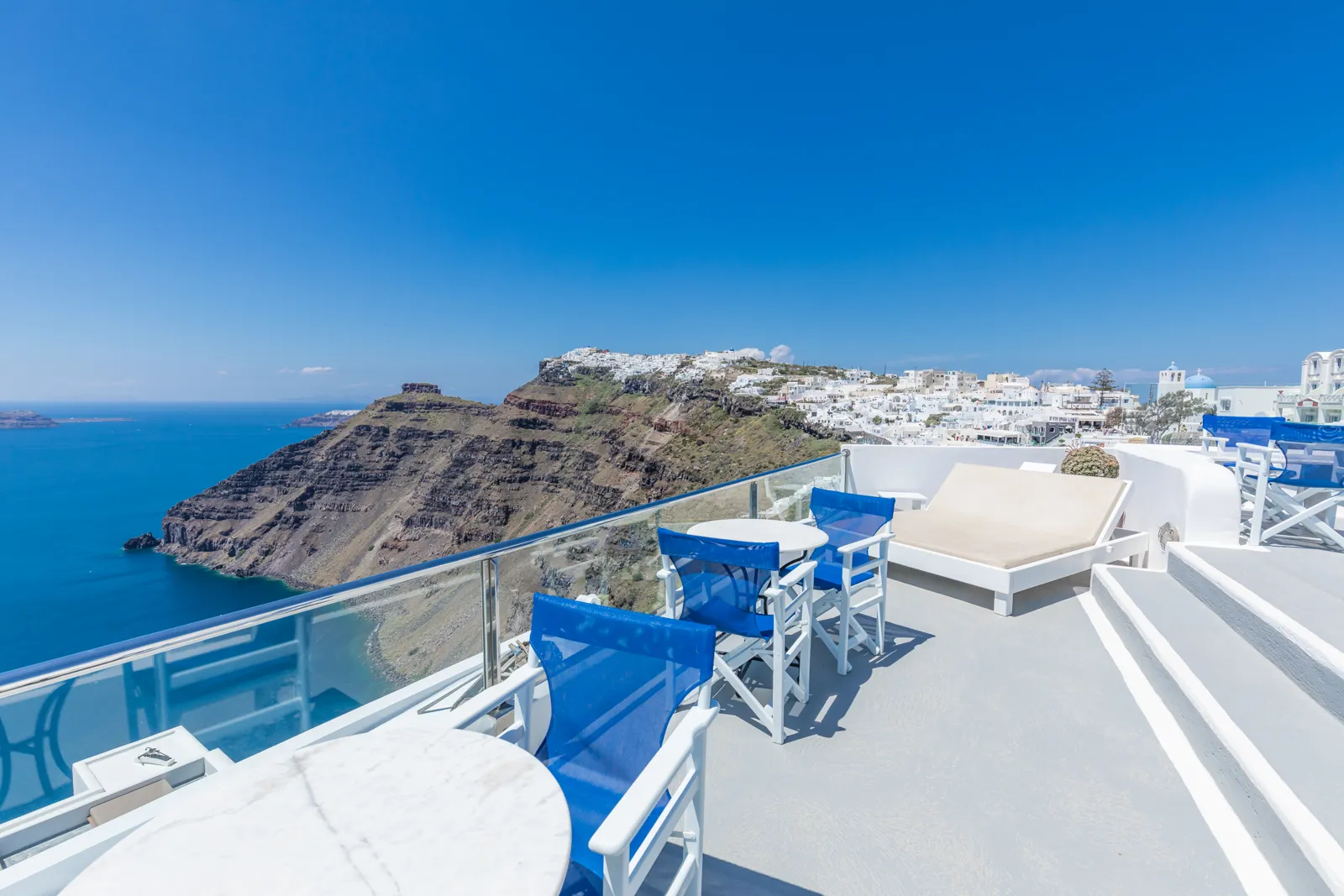
Fira stretches along the rim of the caldera, more than 200 m (656 ft) above the sea. It is the hub of the island: bus station, shops, restaurants and many hotels with a view. The Museum of Prehistoric Thera displays objects and frescoes from the site of Akrotiri. Below, the old port is linked to the town by a cable car and a long stairway. Fira is very busy, especially when several cruise ships call on the same day.
Oia and its sunsets
At the northern tip of the island, Oia is the most photographed village on Santorini, with its white houses, blue domes and old captains’ mansions. In the evening, crowds gather near the castle ruins for the sunset. To enjoy it more peacefully, come in the morning, outside summer, or look for another viewpoint along the ridge. Below, the small bay of Ammoudi has fish tavernas.
Imerovigli, Firostefani and Skaros Rock
Between Fira and Oia, Imerovigli is the highest point on the caldera rim. Quieter than its neighbours, it is known for hotels with infinity pools. Skaros Rock, the former site of a Venetian fortress, juts into the caldera and is reached by a path. Firostefani, a few minutes’ walk from Fira, offers similar views in a calmer setting.
The Fira to Oia trail
This trail follows the caldera ridge for about ten kilometres (6 mi). It passes through Firostefani and Imerovigli, then climbs and descends over wilder ground to Oia. Allow generally 3 to 5 hours depending on your pace and breaks. There is almost no shade: set off early with plenty of water, and avoid it in the heat of the day. You can return by bus.
Akrotiri archaeological site
In the south of the island, Akrotiri is a Bronze Age town buried under ash in the great eruption of Santorini, about 3,600 years ago. Protected by a roof, the site shows streets and buildings on several levels. It is one of the major archaeological visits in Greece. Combine it with the Museum of Prehistoric Thera in Fira.
Nea Kameni volcano and the hot springs
In the centre of the caldera, the islets of Nea Kameni and Palea Kameni are the youngest parts of the volcano. Boat trips leave from Fira’s old port or Athinios: a walk over lava flows to the craters, then a swim near the hot springs of Palea Kameni. In the event of an alert, follow the instructions of the Greek civil protection authorities.
Black sand beaches: Kamari, Perissa and Perivolos
On the east coast, the beaches of Kamari, Perissa and Perivolos are long, lined with tavernas and beach clubs, and equipped with sunbeds. The black volcanic sand becomes very hot in summer. The Mesa Vouno headland separates Kamari from Perissa; at its summit lie the ruins of Ancient Thera, reached by a winding road. The famous Red Beach, near Akrotiri, is exposed to rockfalls: respect the signs and access bans.
Pyrgos, Megalochori and the vineyards
Pyrgos, a hilltop village in the centre of the island, keeps its lanes and the remains of a Venetian castle, with a view over the whole island. Megalochori, further south, is a quiet traditional village. Santorini produces renowned wines, notably from the assyrtiko grape, whose vines are often trained into low baskets to protect them from the wind. Several estates offer tours and tastings.
Santorini beaches: which one to choose?
Santorini’s beaches are of volcanic sand or pebbles. Here is how to choose according to your trip:
| Beach | Who for? | Good to know |
|---|---|---|
| Kamari | Families, beach stay with services | Long black sand beach, tavernas and sunbeds, buses to Fira |
| Perissa and Perivolos | Budget travellers, beach clubs | Black sand very hot in summer: bring sandals |
| Red Beach (near Akrotiri) | Photos, to be seen from a distance | Exposed to rockfalls: respect closed areas |
| Ammoudi (below Oia) | Swimming in the caldera | Small port below Oia, very busy in summer |
Things to do in Santorini: 8 experiences not to miss
- Watch the sunset over the caldera, in Oia or from a quieter spot such as Imerovigli or Pyrgos
- Walk from Fira to Oia along the ridge trail, early in the morning
- Climb Skaros Rock, in Imerovigli
- Visit the Akrotiri site, then the Museum of Prehistoric Thera in Fira
- Take a boat to Nea Kameni and the hot springs of Palea Kameni
- Swim at Kamari or Perissa, then climb to Ancient Thera on Mesa Vouno
- Taste an assyrtiko at a winery around Pyrgos and Megalochori
- Go down to Ammoudi, below Oia, for a swim in the caldera
Itinerary ideas for Santorini
3 to 4 days: the essentials of the island
- Day 1: Fira, the Museum of Prehistoric Thera, sunset over the caldera
- Day 2: the Fira to Oia trail in the morning, Oia and Ammoudi in the afternoon
- Day 3: boat trip to Nea Kameni and the hot springs
- Day 4: Akrotiri, Megalochori, Pyrgos and a winery, a swim at Perissa or Kamari
7 to 10 days: Santorini and the Cyclades or Crete
- Days 1-4: the programme above in Santorini
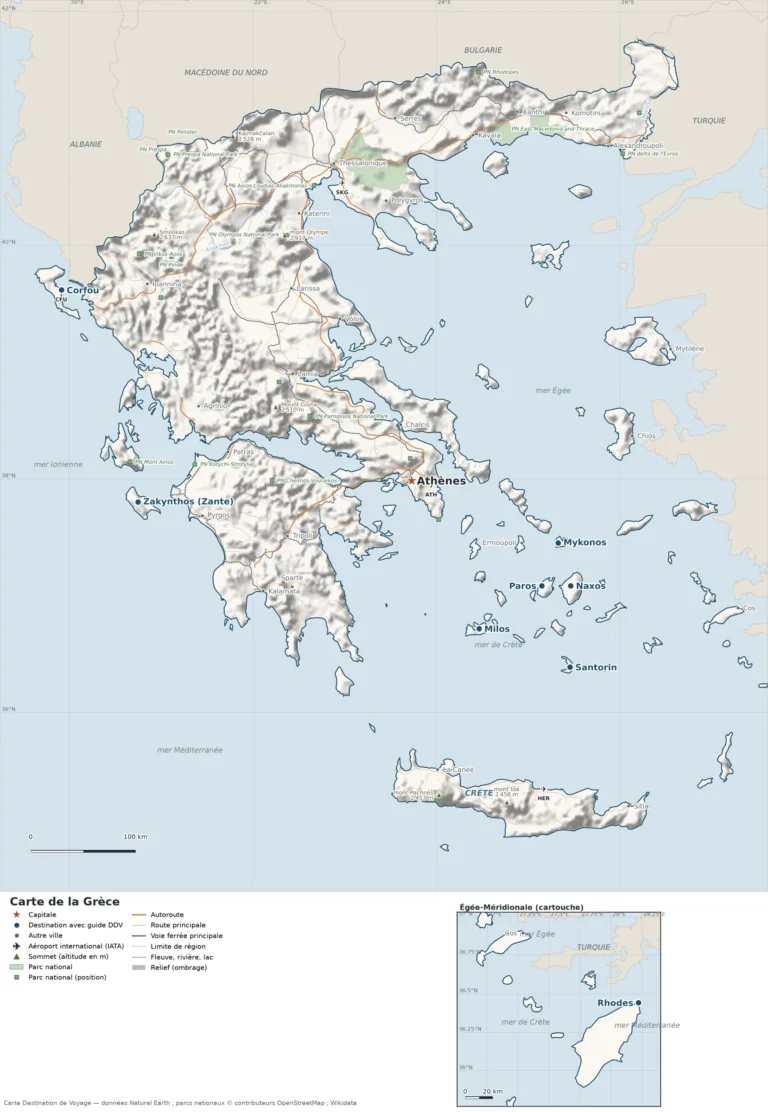
- Days 5-7: ferry to another Cycladic island (Naxos, Paros or Milos depending on connections)
- Days 8-10: ferry back to Athens, or ferry to Crete to extend the trip
Ferry connections and timetables vary greatly with the season: check them before fixing your itinerary. To continue south, see our Crete travel guide. If Crete tempts you next, check when to go to Crete: connections there also vary a lot by season.
Budget for a trip to Santorini
Santorini is one of the most expensive islands in Greece, especially for accommodation with a caldera view. Indicative amounts per person per day, excluding flights:
| Item | Budget | Comfort |
|---|---|---|
| Accommodation (based on a shared double room) | roughly €35 to €70 | roughly €100 to €250 |
| Meals | roughly €25 to €40 | roughly €50 to €90 |
| Transport (bus, shared rental, fuel) | roughly €5 to €15 | roughly €20 to €40 |
| Sights and activities | roughly €10 to €20 | roughly €30 to €80 |
| Total per day | roughly €75 to €145 | roughly €200 to €460 |
To cut costs, stay in Kamari, Perissa or an inland village, take the bus and have lunch at gyros stands and bakeries. The same rooms can cost much less in April, May and October than in August.
Getting around Santorini
- Buses (KTEL): the network starts from Fira and serves Oia, Kamari, Perissa, Akrotiri, the airport and Athinios port. Buses are frequent in season but often full in summer; almost all connections go via Fira.
- Car, scooter or quad: handy for exploring the island at your own pace. Roads are narrow and busy in summer, and parking is difficult in Oia and Fira. Quads are popular but require great care. GOV.UK advises keeping valuables out of sight and parking in a well-lit area or secure car park.
- Taxis and transfers: few compared with demand in summer; book your transfer from the airport or port.
- Ferries: boats link Santorini with Piraeus, Rafina, the other Cyclades and Crete, with journey times that vary widely by type of boat. Athinios port is far from the villages: plan your transfer.
- Fira cable car and stairway: they link the town with the old port, where volcano excursions depart.
Where to stay in Santorini
| Base | Who for? | Good to know |
|---|---|---|
| Fira | First visit, buses, nightlife | Lively, caldera view, daytime crowds |
| Firostefani and Imerovigli | Couples, views and quiet | Expensive hotels with a view, lots of steps |
| Oia | Sunsets, upmarket stay | Very busy in the evening in summer |
| Kamari | Beach, families, mid-range budget | No caldera view, buses to Fira |
| Perissa and Perivolos | Beach, tight budgets | Further from Fira and Oia |
| Pyrgos, Megalochori | Quiet, authenticity | Car or bus needed |
Hotels carved into the caldera cliff are often reachable only by stairs: check this if you are travelling with heavy luggage, young children or reduced mobility. In July-August, book several months ahead.
Entry requirements, health and safety
- US citizens: Greece is in the Schengen area: you may enter without a visa for up to 90 days for tourism or business. Greek law requires three months of passport validity beyond your departure date, but the State Department recommends at least six months; you may be asked for proof of sufficient funds and a return ticket (U.S. Department of State, travel.state.gov, last updated February 19, 2026).
- UK citizens: no visa for up to 90 days in any 180-day period as a tourist. Your passport must have been issued less than 10 years before the day you arrive and be valid at least 3 months after the day you plan to leave the Schengen area. Under the EU Entry/Exit System, the Greek authorities have indicated that they will not collect fingerprints and photos from UK travellers: follow the advice of officials on the ground (UK FCDO, GOV.UK, updated 11 August 2026).
- Health: UK travellers can use a GHIC or EHIC for state healthcare; GOV.UK notes that treatment may be limited on the islands and that there are serious shortages of ambulances on some of them. Whatever your nationality, take out travel insurance covering medical costs, including evacuation from the island.
- Sea: according to GOV.UK, people drown in the sea in Greece every year; follow the beach flag system (a red flag means you must not enter the water).
- Wildfires and earthquakes: causing a wildfire is a criminal offence in Greece, even if unintentional; set your phone to receive emergency alerts and follow @112Greece for official updates. There is also a risk of earthquakes (GOV.UK). Emergency number: 112.
- Theft: keep valuables out of sight and be alert to car crime (GOV.UK).
- Cliffs and trails: the caldera cliffs and Red Beach are exposed to rockfalls; respect closed areas. In very hot weather, postpone walks.
See our travel insurance guide to choose suitable cover.
Practical tips for Santorini
- Money: cards are widely accepted; keep some cash for small shops, buses and tips.
- Mobile data: check your home carrier’s roaming charges and data limits before you go.
- Avoiding crowds: visit Oia and Fira early in the morning and watch the sunset from a less famous point on the caldera or from Pyrgos.
- Steps and stairs: comfortable shoes are essential; the lanes are steep and often slippery.
- Etiquette: cover shoulders and knees in churches and monasteries; respect private terraces and rooftops, often mistaken for viewpoints.
- Restaurants: it is customary to leave a small tip if you enjoyed the service.
Santorini: who is it for?
Our verdict by traveller type, based on the information in this guide (places, budget, seasons).
| Traveller type | Our verdict | Why |
|---|---|---|
| Couples | Very well suited | Sunsets over the caldera, hotels with a view in Imerovigli and Firostefani, assyrtiko tastings. |
| Families | Suited | Kamari and its equipped beaches; caldera hotels are often reachable only by stairs. |
| Budget travellers | With reservations | One of the most expensive islands in Greece: stay in Kamari or Perissa and take the bus. |
| Culture | Suited | Akrotiri, the Museum of Prehistoric Thera, Ancient Thera. |
| Beach lovers | Suited | Black sand at Kamari, Perissa and Perivolos, very hot in summer. |
| Hikers | Suited | The Fira to Oia trail, Skaros Rock. |
Frequently asked questions
How many days do you need in Santorini?
Three to four days let you see the essentials: Fira, Oia, the caldera trail, Akrotiri, a boat trip to the volcano and a beach. Many travellers then combine Santorini with another Cycladic island or with Crete.
Where should you stay in Santorini?
Fira for a first visit and easy bus connections, Imerovigli or Oia for the view and quiet evenings, Kamari or Perissa for the beach and a more reasonable budget.
Do you need to rent a car in Santorini?
It is not essential: buses serve the main villages and beaches from Fira. A car or scooter gives more freedom, but parking is difficult in Fira and Oia in summer.
Can you swim in the caldera?
Yes, especially on boat trips that stop near the hot springs of Palea Kameni, or at Ammoudi, below Oia. The most convenient beaches remain those on the east coast, such as Kamari and Perissa.
Is Santorini safe?
The main risks noted by GOV.UK and the U.S. State Department for Greece are theft, including from cars, heat, wildfires, the sea and earthquakes. Follow civil protection alerts, as the island lies in a seismic and volcanic zone, and call 112 in an emergency.
Where can you watch the sunset in Santorini?
In Oia, at the northern tip: it is the most famous viewpoint, but also the busiest in summer. For more peace, choose another point on the caldera rim, such as Imerovigli and Skaros Rock, or the hilltop village of Pyrgos, in the centre of the island.
Is Santorini expensive?
Yes, it is one of the most expensive islands in Greece, especially for hotels with a caldera view in July-August. Allow roughly €75 to €145 per person per day on a budget and €200 to €460 in comfort, excluding flights. Staying in Kamari, Perissa or inland and taking the bus cuts costs considerably.
Which beach should you choose in Santorini?
Kamari for an equipped beach well served by buses, Perissa and Perivolos for a tighter budget, Ammoudi for a swim in the caldera below Oia. Red Beach, near Akrotiri, is best admired from a distance because of rockfalls.
See also: to avoid the July-August peak, read when to go to Santorini. If you are choosing between several islands, see which Greek island to choose and our Crete guide. Before you leave, check the time in Greece.
Our sources
- Climate data: monthly averages for the Santorini weather station (183 m / 600 ft above sea level) published by the National Observatory of Athens (meteo.gr monthly bulletins, July 2013 to March 2025)
- Entry requirements, health and safety checked on 26 October 2026: U.S. Department of State, Greece country information (last updated February 19, 2026) and UK FCDO, GOV.UK foreign travel advice for Greece (updated 11 August 2026)
- Electricity: Visit Greece (Greek National Tourism Organisation), travel tips, checked 26 October 2026
- Our methodology
Updated October 2026.
To combine Santorini with Athens or other islands, see our Greece travel guide, our Crete guide and our Corfu guide. For another Mediterranean island, see Cyprus, Malta and our other destinations in Europe.