Looking for things to do in Thessaloniki? Walk the waterfront to the White Tower, see the Arch of Galerius and the Rotunda, step inside the Unesco-listed Byzantine churches, climb up to the old upper town of Ano Poli and its walls, then eat at the Modiano and Kapani markets. To visit Thessaloniki, allow 2 to 3 days, more if you add Vergina, Pella or the beaches of Halkidiki. The best time is May to June and September to October.
Greece’s second city, a port in Macedonia on the Thermaic Gulf, Thessaloniki was a great Roman, Byzantine and then Ottoman city. This guide covers the highlights, a tour of the fifteen Unesco monuments ordered by century, the beaches, an itinerary and two calculations of our own: the sunset time on the 15th of each month and the number of rainy days to expect on a four-day stay. More on the country in our Greece travel guide.

Our travel deals for Thessaloniki
Affiliate links: we earn a commission, at no extra cost to you.
 FlightsKiwi.comCompare flights and airline combinations to Thessaloniki.Compare flights
- Airport transferKiwitaxiPrivate driver booked in advance at a fixed price.Book a transfer
- Tickets and toursTiqetsEntry tickets and guided tours to book online; compare with the official price.See tickets
- Audio guidesWeGoTripSelf-guided audio tours on your phone.See audio tours




Thessaloniki at a glance
- Country Greece (Central Macedonia region)
- Language Greek; English widely spoken in tourism
- Currency euro (€)
- Time zone 2 hours ahead of London all year · detailsLocal time now: –:–
- Airports Thessaloniki international airportNonstop or one-stop depending on your departure city and the season
- Entry Schengen area: no visa for up to 90 days for US citizens (tourism or business) and UK citizens (in any 180-day period) · travel.state.gov · GOV.UKUS: 6 months’ passport validity recommended; UK: valid 3 months after leaving the Schengen area
- Electricity check voltage and plug types before you go · plugs
- Suggested stay 2 to 3 days in the city, 4 to 5 with day trips
- Best time May-June and September-October
Things to do in Thessaloniki: the highlights
The waterfront and the White Tower
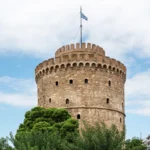
The Nea Paralia promenade runs for several kilometres along the gulf, from the port to the statue of Alexander the Great and Zongolopoulos’s « Umbrellas » sculpture. The White Tower, a former Ottoman tower that became the city’s symbol, houses a museum on the history of Thessaloniki; the top offers a view over the gulf.
The Arch of Galerius and the Rotunda
In the heart of the city, the triumphal arch of the Emperor Galerius, carved with battle scenes, leads to the Rotunda, a 4th-century Roman building turned into a church and then a mosque, whose minaret survives. Further down, the remains of Galerius’s palace spread around Navarinou Square.
The Roman agora and Aristotelous Square
The excavations of the Roman agora, with its small odeon, take up a large area below the modern city. Aristotelous Square, open to the sea, is the main meeting place in the centre.
The Byzantine churches
Agios Dimitrios, dedicated to the city’s patron saint, has a crypt and mosaics. Agia Sofia, the Acheiropoietos and the small Panagia Chalkeon complete a tour of the centre. These churches are places of worship: dress modestly and be discreet during services.
Ano Poli, the walls and the Heptapyrgion
The upper town, spared by the fire of 1917, keeps its sloping lanes and old houses. Here you will find Hosios David and its mosaic, Vlatadon monastery and, at the top, the Heptapyrgion fortress (Yedi Kule), long used as a prison. The walls offer a wide view over the city and the gulf, especially late in the day.
The museums
The Archaeological Museum displays finds from Macedonia, including gold work from ancient tombs. Next door, the Museum of Byzantine Culture traces daily and religious life of the period. Check opening hours and closing days before you go.
Markets and food
The Kapani (Vlali) and Modiano markets are packed with fresh produce stalls, spices and small tavernas. The Ladadika district, former warehouses near the port, is full of restaurants and bars. Bougatsa, a filo pastry filled with custard or cheese, is the local breakfast speciality.
The fifteen Unesco monuments, by century
In 1988, Unesco added fifteen « Paleochristian and Byzantine Monuments of Thessaloniki » to the World Heritage List. We have ordered them by period to create a chronological walk, from the lower town up to Ano Poli.
| Period | Monument | Area |
|---|---|---|
| 4th-5th c. | City walls | Ano Poli and around the centre |
| 4th c. | Rotunda (Agios Georgios) | Near the Arch of Galerius |
| 5th c. | Acheiropoietos | Centre |
| 6th c. | Hosios David (Latomou monastery) | Ano Poli |
| 7th c. | Agios Dimitrios | Centre, above the agora |
| 8th c. | Agia Sofia | Centre |
| 11th c. | Panagia Chalkeon | Near Aristotelous Square |
| 13th c. | Agia Ekaterini | Ano Poli |
| 14th c. | Agios Panteleimon, Holy Apostles, Agios Nikolaos Orfanos, Christ the Saviour, Vlatadon monastery, Prophet Elijah, Byzantine bath | Centre and Ano Poli |
Tip: see the centre (Rotunda, Acheiropoietos, Agia Sofia, Panagia Chalkeon, Agios Dimitrios) in the morning, then go up to Ano Poli by bus or taxi and walk back down via Vlatadon, Hosios David and the walls.
Thessaloniki and the beaches
The city-centre waterfront is a promenade, not a beach. The nearest beaches are towards Peraia, to the south-east, beyond the airport. For big beaches, head to the Halkidiki peninsula (Kassandra, Sithonia) by car or regional bus. Before swimming, check the bathing water quality published each season by the European Environment Agency.
Day trips from Thessaloniki
Vergina (Aigai) and Pella
To the west, Vergina, ancient Aigai, is home to the museum of the Macedonian royal tombs, including the one attributed to Philip II. Pella, the capital where Alexander the Great was born, has floor mosaics. The two can be combined in a day by car or on a tour.
Mount Olympus and Halkidiki
To the south-west, the Olympus massif offers hikes from Litochoro. To the south-east, Halkidiki and its three peninsulas are where the beaches are; on the third, Mount Athos is open only to men with a special permit, but you can sail along its coast by boat.
Itinerary: Thessaloniki in 3 days (and more)
- Day 1: waterfront, White Tower, Arch of Galerius and Rotunda, Galerius’s palace; Ladadika in the evening
- Day 2: Roman agora, Modiano and Kapani markets, churches in the centre; Archaeological and Byzantine museums
- Day 3: Ano Poli, Vlatadon, Heptapyrgion, Hosios David and the walls at sunset
- Days 4-5: Vergina and Pella, or a day in Halkidiki
When to go to Thessaloniki
Go from May to June or September to October: average highs range from 24.8 °C (77 °F) in May to 29.9 °C (86 °F) in June, and from 27.2 °C (81 °F) in September to 21.4 °C (71 °F) in October. July and August are the hottest months (an average high of 32.2 °C, or 90 °F, in July) and the sunniest (326 hours in July). Winter is cool (an average low of 2.2 °C, or 36 °F, in January) and November is the wettest month (60.2 mm, or 2.4 in). The UK FCDO notes that Greece can experience extreme heat and wildfires, with a high wildfire risk from April to October (GOV.UK, updated 11 August 2026). For the rest of the country, see the best time to visit Greece.
| Month | Avg max | Avg min | Rain | Rainy days | Sunshine (h) | Verdict |
|---|---|---|---|---|---|---|
| January | 9.4 °C (49 °F) | 2.2 °C (36 °F) | 32.5 mm (1.3 in) | 11.5 | 99 | ⚠️ Cool, city only |
| February | 11.1 °C (52 °F) | 3.3 °C (38 °F) | 38.8 mm (1.5 in) | 10.7 | 103 | ⚠️ Cool |
| March | 14.7 °C (58 °F) | 5.6 °C (42 °F) | 37.6 mm (1.5 in) | 12.1 | 147 | ⚠️ Mild, frequent rain |
| April | 19.3 °C (67 °F) | 8.8 °C (48 °F) | 38.4 mm (1.5 in) | 11.1 | 203 | ✅ Mild spring |
| May | 24.8 °C (77 °F) | 13.8 °C (57 °F) | 40.3 mm (1.6 in) | 11.0 | 253 | ✅ Ideal for sightseeing |
| June | 29.9 °C (86 °F) | 18.6 °C (65 °F) | 27.5 mm (1.1 in) | 7.9 | 296 | ✅ Hot, swimming possible |
| July | 32.2 °C (90 °F) | 20.9 °C (70 °F) | 22.3 mm (0.9 in) | 6.7 | 326 | ⚠️ Very hot |
| August | 32.1 °C (90 °F) | 20.8 °C (69 °F) | 22.4 mm (0.9 in) | 5.1 | 296 | ⚠️ Very hot |
| September | 27.2 °C (81 °F) | 16.8 °C (62 °F) | 25.2 mm (1.0 in) | 7.0 | 230 | ✅ Hot and drier |
| October | 21.4 °C (71 °F) | 12.6 °C (55 °F) | 43.8 mm (1.7 in) | 9.3 | 166 | ✅ Mild, still bright |
| November | 15.6 °C (60 °F) | 8.2 °C (47 °F) | 60.2 mm (2.4 in) | 11.8 | 118 | ❌ Wettest month |
| December | 10.7 °C (51 °F) | 3.9 °C (39 °F) | 46.5 mm (1.8 in) | 12.7 | 103 | ❌ Cold and grey |
Sunset and rain on a 4-day stay
Sunset over the gulf, seen from the waterfront or the walls, is a highlight of any visit. We calculated its time on the 15th of each month, and the number of rainy days to expect on a four-day stay.
| Month | Sunset (15th) | Rainy days in 4 days |
|---|---|---|
| January | 17:26 | 1.5 |
| February | 18:04 | 1.5 |
| March | 18:36 | 1.6 |
| April | 20:08 | 1.5 |
| May | 20:40 | 1.4 |
| June | 21:02 | 1.1 |
| July | 20:58 | 0.9 |
| August | 20:28 | 0.7 |
| September | 19:38 | 0.9 |
| October | 18:50 | 1.2 |
| November | 17:12 | 1.6 |
| December | 17:02 | 1.6 |
- In June, the sun sets at around 21:02: long evenings by the water.
- In August, about 0.7 rainy days are expected in four days, the lowest of the year.
- In December, the sun sets as early as 17:02 and 1.6 rainy days are expected in four: plan for museums.
Getting around Thessaloniki
- From the airport: city buses to the centre, or a taxi. Keep an eye on your bags: the U.S. State Department reports pickpocketing and bag-snatching at tourist sites and on public transport.
- In the city: the centre is walkable; take a bus up to Ano Poli. The city has a metro: check which lines and stations are open.
- Train: the station links Thessaloniki with Athens and the north of the country.
- Car: useful for Vergina, Olympus and Halkidiki.
Where to stay in Thessaloniki
| Area | Best for | Highlights |
|---|---|---|
| Aristotelous Square and the waterfront | First visit | Everything on foot, views of the gulf |
| Ladadika | Nightlife | Restaurants and bars, near the port |
| Around the Rotunda and the Arch of Galerius | Sightseeing | Monuments, student atmosphere |
| Ano Poli | Peace and quiet | Lanes, views; steep climb |
Entry requirements, health and safety
- US citizens: Greece is in the Schengen area: you may enter without a visa for up to 90 days for tourism or business. Greek law requires three months of passport validity beyond your departure date, but the State Department recommends at least six months; you may be asked for proof of sufficient funds and a return ticket (U.S. Department of State, travel.state.gov, last updated February 19, 2026).
- UK citizens: no visa for up to 90 days in any 180-day period as a tourist. Your passport must have been issued less than 10 years before the day you arrive and be valid at least 3 months after the day you plan to leave the Schengen area. Under the EU Entry/Exit System, the Greek authorities have indicated that they will not collect fingerprints and photos from UK travellers: follow the advice of officials on the ground (UK FCDO, GOV.UK, updated 11 August 2026).
- Health: UK travellers can use a GHIC or EHIC for state healthcare (GOV.UK); whatever your nationality, take out travel insurance covering medical costs. See our travel insurance guide.
- Earthquakes and alerts: there is a risk of earthquakes in Greece; GOV.UK advises learning the safety procedures and making sure your phone is set to receive emergency alerts. Emergency number: 112.
- Demonstrations: the U.S. State Department notes that demonstrators frequently gather at Aristotelous Square, Aristotle University and the Kamara area in Thessaloniki; avoid gatherings.
- Theft: pickpocketing and bag-snatching occur at popular tourist sites and on public transport (travel.state.gov).
Practical tips for Thessaloniki
- Payment: cards widely accepted; keep a little cash for small tavernas and the markets.
- Packing: comfortable shoes for the slopes of Ano Poli, covered shoulders and knees for churches; see what to pack.
- Mobile data: check your home carrier’s roaming charges; see our eSIM guide.
- Museums: check closing days before you go.
Combining with the capital? See our Athens guide.
Frequently asked questions
How many days do you need in Thessaloniki?
Two to three days for the city; four to five with Vergina, Pella or Halkidiki.
What is the best time to visit Thessaloniki?
May-June and September-October: moderate heat and little rain according to the airport station normals (Infoclimat 1991-2020 and HNMS 1971-2000).
Can you swim in Thessaloniki?
Not on the city-centre waterfront. The nearest beaches are towards Peraia; the biggest are in Halkidiki.
How do you fly to Thessaloniki?
Thessaloniki has an international airport; depending on where you start, you may need to connect through Athens or another European hub. Check current routes with the airport and the airlines.
Which Thessaloniki monuments are Unesco-listed?
Fifteen Paleochristian and Byzantine monuments, inscribed in 1988: the walls, the Rotunda, Agios Dimitrios, Agia Sofia, the Acheiropoietos, Hosios David and Vlatadon, among others.
Do you need a visa for Greece?
US and UK citizens do not need a visa for tourist stays of up to 90 days (Schengen rules), according to travel.state.gov and GOV.UK; check passport validity rules before you go.
Our sources
- Infoclimat and HNMS (Hellenic National Meteorological Service): normals for the Thessaloniki airport station: temperatures and sunshine 1991-2020 (Infoclimat, based on station records), precipitation 1971-2000 (HNMS), via the Wikipedia article « Thessaloniki »
- Destination de Voyage calculation: sunset time on the 15th of each month and rainy days expected over 4 days
- List of monuments inscribed by Unesco, via the Wikipedia article « Paleochristian and Byzantine monuments of Thessaloniki »
- Entry requirements, health and safety checked on 26 October 2026: U.S. Department of State, Greece country information (last updated February 19, 2026) and UK FCDO, GOV.UK foreign travel advice for Greece (updated 11 August 2026)
- Our methodology
Updated October 2026.
To extend your trip, see our Greece travel guide and our other destinations in Europe.