Visiting Naxos means discovering the largest island in the Cyclades: a Chora crowned by a Venetian kastro, the Portara, the monumental gateway of an unfinished temple, long sandy beaches on the west coast and a mountainous interior dotted with marble villages, olive groves and abandoned ancient kouroi. What are the best things to do in Naxos? This guide covers the highlights, itineraries, budget, best time to go and how to organise a trip to Naxos.

Our travel deals for Naxos
Affiliate links: we earn a commission, at no extra cost to you.
 Learn the languageTargumiLearn a few words of Greek before you go — 30% off via our link.See the course
- FlightsKiwi.comCompare flights and airline combinations to Naxos.Compare flights


Naxos at a glance
- Location Cyclades archipelagoIn the Aegean Sea, east of Paros and south of Mykonos
- Airports Naxos airport, south of Chora, with domestic flights from Athens · details
- Ferry from Piraeus or Rafina(Athens), by high-speed or conventional ferry, depending on the company
- Ideal length 5 to 7 days, for the coast and the villages
- Best time late May-June and September
- Time zone UTC+2, UTC+3 in summer: 2 hours ahead of London, 7 hours ahead of New York · detailsLocal time now: –:–
- Entry Schengen area: no visa for up to 90 days for US citizens (tourism or business) and UK citizens (in any 180-day period) · US: travel.state.gov · UK: GOV.UK
- Currency the euro · currencies
- Electricity 230 V / 50 Hz, type F plugs (Visit Greece); US and UK travellers need an adapter, and US devices must accept 230 V · plugs
- Budget see our budget section
When to go to Naxos
The best times to go to Naxos are late May-June and September: 22 to 26 °C (72 to 79 °F) in the afternoon, almost no rain, a pleasant sea and moderate crowds. July and August are the hottest (27 °C / 81 °F) and the busiest; the meltemi often blows, to the delight of windsurfers. From November to March, the island is quiet and wetter; some hotels close, but Naxos, with a large year-round population, stays lively. It has a livelier neighbour: our comparison to choose between Naxos and Paros helps you decide according to what you want.
The climate of Naxos is dry and tempered by the sea: rain falls mainly from November to February, almost never from June to August. In mountain villages such as Apeiranthos it is noticeably cooler than by the water, which makes hiking pleasant in spring and autumn.
When to go to Naxos: the essentials
- Best times: late May, June and September
- For the beach: June to September, warmest sea in August-September
- For hiking and villages: April-May and October
- For windsurfing and kitesurfing: July-August, at Mikri Vigla and Agios Georgios
- Hottest month: July, average high of 27.1 °C (81 °F)
- Wettest months: December (69 mm / 2.7 in) and January (68 mm / 2.7 in)
- Low season: November to March, some places closed
Naxos climate month by month
| Month | High °C (°F) | Low °C (°F) | Rain mm (in) | Crowds | Prices | Verdict |
|---|---|---|---|---|---|---|
| January | 14.4 (58) | 9.6 (49) | 67.9 (2.7) | Very low | Low | ❌ Cool and wet |
| February | 14.6 (58) | 9.4 (49) | 56.3 (2.2) | Very low | Low | ❌ Cool and wet |
| March | 15.8 (60) | 10.4 (51) | 45.7 (1.8) | Low | Low | ⚠️ Still cool, few services |
| April | 18.7 (66) | 12.5 (54) | 17.6 (0.7) | Medium (Easter) | Medium | ⚠️ Mild, cold sea, good for walking |
| May | 22.1 (72) | 15.7 (60) | 10.6 (0.4) | Medium | Medium | ✅ Mild, few crowds |
| June | 25.9 (79) | 19.6 (67) | 2.4 (0.1) | High | High | ✅ Hot, one of the best months |
| July | 27.1 (81) | 22.0 (72) | 0.9 (0.0) | Very high | Very high | ⚠️ Hot, windy, very busy |
| August | 27.0 (81) | 22.2 (72) | 1.6 (0.1) | Very high | Very high | ⚠️ Peak crowds and prices |
| September | 25.1 (77) | 20.1 (68) | 7.7 (0.3) | High | High | ✅ Hot, sea at its best |
| October | 21.9 (71) | 17.0 (63) | 38.6 (1.5) | Medium | Medium | ✅ Mild, end of season |
| November | 18.8 (66) | 13.7 (57) | 52.3 (2.1) | Very low | Low | ❌ Rain returns |
| December | 15.9 (61) | 11.1 (52) | 69.0 (2.7) | Very low | Low | ❌ Cool and wet |
Naxos season by season
- Spring (April-May): 19 to 22 °C (66 to 72 °F) in the afternoon, green countryside in flower, pleasant trails. The sea stays cool; hotels gradually reopen.
- Summer (June to August): 26 to 27 °C (79 to 81 °F) by day, warm nights, almost no rain. Busy beaches, frequent meltemi in July-August.
- Autumn (September-October): 22 to 25 °C (72 to 77 °F), sea still warm in September, fewer crowds. The first rains arrive in October.
- Winter (November to March): 14 to 19 °C (57 to 66 °F) by day, rain and wind, possible snow on the peaks. Chora stays inhabited; fewer ferries.
Naxos month by month
January: 14 °C (57 °F), one of the wettest months. A quiet island and local life.
February: 15 °C (59 °F), still damp. Carnival time in some villages, including Apeiranthos.
March: 16 °C (61 °F), less rain. Green countryside, few visitors.
April: 19 °C (66 °F), the season starts, often around Easter. Ideal for hiking.
May: 22 °C (72 °F), almost dry. Excellent for the villages, the kouroi and Mount Zas.
June: 26 °C (79 °F), pleasant sea, everything is open. One of the best months.
July: The hottest month (27.1 °C / 81 °F), frequent meltemi. High season, perfect for kitesurfing.
August: 27 °C (81 °F), peak crowds, especially around 15 August (a Greek public holiday). Book early.
September: 25 °C (77 °F), the sea at its warmest, fewer people. One of the best months.
October: 22 °C (72 °F), first rains. A quiet end of season, a good month for walking.
November: 19 °C (66 °F), about 50 mm (2.0 in) of rain. Many beach hotels are closed.
December: 16 °C (61 °F), the wettest month. Off-season Naxos.
To compare with the other islands, see our page on when to go to Greece.
Things to do in Naxos: the highlights
The Portara
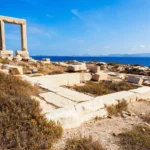
On the islet of Palatia, linked to the port by a causeway, the Portara is the monumental marble doorframe of a temple begun in the 6th century BC and never finished. It is traditionally associated with Apollo. It is the island’s emblem and a very popular sunset viewpoint, with Chora in the background.
Chora and the Kastro
Chora, the capital, climbs from the port to the Kastro, the upper town fortified by the Venetians in the 13th century. Its vaulted passages hide old mansions, the Catholic cathedral and the archaeological museum, housed in a former school. Below, the old Bourgos quarter and the waterfront are full of tavernas and shops.
The west coast beaches
Naxos has some of the longest sandy beaches in the Cyclades, lined up south of Chora. Agios Georgios, right next to town, is shallow and family-friendly. Further south, Agios Prokopios, Agia Anna and then Plaka, several kilometres long, are the best known. Mikri Vigla, on a small headland, is a kitesurfing and windsurfing spot; Kastraki and Alyko, further on, are wilder. Buses link Chora with most of these beaches in season.
The mountain villages: Halki, Filoti, Apeiranthos
In the Tragea valley, Halki, the island’s former capital, keeps neoclassical houses and a distillery of kitron, a liqueur made from citron leaves and a Naxos speciality. Filoti is terraced at the foot of Mount Zas. Apeiranthos, further east, is a mountain village with marble-paved lanes and several small museums. The whole area is best explored by car, with stops at tavernas and cheese makers.
The kouroi
In antiquity, Naxos was an island of marble quarries. Several kouroi, colossal statues of young men, were left unfinished on site. The most visited are near Melanes, in a garden, and at Apollonas, in the north of the island, where a kouros about ten metres (33 ft) long lies in an old quarry above the village.
The Temple of Demeter and Panagia Drosiani church
Near Sangri, the marble Temple of Demeter dates from the Archaic period; it has been partly rebuilt. Not far from Halki, the small church of Panagia Drosiani preserves some of the oldest Byzantine frescoes in Greece. Both visits fit easily into a day inland.
Mount Zas and hiking
Mount Zas, or Zeus, rises to just over 1,000 m (3,300 ft): it is the highest point in the Cyclades. Several trails climb it, notably from Filoti or the chapel of Agia Marina; allow a few hours there and back and avoid summer afternoons. Naxos has many waymarked paths between villages, olive groves and valleys.
Boat trips
From Chora, boats leave in season for the Small Cyclades (Koufonissia, Iraklia, Schinoussa), known for their clear water, and for Delos and Mykonos. Paros is a short ferry ride away. Departures depend on the weather and may be cancelled in strong wind.
Itinerary ideas for Naxos
Naxos in 5 days
- Day 1: Chora, the Kastro, the archaeological museum, sunset at the Portara
- Day 2: Agios Prokopios, Agia Anna and Plaka beaches
- Day 3: Temple of Demeter, Halki, Panagia Drosiani, Filoti and Apeiranthos
- Day 4: hike up Mount Zas in the morning, the Melanes kouros in the afternoon
- Day 5: boat trip to the Small Cyclades, or the northern road to the Apollonas kouros
10 days in the Cyclades
- Days 1 and 2: Athens and the Acropolis
- Days 3 to 5: Paros and Antiparos
- Days 6 to 8: Naxos
- Days 9 and 10: Santorini, then home
To plan your route, see our guide to things to do in Paros, our page on what to see in Santorini, our Mykonos travel guide and our selection of Greek islands. For the first stop, see our page on visiting Athens.
Budget for a stay in Naxos
Naxos is one of the most affordable Cyclades, thanks to its size and its farming. Indicative amounts per person per day in high season, excluding flights:
| Item | Budget | Comfort |
|---|---|---|
| Accommodation (shared double room) | roughly €30 to €55 | roughly €80 to €150 |
| Meals | roughly €20 to €30 | roughly €40 to €65 |
| Local transport | roughly €5 to €10 | roughly €20 to €40 (car) |
| Activities (boat, museums, gear) | roughly €5 to €15 | roughly €20 to €40 |
| Total per day | roughly €60 to €100 | roughly €140 to €250 |
To cut costs: stay in Chora or Agios Georgios and use the buses, eat in village tavernas and try local produce (cheeses, potatoes, kitron).
Getting there and getting around Naxos
- By plane: the airport, south of Chora, has domestic flights from Athens; there are no long-haul flights, so international travellers connect in Athens.
- By ferry: from Piraeus or Rafina, with frequent connections in season to Paros, Mykonos, Santorini, Ios, Amorgos and the Small Cyclades. Ferries dock at Chora.
- Buses: the local network serves the west coast beaches and the main villages from the bus station at the port.
- Car or scooter: recommended for the interior and the north; winding mountain roads. GOV.UK advises keeping valuables out of sight and locking your vehicle.
Where to stay in Naxos
- Chora: for ferries, restaurants and evening life; practical without a car
- Agios Georgios: family beach within walking distance of Chora
- Agios Prokopios and Agia Anna: fine beaches, plenty of hotels, frequent buses
- Plaka and Mikri Vigla: quieter, for the beach and water sports
- Halki, Filoti, Apeiranthos: peaceful inland villages, car essential
Entry requirements, health and safety
- US citizens: Greece is in the Schengen area: you may enter without a visa for up to 90 days for tourism or business. Greek law requires three months of passport validity beyond your departure date, but the State Department recommends at least six months; you may be asked for proof of sufficient funds and a return ticket (U.S. Department of State, travel.state.gov, last updated February 19, 2026).
- UK citizens: no visa for up to 90 days in any 180-day period as a tourist. Your passport must have been issued less than 10 years before the day you arrive and be valid at least 3 months after the day you plan to leave the Schengen area. Under the EU Entry/Exit System, the Greek authorities have indicated that they will not collect fingerprints and photos from UK travellers: follow the advice of officials on the ground (UK FCDO, GOV.UK, updated 11 August 2026).
- Health: UK travellers can use a GHIC or EHIC for state healthcare; GOV.UK notes that treatment may be limited on the islands and that there are serious shortages of ambulances on some of them. Whatever your nationality, take out travel insurance covering medical costs, including evacuation from the island.
- Sea: according to GOV.UK, people drown in the sea in Greece every year; follow the beach flag system (a red flag means you must not enter the water).
- Wildfires and earthquakes: causing a wildfire is a criminal offence in Greece, even if unintentional; set your phone to receive emergency alerts and follow @112Greece for official updates. There is also a risk of earthquakes (GOV.UK). Emergency number: 112.
- Theft: keep valuables out of sight and be alert to car crime (GOV.UK).
- Hiking: in the mountains, check conditions before setting out and carry water.
Our travel insurance guide helps you choose suitable cover, including evacuation from an island.
Practical tips for Naxos
- Money: cards are widely accepted in Chora and on the coast; keep cash for villages and buses.
- Bookings: in July-August, book accommodation, ferries and car in advance.
- Wind: when the meltemi blows, the west coast beaches are exposed; ask about sheltered coves.
- Food: try Naxos graviera cheese, the local potatoes and kitron.
- Dress: cover shoulders and knees to enter churches and monasteries.
- Mobile data: check your home carrier’s roaming charges and data limits before you go.
- Language: Before you leave, you can pick up some basic Greek with Targumi’s online lessons, with 30% off via our link.
Naxos: who is it for?
- Families: yes: the sandy west coast beaches, such as Agios Georgios or Agios Prokopios, are shallow, and prices stay more affordable than on other Cyclades.
- Beach lovers: yes: long sandy beaches south of Chora (Agios Prokopios, Agia Anna, Plaka), served by bus in season, and wilder beaches such as Kastraki and Alyko.
- Hikers: yes: Mount Zas, the highest point in the Cyclades, and many waymarked paths between villages and olive groves, best in April-May and October.
- Culture and heritage: yes: the Portara, the Venetian Kastro, the unfinished kouroi, the Temple of Demeter and the frescoes of Panagia Drosiani.
- Board sports: yes in July-August, when the meltemi blows: Mikri Vigla and Agios Georgios are the kitesurfing and windsurfing spots.
- Budget travellers: fairly: Naxos is one of the most affordable Cyclades, roughly €60 to €100 per person per day on a budget in high season.
- Nightlife: less pronounced: Paros, a short ferry ride away, is livelier in the evening.
See also
To compare seasons and islands, see our page on when to go to Greece. If you are after hiking and mountain villages, our pages on Greece in April and Greece in October cover these two shoulder months. Finally, check the time in Greece.
Frequently asked questions
When is the best time to go to Naxos?
Late May, June and September: 22 to 26 °C (72 to 79 °F) in the afternoon, almost no rain, a pleasant sea and fewer people than in July-August. April, May and October suit hiking well.
How many days do you need in Naxos?
Allow at least five days: two for Chora and the beaches, two for the villages, the kouroi and Mount Zas, and one for a boat trip. A week gives you more time on the beach.
How do you get to Naxos?
There are no long-haul flights. Fly to Athens, then take a domestic flight to Naxos or a ferry from Piraeus or Rafina.
Do you need a car in Naxos?
Not for Chora and the west coast beaches, which are well served by buses in season. For the mountain villages, the kouroi and the north of the island, a car or scooter is much more practical.
Naxos or Paros: which should you choose?
Naxos is bigger, more mountainous and more agricultural, with long sandy beaches and many villages. Paros is more compact and livelier in the evening. The two islands are a short ferry ride apart.
Is Naxos good for families?
Yes: the sandy west coast beaches, such as Agios Georgios or Agios Prokopios, are shallow, and prices stay more affordable than on other Cyclades.
Our sources
- Climate data: Hellenic National Meteorological Service (HNMS), « Climatic Data by City », Naxos station, consulted on 13 October 2026
- Entry requirements, health and safety checked on 26 October 2026: U.S. Department of State, Greece country information (last updated February 19, 2026) and UK FCDO, GOV.UK foreign travel advice for Greece (updated 11 August 2026)
- Electricity: Visit Greece (Greek National Tourism Organisation), travel tips, checked 26 October 2026
- Our methodology
Updated October 2026.
To extend your trip, see our Greece travel guide, our pages on visiting Paros, a trip to Santorini, things to do in Mykonos, what to see in Crete and what to see in Corfu, as well as our guide to things to do in Zakynthos, on the Ionian side. For date ideas, see where to go in May or in September, and our other destinations in Europe.