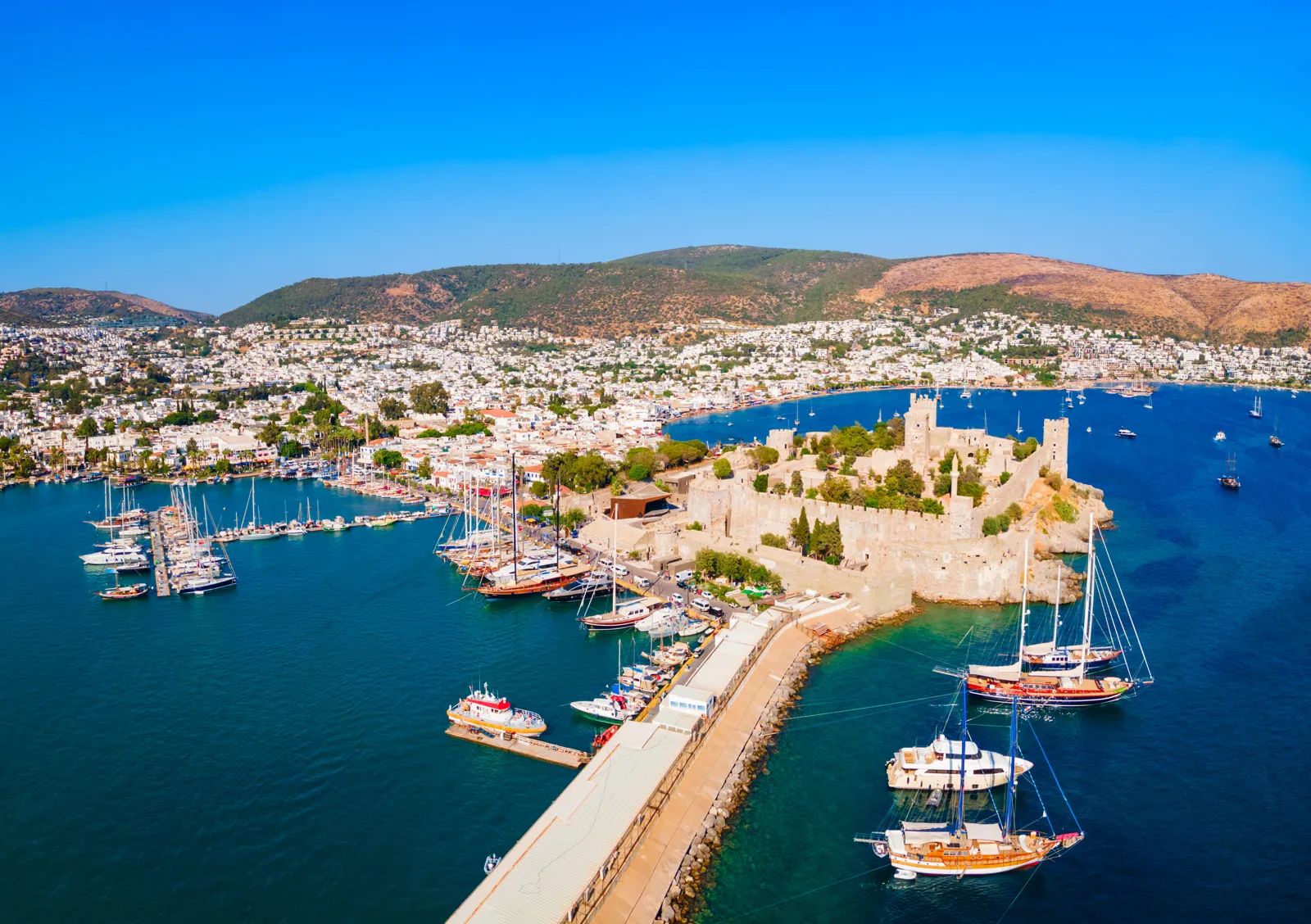
Kos, a Dodecanese island facing the Turkish coast, is the birthplace of Hippocrates: ancient ruins in the middle of town, a Knights’ castle, long sandy beaches and cycle paths on mostly flat terrain. For things to do in Kos, allow 5 to 7 days to alternate beaches, villages and excursions to Nisyros, Kalymnos or Bodrum. The best times are June and September; July and August are very hot and very busy.
This guide covers the highlights, choosing a beach according to the wind, an itinerary, and the month-by-month climate with sunset times calculated for each month.

Our travel deals for Kos
Affiliate links: we earn a commission, at no extra cost to you.
 FlightsKiwi.comCompare flights and airline combinations to Kos.Compare flights

Kos at a glance
- Country Greece, Dodecanese archipelago
- Language Greek; English widely spoken in tourism
- Currency the euro (€) · currencies
- Time zone UTC+2, UTC+3 in summer: 2 hours ahead of London, 7 hours ahead of New York · detailsLocal time now: –:–
- Airports Kos International Airport (KGS), near Antimachia · details
- Entry Schengen area: no visa for up to 90 days for US citizens (tourism or business) and UK citizens (in any 180-day period) · travel.state.gov · GOV.UK
- Electricity check voltage and plug types before you go · plugs
Things to do in Kos: the highlights
Kos Town and its ancient ruins
The island’s capital is an open-air museum: the ancient agora below the ramparts, the Roman odeon, the Casa Romana (a restored Roman house with mosaics) and the excavated western quarter. Everything can be seen on foot or by bike in a day.
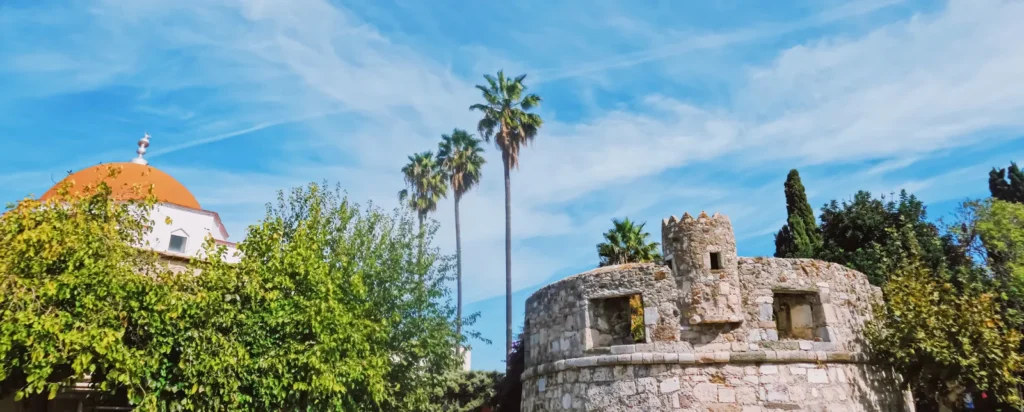
Neratzia Castle
A fortress of the Knights of St John at the harbour entrance, once linked to the town by a bridge. Check opening days and hours on the Greek Ministry of Culture website before you go.
Hippocrates’ plane tree and the Gazi Hassan Pasha mosque
According to tradition, Hippocrates taught in the shade of a plane tree: the very old, propped-up tree on the square is said to be its descendant. Right next to it, the Ottoman Gazi Hassan Pasha mosque recalls the centuries of Turkish rule.
The Asklepieion
A sanctuary dedicated to Asclepius, god of medicine, built in terraces on a hill near the town, with views of the sea and the Turkish coast. Go early in the morning or late in the afternoon in summer: the site has little shade. A little tourist train and bikes are the easiest ways to get there.
Zia and Mount Dikeos
A mountain village on the slopes of Mount Dikeos (about 846 m / 2,776 ft, the island’s highest point), known for its sunsets. Hikers climb to the summit from Zia; set off early and take water.
Palio Pyli
An abandoned Byzantine village and castle ruins on a rocky outcrop above the present-day village of Pyli: a short walk among pine trees.
Kefalos and the south-west peninsula
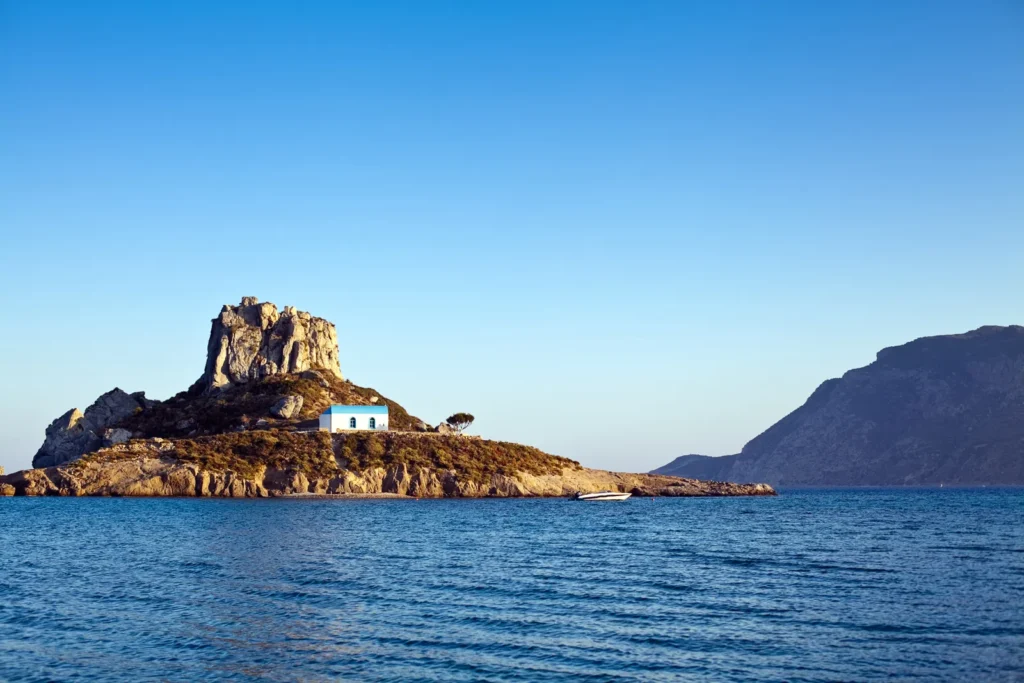
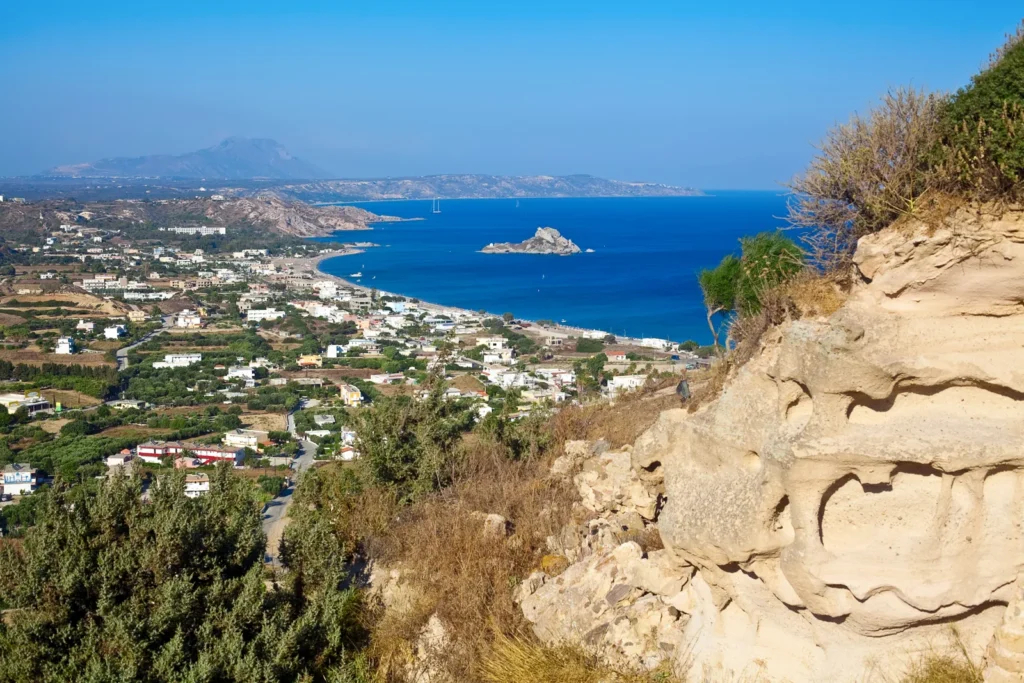
The wildest part of the island: the early Christian basilica of Agios Stefanos facing the islet of Kastri, the beaches of Kamilia and Agios Theologos, and the hilltop village of Kefalos.
The Therma hot springs
South-east of the town, a hot spring mixes with the sea in a small rock pool at the foot of a cliff. A pleasant swim in the evening, when the crowds thin out.
Which beach to choose in Kos?
In summer, the meltemi, a northerly wind common in the Aegean, blows mainly on the north coast. Your choice of beach therefore depends on the day’s wind.
| Beach | Coast | Strengths | If the wind is blowing |
|---|---|---|---|
| Tigaki | North | Fine sand, shallow water, families | Choppy, ideal for kitesurfing and windsurfing |
| Marmari | North | Large beach, board-sports spots | Very windy |
| Mastichari | North-west | Fishing village, ferries to Kalymnos | Exposed |
| Lambi and Psalidi | North-east, near the town | Reachable by bike | Exposed |
| Kardamena | South | Lively resort, boats to Nisyros | More sheltered |
| Paradise Beach and Kamilia | South-west | Sand, turquoise water | More sheltered |
| Agios Stefanos | South-west | Ancient basilica, Kastri islet | More sheltered |
Itinerary: Kos in one week
- Day 1: Kos Town, the agora, Neratzia Castle, Hippocrates’ plane tree, the harbour
- Day 2: the Asklepieion by bike in the morning, Lambi beach in the afternoon
- Day 3: Tigaki or Marmari (beach or board sports), then Zia for sunset
- Day 4: boat trip to Nisyros and its volcano from Kardamena
- Day 5: Kefalos, Agios Stefanos, Paradise Beach
- Day 6: Kalymnos from Mastichari, or Bodrum (Turkey) from Kos harbour
- Day 7: Palio Pyli in the morning, the Therma hot springs in the evening
Day trip to Bodrum: the Turkish coast is very close. To enter Turkey, US citizens with an ordinary passport are exempt from a visa for up to 90 days in any 180-day period, with a passport valid six months beyond the entry date (travel.state.gov, last updated June 11, 2026); UK citizens can visit without a visa for up to 90 days in any 180-day period, with a passport valid at least 150 days after arrival and one blank page (GOV.UK, updated 19 October 2026). Check your passport before booking.
Kos combines with Rhodes, linked by ferry, and the other Dodecanese islands. See also our guide to the Greek islands and our Greece cruise ideas.
When to go to Kos
The best times are June and September, with May and October as good compromises. From June to September it hardly rains; July and August are the hottest and busiest months. From November to February it is mild, but most of the rain falls and many hotels and tavernas close.
A note on the figures: we have not found official climate normals published for Kos. The table uses those of the nearest official station, Bodrum, across the strait. The climate is comparable, but exact values may differ slightly on the island, especially on the windy north coast.
| Month | High | Low | Rain | Rain over 7 days | Sun (h/day) | Sunset (local time) | Verdict |
|---|---|---|---|---|---|---|---|
| January | 15.5 °C (60 °F) | 8.5 °C (47 °F) | 138 mm (5.4 in) | ≈ 2.3 d | 4.8 | 5:17 pm | ❌ Rainy, season closed |
| February | 16.0 °C (61 °F) | 8.8 °C (48 °F) | 108 mm (4.3 in) | ≈ 2.2 d | 5.3 | 5:50 pm | ❌ Rainy, season closed |
| March | 18.3 °C (65 °F) | 10.3 °C (51 °F) | 70 mm (2.8 in) | ≈ 1.5 d | 6.4 | 6:17 pm | ⚠️ Mild, few services |
| April | 21.7 °C (71 °F) | 13.1 °C (56 °F) | 44 mm (1.7 in) | ≈ 1.2 d | 7.8 | 7:45 pm | ⚠️ Mild, cool sea |
| May | 26.6 °C (80 °F) | 17.2 °C (63 °F) | 20 mm (0.8 in) | ≈ 0.6 d | 8.6 | 8:11 pm | ✅ Pleasant, quiet |
| June | 32.1 °C (90 °F) | 21.6 °C (71 °F) | 2 mm (0.1 in) | ≈ 0.4 d | 10.0 | 8:31 pm | ✅ Ideal, pleasant sea |
| July | 35.2 °C (95 °F) | 24.1 °C (75 °F) | 0 mm (0.0 in) | ≈ 0.2 d | 10.3 | 8:30 pm | ⚠️ Very hot, crowds, meltemi |
| August | 35.3 °C (96 °F) | 24.4 °C (76 °F) | 0 mm (0.0 in) | ≈ 0.2 d | 10.2 | 8:02 pm | ⚠️ Very hot, crowds, meltemi |
| September | 31.2 °C (88 °F) | 21.2 °C (70 °F) | 20 mm (0.8 in) | ≈ 0.5 d | 8.9 | 7:18 pm | ✅ Ideal, warm sea |
| October | 26.4 °C (80 °F) | 17.5 °C (64 °F) | 49 mm (1.9 in) | ≈ 0.9 d | 7.2 | 6:34 pm | ✅ Mild, end of season |
| November | 21.2 °C (70 °F) | 13.3 °C (56 °F) | 100 mm (3.9 in) | ≈ 1.4 d | 5.9 | 5:01 pm | ⚠️ Rain returns |
| December | 17.0 °C (63 °F) | 10.1 °C (50 °F) | 150 mm (5.9 in) | ≈ 2.3 d | 4.5 | 4:55 pm | ❌ Rainy, season closed |
In practice, the sun sets at around 8:30 pm in June and July: for a sunset in Zia in June, be there by about 8:15 pm.
For the other islands, see when to go to Greece.
Getting around Kos
- Bike: the island is fairly flat in the north-east and Kos Town has cycle paths; hiring is easy.
- Bus: the KTEL network links the town with the villages and the main beaches; a bus serves the airport.
- Car or scooter: useful for Kefalos, Zia and the south-west beaches. GOV.UK warns that quad bike accidents cause serious injuries every year.
- Boats: to Kalymnos and Pserimos from Mastichari or the town, to Nisyros from Kardamena, to Bodrum from Kos harbour.

Where to stay in Kos
| Area | Best for | Strengths |
|---|---|---|
| Kos Town | No car, culture | Ruins, restaurants, buses and ferries |
| Tigaki and Marmari | Families, board sports | Sandy beaches, shallow water |
| Kardamena | Nightlife, low budget | Lively resort, boats to Nisyros |
| Kefalos | Calm, nature | South-west beaches, sunsets |
| Mastichari | Village atmosphere | Harbour, access to Kalymnos |
Entry requirements, health and safety
- US citizens: Greece is in the Schengen area: you may enter without a visa for up to 90 days for tourism or business. Greek law requires three months of passport validity beyond your departure date, but the State Department recommends at least six months; you may be asked for proof of sufficient funds and a return ticket (U.S. Department of State, travel.state.gov, last updated February 19, 2026).
- UK citizens: no visa for up to 90 days in any 180-day period as a tourist. Your passport must have been issued less than 10 years before the day you arrive and be valid at least 3 months after the day you plan to leave the Schengen area. Under the EU Entry/Exit System, the Greek authorities have indicated that they will not collect fingerprints and photos from UK travellers: follow the advice of officials on the ground (UK FCDO, GOV.UK, updated 11 August 2026).
- Health: UK travellers need a GHIC or EHIC for medically necessary state healthcare (GOV.UK); whatever your nationality, take out travel insurance covering medical costs and evacuation from an island.
- Wildfires: according to the UK FCDO (GOV.UK, updated 11 August 2026), the wildfire risk is high from April to October; make sure your phone can receive emergency alerts. Causing a wildfire is a criminal offence in Greece, even if unintentional. If you see a fire, call 112.
- Swimming: many organised beaches use a flag system, and a red flag means you must not enter the water; take extra care where there are no lifeguards, flags or signs (GOV.UK).
- Earthquakes: there is a risk of earthquakes and earth tremors in Greece; familiarise yourself with safety procedures (GOV.UK).
- See our travel insurance guide.
Practical tips for Kos
- Money: euro; carry some cash for small villages.
- Heat: visit the Asklepieion and the ruins early in the morning in summer.
- Wind: check the meltemi forecast to choose your beach and boat trips.
- Places of worship: cover shoulders and knees in churches and monasteries.
Frequently asked questions
How many days should you stay in Kos?
Five to seven days for the town, the Asklepieion, the beaches and one or two boat trips; three days for a short break.
How do you fly to Kos?
Kos International Airport, near Antimachia, receives seasonal international flights; check current routes with the airlines, as services vary by season.
Can you go to Turkey from Kos?
Yes, boats link Kos with Bodrum. US citizens need a passport valid six months beyond entry (travel.state.gov); UK citizens need a passport valid at least 150 days after arrival (GOV.UK). Both can stay up to 90 days in any 180-day period without a visa.
What is the best beach in Kos?
Tigaki for families, Marmari for board sports, Paradise Beach and Agios Stefanos in the south-west when the north wind blows.
When is the best time to go to Kos?
June and September: pleasant heat and sea, almost no rain and fewer people than in July and August.
Our sources
- Climate: World Meteorological Organization 1991-2020 normals for the Bodrum station (Turkey), across the strait, supplied by the Turkish State Meteorological Service (MGM) and archived by NOAA (NCEI) (no official normals published for Kos, to our knowledge)
- Destination de Voyage calculations: rain over 7 days, hours of sunshine per day, sunset (NOAA solar algorithm)
- Entry requirements, health and safety checked on 26 October 2026: U.S. Department of State, Greece country information (last updated February 19, 2026) and UK FCDO, GOV.UK foreign travel advice for Greece (updated 11 August 2026)
- Turkey entry checked on 26 October 2026: U.S. Department of State, Türkiye country information (last updated June 11, 2026) and UK FCDO, GOV.UK entry requirements for Turkey (updated 19 October 2026)
- Air links: Wikipedia article « Kos International Airport », consulted on 15 October 2026
- Our methodology
Updated October 2026.
To extend your trip, see our Greece travel guide and our Athens page.