
Amorgos is the easternmost island of the Cyclades, long and mountainous, known for its monastery clinging to a cliff and for scenes from Luc Besson’s film The Big Blue. People come less for the beaches than for the hiking trails, the white villages and very clear water. Wondering about things to do in Amorgos? This guide covers the highlights, two possible bases (Katapola or Aegiali), an itinerary and the climate month by month. Allow 4 to 7 days, ideally in May-June or September.

Our travel deals for Amorgos
Affiliate links: we earn a commission, at no extra cost to you.
 FlightsKiwi.comCompare flights and airline combinations to Amorgos.Compare flights

Amorgos at a glance
- Country Greece, eastern Cyclades; east of Naxos
- Area about 121 km² (47 sq mi), 1,973 inhabitants (2011)
- Ports Katapola (centre of the island) and Aegiali (north)
- Access by boat only (no airport)Ferries from Piraeus and from the other Cyclades, Naxos in particular
- Currency the euro (€) · currencies
- Time zone UTC+2, UTC+3 in summer: 2 hours ahead of London, 7 hours ahead of New YorkLocal time now: –:–
- Entry Schengen area: no visa for up to 90 days for US citizens (tourism or business) and UK citizens (in any 180-day period) · US: travel.state.gov · UK: GOV.UK
- Electricity 230 V / 50 Hz, type F plugs (Visit Greece); US and UK travellers need an adapter, and US devices must accept 230 V · plugs
Things to do in Amorgos: the highlights
The monastery of Panagia Hozoviotissa
The monastery is built into a rock face about 300 m (984 ft) above the sea on the south-east coast. Tradition links it to the Byzantine emperor Alexios I Komnenos and dates it to 1088. You reach it by a long flight of steps from the road; opening hours are limited, so check them locally before you go.
Chora, the hilltop village
The island’s main village stands at about 320 m (1,050 ft) above Katapola: white lanes, chapels, windmills on the ridge and a rock topped by an old Venetian kastro. Part of The Big Blue was filmed here and below the monastery in 1987. Several trails start from Chora.
Katapola and the ancient site of Minoa
Katapola, the main port, curves around a deep bay with tavernas and small beaches. On the hill above, the ruins of ancient Minoa look down over the bay; you walk up.
Aegiali, Tholaria and Langada
In the north, Aegiali has the island’s longest sandy beach, in a sheltered bay. Above it, the villages of Tholaria and Langada overlook the bay, linked by a loop trail popular with hikers. Mount Krikellos (821 m, 2,694 ft), the island’s highest point, rises to the east.
The southern beaches: Agia Anna, Mouros, Kalotaritissa
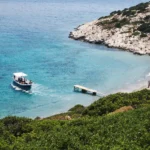
Below the monastery, the small rocky cove of Agia Anna is one of the island’s signature views. Further south, Mouros is a pebble beach at the foot of the cliffs, and Kalotaritissa, at the south-western tip, a calm bay from which boats leave for the nearby islets. Near Kalotaritissa, the rusty wreck of the Olympia lies close to the shore.
Hiking: the trail network
Amorgos is one of the best-equipped Cyclades islands for waymarked trails: old mule tracks between villages, the ridge path from Chora to Aegiali, the Langada-Tholaria loop, descents to the coves. Take a hiking map and plenty of water and set off early, as shade is scarce. The UK FCDO (updated 11 August 2026) notes that trails in Greece often lack shade, that route markings vary, and advises planning your route and telling someone where you are going.
Katapola or Aegiali: where to stay?
| Criterion | Katapola | Aegiali |
|---|---|---|
| Location | Centre-west, main port | North, second port |
| Beach | Small beaches around the bay | Long sandy beach |
| For sightseeing | Close to Chora, the monastery and the south | Close to Tholaria, Langada and the northern trails |
| Atmosphere | Lively port, more boats | Quiet resort, popular with hikers |
| Best for | No car, short stay, sightseeing | Beach and hiking stay |
Chora is a third option for a quieter, more traditional stay, with fewer beaches within walking distance. In summer, book early: accommodation is limited.
Itinerary: Amorgos in 4 days
- Day 1: arrive in Katapola, walk up to Minoa, sunset over the bay
- Day 2: Chora in the morning, the Hozoviotissa monastery (before the heat), a swim at Agia Anna
- Day 3: the south: Mouros, Kalotaritissa and the wreck of the Olympia, the village of Arkesini
- Day 4: the north: Aegiali, the Langada-Tholaria loop on foot, Aegiali beach
Amorgos combines well with Naxos, which has many boat connections, and with the Small Cyclades. For a first trip to the archipelago, see our guide to the Greek islands and our Naxos or Paros comparison.
When to go to Amorgos
May-June and September are the best months: the sea is warm enough to swim, the heat is bearable for walking (22 to 26 °C, or 72 to 79 °F, in the afternoon at the Naxos station), there is almost no rain and boats are still fairly frequent. July-August is peak season: heat, full boats and accommodation, and above all the meltemi, a strong north wind over the Cyclades that can disrupt crossings. April and October suit hikers. From November to March the island slows right down, connections are rare and rain is more frequent.
| Month | Avg max | Avg min | Rain | Rain days | Rain days per 7-day stay | Sunset | Verdict |
|---|---|---|---|---|---|---|---|
| January | 14.4 °C (58 °F) | 9.6 °C (49 °F) | 67.9 mm (2.7 in) | 12.7 | 2.9 | 17:23 | ❌ Rainy, island closed |
| February | 14.6 °C (58 °F) | 9.4 °C (49 °F) | 56.3 mm (2.2 in) | 11.0 | 2.8 | 17:56 | ❌ Rainy, island closed |
| March | 15.8 °C (60 °F) | 10.4 °C (51 °F) | 45.7 mm (1.8 in) | 9.5 | 2.1 | 18:23 | ⚠️ Cool, few boats |
| April | 18.7 °C (66 °F) | 12.5 °C (54 °F) | 17.6 mm (0.7 in) | 6.0 | 1.4 | 19:50 | ✅ Hiking, flowers |
| May | 22.1 °C (72 °F) | 15.7 °C (60 °F) | 10.6 mm (0.4 in) | 3.6 | 0.8 | 20:16 | ✅ Ideal |
| June | 25.9 °C (79 °F) | 19.6 °C (67 °F) | 2.4 mm (0.1 in) | 1.1 | 0.3 | 20:37 | ✅ Ideal, warm sea |
| July | 27.1 °C (81 °F) | 22.0 °C (72 °F) | 0.9 mm (0.0 in) | 0.4 | 0.1 | 20:35 | ⚠️ Hot, windy, fully booked |
| August | 27.0 °C (81 °F) | 22.2 °C (72 °F) | 1.6 mm (0.1 in) | 0.3 | 0.1 | 20:08 | ⚠️ Hot, windy, fully booked |
| September | 25.1 °C (77 °F) | 20.1 °C (68 °F) | 7.7 mm (0.3 in) | 1.9 | 0.4 | 19:24 | ✅ Ideal, warm sea |
| October | 21.9 °C (71 °F) | 17.0 °C (63 °F) | 38.6 mm (1.5 in) | 5.5 | 1.2 | 18:40 | ✅ Hiking, end of season |
| November | 18.8 °C (66 °F) | 13.7 °C (57 °F) | 52.3 mm (2.1 in) | 8.8 | 2.1 | 17:07 | ❌ Rainy, few services |
| December | 15.9 °C (61 °F) | 11.1 °C (52 °F) | 69.0 mm (2.7 in) | 12.6 | 2.8 | 17:01 | ❌ Rainy, island closed |
Our calculation: over a week from June to September you can expect less than one day of rain (0.1 to 0.4), against about 2.9 in January. In June the sun sets at around 20:37 (8:37 pm): long evenings to enjoy Chora once the heat drops. To compare with other islands, see the best time to visit Greece.
Budget for Amorgos
As on the other Cyclades, prices rise sharply in July and August. Rooms in guesthouses and studios cost less than hotels with a view; hiking is free, while boat trips and vehicle hire cost extra. Add the ferry from Piraeus or Naxos, whose price varies with the vessel and the season.
Getting around Amorgos
- Getting there: conventional ferries and fast boats from Piraeus (a long crossing, often most of the day on a conventional ferry) and connections from Naxos and the Small Cyclades. Compare times and schedules on booking sites, as they vary a lot with the season.
- Local bus: it links Katapola, Chora, the monastery, Aegiali and a few beaches, less frequently out of season.
- Car or scooter: handy for combining north and south; the main road follows the island’s ridge. For licence rules, see the entry section below.
- Water taxis: from Katapola to some beaches in season.
- On foot: the trail network links most villages.
Entry requirements, health and safety
- US citizens: Greece is in the Schengen area, so you may enter without a visa for up to 90 days for tourism or business. Greek law requires three months of passport validity beyond your departure date, but the State Department recommends at least six months; you must be able to show proof of sufficient funds and a return ticket if asked (U.S. Department of State, travel.state.gov, last updated February 19, 2026).
- UK citizens: no visa for up to 90 days in any 180-day period in the Schengen area. Your passport must have been issued less than 10 years before you arrive and be valid for at least 3 months after the day you plan to leave; you may be asked for a return or onward ticket and proof of funds. Greek authorities have indicated they will not collect fingerprints and photos from UK travellers under the EU Entry/Exit System (UK FCDO, GOV.UK, updated 11 August 2026).
- Health: according to the UK FCDO (updated 11 August 2026), treatment may be limited on the islands and some islands face serious shortages of ambulances; UK travellers need a GHIC or EHIC for state healthcare, which is not a substitute for travel insurance. The U.S. State Department strongly recommends insurance that covers medical evacuation.
- Wildfires: the UK FCDO (updated 11 August 2026) reports a high wildfire risk from April to October; causing a wildfire is a criminal offence in Greece, even if unintentional. Do not light fires or barbecues.
- Emergencies: call 112 (ambulance, fire, police); for an ambulance you can also dial 166 (UK FCDO). Visit Greece lists the Tourist Police on 1571 (24/7).
- Quads and mopeds: helmets are compulsory; UK travellers need a licence with at least category A1 to hire a moped (UK category P is not valid in Greece), and quad biking is excluded from many insurance policies (UK FCDO, updated 11 August 2026). For cars, Greek law requires US visitors to carry a US licence and an International Driving Permit (travel.state.gov).
- See our travel insurance guide.
Practical tips for Amorgos
- Sea conditions: in summer the meltemi can delay or cancel boats; leave a day’s margin before a return flight from Athens.
- Hiking: closed shoes, a hat and plenty of water; ask about trail conditions. The UK FCDO advises avoiding the hottest hours and not hiking alone if you can.
- Monastery: go in the morning, before the heat, and dress respectfully for a place of worship.
- Mobile data: check your home carrier’s roaming charges before you go.
Frequently asked questions
How many days should you spend in Amorgos?
Four days are enough for Chora, the monastery, the south and Aegiali; a week lets you hike without rushing.
How do you get to Amorgos?
By boat only: from Piraeus, or from Naxos and the other Cyclades. There is no airport on the island.
Where was The Big Blue filmed in Amorgos?
Part of the film was shot in 1987 in Chora and below the Hozoviotissa monastery, on the south-east coast.
Do you need a car in Amorgos?
Not necessarily: the bus links the main villages. A car or scooter does make it easier to combine the north and the south.
Is Amorgos a beach island?
More a hiking and scenery island: the beaches are often small and rocky, except for the sandy bay of Aegiali.
Our sources
- HNMS (Hellenic National Meteorological Service): « Climatic Data by City », Naxos station, accessed 15 October 2026
- Destination de Voyage calculation: rain days expected over 7 days and sunset times (NOAA solar algorithm)
- Wikipedia: « Amorgos » article, accessed 15 October 2026
- Entry requirements, health and safety checked on 26 October 2026: U.S. Department of State, Greece country information (last updated February 19, 2026) and UK FCDO, GOV.UK foreign travel advice for Greece (updated 11 August 2026).
- Visit Greece (Greek National Tourism Organisation), travel tips: electricity and emergency numbers, checked 26 October 2026
- Our methodology
Updated October 2026.
To extend your trip, see our Greece travel guide, the Santorini page and our other destinations in Europe.
