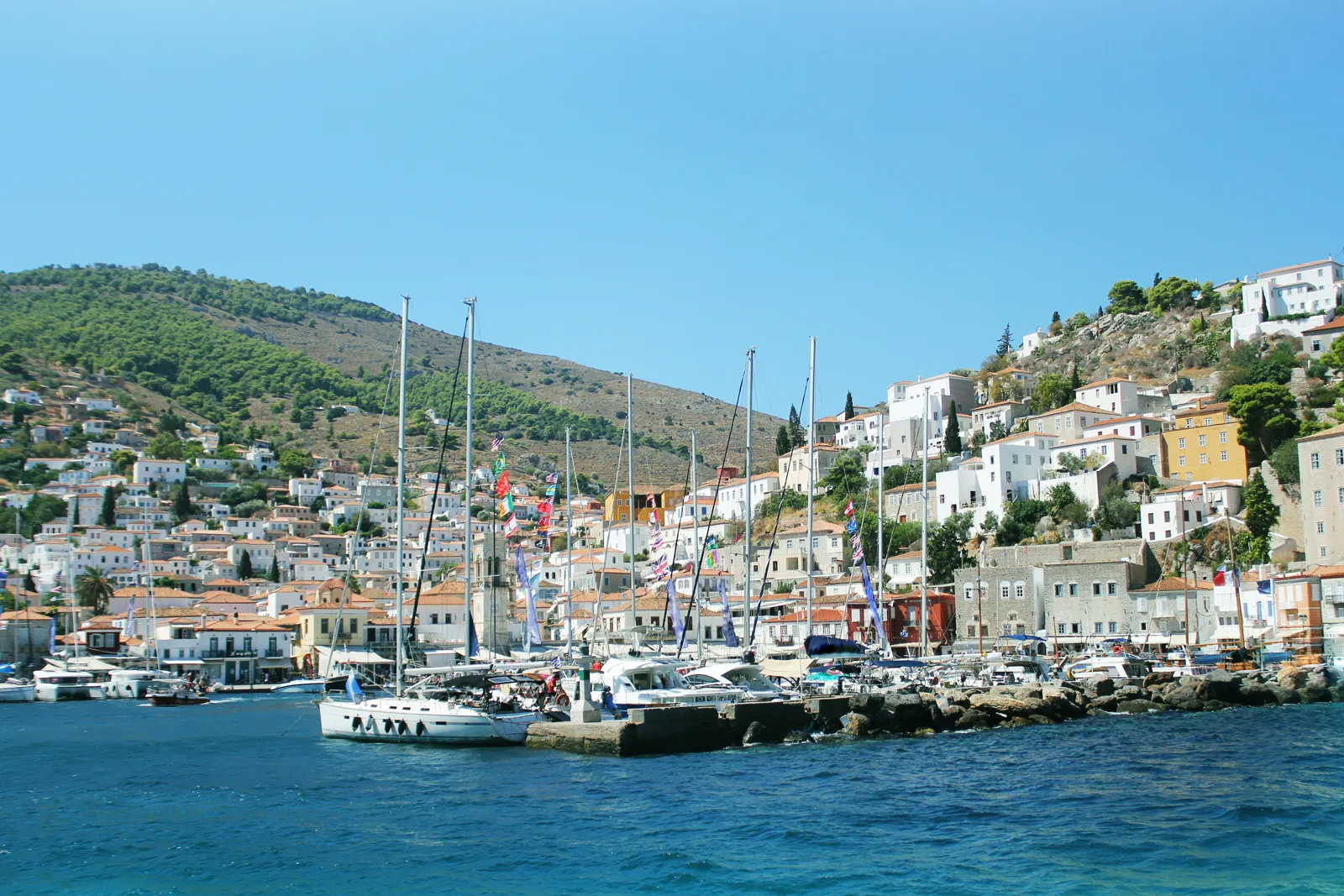
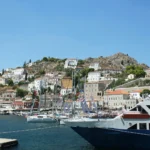
Hydra, in the Saronic Gulf, is the Greek island without cars: you get around on foot, by donkey or by water taxi. Its amphitheatre-shaped harbour, stone captains’ mansions and rocky coves make it a classic trip from Athens, less than two hours away by fast boat. For the things to do in Hydra, a day is enough for the harbour and a swim; 2 to 3 days let you hike and enjoy the quiet evenings, preferably from April to June or in September-October.
This guide brings together the highlights, the budget and the climate, with a calculation other guides do not give: how much time you really get on the island on a day trip, depending on the boat you choose.

Our travel deals for Hydra
Affiliate links: we earn a commission, at no extra cost to you.
 FlightsKiwi.comCompare flights and airline combinations to Hydra.Compare flights

Hydra at a glance
- Country Greece, Saronic Islands; off the Peloponnese
- Language Greek; English widely spoken in tourism
- Currency the euro (€) · currencies
- Time zone UTC+2, UTC+3 in summer: 2 hours ahead of London, 7 hours ahead of New York · detailsLocal time now: –:–
- Access fast boat from Piraeus · detailsAbout 1 h 15 min to 2 h 20 min depending on the company and the stops
- Entry Schengen area: no visa for up to 90 days for US citizens (tourism or business) and UK citizens (in any 180-day period) · US: travel.state.gov · UK: GOV.UK
- Electricity 230 V / 50 Hz, type F plugs (Visit Greece); US and UK travellers need an adapter, and US devices must accept 230 V · plugs
- Special feature no cars or scooters; donkeys, mules, water taxis
- Budget see our budget section
Things to do in Hydra: the highlights
The harbour and the captains’ mansions
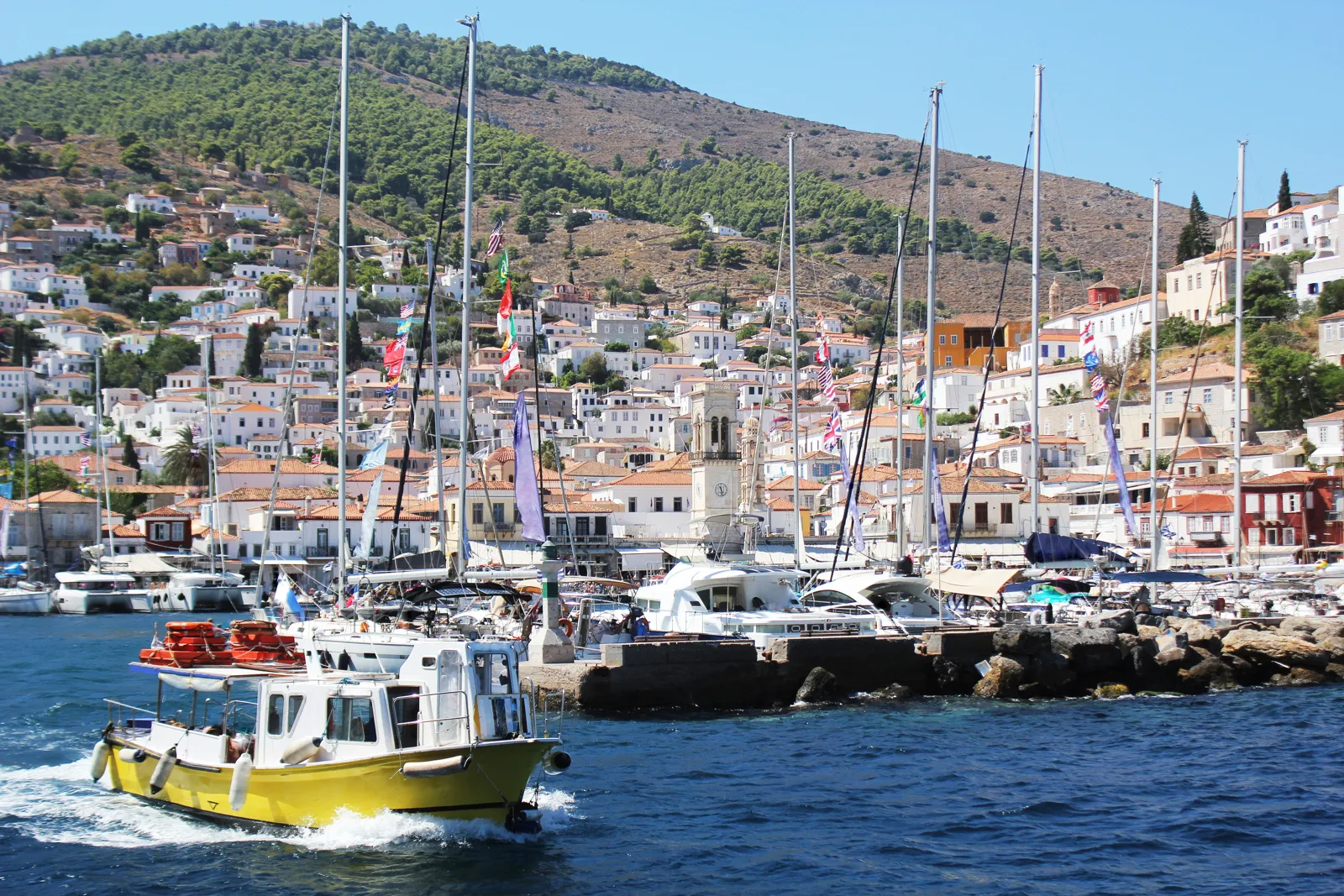
The harbour is the heart of the island: cafés, shops, fishing boats and yachts at the foot of stone houses stacked up the hill. The grand mansions (archontika) recall the wealth of Hydra’s shipowners and their role in the Greek War of Independence. Some can be visited, such as the Lazaros Kountouriotis mansion, an annex of the National Historical Museum.
The Historical Archives Museum and the Monastery of the Dormition
On the harbour, the Historical Archives Museum presents the island’s maritime history. The Monastery of the Dormition of the Virgin, with its clock tower, is the most visible monument from the quay.
The Spilia and Hydronetta swimming spots
There is no sandy beach near the harbour, but rocky platforms fitted with ladders, a few minutes’ walk to the west: Spilia, then Hydronetta. You swim in deep, clear water; the UK FCDO (updated 11 August 2026) advises not diving into unknown water, as hidden rocks can cause serious injury.
Kamini and Vlychos on foot
A coastal path links the harbour to the small fishing port of Kamini, then to the hamlet of Vlychos and its pebble beach: about an hour’s walk one way, with tavernas along the way. You can come back by water taxi.
The monasteries of Profitis Ilias and Agia Efpraxia
For a hike, climb from the harbour to the monasteries of Profitis Ilias and Agia Efpraxia, on the heights. The path is steep and has little shade: set off early and take water. The view stretches over the Peloponnese and the gulf.
Beaches by water taxi
The more distant beaches (Bisti and Agios Nikolaos to the west, Mandraki to the east) are reached by water taxi or shuttle boat from the harbour in season. Hydra has long attracted artists and writers; the singer Leonard Cohen lived here.
Hydra on a day trip: how much time on the island?
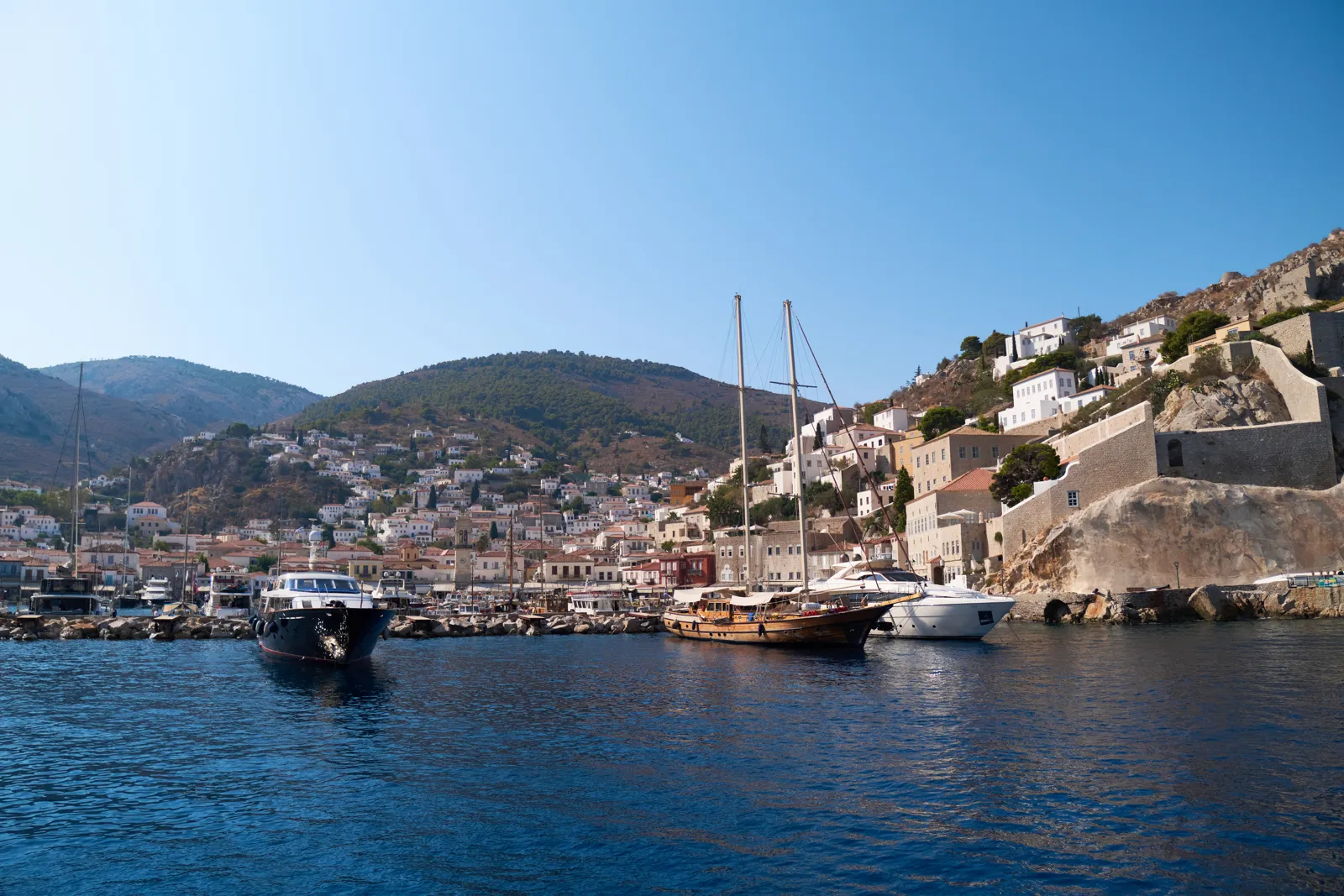
Many visitors see Hydra in a day from Athens. The time you actually have depends mostly on the boat: fast and direct, or slower with stops at Poros or Ermioni. We calculated four typical scenarios, based on crossing times listed on ferry comparison sites.
| Scenario | Leave Piraeus | Arrive in Hydra | Return from Hydra | Usable time on the island |
|---|---|---|---|---|
| Most direct fast boat (about 1 h 15 min) | 08:30 | 09:45 | 19:00 | 8 h 45 min |
| Fast boat with stops (about 2 h) | 08:30 | 10:30 | 19:00 | 8 h 00 min |
| Later departure, afternoon return | 10:00 | 12:00 | 17:00 | 4 h 30 min |
| Off season, slow service (about 2 h 20 min) | 09:00 | 11:20 | 16:30 | 4 h 40 min |
- Add the journey to Piraeus from central Athens (metro, about 30 minutes to 1 hour depending on where you start) and arrive early at the quay.
- Choose a direct service if you are only doing the round trip: you gain nearly 2 hours on the island.
- Out of season, there are fewer sailings (at least two a day according to Ferries in Greece): a night on the island becomes more comfortable.
- In summer, book your return: the last Sunday boats are often full.
Itinerary: Hydra in 2 days
- Day 1, morning: arrive at the harbour, the Historical Archives Museum, the lanes and the captains’ mansions
- Day 1, afternoon: a swim at Spilia or Hydronetta, then sunset from the terraces west of the harbour
- Day 2, early morning: climb to the monasteries of Profitis Ilias and Agia Efpraxia
- Day 2, afternoon: the coastal path to Kamini and Vlychos, back by water taxi
Hydra combines well with Poros, Aegina or Spetses, the other Saronic Gulf islands, and with a stay in Athens. To go further, see our guide to the Greek islands.
When to go to Hydra
The best times are April to June and September to October: 21 to 30 °C (70 to 86 °F) in the afternoon, paths that are pleasant for walking and fewer crowds. In July and August, the National Observatory of Athens station records an average maximum of nearly 33 °C (91 °F): walking becomes hard during the day and weekend boats are full. Winter is mild (about 15 °C, or 59 °F, in the afternoon in January) but many places close and crossings are less frequent.
| Month | Avg max | Avg min | Sunset | Day length | Crowds | Prices | Verdict |
|---|---|---|---|---|---|---|---|
| January | 14.8 °C (59 °F) | 10.2 °C (50 °F) | 17:31 | 9 h 53 min | Very low | Low | ⚠️ Mild, island asleep |
| February | 15.6 °C (60 °F) | 10.8 °C (51 °F) | 18:05 | 10 h 50 min | Very low | Low | ⚠️ Mild, island asleep |
| March | 17.2 °C (63 °F) | 11.7 °C (53 °F) | 18:33 | 11 h 56 min | Low | Low | ⚠️ Cool, few services |
| April | 20.8 °C (69 °F) | 14.4 °C (58 °F) | 20:00 | 13 h 10 min | Medium | Medium | ✅ Ideal for walking |
| May | 25.0 °C (77 °F) | 18.4 °C (65 °F) | 20:27 | 14 h 11 min | Medium | Medium | ✅ Ideal, sea warming up |
| June | 29.7 °C (85 °F) | 22.8 °C (73 °F) | 20:48 | 14 h 43 min | High | High | ✅ Hot, swimming |
| July | 32.9 °C (91 °F) | 25.9 °C (79 °F) | 20:46 | 14 h 29 min | Very high | Very high | ⚠️ Very hot, crowds |
| August | 32.8 °C (91 °F) | 26.4 °C (80 °F) | 20:18 | 13 h 36 min | Very high | Very high | ⚠️ Very hot, crowds |
| September | 28.9 °C (84 °F) | 23.2 °C (74 °F) | 19:34 | 12 h 26 min | High | High | ✅ Warm sea, fewer people |
| October | 24.1 °C (75 °F) | 19.2 °C (67 °F) | 18:49 | 11 h 15 min | Medium | Medium | ✅ Mild, pleasant |
| November | 20.3 °C (69 °F) | 15.9 °C (61 °F) | 17:15 | 10 h 10 min | Low | Low | ⚠️ End of season |
| December | 16.6 °C (62 °F) | 12.3 °C (54 °F) | 17:09 | 9 h 36 min | Very low | Low | ❌ Quiet, many closures |
As across the Athens region, most of the rain falls from November to March. To compare with other regions, see the best time to visit Greece.
Budget for visiting Hydra
| Item (per person per day) | Small budget | Comfort |
|---|---|---|
| Accommodation (based on a shared double room) | about €40 to €60 (guesthouse) | about €100 to €180 (characterful guesthouse) |
| Meals | about €25 to €35 | about €50 to €80 |
| Water taxi, luggage transport | about €0 to €10 | about €20 to €40 |
| Total (excluding ferry) | about €80 to €120 | about €180 to €300 |
Getting around Hydra
- On foot: the main way to get around; the lanes are stepped, so wear suitable shoes and travel light.
- Donkeys and mules: they carry luggage and goods from the harbour; ask your accommodation.
- Water taxis: at the harbour, for the beaches and coastal hamlets.
- Getting there: fast boats from Piraeus, less often from other ports in the gulf; book in summer.
Where to stay in Hydra
| Area | Best for | Highlights |
|---|---|---|
| Harbour (Hydra town) | First stay, minimal effort | Everything on foot, restaurants, boat departures |
| Above the harbour | Couples, views | Quiet, terraces; many steps |
| Kamini | Quiet, village feel | Small fishing port, sunsets |
| Vlychos | Quiet beach stay | Beach, tavernas; reached on foot or by boat |
Entry requirements, health and safety
- US citizens: Greece is in the Schengen area, so you may enter without a visa for up to 90 days for tourism or business. Greek law requires three months of passport validity beyond your departure date, but the State Department recommends at least six months; you must be able to show proof of sufficient funds and a return ticket if asked (U.S. Department of State, travel.state.gov, last updated February 19, 2026).
- UK citizens: no visa for up to 90 days in any 180-day period in the Schengen area. Your passport must have been issued less than 10 years before you arrive and be valid for at least 3 months after the day you plan to leave; you may be asked for a return or onward ticket and proof of funds. Greek authorities have indicated they will not collect fingerprints and photos from UK travellers under the EU Entry/Exit System (UK FCDO, GOV.UK, updated 11 August 2026).
- Health: according to the UK FCDO (updated 11 August 2026), treatment may be limited on the islands and some islands face serious shortages of ambulances; UK travellers need a GHIC or EHIC for state healthcare, which is not a substitute for travel insurance. The U.S. State Department strongly recommends insurance that covers medical evacuation.
- Wildfires: the UK FCDO (updated 11 August 2026) reports a high wildfire risk from April to October; causing a wildfire is a criminal offence in Greece, even if unintentional. Do not light fires or barbecues.
- Hiking: trails often lack shade; avoid the peak hours of sun, take plenty of water and tell someone your route (UK FCDO, updated 11 August 2026).
- Emergencies: call 112 (ambulance, fire, police); for an ambulance you can also dial 166 (UK FCDO). Visit Greece lists the Tourist Police on 1571 (24/7).
- See our travel insurance guide.
Practical tips for Hydra
- Money: euro; cards are accepted in most places, keep cash for water taxis.
- Luggage: a backpack is better than a big wheeled suitcase.
- Heat: in summer, walk early in the morning or late in the day.
- Respect: dress appropriately in monasteries (shoulders and knees covered).
- Mobile data: check your home carrier’s roaming charges before you go.
Frequently asked questions
Can you visit Hydra as a day trip from Athens?
Yes. With a direct fast boat you can have 8 to 9 hours on the island; with a slow service and an afternoon return, more like 4 to 5 hours. Check the timetable for your day.
How long is the crossing from Piraeus to Hydra?
About 1 h 15 min to 2 h 20 min depending on the company, the vessel and the stops at Poros or Ermioni.
Why are there no cars on Hydra?
Motor vehicles are not allowed on the island, apart from a few service vehicles: people get around on foot, by donkey or by water taxi.
Are there beaches on Hydra?
Few sandy beaches: near the harbour you swim from rocky platforms (Spilia, Hydronetta); pebble beaches such as Vlychos or Bisti are reached on foot or by boat.
What is the best time to go to Hydra?
From April to June and in September-October, to walk without the summer heat and avoid the weekend crowds of July-August.
Our sources
- National Observatory of Athens: 2010-2024 averages from the Hydra weather station (monthly bulletins), via the Wikipedia article « Hydra (island) »
- Destination de Voyage calculation: usable time on the island by ferry scenario, sunset and day length (NOAA solar algorithm)
- Crossing times: Ferryscanner, Direct Ferries and Ferries in Greece, accessed 15 October 2026
- Entry requirements, health and safety checked on 26 October 2026: U.S. Department of State, Greece country information (last updated February 19, 2026) and UK FCDO, GOV.UK foreign travel advice for Greece (updated 11 August 2026).
- Visit Greece (Greek National Tourism Organisation), travel tips: electricity and emergency numbers, checked 26 October 2026
- Our methodology
Updated October 2026.
To extend your trip, see our Greece travel guide, our ideas for a cruise in Greece and our other destinations in Europe.