For a trip to Central Asia, starting with Uzbekistan, the best time is spring (mid-April to early June) and autumn (September to October): 20 to 28 °C (68 to 82 °F) in the afternoon in Tashkent, little rain and ideal light on the domes of Samarkand. Summer is scorching on the plains (an average high of 36 °C / 97 °F in Tashkent in July), but it is the season for the mountains of Kyrgyzstan and Tajikistan. Winter is cold and gray, with frosts. This Central Asia travel guide covers seasons, highlights and entry rules country by country.
Central Asia includes five countries: Uzbekistan, Kyrgyzstan, Kazakhstan, Tajikistan and Turkmenistan. The Silk Road cities are mostly in Uzbekistan; the great mountain landscapes are in Kyrgyzstan, Tajikistan and southeastern Kazakhstan. This guide helps you choose the season and your stops, and prepare the paperwork, country by country. Further east, outside this list, the neighboring steppes are planned separately: see things to do in Mongolia to extend the journey.
Central Asia: the essentials
Silk Road (Samarkand, Bukhara, Khiva): mid-April to early June and September to October
Mountains (Kyrgyzstan, Pamir, Tian Shan): June to September
Avoid on the plains: July and August (over 35 °C / 95 °F in the afternoon), and winter if you dislike the cold
Visas for US and UK citizens: visa-free short stays in Kazakhstan and Kyrgyzstan for both; Uzbekistan visa-free for UK citizens, e-visa route described for US citizens; Tajikistan visa-free for US citizens, visa or e-visa for UK citizens; Turkmenistan always requires a sponsored visa (details below)
Permits: Tajikistan’s Gorno-Badakhshan (Pamir) region and the Khatlon border areas require a separate permit (GOV.UK)
Suggested length: 10 to 15 days for Uzbekistan, 3 weeks to combine it with Kyrgyzstan
Safety: what the official advice says
Uzbekistan: be cautious near the Afghan border; the banks of the Amu Darya are fenced off as a military « neutral zone », where approaching the fence or photographing military sites risks arrest, and many sites near the border require permission or an organized tour (UK FCDO, GOV.UK, updated 19 March 2026).
Tajikistan: cross-border attacks from Afghanistan killed several people in 2025, and armed clashes along the Afghan border were reported in August 2026; there is a risk of civil unrest in Khorog and other towns of Gorno-Badakhshan (GOV.UK, updated 19 August 2026). A permit is required for areas within 20 km (12 mi) of the Afghan border in Khatlon.
Turkmenistan: border crossings may be closed without notice (GOV.UK, updated 21 October 2026).
Kazakhstan and Kyrgyzstan: no area-specific warnings were found in the GOV.UK pages we read; check road safety and local advice.
Situation checked on 24 October 2026: check the latest FCDO and State Department advice before booking.
When to go to Central Asia: the climate month by month
The table below gives the normals for Tashkent, the Uzbek capital and the region’s main air gateway. The climate is continental and dry: cold winters, very hot summers, with rain concentrated from November to April. Samarkand has a very similar profile; Bukhara and Khiva, on the edge of the desert, are hotter in summer.
Month
High
Low
Rain
Crowds
Prices
Verdict
January
7.2 °C (45 °F)
-1.3 °C (30 °F)
55 mm (2.2 in)
Low
Low
❌ Cold, gray, frosty nights
February
9.5 °C (49 °F)
0.1 °C (32 °F)
72 mm (2.8 in)
Low
Low
⚠️ Cold, wettest month
March
16.0 °C (61 °F)
5.3 °C (42 °F)
66 mm (2.6 in)
Medium (Navruz)
Medium
⚠️ Warming up, frequent showers
April
22.3 °C (72 °F)
10.1 °C (50 °F)
63 mm (2.5 in)
High
High
✅ Mild, orchards in bloom
May
28.0 °C (82 °F)
14.3 °C (58 °F)
41 mm (1.6 in)
High
High
✅ The ideal month for the Silk Road
June
33.6 °C (92 °F)
18.4 °C (65 °F)
17 mm (0.7 in)
Medium
Medium
⚠️ Heat setting in, mountains accessible
July
35.9 °C (97 °F)
20.1 °C (68 °F)
3 mm (0.1 in)
Medium
Medium
❌ Heatwave on the plains
August
34.9 °C (95 °F)
18.4 °C (65 °F)
2 mm (0.1 in)
Medium
Medium
❌ Very hot, head for the mountains
September
29.5 °C (85 °F)
13.4 °C (56 °F)
5 mm (0.2 in)
High
High
✅ Dry, cooling down, full markets
October
22.2 °C (72 °F)
8.3 °C (47 °F)
24 mm (0.9 in)
High
High
✅ Mild and bright
November
14.1 °C (57 °F)
3.6 °C (38 °F)
51 mm (2.0 in)
Low
Low
⚠️ Cooler, rain returns
December
8.6 °C (47 °F)
-0.1 °C (32 °F)
58 mm (2.3 in)
Low
Low
❌ Cold, short days
Temperatures and rainfall: 1991–2020 normals for the Tashkent station published by the World Meteorological Organization (WMO). Crowds and prices: indicative estimate.
For comparison, the 1991–2020 normals for Bukhara (WMO data distributed by NOAA) give highs of 24.4 °C (76 °F) in April, 30.7 °C (87 °F) in May and 37.3 °C (99 °F) in July: in the west of the country, the pleasant spring window closes earlier than in Tashkent. For Khiva, in the Karakum Desert, aim for April, May and late September to October.
The seasons in Central Asia
Spring (April to early June): the best season for the cities
Pros: mild temperatures, green countryside, Navruz (the Persian New Year, around March 21) celebrated across the region
Cons: high season in Samarkand and Bukhara, trains and hotels to book early; high mountain passes still snowbound
Our tip: May is the most balanced month for Uzbekistan
Summer (June to August): the mountain season
Pros: high-altitude lakes and pastures accessible in Kyrgyzstan (Song-Kul, Issyk-Kul), hiking in the Tian Shan, herders’ yurts open
Cons: crushing heat in Bukhara and Khiva; sightsee early in the morning and late in the day
Who for? Hikers and those combining Uzbekistan with Kyrgyzstan
Autumn (September to October): the second-best time
Pros: dry skies, markets full of melons, grapes and pomegranates, falling temperatures
Cons: high season as in spring; in the mountains, nights turn cold from late September
Our tip: September to combine cities and mountains, October for the cities only
Winter (November to March): quiet and cold
Sites are almost empty and prices lower, but it freezes at night in Tashkent in December and January and days are short. Kazakhstan and Kyrgyzstan offer skiing (Shymbulak near Almaty, Karakol). An option for travelers who can handle the cold and want peace and quiet.
Things to do in Central Asia: the highlights
Samarkand: Registan Square, the Gur-e-Amir mausoleum and the Shah-i-Zinda necropolis (Uzbekistan)
Bukhara: the Po-i-Kalyan ensemble, the Ark citadel and the Lyab-i Hauz pool
Khiva: the walled city of Itchan Kala, best seen at sunset from the ramparts
Tashkent: the metro with its decorated stations and Chorsu Bazaar
The Fergana Valley: silk and ceramics in Margilan, Rishtan and Kokand
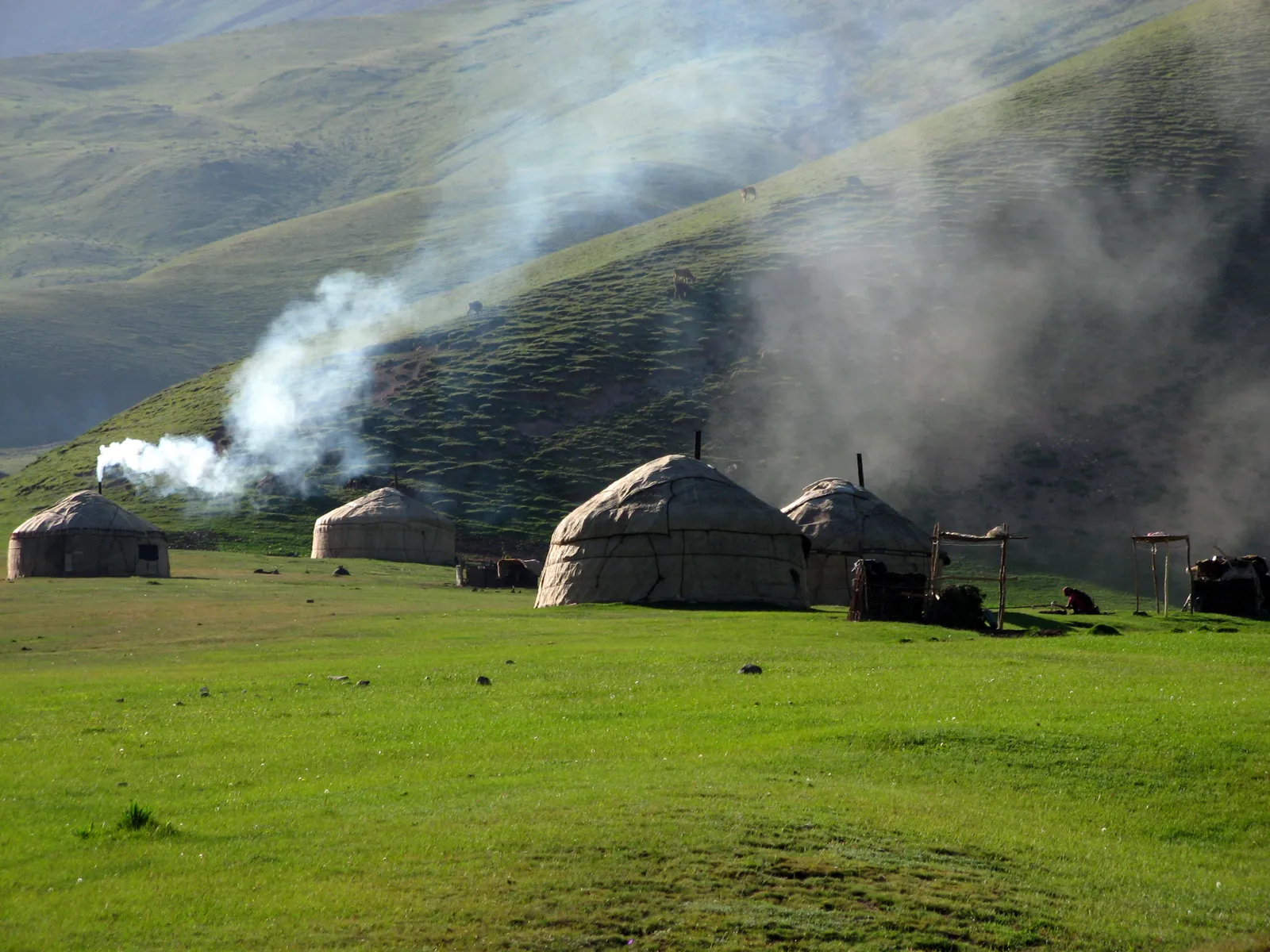
Kyrgyzstan’s lakes: Issyk-Kul and Song-Kul, above 3,000 m (9,800 ft), with nights in a yurt (Kyrgyzstan)
The Almaty region: Big Almaty Lake, the Kolsai Lakes and Charyn Canyon (Kazakhstan)
The Fann Mountains: hiking in Tajikistan, away from the Afghan border areas
The Silk Road in Uzbekistan: what to see
Samarkand
The most famous city in Central Asia. Registan Square lines up three madrasas covered in blue tiles; around it are the Bibi-Khanym Mosque, Tamerlane’s Gur-e-Amir mausoleum and the Shah-i-Zinda necropolis, a street of mausoleums with very fine tilework. Allow two full days. The fast train links Tashkent and Samarkand in a few hours.
Bukhara
More intimate than Samarkand, Bukhara has kept a dense historic center: the Po-i-Kalyan ensemble and its minaret, the Ark citadel, the Lyab-i Hauz pool lined with madrasas, the trading domes and the Samanid Mausoleum. It is explored on foot. Two to three days is a good pace.
Khiva
Itchan Kala, Khiva’s inner town, is a walled city of mud brick packed with mosques, minarets and palaces. Its small size means you can see everything in a day, but a night there lets you enjoy the ramparts at sunset. Khiva is reached by train or by plane via Urgench.
Tashkent and the Fergana Valley
Tashkent, rebuilt after the 1966 earthquake, is visited for its metro with decorated stations, Chorsu Bazaar and the Hazrati Imam complex. The Fergana Valley, to the east, is the land of silk and ceramics (Margilan, Rishtan, Kokand).
The other countries of Central Asia
Kyrgyzstan: lakes and mountains
Kyrgyzstan is the country of hiking and nomadic life: Issyk-Kul lake, Song-Kul lake above 3,000 m (9,800 ft), the valleys around Karakol, nights in a yurt. The ideal season runs from June to September; outside it, many high-altitude tracks are under snow. Road travel is the main risk: drive carefully and avoid traveling at night.
Kazakhstan: Almaty and the Tian Shan
Kazakhstan is huge, but most travelers focus on the Almaty region: Big Almaty Lake, the Kolsai Lakes and Charyn Canyon. Turkestan, in the south, is home to the Mausoleum of Khoja Ahmed Yasawi. Some border areas require permits: check access with a local operator before setting off.
Tajikistan: the Pamir
Tajikistan draws travelers for the Pamir Highway and the mountains of Gorno-Badakhshan (GBAO), accessible from June to September. According to GOV.UK (updated 19 August 2026), you need a separate permit for GBAO in addition to your visa or visa-free entry, the government sometimes stops issuing permits at short notice, and part of the classic route runs along the Afghan border, where armed clashes have occurred. Check possible routes before you leave. Dushanbe and the Fann Mountains, in the north, are away from this area.
Turkmenistan: a country apart
Turkmenistan cannot be visited independently: tourist visas require a sponsor. Since 1 October 2026, tourists receive an e-visa, but the application still goes through a tour agency acting as sponsor (GOV.UK, updated 21 October 2026). Most visitors go with an agency to Ashgabat, the ancient site of Merv and the Darvaza gas crater.
When to go by trip type
Your trip
Best period
Where?
Silk Road (cities)
Mid-April to early June, September to October
Samarkand, Bukhara, Khiva
Hiking and mountain lakes
June to September
Kyrgyzstan (Song-Kul, Karakol), Fann Mountains
Cities and mountains combined
June or September
Uzbekistan + Kyrgyzstan
Low budget, few crowds
November, March
Uzbekistan
Skiing
December to March
Shymbulak (Almaty), Karakol
Navruz
Around March 21
The whole region
Itinerary ideas for Central Asia
10 days in Uzbekistan: Tashkent (1 day), Khiva (1–2 days, by plane or night train), Bukhara (3 days), Samarkand (2–3 days), back to Tashkent
2 weeks: the same route, plus the Fergana Valley or a stop in Shakhrisabz and Nurata
3 weeks: Uzbekistan, then Kyrgyzstan via the Fergana Valley land border (Osh) or by plane to Bishkek, for Song-Kul and Issyk-Kul
Entry requirements for Central Asia, country by country
Information read on 24 October 2026 on the U.S. Department of State (travel.state.gov) and UK FCDO (GOV.UK) pages for each country. Rules change: check them again before you leave.
US citizens
Country
Visa (US tourist)
Points to note
Kazakhstan
Visa-free up to 30 days per visit, 90 days in total per six months (travel.state.gov, August 13, 2026)
Overstaying can lead to fines, imprisonment or delays on exit
Kyrgyzstan
Visa-free up to 60 days, then an equal period outside the country (travel.state.gov, June 11, 2026)
Make sure your passport is stamped on entry
Uzbekistan
Tourist stays of 30 days or less: e-visa route described by travel.state.gov (January 29, 2026)
Print the e-visa approval email; payment confirmation is not approval. Check current rules with the Embassy of Uzbekistan
Tajikistan
Visa-free up to 30 days; passport valid 6 months with 2 blank pages (travel.state.gov, August 27, 2026)
Register with OVIR within 10 days for stays of 10 days or more; GBAO permit needed
Turkmenistan
Visa required, on a letter of invitation (travel.state.gov, September 3, 2026)
Register with the State Migration Service within 3 working days for longer stays
UK citizens
Country
Visa (UK tourist)
Points to note
Kazakhstan
Visa-free up to 30 days, maximum 90 days in any 180; passport valid 30 days from arrival with one blank page (GOV.UK, 13 October 2026)
Your hotel or host registers your arrival within 3 working days; a local SIM is blocked after 30 days without IMEI verification
Kyrgyzstan
Visa-free up to 30 days per 60-day period; passport valid 6 months from arrival (GOV.UK, 14 September 2026)
Registration needed only beyond 30 days
Uzbekistan
Visa-free up to 30 days; passport valid 3 months from arrival (GOV.UK, 19 March 2026)
Registration within 3 days (done by hotels); keep a full record of where you stayed
Tajikistan
Visa required: e-visa or pre-approved visa on arrival; passport valid 6 months with 2 blank pages (GOV.UK, 19 August 2026)
Separate permits for GBAO and the Khatlon border areas; registration rules for stays over 10 days without an e-visa
Turkmenistan
Visa required; tourist e-visa since 1 October 2026, through a sponsoring agency; passport valid 6 months after departure (GOV.UK, 21 October 2026)
Register within 3 days for stays over 3 working days (usually done by the hotel or sponsor)
On the health side, check vaccine recommendations at least 8 weeks before your trip (TravelHealthPro, as advised by GOV.UK), drink bottled water, and plan for heat in summer and cold and altitude in the mountains. Take insurance covering medical evacuation, especially for trekking in remote areas.
Practical tips for Central Asia
Flights: Tashkent, Almaty and Bishkek are the main gateways; check current routes with the airlines.
Transport: in Uzbekistan, trains link Tashkent, Samarkand, Bukhara and Khiva; book ahead in spring and autumn. In Kyrgyzstan, a car with driver is the most common option.
Currency: Uzbek som, Kyrgyz som, Kazakh tenge, Tajik somoni and Turkmen manat. Bring cash in good condition. You can use our currency converter.
Phone: in Kazakhstan, a foreign phone used with a local SIM card is blocked after 30 days unless its IMEI is verified; a global eSIM is an alternative for longer stays (GOV.UK).
Etiquette: modest dress in mosques and religious sites; ask before photographing people.
Who is Central Asia for?
Our verdicts by traveler profile, based on the information in this guide (places, budget, seasons).
Profile
Our verdict
Why
Culture and history
Very well suited
Samarkand, Bukhara and Khiva, on the Silk Road.
Hiking and nature
Very well suited
Issyk-Kul and Song-Kul in Kyrgyzstan, the Tian Shan, the Fann Mountains, from June to September.
Couples
Suited
Khiva’s ramparts at sunset, nights in a yurt in Kyrgyzstan.
Budget travelers
Suited
In November and March, almost empty sites and lower prices in Uzbekistan.
Families
With reservations
Heat over 35 °C (95 °F) on the plains in July–August and long mountain drives.
Independent travel
Suited
Easy in Uzbekistan thanks to the train; Turkmenistan requires an agency and the Pamir a special permit.
Frequently asked questions
When should you go to Uzbekistan?
From mid-April to early June and from September to October. In Tashkent, highs are then roughly 22 to 30 °C (72 to 86 °F), compared with nearly 36 °C (97 °F) in July. May and September are the most balanced months.
Do I need a visa for Uzbekistan?
British citizens can visit visa-free for up to 30 days with a passport valid for at least 3 months from arrival (GOV.UK, updated 19 March 2026). For US citizens, travel.state.gov (last updated January 29, 2026) describes an e-visa for tourist stays of 30 days or less: check with the Embassy of Uzbekistan. Registration is required within 3 days; hotels do it for you.
Is Uzbekistan safe?
The main tourist sites (Samarkand, Bukhara, Khiva) are far from the Afghan border. Near that border, the UK FCDO advises caution: the riverbank is a fenced military zone and many nearby sites require permission or an organized tour.
How many days do you need to visit Uzbekistan?
Ten days is enough for Tashkent, Khiva, Bukhara and Samarkand. With two weeks, add the Fergana Valley or Shakhrisabz.
What is the best time to visit Kyrgyzstan?
June to September, when high-altitude lakes and pastures are accessible. Outside that period, many mountain tracks are under snow.
Can you visit the Pamir in Tajikistan?
Yes, with a separate permit for Gorno-Badakhshan in addition to your entry document, which the government sometimes stops issuing at short notice (GOV.UK). Part of the route runs along the Afghan border, where armed clashes have occurred: check possible routes before you leave.
Which countries should you visit in Central Asia?
Central Asia is made up of five countries: Uzbekistan for the Silk Road cities (Samarkand, Bukhara, Khiva), Kyrgyzstan for lakes and mountains, Kazakhstan (Almaty, Tian Shan), Tajikistan (Pamir) and Turkmenistan, which is more closed. For a first trip, Uzbekistan is the easiest; month-by-month details are on our page best time to visit Uzbekistan.
UK FCDO, GOV.UK foreign travel advice, read on 24 October 2026: Kazakhstan (updated 13 October 2026), Kyrgyzstan (updated 14 September 2026), Uzbekistan (updated 19 March 2026), Tajikistan (updated 19 August 2026), Turkmenistan (updated 21 October 2026)
U.S. Department of State, travel.state.gov country information, read on 24 October 2026: Kazakhstan (last updated August 13, 2026), Kyrgyzstan (last updated June 11, 2026), Uzbekistan (last updated January 29, 2026), Tajikistan (last updated August 27, 2026), Turkmenistan (last updated September 3, 2026)
World Meteorological Organization (WMO), 1991–2020 climate normals for Tashkent
Transparency: this page contains affiliate links, labelled as such. If you book through them we may earn a commission at no extra cost to you; it does not influence our content or recommendations. How we fund the site.