Milos is a volcanic island in the south-west Cyclades, known for its sculpted coastline: the white rocks of Sarakiniko, the sea caves of Kleftiko reached by boat, the fishing villages with brightly painted doors (the « syrmata ») of Klima, and the hilltop village of Plaka. It is also where the Venus de Milo, now in the Louvre, was discovered. For things to do in Milos, allow 4 to 5 days, ideally from late May to late June or in September.
Quieter than Santorini or Mykonos, Milos has become known in recent years for its beaches and boat trips. This guide brings together the highlights, an itinerary, the budget, where to stay and the climate based on official normals, with two calculations of our own: sunset times month by month and the number of rain days to expect over a week.

Our travel deals for Milos
Affiliate links: we earn a commission, at no extra cost to you.
 FlightsKiwi.comCompare flights and airline combinations to Milos.Compare flights

Milos at a glance
- Country Greece, Cyclades archipelago; main port: Adamas
- Language Greek; English widely spoken in tourism
- Currency the euro (€) · currencies
- Time zone UTC+2, UTC+3 in summer: 2 hours ahead of London, 7 hours ahead of New York · detailsLocal time now: –:–
- Airports Milos airport (MLO), domestic flights from Athens; ferries from Piraeus · details
- Entry Schengen area: no visa for up to 90 days for US citizens (tourism or business) and UK citizens (in any 180-day period) · travel.state.gov · GOV.UK
- Electricity check voltage and plug types before you go · plugs
- Ideal length 4 to 5 days
- Budget see our budget section
Things to do in Milos: the highlights
Sarakiniko
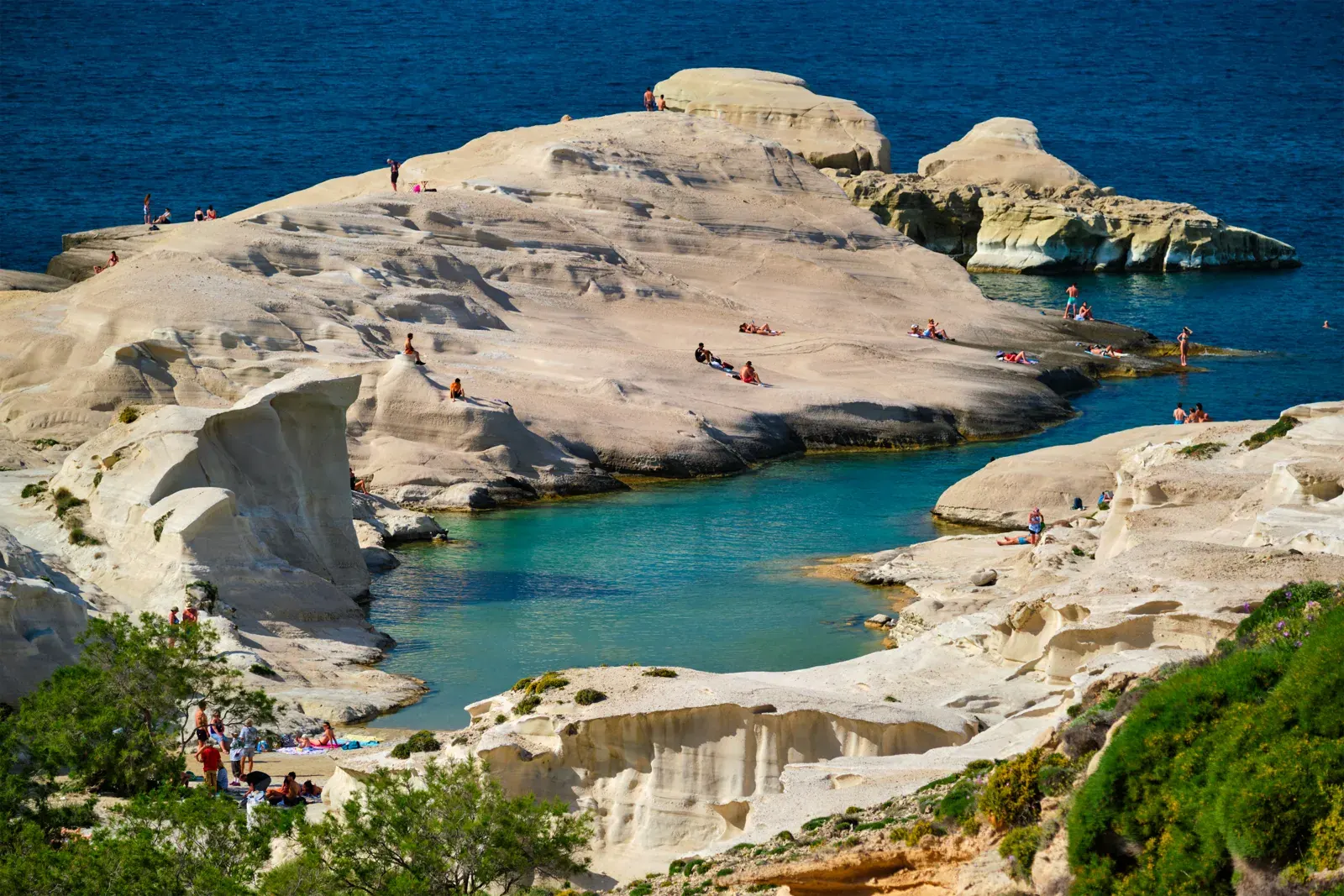
In the north of the island, the Sarakiniko coast is made of white volcanic rock eroded into waves and arches, plunging into a small cove. Come early in the morning or at sunset: the site is very busy in summer and has almost no shade. When the north wind blows, the sea quickly gets rough.
Kleftiko, by sea
In the south-west, the cliffs and caves of Kleftiko, a former pirate hideout, can practically only be reached by boat. Day trips leave from Adamas and often circle the island with swimming stops; by sailing boat or motorboat, they depend on sea conditions.
Plaka and the Kastro
The main town, Plaka, overlooks the island from a hill. Its whitewashed lanes lead to the top of the Kastro and the church of Panagia Thalassitra, from where the view over Milos Bay at sunset is the best known. The archaeological museum displays a copy of the Venus de Milo.
Klima, Firopotamos and Mandrakia
The « syrmata » are fishermen’s houses built at water level, with a boat shelter on the ground floor and brightly painted doors. Klima, below Plaka, is the most photographed; Firopotamos and Mandrakia, in the north, are smaller, and you can swim there.
The catacombs and the ancient theatre
Near Trypiti, the early Christian catacombs are among the most important in Greece. A path leads down to the Roman theatre, facing the bay, and to the spot where the Venus de Milo was found in 1820, marked by a plaque.
The southern beaches and Papafragas
The south of the island (Firiplaka, Tsigrado, Provatas, Paliochori) is better sheltered from the north wind: this is where you swim when the meltemi blows. In the north-east, Papafragas is a narrow inlet between two cliffs. The wild south-west is explored on dirt tracks where a suitable vehicle is recommended.
Itinerary: Milos in 4 days
- Day 1: Adamas, Plaka and the Kastro at sunset, dinner in Plaka or Trypiti
- Day 2: boat trip to Kleftiko and the south-west coast (book according to the weather)
- Day 3: Sarakiniko early in the morning, Papafragas, Mandrakia and Firopotamos, then Klima
- Day 4: catacombs and ancient theatre, southern beaches (Firiplaka, Paliochori)
Milos combines by ferry with Sifnos, Serifos or Kimolos, then with Paros, Naxos or Santorini depending on the season’s connections. See our guide to the Greek islands to plan a route, and Athens for the starting point.
Decision tree: where to stay and how to get around
- No car, first visit → Adamas: port, buses, boat-trip agencies.
- Sunsets and villages → Plaka or Trypiti, on the heights, with a vehicle.
- Calm and sea → Pollonia, in the north-east, departure point for boats to Kimolos.
- Exploring remote beaches → hire a vehicle suited to dirt tracks; check the insurance conditions off paved roads. GOV.UK warns that quad bike accidents cause serious injuries every year.
- Meltemi forecast → favour the southern beaches, and postpone the boat trip if it is cancelled.
What time is sunset on Milos?
| Month | Sunrise | Sunset | Day length |
|---|---|---|---|
| January | 7:33 am | 5:29 pm | 9 h 55 |
| February | 7:10 am | 6:02 pm | 10 h 52 |
| March | 6:32 am | 6:29 pm | 11 h 56 |
| April | 6:48 am | 7:56 pm | 13 h 08 |
| May | 6:14 am | 8:22 pm | 14 h 08 |
| June | 6:02 am | 8:42 pm | 14 h 40 |
| July | 6:15 am | 8:41 pm | 14 h 26 |
| August | 6:39 am | 8:13 pm | 13 h 34 |
| September | 7:04 am | 7:30 pm | 12 h 26 |
| October | 7:29 am | 6:46 pm | 11 h 16 |
| November | 7:00 am | 5:13 pm | 10 h 13 |
| December | 7:27 am | 5:07 pm | 9 h 40 |
In June, the sun sets around 8:42 pm: go up to Plaka an hour before to find a spot. In October, it sets around 6:46 pm, leaving a longer evening after the show.
When to go to Milos
The best time is from late May to late June and from September to early October: 23 to 27 °C (73 to 81 °F) in the afternoon, practically no rain, and fewer people than in July and August. Summer is dry (less than 2 mm / 0.1 in of rain in July and August according to the normals), but it is the season of the meltemi, a northerly wind common in July and August in the Cyclades, which can cancel boat trips and churn up the northern beaches. From October to March the island is very quiet, some accommodation and restaurants close, and there are fewer ferry connections.
| Month | High | Low | Rain | Rain days | Per 7 days | Crowds | Prices | Verdict |
|---|---|---|---|---|---|---|---|---|
| January | 12.9 °C (55 °F) | 8.5 °C (47 °F) | 75 mm (3.0 in) | 8.8 | 2.0 | Very low | Low | ❌ Off season, many closures |
| February | 13.2 °C (56 °F) | 8.5 °C (47 °F) | 51 mm (2.0 in) | 7.3 | 1.8 | Very low | Low | ❌ Off season |
| March | 14.8 °C (59 °F) | 9.6 °C (49 °F) | 47 mm (1.9 in) | 5.7 | 1.3 | Low | Low | ⚠️ Cool, very quiet island |
| April | 18.4 °C (65 °F) | 12.4 °C (54 °F) | 20 mm (0.8 in) | 2.9 | 0.7 | Low | Medium | ⚠️ Mild, cold sea |
| May | 22.8 °C (73 °F) | 15.9 °C (61 °F) | 13 mm (0.5 in) | 1.4 | 0.3 | Medium | Medium | ✅ Pleasant, few people |
| June | 27.1 °C (81 °F) | 19.8 °C (68 °F) | 3 mm (0.1 in) | 0.3 | 0.1 | High | High | ✅ Ideal: warm, sea warming up |
| July | 28.1 °C (83 °F) | 21.8 °C (71 °F) | 0 mm (0.0 in) | 0.1 | 0.0 | Very high | Very high | ⚠️ Hot, meltemi, crowds |
| August | 27.6 °C (82 °F) | 21.6 °C (71 °F) | 1 mm (0.0 in) | 0.1 | 0.0 | Very high | Very high | ⚠️ Peak crowds and prices, meltemi |
| September | 25.2 °C (77 °F) | 19.6 °C (67 °F) | 6 mm (0.2 in) | 0.9 | 0.2 | High | High | ✅ Ideal: warm sea |
| October | 21.3 °C (70 °F) | 16.1 °C (61 °F) | 43 mm (1.7 in) | 3.9 | 0.9 | Medium | Medium | ✅ Still mild, end of season |
| November | 18.0 °C (64 °F) | 13.1 °C (56 °F) | 61 mm (2.4 in) | 5.8 | 1.4 | Very low | Low | ❌ Rainy, off season |
| December | 14.6 °C (58 °F) | 10.3 °C (51 °F) | 90 mm (3.5 in) | 9.0 | 2.0 | Very low | Low | ❌ Off season |
These normals date from 1961-1990: recent summers are often hotter. To compare with the rest of the country, see when to go to Greece.
Budget for visiting Milos
| Item (per person per day) | Low budget | Comfort |
|---|---|---|
| Accommodation (sharing a double room) | roughly €40 to €60 (studio, guesthouse) | roughly €100 to €180 (boutique hotel) |
| Meals | roughly €25 to €35 (tavernas, gyros) | roughly €50 to €80 |
| Getting around the island | roughly €10 to €20 (bus, scooter) | roughly €30 to €50 (car or quad) |
| Boat trip (one-off) | roughly €50 to €70 for a day on a shared boat | more by sailing boat or private charter |
| Total | roughly €80 to €120 | roughly €180 to €300 |
Getting around Milos
- Getting there: by ferry to the port of Adamas from Piraeus or the other Cyclades (journey times vary by company and stops: check with the operators), or by domestic flight from Athens to the island’s small airport.
- Bus: a network links Adamas with the main villages and some beaches in season; limited frequencies outside summer.
- Rental: car, scooter or quad are the most flexible options; book early in summer, as supply is limited.
- Boats: essential for Kleftiko; from Pollonia, shuttles to the neighbouring island of Kimolos.
Where to stay on Milos
| Area | Best for | Strengths |
|---|---|---|
| Adamas | No car, first visit | Port, buses, restaurants, boat departures |
| Plaka and Trypiti | Couples, sunsets | Hilltop villages, views, quiet evenings |
| Pollonia | Calm, families | Small harbour, beach, access to Kimolos |
| Klima, Firopotamos | An unusual experience | Converted syrmata at the water’s edge; very limited supply |
Entry requirements, health and safety
- US citizens: Greece is in the Schengen area: you may enter without a visa for up to 90 days for tourism or business. Greek law requires three months of passport validity beyond your departure date, but the State Department recommends at least six months; you may be asked for proof of sufficient funds and a return ticket (U.S. Department of State, travel.state.gov, last updated February 19, 2026).
- UK citizens: no visa for up to 90 days in any 180-day period as a tourist. Your passport must have been issued less than 10 years before the day you arrive and be valid at least 3 months after the day you plan to leave the Schengen area. Under the EU Entry/Exit System, the Greek authorities have indicated that they will not collect fingerprints and photos from UK travellers: follow the advice of officials on the ground (UK FCDO, GOV.UK, updated 11 August 2026).
- Health: UK travellers need a GHIC or EHIC for medically necessary state healthcare (GOV.UK); whatever your nationality, take out travel insurance covering medical costs and evacuation from an island. Medical facilities on a small island are limited.
- Wildfires: according to the UK FCDO (GOV.UK, updated 11 August 2026), the wildfire risk is high from April to October; make sure your phone can receive emergency alerts. Causing a wildfire is a criminal offence in Greece, even if unintentional. If you see a fire, call 112.
- Swimming: many organised beaches use a flag system, and a red flag means you must not enter the water; take extra care where there are no lifeguards, flags or signs (GOV.UK).
- At sea: the wind can rise quickly; follow the captains’ instructions and do not swim below the cliffs in rough seas.
- See our travel insurance guide.
Practical tips for Milos
- Money: euro; keep some cash for small tavernas.
- Sun: many beaches have neither shade nor facilities: bring water, a hat and shoes for the rocks.
- Food: pittarakia (small cheese pastries), grilled fish, loukoumades.
- Off season: before booking, check that your accommodation and the ferry connections are running.
Frequently asked questions
How many days should you stay on Milos?
Four to five days let you see Plaka, Sarakiniko and the fishing villages and take a boat trip to Kleftiko, with a margin if the sea is too rough.
How do you get to Milos from Athens?
By ferry from Piraeus (journey times vary by company and stops) or by domestic flight from Athens airport.
What is the best time to go to Milos?
From late May to late June and from September to early October: heat without excess, no rain and fewer people than in high summer.
Can you walk to Kleftiko?
Access is almost always by boat, on an excursion from Adamas; the land trails are long and not well suited.
Do you need a car on Milos?
It is recommended for the villages and beaches; buses cover the essentials in season, but with few departures.
Milos or Santorini?
Santorini for the caldera and spectacular villages, with large crowds; Milos for the beaches, the sea and a quieter atmosphere.
Our sources
- Hellenic National Meteorological Service: 1961-1990 normals for the Milos station, distributed by the World Meteorological Organization and NOAA, via the climate table of the Wikipedia article « Milos »
- Destination de Voyage calculation: sunrise, sunset and day length (NOAA solar algorithm), rain days over 7 days
- Entry requirements, health and safety checked on 26 October 2026: U.S. Department of State, Greece country information (last updated February 19, 2026) and UK FCDO, GOV.UK foreign travel advice for Greece (updated 11 August 2026)
- Our methodology
Updated October 2026.
To extend your trip, see our Greece travel guide, our Greece cruise ideas and our other destinations in Europe.