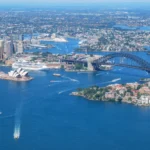
Visiting Sydney means discovering a big city built around water: the Opera House and the Harbour Bridge on the harbour, the historic Rocks district, ferries to Manly, the beaches of Bondi and Coogee linked by a coastal walk and, two hours away by train, the Blue Mountains. This Sydney travel guide tells you what to do in Sydney in 3 to 5 days, when to go, how much to budget and where to stay, before you continue your trip around Australia.
Our travel deals for Sydney
Affiliate links: we earn a commission, at no extra cost to you.
FlightsKiwi.comCompare flights and airline combinations to Sydney.
With its white shells designed by Danish architect Jørn Utzon, the UNESCO-listed Opera House is the symbol of the city. You can walk around it freely along the waterfront. Guided tours let you see inside the halls; better still, see a performance (opera, concert, dance). For the classic photo of the Opera House in front of the bridge, head to the Mrs Macquarie’s Chair lookout at the end of the Botanic Garden.
The Harbour Bridge
The great steel arch bridge links the centre to the North Shore. Walking across is free and offers a fine view of the Opera House. To go higher, there are two paid options: the south pylon, which houses a small museum and a lookout, or the guided, harnessed climb of the arch (BridgeClimb) to the summit.
Circular Quay and The Rocks
Circular Quay is the ferry terminal between the Opera House and the bridge. Right next door, The Rocks is the city’s oldest district, born with the penal colony founded in 1788: lanes, sandstone houses, old pubs and a weekend market. The Museum of Contemporary Art (MCA) is on the quay.
The Royal Botanic Garden and The Domain
The Royal Botanic Garden runs along the harbour from the Opera House to Mrs Macquarie’s Chair. Entry is free. Just behind, the Art Gallery of New South Wales displays Australian and Aboriginal art, with a recent building, Sydney Modern; entry to the permanent collections is free.
Bondi and the coastal walk to Coogee
Bondi Beach, Australia’s most famous beach, is half an hour from the centre by bus. From there, the Bondi to Coogee coastal walk, about 6 km (4 mi) long, follows the cliffs past the beaches of Tamarama, Bronte and Clovelly and the Bondi Icebergs ocean pool. Allow two to three hours with breaks. Swim only between the red and yellow flags, in patrolled areas.
The ferry to Manly
The ferry from Circular Quay to Manly crosses the whole harbour, passing the Opera House and the cliffs at the harbour entrance: one of the city’s finest outings for the price of a public-transport fare. In Manly: a surf beach, the Corso promenade and a trail to North Head for ocean views.
Darling Harbour, Barangaroo and the centre
West of the centre, Darling Harbour brings together the Sea Life aquarium, the Australian National Maritime Museum and many restaurants. To the north, the new Barangaroo district has a harbourside promenade. In the centre, the Queen Victoria Building, a late 19th-century shopping arcade, St Mary’s Cathedral and Hyde Park are easy to explore on foot. The Sydney Tower Eye offers a 360-degree view.
Taronga Zoo and Watsons Bay
Taronga Zoo, reached by ferry, showcases Australian wildlife (koalas, kangaroos, platypuses) with the city skyline as a backdrop. Further on, the village of Watsons Bay, also served by ferry, lets you walk to Hornby Lighthouse and the cliffs of The Gap.
Day trips from Sydney
The Blue Mountains: about two hours by train to Katoomba: sandstone cliffs, eucalyptus forests, the Three Sisters rock formation and hiking trails. A UNESCO World Heritage Site.
Coastal national parks: the Royal National Park to the south and Ku-ring-gai Chase National Park to the north, for hiking and beaches.
The Hunter Valley: a wine region about two hours’ drive north.
Port Stephens: dunes and dolphin watching, to the north.
Whale watching: boat trips leave Sydney during the whales’ migration along the coast, generally from May to November; check the season with operators.
Itinerary: how many days in Sydney?
Sydney in 3 days
Day 1: The Rocks, Circular Quay, the Opera House (guided tour), the Botanic Garden to Mrs Macquarie’s Chair, a walk across the Harbour Bridge at sunset
Day 2: Bondi Beach, the coastal walk to Coogee, an evening in Surry Hills or Paddington
Day 3: ferry to Manly and North Head in the morning, the Art Gallery of NSW and Darling Harbour in the afternoon
Sydney and the Blue Mountains in 5 to 6 days
Days 1 to 3: the itinerary above
Day 4: Taronga Zoo by ferry, then Watsons Bay
Days 5 and 6: the Blue Mountains, with a night in Katoomba or Leura to hike at a relaxed pace
The best times to visit Sydney are the southern spring (September to November) and the southern autumn (March to May). Afternoons reach 22 to 25 °C (72 to 77 °F), with fewer crowds than in summer. For the beach, aim for December to February, the southern summer (26 to 28 °C / 79 to 82 °F). The seasons are reversed compared with the Northern Hemisphere, and winter stays mild: almost 18 °C (64 °F) in the afternoon in July. It rains all year, with no real dry season. The table uses the official Bureau of Meteorology normals.
Month
High °C (°F)
Low °C (°F)
Rain mm (in)
Crowds
Prices
Verdict
January
27.7 (82)
20.0 (68)
81 (3.2)
Very high (summer holidays)
Very high
✅ Beach, heat, Sydney Festival
February
27.1 (81)
20.0 (68)
117 (4.6)
High
High
✅ Hot, possible storms
March
25.8 (78)
18.5 (65)
96 (3.8)
Medium
Medium
✅ Sea still warm, fewer crowds
April
23.3 (74)
15.2 (59)
98 (3.9)
Medium (Easter)
Medium
✅ Mild, ideal for walking
May
20.6 (69)
12.1 (54)
89 (3.5)
Medium (Vivid)
Medium
✅ Cool evenings, Vivid Sydney
June
18.1 (65)
9.8 (50)
126 (5.0)
Medium (Vivid)
Medium
⚠️ Wettest month
July
17.7 (64)
8.5 (47)
70 (2.8)
Low
Low
⚠️ Mild winter, cold sea
August
19.1 (66)
9.3 (49)
63 (2.5)
Low
Low
⚠️ Dry and cool, whales
September
21.6 (71)
11.9 (53)
59 (2.3)
Medium
Medium
✅ Spring, milder again
October
23.6 (74)
14.4 (58)
56 (2.2)
Medium
Medium
✅ Driest month
November
24.6 (76)
16.5 (62)
72 (2.8)
Medium
Medium
✅ Warm, start of beach season
December
26.4 (80)
18.4 (65)
67 (2.6)
Very high (holidays)
Very high
✅ Summer, New Year’s Eve fireworks
Temperature and rainfall: 1991-2020 normals for the Sydney Airport station, published by the Bureau of Meteorology (BoM, Australia’s weather service), as reported by Wikipedia (article « Climate of Sydney »). Crowds and prices: estimate based on tourist seasons and Australian school holidays.
Differences in rainfall between months are modest (56 to 126 mm / 2.2 to 5.0 in): rain often comes in short showers, and sunshine stays high all year according to the same source. Heatwaves and bushfire smoke can disrupt summer, though: the U.S. Department of State notes that air pollution from seasonal bushfires can be a significant problem in certain months.
Southern summer (December to February)
High season: beaches, terraces, long evenings, the sea at its warmest. It is also Australia’s summer school holidays and the year-end festive season: hotel prices rise, especially around 31 December. February can be stormy and muggy.
Southern autumn (March to May)
The best compromise: 21 to 26 °C (70 to 79 °F), the sea still pleasant in March, fewer crowds. Vivid Sydney, the festival of light projected onto the Opera House and buildings in the centre, generally starts in late May.
Southern winter (June to August)
Mild for a winter (18 °C / 64 °F in the afternoon), but cool in the morning and evening. June is the wettest month, July and August drier. The sea is too cold for most swimmers, but it is whale season and prices are lower.
Southern spring (September to November)
Milder weather returns, with October the driest month. Jacarandas bloom purple in several neighborhoods in late spring. A good season to combine Sydney with the rest of the country (see when to go to Australia).
When to go to Sydney by trip type
Plan
Best time
Sightseeing and walks
September-November, March-May
Beach and swimming
December to March
New Year’s Eve and fireworks
31 December
Blue Mountains and hiking
September-November, March-May
Whale watching
About May to November
Tight budget
June to August (outside Vivid)
Major events in Sydney
When
Event
January
Sydney Festival: shows and concerts across the city
26 January
Australia Day, national public holiday
February-March
Sydney Gay and Lesbian Mardi Gras and its big parade
Late May to June
Vivid Sydney: festival of light, music and ideas
August
City2Surf, a running race from the centre to Bondi
31 December
New Year’s Eve fireworks over the harbour and the Harbour Bridge
Exact dates change every year: check the programme on the official websites before booking.
January: The hottest month (27.7 °C / 82 °F), crowded beaches, Sydney Festival.
February: Hot and the stormiest month of summer (117 mm / 4.6 in).
March: 26 °C (79 °F), sea still warm, fewer crowds.
April: 23 °C (73 °F): ideal for walking and sightseeing.
May: 21 °C (70 °F), Vivid Sydney starts at the end of the month.
June: The wettest month (126 mm / 5.0 in), cool.
July: The coolest month (17.7 °C / 64 °F in the afternoon, 8.5 °C / 47 °F at night).
August: Dry and bright, whales offshore.
September: Spring, 21.6 °C (71 °F), prices still moderate.
October: The driest month (56 mm / 2.2 in), 23.6 °C (74 °F).
November: 24.6 °C (76 °F), start of beach season.
December: Summer and holidays, New Year’s Eve fireworks: book early.
With the seasons reversed, adapt your luggage: see our packing list. If you travel with a backpack rather than a suitcase, our guide to choosing a travel backpack covers volume, carrying and cabin baggage.
Budget for a trip to Sydney
Sydney is one of Australia’s most expensive cities, especially for accommodation. Indicative amounts per person per day, excluding international flights:
Item
Budget
Comfort
Accommodation (sharing a double room or hostel)
roughly A$70 to A$110
roughly A$175 to A$320
Meals
roughly A$50 to A$70
roughly A$95 to A$160
Transport (train, bus, ferry)
roughly A$13 to A$20
roughly A$20 to A$40
Sightseeing and activities
roughly A$25 to A$40
roughly A$65 to A$95
Total per day
roughly A$160 to A$240 per person per day
roughly A$350 to A$600 per person per day
Indicative estimates converted from euros at the European Central Bank rate of 23 October 2026 and rounded; they vary with the season. Higher prices around New Year.
To save money: many major sights are free (crossing the bridge, the Botanic Garden, the Art Gallery of NSW collections, the Bondi-Coogee walk), the Manly ferry costs a regular public-transport fare, and supermarkets and food courts are much cheaper than restaurants.
Getting there and getting around Sydney
Sydney Airport (Kingsford Smith), south of the centre, is the city’s international gateway, with connections via Asia, the Middle East, the Pacific and North America. The Airport Link train connects it to Central and Circular Quay in about fifteen minutes; according to Transport for NSW (transportnsw.info, checked 26 October 2026), a Sydney Airport station access fee, charged by the private company that owns the airport stations, is added automatically when you tap off, and it is not included in the daily travel caps.
Opal card or contactless bank card: the same payment works on trains, buses, ferries, the metro and light rail, with daily and weekly fare caps (Transport for NSW); use the same card or device for every trip to benefit from capping.
Ferries: from Circular Quay to Manly, Taronga, Watsons Bay and the Parramatta River; transport and sightseeing in one.
Train and metro: for the centre, the airport, the suburbs and the Blue Mountains.
Bus: essential for Bondi and the eastern beaches.
Light rail: runs through the centre from Circular Quay to Central and the south-eastern suburbs.
Car: traffic drives on the left (U.S. Department of State). UK visitors can drive with a UK photocard licence as temporary overseas visitors and must carry their licence and passport when driving (GOV.UK); US drivers should check the rules of the state they will drive in.
Where to stay in Sydney
The Rocks and Circular Quay: at the foot of the Opera House and the bridge, very handy for ferries; the most expensive.
Centre (CBD) and Darling Harbour: well connected, wide choice of chain hotels.
Surry Hills and Darlinghurst: lively neighborhoods with cafés and restaurants, close to Central.
Bondi: to stay by the beach; 30 minutes from the centre by bus.
Manly: a quieter seaside feel, linked to the centre by ferry.
Kings Cross and Potts Point: many hostels and affordable hotels, lively at night.
For New Year’s Eve or during Vivid Sydney, book several months ahead.
Entry requirements, health and safety
US citizens: according to the U.S. Department of State (travel.state.gov, last updated August 13, 2026), you need a valid US passport and a visa or an approved Electronic Travel Authority (ETA). For tourism or business stays of less than 90 days, the ETA, obtained through the Australian ETA app for a small fee, is enough. Overstaying, even briefly, can lead to detention and removal.
UK citizens: according to the UK FCDO (GOV.UK, updated 19 March 2026), you must have a visa to visit Australia: usually an eVisitor visa (no application charge) or an ETA through the ETA app (no visa charge, but there may be a service fee). Your passport must be valid for the length of your planned stay.
Customs and quarantine: you must fill in an Incoming Passenger Card and declare risk goods such as food, animal products and plant material (GOV.UK). For allowances on your return, check your home country’s rules (e.g. CBP in the US, HMRC in the UK).
Beaches: rip currents are the main hazard for swimmers and can occur at any beach (UK FCDO); swim only between the flags where a lifeguard is present, and never alone (U.S. Department of State).
Bushfires and heat: the bushfire risk is higher in spring and summer, from October to February, and extreme heat is a serious risk (UK FCDO, GOV.UK, updated 19 March 2026).
Health: UK visitors get essential and urgent hospital treatment free under a reciprocal agreement, with charges for GP visits and prescriptions (GOV.UK); US travelers should check their insurance covers care abroad.
Emergencies: dial 000 for ambulance, fire and police.
Sun: sunscreen, hat and sunglasses all year round.
Entry requirements checked on 26 October 2026; check them again before you travel. More details in our Australia visa guide; to compare policies, see our travel insurance guide.
Practical tips for Sydney
Money: contactless card payment is the norm, even for small amounts. Tipping is not compulsory.
Time difference: plan one or two quiet days on arrival to recover from jet lag.
Mobile data: a local SIM card or an eSIM is cheaper than roaming.
Frequently asked questions
How many days do you need in Sydney?
Three to four days for the Opera House, the bridge, The Rocks, Bondi, Manly and the museums. Add two days for the Blue Mountains.
What is the best time to visit Sydney?
September to November and March to May: 21 to 26 °C (70 to 79 °F) in the afternoon according to Bureau of Meteorology normals. For the beach, choose December to February.
How do you get from Sydney Airport to the city?
By the Airport Link train to Central and Circular Quay in about fifteen minutes; a station access fee is added to the fare, according to Transport for NSW.
Do you need a visa for Sydney?
Yes, an authorization before you travel: US citizens need an Electronic Travel Authority (ETA) for stays under 90 days, according to the U.S. Department of State; UK citizens usually get an eVisitor visa or an ETA, according to the UK FCDO.
What time zone is Sydney in?
UTC+10, and UTC+11 during daylight saving time, from early October to early April.
Our sources
Climate normals: 1991-2020 normals for the Sydney Airport station, published by the Bureau of Meteorology (BoM), as reported by Wikipedia (article « Climate of Sydney »)


 FlightsKiwi.comCompare flights and airline combinations to Sydney.Compare flights