To pay abroad in a foreign currency, three options coexist: exchange cash before you leave (bank or currency exchange office), withdraw local currency at an ATM with your card, or pay directly by card in the local currency. Each has a cost: an exchange commission, fixed fees or a percentage charged by the bank. The right choice depends on the destination, your bank fees and the amount. For shopping outside the European Union, our guide to tax-free shopping: getting VAT back explains how the tax refund works.
This guide compares currency exchange offices, banks and bank cards, explains how to read fees, recalls the eurozone basics and cash-declaration rules, and gives you the habits to adopt before you leave. It quotes no commercial rates: fees vary between banks and exchange offices. Information on the eurozone and card fees was checked on 14 October 2026 on service-public.fr, the Banque de France website and economie.gouv.fr (French official sites); the cash declaration rules were read on 12 November 2026 on CBP and GOV.UK. To work out how much to leave on the ground, see our guide to tipping abroad.
Key facts on exchanging money when you travel
- Eurozone: prices and payments are in euros; if your card or account is in dollars or pounds, each payment is still a currency conversion, so check your bank’s fees.
- Outside the euro: each card payment or withdrawal involves a currency conversion and a commission (a variable share, sometimes a fixed share).
- Exchange office: currency available immediately, but an exchange commission applies; compare the rate offered with the reference rate.
- Bank: prefer your own bank (non-customer fees elsewhere) and order a few days in advance.
- Before you leave: check the card’s expiry date and its limits abroad, and tell your bank where you are going.
- Customs: US and UK rules require you to report more than $10,000 (US) or declare £10,000 or more (UK), or the equivalent, when carrying cash across the border.
Eurozone or not: what changes
The countries of the eurozone (Germany, Austria, Belgium, Bulgaria, Croatia, Cyprus, Estonia, Finland, France, Greece, Ireland, Italy, Latvia, Lithuania, Luxembourg, Malta, the Netherlands, Portugal, Slovakia, Slovenia and Spain, according to service-public.fr) all use the euro. A few countries use the euro without being members of the eurozone: European rules do not necessarily apply there and extra fees are possible.
The euro, on the other hand, is not the legal currency in the Czech Republic, Hungary, Poland, Romania, Sweden, Denmark, Switzerland and the United Kingdom. Some tourist businesses (stations, airports, ferries) accept euros there, but they are not obliged to, and extra rates or fees may apply. Our currency converter gives the rate for the main currencies.
Exchange office, bank or card: the comparison
| Option | Advantages | Drawbacks | Good use |
|---|---|---|---|
| Exchange office (before departure or on site) | Currency handed over immediately; useful for currencies that are hard to find | Exchange commission; rate varies between offices; the gap is often unfavorable in transit locations | A small arrival sum, or a currency you cannot find at home |
| Your bank at home | No « non-customer » fees; a regulated transaction | A few days’ wait to order; exchange commission | A spare sum ordered in advance |
| ATM withdrawal on site | Local currency at the rate applied by the card network; convenient | Withdrawal fees from your bank (often fixed + percentage), sometimes the ATM operator’s fees | Withdraw a sufficient amount in one go rather than often |
| Card payment in foreign currency | No cash to carry; exact amount | Commission on each payment depending on your account agreement | Hotels, restaurants, transport; check your limits |
| Transfer in foreign currency | Useful to pay for accommodation or costs in advance | International transfer: exchange and transfer fees | A deposit or large payment before departure |
How to choose an exchange office
The Banque de France points out that exchanging euros for foreign currency at a bank or an exchange office is not free: an exchange commission applies. To compare two offices, look at:
- the exchange rate offered, compared with the day’s reference rate (visible in our converter): the bigger the gap, the more the exchange costs you;
- the commission, fixed or a percentage, sometimes added on top of the rate gap;
- the final amount handed over for a given sum: it is the only truly comparable figure;
- whether the currency is available: some currencies are hard to find at home and have to be exchanged on arrival, and before you return (Banque de France).
Beware of « 0% commission » signs: the cost may be hidden in the rate applied.
Bank card when traveling: fees and habits
According to economie.gouv.fr, card fees abroad vary with the type of transaction (payment or withdrawal), the type of card and the country (eurozone or not), and generally include a fixed commission and a proportional commission. Service-public.fr states that the exchange rate and the commission must appear on your account statement. Before you leave:
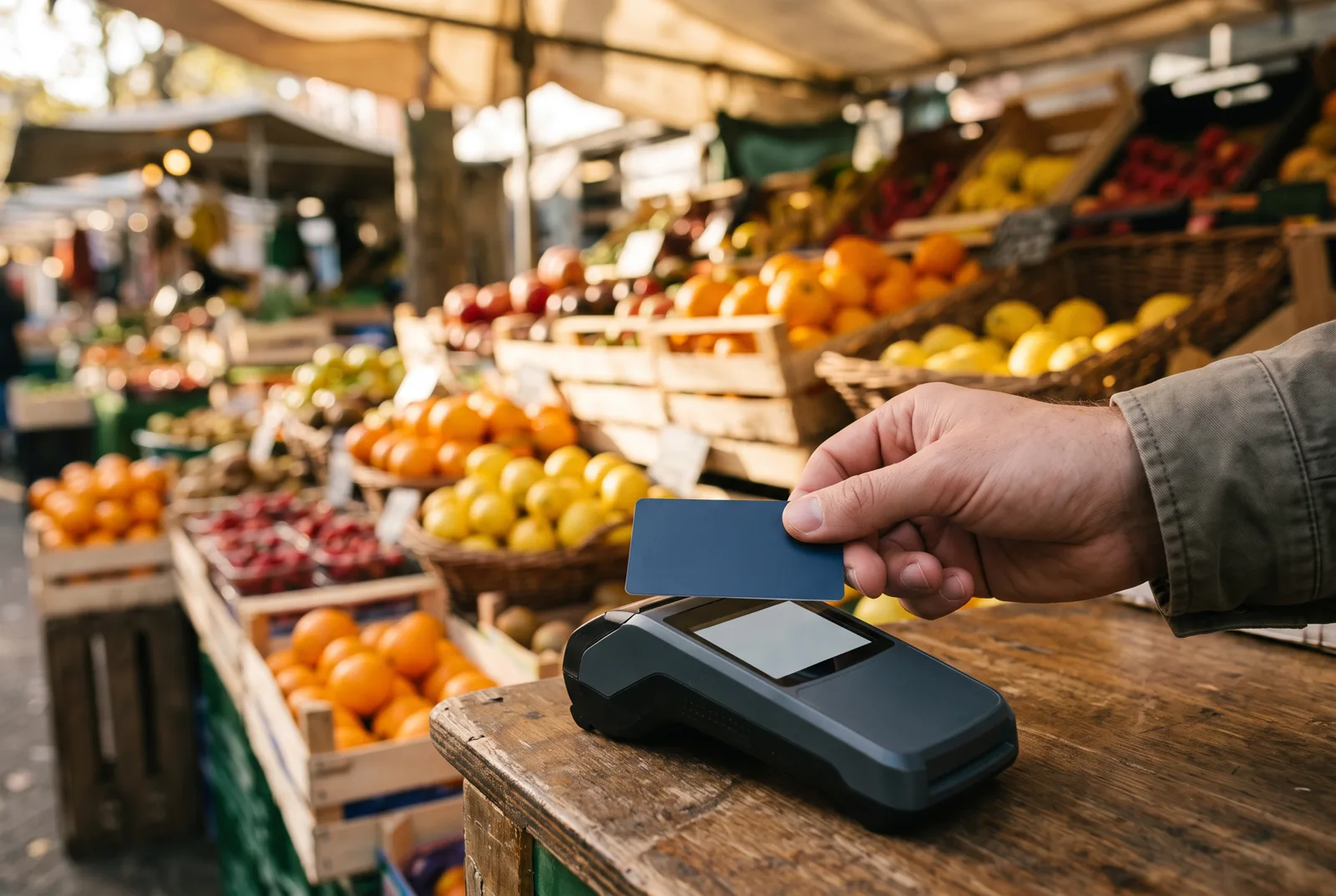
- Read your bank’s fee schedule (or account agreement) for payments and withdrawals in foreign currency.
- Check the card’s expiry date: a card renewed during the trip would be sent to your home address or a branch.
- Adjust payment and withdrawal limits abroad, which are often different from those at home; many banks let you do this in their app.
- Tell your bank where you are going, to avoid an anti-fraud block.
- Check whether it is a debit or a credit card: to rent a car abroad (for example in the United States), rental companies very often ask for a credit card (economie.gouv.fr). Our road trip guide details the deposit.
- Bring two payment methods stored separately, in case of loss or theft.
When paying in a foreign currency, a terminal or ATM may offer to charge the amount directly in your home currency. The conversion is then made by the merchant or the operator, at its own rate: compare with the amount in local currency, which your bank will convert under the terms of your contract.
How much cash should you take?
There is no standard amount: it all depends on the destination (in some countries cards are accepted almost everywhere; in others cash remains essential in markets or rural areas). Check the country’s travel advice from your own government (GOV.UK foreign travel advice for UK travelers, travel.state.gov for US travelers) and our destination pages, for example Morocco, Thailand or Japan, which give the currency and payment habits. To limit withdrawal fees, economie.gouv.fr advises withdrawing a substantial amount at once rather than making many small withdrawals.
Customs: reporting and declaring large amounts of cash
United States. CBP (cbp.gov, « Know Before You Go: Traveling Abroad », read on 12 November 2026) says travelers carrying over $10,000, or its foreign equivalent, must file a FinCEN Form 105 with CBP. The threshold applies to the total carried by an individual or groups traveling together, such as families. Reportable items include U.S. or foreign currency, traveler’s checks, money orders and bearer negotiable instruments. You can file online, but you must arrive in the U.S. at a port of entry within 72 hours. The page does not state a maximum amount you may carry: it sets a reporting requirement.
United Kingdom. GOV.UK (gov.uk/bringing-cash-into-uk, read on 12 November 2026) says you must declare cash of £10,000 or more to UK customs if you are carrying it between Great Britain and a country outside the UK, including as a family or group with £10,000 or more in total. The earliest you can declare is 72 hours before you travel: online (or by phone if you cannot use the online service), at the red channel on arrival, or before you go when leaving. The helpline is 0300 322 9434. Northern Ireland has different rules (€10,000 or equivalent).
Other countries have their own thresholds and declaration systems: check those of your destination and of the countries you transit before you travel.
If your card is lost or stolen
Report it to your bank immediately (note its emergency number before you leave). In case of theft, file a report with the local authorities and inform your country’s embassy or consulate. When you get home, check that all the transactions on your statement are yours. Some cards include assistance or insurance cover, which generally applies if the trip was paid for with the card: compare them in our travel insurance guide.
Frequently asked questions
Is it better to exchange money at home or on site?
It depends on the currency and the fees. Exchanging a small sum before you leave avoids arriving without cash; some currencies are only available on site. Always compare the final amount handed over.
Is an exchange office better value than a bank?
Not necessarily: both charge an exchange commission. Your own bank avoids the fees reserved for non-customers, while an exchange office hands over the currency immediately.
Does paying by card abroad cost fees?
Outside your home currency area, an exchange commission applies, with a variable share and sometimes a fixed share, shown on your statement. Check your bank’s fee schedule.
Should you pay in your home currency or in local currency?
When a terminal offers your home currency, the conversion is made at the merchant’s rate. Compare with the amount in local currency, converted by your bank under your contract.
How much cash can you carry when traveling?
There is no cap, but you must report more than $10,000 (or the equivalent) to CBP in the US, or declare £10,000 or more to UK customs, including as a family or group.
Should you tell your bank before you leave?
It is advisable (economie.gouv.fr): some banks block cards on international destinations to limit fraud.
Our sources
- Service-public.fr, « How to pay abroad? » (F2404, checked 28 August 2026), consulted on 14 October 2026.
- Banque de France, « Foreign currencies », consulted on 14 October 2026.
- Economie.gouv.fr, « Means of payment: get ready before going on vacation » (2 July 2026), consulted on 14 October 2026.
- CBP, Know Before You Go: Traveling Abroad (currency reporting), read on 12 November 2026.
- GOV.UK, Take cash in and out of the UK, read on 12 November 2026.
- Our methodology
Updated November 2026.