
A successful road trip comes down to three choices made before you leave: a realistic itinerary (no more than a few hours on the road per day), a vehicle suited to the terrain and the number of passengers, and the right papers to drive in the country you are visiting. The rest (accommodation, stops, budget) follows from these three decisions.
This guide explains how to plan a road trip step by step: choosing the destination and season, building the itinerary, renting a car abroad or a van, estimating the budget line by line, and checking which license you need. It then offers sample itineraries, each linked to our destination guide, and a checklist to tick before you hit the road.

Our travel deals for Road trip
Affiliate links: we earn a commission, at no extra cost to you.
 Car rentalEconomybookingsRental comparison: check excess, mileage and minimum age.Compare rentals

Planning a road trip: the essentials
- Driving time: plan days with little driving between the long stages; distances on a map often underestimate real times (mountain roads, tracks, crossing cities).
- License: rules differ by country: some accept your home license for a short stay, others require an international driving permit (IDP). UK drivers can check on GOV.UK; US drivers get an IDP from AAA.
- Vehicle: car and hotels for flexibility, van or motorhome for independence; check the included mileage, the deductible (excess) and the forbidden zones in the contract.
- Season: weather determines road conditions (snow, closed tracks, rain); check our « when to go » pages before fixing dates.
- Budget: four big items (vehicle, fuel, accommodation, meals) and often-forgotten costs (tolls, parking, ferries, drop-off in another city).
What is a road trip, and who is it for?
A road trip is a touring journey by car, van or motorhome where the road is part of the trip. You change stops every one to three days, stop where you like, and reach places poorly served by public transport: nature parks, wild coastlines, inland villages.
It suits couples, groups of friends and families with children who tolerate the car. It suits less well if nobody likes driving, if you mostly want to visit big cities (where a car becomes a parking problem) or if the country drives on the other side of the road or has difficult roads that make you uneasy. For touring trips without a car (train, bus, bike), see our guide to touring trips.
Planning a road trip in 7 steps
- Choose the destination according to the season. The same country can be ideal in summer and difficult in winter (closed mountain roads, short days). Cross your dates with our « when to go » pages and our Where to go in… section.
- Set the length and the number of stops. Count the nights, then spread them: one or two nights per stop, with a few longer stops to catch your breath.
- Draw the route. Loop (start and finish at the same airport, simpler rental) or one-way (more useful road, but possible drop-off fees). Check real journey times on a route planner, not just kilometers or miles.
- Check the license and the driving rules. International permit if needed, side of the road, vignettes or tolls, compulsory equipment. For UK drivers, the GOV.UK « driving abroad » page is the starting point; for US drivers, AAA issues International Driving Permits.
- Book the vehicle. Compare the conditions (mileage, deductible, additional driver, one-way) as much as the price; in high season, book early, especially for vans and automatic transmissions.
- Book the key accommodation. Nights in high-demand areas (national parks, small islands, isolated villages) go first; stay flexible elsewhere.
- Prepare the car and the apps. Offline maps downloaded, cigarette-lighter charger, cable, first-aid kit, water and snacks: the checklist at the end of the article covers it all.
How many miles per day?
There is no universal rule, but one principle: driving time matters more than distance. A 200 km (124 mi) stage on a motorway and a 200 km stage on mountain roads or tracks are nothing alike. To avoid days spent only behind the wheel, alternate:
| Type of day | Target driving time | Use |
|---|---|---|
| Transfer day | Half a day of driving at most | Change region, with photo stops and a lunch break |
| Mixed day | A few hours, split between morning and late afternoon | A visit in the morning, a scenic road in the afternoon |
| Day on site | Little or no driving | Hiking, beach, exploring a city on foot: the break that makes the trip enjoyable |
Add a margin for the unexpected: roadworks, weather, a full ferry, unplanned stops. An itinerary that is too tight is the first cause of a disappointing road trip.
Sample road trip itineraries
These route ideas give you an outline; each destination guide details the stops, distances and best season. Durations are comfortable minimums, not records.
| Destination | Recommended length | Type of road | Best period (see guide) |
|---|---|---|---|
| Iceland (ring road) | 10 days to 2 weeks | Paved main road; Highlands tracks for 4×4 only | When to go to Iceland |
| Scotland and Highlands | 8 to 12 days | Narrow roads, sometimes single-track, driving on the left | Scotland guide |
| Ireland (west coast) | 8 to 12 days | Winding coastal roads, driving on the left | When to go to Ireland |
| Norway (fjords) | 10 days to 2 weeks | Mountain roads, many ferries | When to go to Norway |
| Portugal (north to the Algarve) | 8 to 12 days | Toll motorways and national roads | Portugal guide |
| Andalusia | 7 to 10 days | Motorways and white-village roads | Andalusia guide |
| Tuscany, Puglia or Sicily | 7 to 10 days | Country roads, historic centers often with restricted access | Italy guide |
| Corsica | 7 to 10 days | Slow, winding mountain roads | Corsica guide |
| Croatia (Dalmatian coast) | 8 to 12 days | Motorway and coastal road, ferries to the islands | Croatia guide |
| California and the American West | 2 to 3 weeks | Long distances, national parks | United States guide |
| New Zealand | 2 to 3 weeks | Mostly two-lane roads, driving on the left | When to go to New Zealand |
| Australia (one region) | 2 to 3 weeks | Very long distances, driving on the left | Australia guide |
| Costa Rica | 10 days to 2 weeks | Some unpaved roads, 4×4 useful depending on route | Costa Rica guide |
| Réunion | 8 to 12 days | Winding mountain roads | Réunion guide |
| Morocco | 8 to 12 days | Main roads and mountain roads | Morocco guide |
Car, van or motorhome: what to rent?
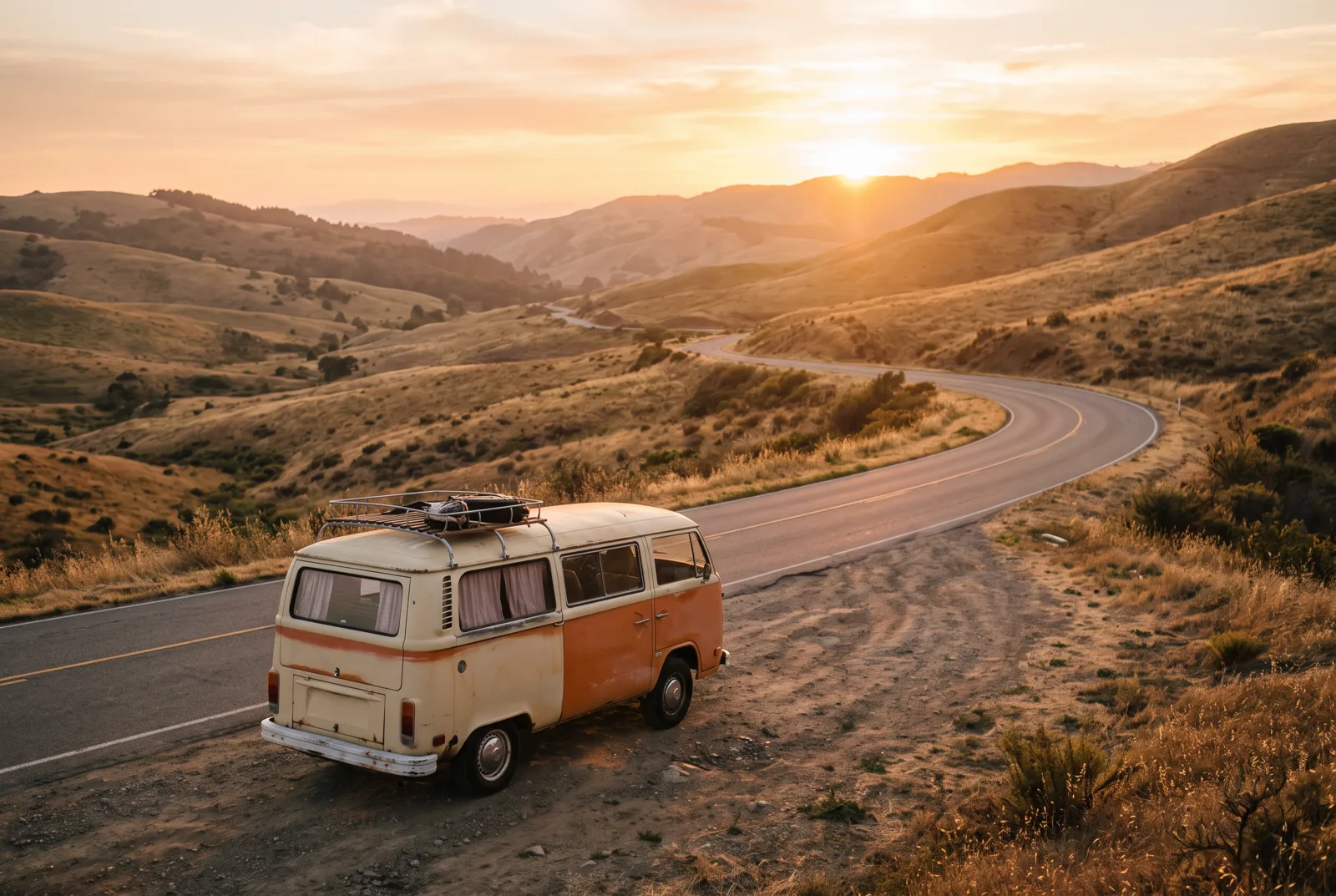
| Vehicle | Strengths | Weaknesses | Who for |
|---|---|---|---|
| Rental car | Flexible, easy to park, more fuel-efficient | Accommodation to book each night | Couples, families, itineraries with cities |
| Camper van | Freedom of stops, basic kitchen on board | Limited comfort, overnight parking rules vary by country | Couples, flexible travelers |
| Motorhome | Independence, space, bathroom depending on model | Hard to handle on narrow roads, higher fuel consumption, campsites to plan | Families, long stays |
| 4×4 | Access to permitted tracks | More expensive to rent and to fuel | Iceland (Highlands), tracks in Costa Rica |
What to check in the rental contract
- Mileage: unlimited or capped, and the cost of each extra mile or kilometer.
- Deductible (excess): the amount left to you in case of damage, and what the buy-back options cover; some credit cards cover the deductible, so read their terms before buying an option at the counter.
- Exclusions: tracks, fords, undercarriage, windscreen, tires and roof are often excluded from standard cover.
- One-way rentals: drop-off fees if you return the vehicle elsewhere, sometimes high between two countries.
- Border crossings and ferries: permission is needed depending on the rental company.
- Additional driver, minimum age and license seniority: conditions specific to each rental company.
- Fuel: full-to-full or another policy; fuel type or charging for an electric vehicle.
- Security deposit: a credit card in the main driver’s name is usually required; check your card’s limit.
When you pick up the vehicle, photograph or film the bodywork, wheels, windscreen and interior, with the odometer and fuel gauge visible. Have any defect noted on the check-in form.
Driver’s license and driving rules abroad
Rules vary by country: some accept your home license for a short stay, others require an international driving permit (IDP) in addition, or a certified translation. Check the rules of each country on your route before you go.
- UK drivers: GOV.UK says you might need an IDP to drive in some countries, so check for each country you visit. Don’t apply for an IDP if you are moving abroad. You can get one in person at certain shops that have PayPoint; GOV.UK lists the price as £5.50 (checked 12 November 2026). Carry your valid GB or Northern Ireland license; if taking your own vehicle, your log book (V5C) and insurance certificate; for a vehicle hired or leased in the UK, a VE103 certificate; and a UK country sticker and any equipment the destination requires.
- US drivers: AAA issues International Driving Permits only to people who hold a valid US driver’s license (including license holders in Guam, Puerto Rico and the US Virgin Islands). AAA lists a $20 permit fee, plus a $10 passport photo fee if you apply online, with about 5 business days of processing plus shipping; permits cannot be issued more than six months before the desired effective date. An IDP is a translation of your license, « not a license to drive »: carry your US license with it (AAA, checked 12 November 2026).
- Driving on the left: United Kingdom, Ireland, Australia, New Zealand, South Africa, Mauritius… If you are new to this side of the road, choose an automatic transmission. US drivers in particular should plan a quiet first day.
- Tolls and vignettes: some countries use a sticker (vignette) or electronic toll; find out before crossing the border.
Road trip budget: the items to plan for
We don’t give an average amount: it depends too much on the country, season, vehicle and number of travelers. The method below lets you build your own estimate from real quotes.
| Item | How to estimate it | Don’t forget |
|---|---|---|
| Vehicle rental | Quote for your exact dates, options included | One-way fees, additional driver, child seat, GPS |
| Fuel or charging | Total distance × vehicle consumption × local fuel price | Detours and mountain roads increase consumption |
| Accommodation | Number of nights × price found for your dates | Campsites for a van or motorhome, tourist tax |
| Meals | Groceries and picnics vs restaurants, decided day by day | Water and snacks for long stages |
| Tolls, vignettes, parking | Motorway company simulator or country sheet | Parking in city centers and at natural sites |
| Ferries and crossings | Vehicle + passenger fare on the operator’s site | Compulsory booking in high season on some routes |
| Entrance fees and activities | List of the paid sites you chose | National park passes if relevant |
| Insurance and the unexpected | Deductible buy-back, travel insurance, safety margin | Fines, tire repair, an unplanned night |
Sharing fixed costs (vehicle, fuel, multi-bed rooms) makes the formula cheaper with several people. To reduce the bill, see also our tips for finding a cheaper flight and the currency converter.
Safety and insurance
- Leave nothing visible in a parked vehicle, especially in tourist-site car parks.
- Take regular breaks; avoid driving at night on roads you don’t know.
- Check what your travel insurance covers in case of a road accident and repatriation, and whether your credit card covers the rental deductible: our travel insurance guide details the cover.
Road trip checklist
Road trip checklist to tick
Documents
Car
Comfort
Van / motorhome
Frequently asked questions
How long does a road trip take?
Plan at least a week for a region (Andalusia, Tuscany, Corsica) and two to three weeks for countries with long distances (American West, New Zealand, Australia). Allow one or two nights per stop and days without driving.
Do I need an international driving permit for a road trip?
It depends on the country. UK drivers can check on GOV.UK, which lists an IDP at £5.50 from certain PayPoint shops; US drivers get one from AAA ($20, plus a $10 photo fee online). Always carry your home license with it.
Is it better to rent a car or a van?
A car is more flexible and easier to park; a van or motorhome gives independence but means finding authorized overnight parking and often costs more in fuel. The choice depends on the country, the season and your taste for camping.
How do I estimate the budget for a road trip?
Add up real quotes: vehicle rental, fuel (distance × consumption × local price), accommodation, meals, tolls, parking, ferries and activities, then add a margin for the unexpected.
What is the best road trip for a first time?
A loop in a country with short distances and a side of the road you are used to: Portugal, Andalusia, Tuscany or Corsica are easy options to organize.
Can I sleep anywhere in a van?
No. Rules on parking and wild camping vary by country, and sometimes by municipality or park. Find out the local rules and prefer authorized campsites and areas.
Our sources
- GOV.UK, « Driving abroad », checked 12 November 2026.
- AAA, International Driving Permit, checked 12 November 2026.
- Our methodology
Updated November 2026.
