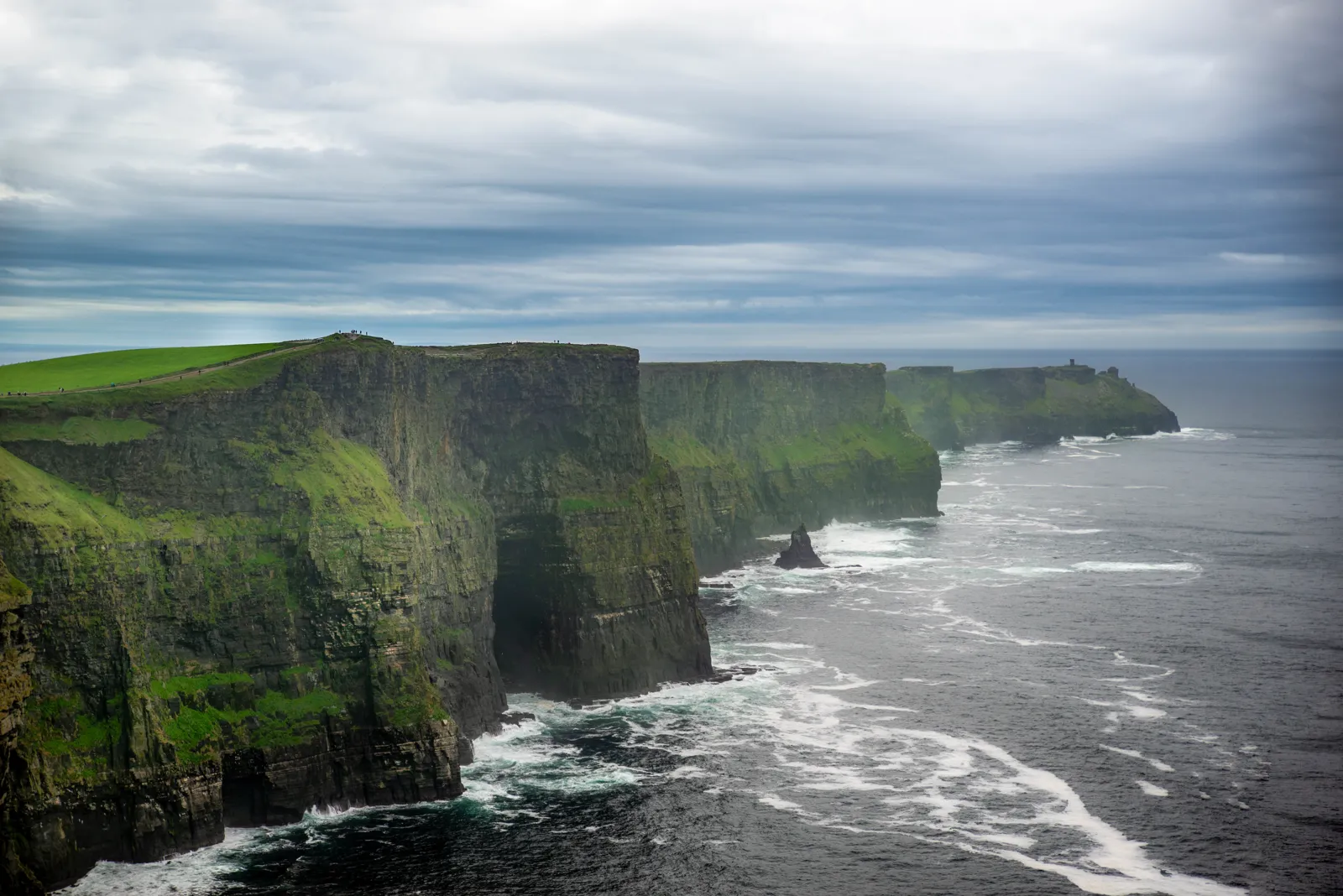
When is the best time to visit Ireland? From May to September: days are long, temperatures are at their mildest (17 to 20 °C, or 63 to 68 °F, in the afternoon in summer) and all excursions run. May, June and September offer the best compromise between weather, crowds and prices; July and August are the warmest months but also the busiest and most expensive. Dublin, Connemara and the west coast can be located on our map of Ireland.
Ireland has an oceanic climate: mild all year, with no real heat or real cold, but damp and very changeable. It can rain in any month, and several times in the same day. The real difference is between the east, around Dublin, which is much drier, and the Atlantic coast of the west (Kerry, Connemara, Mayo), which gets two to three times more rain. This guide is based on the 1991–2020 climate normals published by Met Éireann, the Irish national meteorological service.

Our travel deals for Ireland
Affiliate links: we earn a commission, at no extra cost to you.
 FlightsKiwi.comCompare flights and airline combinations to Ireland.Compare flights

When to go to Ireland at a glance
- Best times May–June and September
- Mildest months July and August (about 19–20 °C, or 66–68 °F, in the afternoon in Dublin and Shannon)
- Driest months April to June, especially on the west coast
- For the Wild Atlantic Way May to September, when days are long and coastal roads can be driven without stress
- St. Patrick’s Day March 17, the national holiday; accommodation in great demand in Dublin that weekend
- Avoid if possible November to February for a nature trip (short days, rain, storms)
- Best value April–May and September–October
- Essential all year a waterproof jacket and several layers of clothing
When to go to Ireland by priority
- Best weather: May to September; May and June are the sunniest months
- Cheapest: November to March, outside the holidays; April–May and September–October for the best value
- Fewest crowds: May and September for a road trip; October to April for a city break, outside St. Patrick’s Day
- Events: St. Patrick’s Day on March 17, Bloomsday on June 16 in Dublin, Galway International Arts Festival in July, Halloween in late October
Ireland: the calendar at a glance
✅ Best months: may, June, July, August, September
❌ Period to avoid: January, February, November
Climate and weather in Ireland month by month
The table below gives the normals for Dublin Airport, the arrival point for most travelers. The east of the island is the driest region: on the west coast it rains much more, as you will see below.
| Month | Avg. max | Avg. min | Rain | Crowds | Prices | Verdict |
|---|---|---|---|---|---|---|
| January | 8.0 °C (46 °F) | 2.3 °C (36 °F) | 62 mm (2.4 in) | Low | Low | ❌ Damp cold, very short days |
| February | 8.5 °C (47 °F) | 2.2 °C (36 °F) | 52 mm (2.0 in) | Low | Low | ❌ The coldest month, storms possible |
| March | 10.1 °C (50 °F) | 3.0 °C (37 °F) | 51 mm (2.0 in) | Medium (St. Patrick’s Day) | Medium, high on the 17th | ⚠️ Still cool, St. Patrick’s Day atmosphere |
| April | 12.3 °C (54 °F) | 4.0 °C (39 °F) | 55 mm (2.2 in) | Medium (Easter) | Medium | ⚠️ Spring, days lengthening fast |
| May | 14.8 °C (59 °F) | 6.6 °C (44 °F) | 57 mm (2.2 in) | Medium | Medium | ✅ Mild, one of the driest months in the west |
| June | 17.7 °C (64 °F) | 9.0 °C (48 °F) | 64 mm (2.5 in) | High | High | ✅ The longest days of the year |
| July | 19.5 °C (67 °F) | 11.3 °C (52 °F) | 61 mm (2.4 in) | Very high | Very high | ✅ The warmest month, but the busiest |
| August | 19.1 °C (66 °F) | 11.2 °C (52 °F) | 73 mm (2.9 in) | Very high | Very high | ✅ Mild, school holidays, prices at their highest |
| September | 16.9 °C (62 °F) | 9.5 °C (49 °F) | 63 mm (2.5 in) | Medium | Medium | ✅ Still mild, crowds easing |
| October | 13.6 °C (56 °F) | 7.1 °C (45 °F) | 78 mm (3.1 in) | Low | Medium to low | ⚠️ Autumn colors, more frequent rain |
| November | 10.3 °C (51 °F) | 4.3 °C (40 °F) | 83 mm (3.3 in) | Low | Low | ❌ The wettest month in Dublin |
| December | 8.3 °C (47 °F) | 2.6 °C (37 °F) | 72 mm (2.8 in) | Low (except holidays) | Low | ⚠️ Christmas atmosphere in town, countryside hard to enjoy |
Sunshine in Ireland
According to Met Éireann, May and June are the sunniest months, with 5 to 6.5 hours of sunshine a day on average over most of the country, and more than 7 hours in the far southeast in early summer. December is the darkest month: about 1 hour of sunshine a day in the north and almost 2 hours in the southeast. Over the year, most regions get 3 hours 15 minutes to 3 hours 45 minutes of sunshine a day.
These figures show the essentials: in Ireland, the gap between winter and summer is small (8 °C, or 46 °F, against 19–20 °C, or 66–68 °F, in the afternoon), and it rains every month. What really changes with the seasons is day length, wind and the opening of sites and tourist services. This small temperature gap is also found next door: our comparison to help you choose between Scotland and Ireland sets landscapes and budget side by side.
Ireland’s seasons: pros and cons
Spring (March to May): nature wakes up
Temperatures climb gently (10 °C, or 50 °F, in March, almost 15 °C, or 59 °F, in May in Dublin) and days lengthen very fast. April and May are among the driest months, particularly on the west coast: in Valentia, in Kerry, about 94 mm (3.7 in) falls in May against 187 mm (7.4 in) in January. Spring begins with St. Patrick’s Day on March 17, the national holiday celebrated across the country.
- Pros: very green landscapes, lambs in the fields, fewer people than in summer, moderate prices outside festival weekends
- Cons: March is still cool and windy; some seasonal attractions and island links only open from Easter or May
- Our tip: May is an excellent month for a road trip on the west coast
Summer (June to August): high season
This is the mildest season (17 to 20 °C, or 63 to 68 °F, in the afternoon) and the season of very long days: around the solstice, it stays light well after 10 p.m. All boat trips, visits and festivals run. July and August are also school holiday months in Ireland and across Europe: the best-known sites (Cliffs of Moher, Ring of Kerry, Dublin) are very busy and accommodation reaches its highest prices. Do not expect Mediterranean heat: even in summer, a day at 15 °C (59 °F) in drizzle is still possible.
- Pros: the mildest temperatures, very long days, everything open, festivals and traditional music in the pubs
- Cons: crowds at the major sites, small roads clogged by coaches and motorhomes, prices at their highest, full accommodation in small towns
- Who is it for? Families tied to school holidays and travelers who want to make the most of the long evenings: book early
Autumn (September–October): the shoulder season
September stays close to summer (17 °C, or 62 °F, in Dublin) with far fewer people once schools are back: it is often the best month for combining decent weather and peace and quiet. October gets rainier, especially in the west (173 mm, or 6.8 in, in Valentia), and the first autumn storms may arrive, but the colors of the forests and the low light are superb.
- Pros: falling crowds, gentler prices, still pleasant temperatures in September
- Cons: days shortening fast, more frequent rain and wind in October, reduced hours at some sites
- Our tip: the first half of September for the Wild Atlantic Way, October rather for Dublin and the east
Winter (November to February): cities and pubs
Winter is rarely very cold (about 8 °C, or 46 °F, in the afternoon, lows around 2–3 °C, or 36–37 °F, in Dublin), and snow is uncommon on low ground. But days are short, rain is frequent and Atlantic storms can disrupt transport. Storm warnings are published by Met Éireann.
- Pros: low prices (outside the holidays), museums and pubs without the crowds, Christmas atmosphere in Dublin, Cork and Galway
- Cons: limited light for landscapes, hiking and coastal roads less pleasant, some attractions closed or on reduced hours
- Who is it for? A cultural weekend in Dublin, a city stay or small budgets
When to go to Ireland by region
Ireland is a small country, but the rainfall gap between east and west is spectacular: the Atlantic coast is the first to receive the low-pressure systems from the ocean. Comparison of the normals for four stations:
| Month | Dublin (airport) | Shannon (Clare) | Cork (airport) | Valentia (Kerry) |
|---|---|---|---|---|
| January | 8.0 °C (46 °F) / 62 mm (2.4 in) | 8.9 °C (48 °F) / 104 mm (4.1 in) | 8.2 °C (47 °F) / 131 mm (5.2 in) | 9.8 °C (50 °F) / 187 mm (7.4 in) |
| February | 8.5 °C (47 °F) / 52 mm (2.0 in) | 9.4 °C (49 °F) / 87 mm (3.4 in) | 8.5 °C (47 °F) / 97 mm (3.8 in) | 9.9 °C (50 °F) / 137 mm (5.4 in) |
| March | 10.1 °C (50 °F) / 51 mm (2.0 in) | 10.9 °C (52 °F) / 76 mm (3.0 in) | 9.8 °C (50 °F) / 92 mm (3.6 in) | 10.8 °C (51 °F) / 116 mm (4.6 in) |
| April | 12.3 °C (54 °F) / 55 mm (2.2 in) | 13.4 °C (56 °F) / 62 mm (2.4 in) | 12.0 °C (54 °F) / 87 mm (3.4 in) | 12.4 °C (54 °F) / 108 mm (4.3 in) |
| May | 14.8 °C (59 °F) / 57 mm (2.2 in) | 16.0 °C (61 °F) / 63 mm (2.5 in) | 14.6 °C (58 °F) / 81 mm (3.2 in) | 14.5 °C (58 °F) / 94 mm (3.7 in) |
| June | 17.7 °C (64 °F) / 64 mm (2.5 in) | 18.3 °C (65 °F) / 70 mm (2.8 in) | 17.0 °C (63 °F) / 83 mm (3.3 in) | 16.6 °C (62 °F) / 101 mm (4.0 in) |
| July | 19.5 °C (67 °F) / 61 mm (2.4 in) | 19.5 °C (67 °F) / 76 mm (3.0 in) | 18.6 °C (65 °F) / 87 mm (3.4 in) | 17.8 °C (64 °F) / 117 mm (4.6 in) |
| August | 19.1 °C (66 °F) / 73 mm (2.9 in) | 19.1 °C (66 °F) / 88 mm (3.5 in) | 18.4 °C (65 °F) / 95 mm (3.7 in) | 18.0 °C (64 °F) / 114 mm (4.5 in) |
| September | 16.9 °C (62 °F) / 63 mm (2.5 in) | 17.5 °C (64 °F) / 77 mm (3.0 in) | 16.5 °C (62 °F) / 92 mm (3.6 in) | 16.9 °C (62 °F) / 130 mm (5.1 in) |
| October | 13.6 °C (56 °F) / 78 mm (3.1 in) | 14.2 °C (58 °F) / 96 mm (3.8 in) | 13.3 °C (56 °F) / 131 mm (5.2 in) | 14.4 °C (58 °F) / 173 mm (6.8 in) |
| November | 10.3 °C (51 °F) / 83 mm (3.3 in) | 11.1 °C (52 °F) / 107 mm (4.2 in) | 10.3 °C (51 °F) / 127 mm (5.0 in) | 11.8 °C (53 °F) / 189 mm (7.4 in) |
| December | 8.3 °C (47 °F) / 72 mm (2.8 in) | 9.2 °C (49 °F) / 115 mm (4.5 in) | 8.7 °C (48 °F) / 137 mm (5.4 in) | 10.4 °C (51 °F) / 179 mm (7.0 in) |
Dublin and the east
This is the driest region of the country: about 770 mm (30.3 in) of rain a year at Dublin Airport. The capital can be visited all year, with museums and pubs offering shelter from showers. For the Wicklow Mountains and the Glendalough valley, south of Dublin, choose May to September. Museums and pubs when it rains, Wicklow in fine weather: our guide to traveling to Dublin helps balance city and nature.
Shannon, County Clare and the Cliffs of Moher
Around Shannon, the gateway to the west, summer is as mild as in Dublin (19–20 °C, or 66–68 °F) but it rains more, about 1,020 mm (40.2 in) a year. The Cliffs of Moher and the Burren are exposed to the Atlantic wind: in bad weather, mist can hide the view completely. Aim for April to September, and keep some flexibility in your schedule so you can go on the clearest day.
Cork and the south
The south is a little cooler in summer than Dublin (18–19 °C, or 64–66 °F, in Cork) and clearly wetter in autumn and winter (more than 130 mm, or 5.1 in, a month from October to January). May to September is the best period for Cork city, Kinsale and the coasts of West Cork.
Kerry and the Atlantic coast (Wild Atlantic Way)
The west coast is the wettest: in Valentia, at the tip of the Iveragh Peninsula (Ring of Kerry), about 1,650 mm (65.0 in) falls a year, with a peak of 170 to 190 mm (6.7 to 7.5 in) a month from October to January. Further north, in Belmullet (Mayo), the annual total is about 1,240 mm (48.8 in) and summer stays cool (17–18 °C, or 63–64 °F). In return, winter there is the mildest in the country. For the Wild Atlantic Way, Connemara or the Ring of Kerry, go from May to September: May and June are often the least rainy months.

When to go to Ireland depending on your plans
| Your plans | Best time | Where? |
|---|---|---|
| First trip (Dublin and the west) | May–June, September | Dublin, Galway, Clare, Kerry |
| Road trip on the Wild Atlantic Way | May to September | West coast, from Donegal to Cork |
| Hiking | May to September | Wicklow, Connemara, Kerry |
| City break in Dublin | All year; April–May and September–October to avoid crowds | Dublin |
| St. Patrick’s Day | Around March 17 | Dublin and every town |
| Seabird watching | Late spring and early summer (nesting season) | Cliffs of Moher, Skellig Islands |
| Family trip | July–August (school holidays) | Dublin, Kerry, Galway |
| Small budget | November to March outside the holidays; April and October for getting around | Dublin, Galway, Cork |
Major events to plan your trip around
| When | Event | Where |
|---|---|---|
| March 17 | St. Patrick’s Day, the national holiday (parades, concerts) | Dublin and the whole country |
| June 16 | Bloomsday, in tribute to James Joyce | Dublin |
| July | Galway International Arts Festival | Galway |
| Summer | Traditional music festivals and local fairs | Whole country |
| Late October | Halloween (Samhain), a festival of Celtic origin | Whole country |
| December | Christmas markets and events | Dublin, Cork, Galway |
Ireland month by month
Ireland in January: Damp cold (8 °C, or 46 °F, in the afternoon, 2 °C, or 36 °F, at night in Dublin), very short days, storms possible. Only for a city stay.
Ireland in February: The coldest month at night, but often a little less rainy than January. Prices at their lowest.
Ireland in March: Still cool (10 °C, or 50 °F), but the atmosphere changes: St. Patrick’s Day, on March 17, draws many visitors to Dublin. Book early for that weekend.
Ireland in April: Days lengthen noticeably and the west coast gets less rain. A good month for Dublin and a first road trip, with warm clothes.
Ireland in May: One of the best months: almost 15 °C (59 °F), one of the driest months in the west, fewer people than in summer. Ideal for the Wild Atlantic Way.
Ireland in June: The longest days of the year and mild temperatures (18 °C, or 64 °F). The start of high season.
Ireland in July: The warmest month (19–20 °C, or 66–68 °F, in Dublin and Shannon), festivals, but crowds and high prices at the best-known sites.
Ireland in August: Close to July, a little rainier. School holidays: book accommodation and a car very early.
Ireland in September: Still mild (17 °C, or 62 °F), far fewer people once schools are back. One of the best months for the west coast.
Ireland in October: Rain increases (173 mm, or 6.8 in, in Valentia), days shorten, but the autumn colors are beautiful. Halloween at the end of the month.
Ireland in November: The wettest month in Dublin and Valentia. Few visitors, low prices, suited to city stays.
Ireland in December: Mild but damp and dark; Christmas atmosphere in the towns. Many services are closed around December 25.
When to book your trip to Ireland
For July–August, book flights, a rental car and accommodation 3 to 6 months ahead: in the small towns of the west coast (Dingle, Doolin, Clifden), the number of rooms is limited and the best places go early. Do the same for St. Patrick’s Day weekend in Dublin. For May, June and September, 1 to 2 months is generally enough; in winter, you can book late. Dublin is the main gateway; Shannon and Cork airports also serve the west and south.
Planning your trip to Ireland
- Entry requirements: see our page on the entry requirements for Ireland.
- Northern Ireland: it is part of the United Kingdom, so check the entry requirements for the United Kingdom before crossing the land border. Drivers are subject to UK traffic laws in Northern Ireland, and traffic signs may differ from those in the Republic (U.S. Department of State, travel.state.gov, last updated March 26, 2026).
- Time difference: Ireland keeps the same time as London (GMT in winter, UTC+1 in summer), generally 5 hours ahead of New York.
- Currency: the euro (the pound sterling in Northern Ireland). Credit cards and Apple Pay are widely accepted throughout Ireland, but not all U.S. credit cards are universally accepted, and U.S. dollars are not legal tender (U.S. Department of State, travel.state.gov, last updated March 26, 2026).
- Health: for medical entry requirements and recommended vaccinations, the UK FCDO (GOV.UK, updated 4 September 2026) refers to TravelHealthPro’s Ireland guide, and the U.S. Department of State recommends being up to date on all vaccinations recommended by the U.S. CDC. Tap water is potable (U.S. Department of State).
- Weather: check Met Éireann’s warnings (met.ie) before car journeys and coastal excursions, especially in autumn and winter.
To go further, see our complete Ireland travel guide. If you are torn with a destination with a similar climate, also see when to go to Scotland or to Iceland, and our destination ideas for March, May, June or September.
Frequently asked questions
What is the best month to visit Ireland?
May, June and September are the most balanced months: mild temperatures (15 to 18 °C, or 59 to 64 °F, in the afternoon), long days, less frequent rain in the west in May–June and fewer people than in July–August.
What is the warmest month in Ireland?
July, with an average high of about 19.5 °C (67 °F) at Dublin Airport and Shannon, according to Met Éireann’s 1991–2020 normals. August is almost as mild. Heat waves are rare.
When does it rain least in Ireland?
In spring and early summer, from April to June, especially on the west coast. The east, around Dublin, is dry all year compared with the west: about 770 mm (30.3 in) of rain a year in Dublin against 1,650 mm (65.0 in) in Valentia, in Kerry.
Can you visit Ireland in winter?
Yes for a city stay: it is rarely very cold (about 8 °C, or 46 °F, in the afternoon), prices are low and the pubs are lively. For a nature trip, winter is not recommended: short days, frequent rain and possible storms.
When should you go for St. Patrick’s Day?
St. Patrick’s Day falls on March 17 every year. The Dublin parade draws huge crowds: book your accommodation several months ahead and bring warm clothes, as it is still cool in March.
When should you drive the Wild Atlantic Way?
From May to September. Days are long, coastal roads are easier to drive and boat trips run. May, June and September avoid the summer crowds.
What is the sunniest month in Ireland?
May and June, according to Met Éireann: 5 to 6.5 hours of sunshine a day on average over most of the country, and more than 7 hours in the far southeast. December is the darkest month.
Should you go to Ireland in October?
Yes for Dublin and the east, or for the autumn colors and Halloween: it is still about 13–14 °C (55–57 °F) in the afternoon. In the west it is a very wet month (173 mm, or 6.8 in, in Valentia) and days shorten fast.
What is the weather like in Ireland in April?
Cool but spring-like: about 12 °C (54 °F) in the afternoon and 4 °C (39 °F) at night in Dublin, with 55 mm (2.2 in) of rain on average. Days lengthen noticeably and the west coast gets less rain than in winter.
Our sources
- Met Éireann (the Irish national meteorological service): 1991–2020 normals for the Dublin Airport, Shannon Airport, Cork Airport, Valentia Observatory and Belmullet stations
- Met Éireann, « Sunshine » page: sunshine duration by month and region, read on 5 October 2026
- Entry, health and safety information read on 26 October 2026: UK FCDO, foreign travel advice for Ireland (GOV.UK, updated 4 September 2026), and U.S. Department of State, Ireland country information (travel.state.gov, last updated March 26, 2026)
- Our methodology
Updated November 2026.