The best time to visit Belgium is from May to September: it is 18 to 23 °C (64 to 73 °F) in the afternoon in Brussels, days are long and terraces, festivals and the coast come alive. April and October suit a city break in Brussels, Bruges or Ghent well. Winter is cool and gray, but December attracts visitors with its Christmas markets. Here is the climate in Belgium month by month and the best time by region and trip type. Brussels, Bruges, Ghent and the Ardennes are on our map of Belgium.
Belgium has a temperate oceanic climate: mild rather than hot summers, cool winters without severe cold, and rain spread throughout the year. There is therefore no dry season: the Uccle normals count an average of 13 to 19 days of precipitation a month, although many are just showers. Differences between regions remain modest: the coast is cooler in summer and milder in winter, while the Ardennes, at a higher altitude, are colder and wetter. To choose your month, here are the official normals of the Royal Meteorological Institute of Belgium (RMI).

Our travel deals for Belgium
Affiliate links: we earn a commission, at no extra cost to you.
 FlightsKiwi.comCompare flights and airline combinations to Belgium.Compare flights

When to go to Belgium at a glance
- Best time May to September
- For a city break April to June, September–October, and December for the Christmas markets
- Hottest months July and August, with an average high of 23 °C (73 °F) in Brussels (Uccle)
- Driest month April, with about 47 mm (1.9 in) in Uccle
- Wettest months December and August (87 mm (3.4 in) each)
- For the Belgian coast June to September
- Cheapest period January to March and November, outside school holidays and major events
When to go to Belgium by priority
- Best weather: May to September (18 to 23 °C (64 to 73 °F) in the afternoon in Brussels); April is the driest month
- Cheapest: January to March and November, outside major events
- Fewest crowds: May, June and September, quieter than July–August, especially in Bruges and on the coast
- Events: Binche carnival (February or March), Mons Ducasse (May or June), National Day on July 21, Ghent Festivities in July, Christmas markets from late November to early January; check dates every year
Belgium: the calendar at a glance
✅ Best months: April, may, June, July, August, September
❌ Period to avoid: January, November
Climate in Belgium month by month
The table uses the 1991–2020 normals for the Uccle station, south of Brussels, published by the RMI. It is the country’s reference station; the coast, the Flemish cities and Wallonia are compared below.
| Month | Avg. max | Avg. min | Rain | Crowds | Prices | Verdict |
|---|---|---|---|---|---|---|
| January | 6.1 °C (43 °F) | 1.4 °C (35 °F) | 76 mm (3.0 in) | Low | Low | ❌ Cold, gray, short days |
| February | 7.1 °C (45 °F) | 1.5 °C (35 °F) | 65 mm (2.6 in) | Low (carnivals) | Low | ⚠️ Cool, Binche carnival |
| March | 10.9 °C (52 °F) | 3.5 °C (38 °F) | 59 mm (2.3 in) | Low to moderate | Low | ⚠️ Cool, changeable spring |
| April | 15.0 °C (59 °F) | 6.0 °C (43 °F) | 47 mm (1.9 in) | Moderate (Easter) | Moderate | ✅ Driest month, good for cities |
| May | 18.4 °C (65 °F) | 9.2 °C (49 °F) | 60 mm (2.4 in) | Moderate to high | Moderate | ✅ Mild, long days |
| June | 21.2 °C (70 °F) | 12.0 °C (54 °F) | 71 mm (2.8 in) | High | Moderate → high | ✅ Pleasant, terraces and festivals |
| July | 23.2 °C (74 °F) | 14.1 °C (57 °F) | 77 mm (3.0 in) | High | High | ✅ Hottest, coast and festivals |
| August | 23.0 °C (73 °F) | 13.9 °C (57 °F) | 87 mm (3.4 in) | High | High | ✅ Warm but frequent thunderstorms |
| September | 19.5 °C (67 °F) | 11.3 °C (52 °F) | 65 mm (2.6 in) | Moderate | Moderate | ✅ Mild, fewer people |
| October | 14.9 °C (59 °F) | 8.1 °C (47 °F) | 68 mm (2.7 in) | Moderate | Moderate | ⚠️ Autumn, colors in the Ardennes |
| November | 9.9 °C (50 °F) | 4.6 °C (40 °F) | 76 mm (3.0 in) | Low | Low | ❌ Gray and damp |
| December | 6.6 °C (44 °F) | 2.1 °C (36 °F) | 87 mm (3.4 in) | High (Christmas markets) | Moderate → high | ⚠️ Cold and rainy, but Christmas markets |
According to the same normals, Uccle receives about 200 hours of sunshine a month from May to July, compared with fewer than 60 hours in December and January. In summer, a large share of the rain falls as thunderstorms, often short. These averages smooth out the extremes: heat waves can push the thermometer above 30 °C (86 °F), and spells of frost or snow remain possible in winter.
The seasons in Belgium: pros and cons
Spring (April–May): mild weather returns
Average highs rise from 15 °C (59 °F) in April to 18 °C (64 °F) in May in Brussels. April is the driest month of the year, and days lengthen quickly. Parks bloom, terraces reopen and tourist sites are still affordable outside the Easter holidays and long weekends in May. The weather remains changeable: pack a warm layer and a raincoat.
- Pros: less rain, long days, moderate prices, cities that are pleasant on foot
- Cons: unsettled weather, cool mornings, crowds on long weekends
- Our tip: May for a Brussels – Ghent – Bruges – Antwerp circuit
Summer (June to August): festival season
This is the mildest period: about 21 to 23 °C (70 to 73 °F) in the afternoon in Brussels, 21 to 22 °C (70 to 72 °F) in Ostend. Music festivals, city festivities and the coast draw large crowds, and Bruges is very busy. Summer is not dry, though: July and August are among the wettest months, often with thunderstorms.
- Pros: pleasant temperatures, long evenings, festivals and popular celebrations, swimming possible on the coast
- Cons: crowds in Bruges and on the coast, higher prices, thunderstorms
- Our tip: stay in Ghent or Bruges on weekdays rather than weekends, and book the coast early
Autumn (September–October): colors and calm
September remains mild (19.5 °C (67 °F)) and often pleasant, with fewer tourists. October cools down (15 °C (59 °F)); it is a good time for the Ardennes forests, when the foliage changes color. November, by contrast, is one of the least pleasant months: gray, damp and dark.
- Pros: fewer crowds, falling prices, beautiful colors in the Ardennes
- Cons: shorter days, more frequent rain from October
- Our tip: September is the best month to combine cities and nature
Winter (November to March): museums, breweries and Christmas markets
It is cool rather than very cold: 6 to 7 °C (43 to 45 °F) in the afternoon in Brussels, 1 to 2 °C (34 to 36 °F) at night in December–January. The sky is often overcast and days are short. In return, December is lively with Christmas markets and lights in Brussels, Bruges, Ghent, Liège and Namur, and February with the carnivals of Wallonia. Museums, traditional taverns (estaminets) and breweries make a city break enjoyable.
- Pros: low prices in January–February, Christmas atmosphere in December, museums without crowds
- Cons: damp cold, little daylight, coast and countryside of little appeal for seaside stays
- Who is it for? A cultural and gourmet weekend in Brussels, Ghent or Bruges

What is the climate like in each region of Belgium?
| Month | Brussels (Uccle) | Bruges | Ostend | Antwerp | Liège |
|---|---|---|---|---|---|
| January | 6.1 °C (43 °F) / 76 mm (3.0 in) | 6.8 °C (44 °F) / 69 mm (2.7 in) | 6.8 °C (44 °F) / 62 mm (2.4 in) | 6.8 °C (44 °F) / 70 mm (2.8 in) | 6.4 °C (44 °F) / 72 mm (2.8 in) |
| February | 7.1 °C (45 °F) / 65 mm (2.6 in) | 7.7 °C (46 °F) / 62 mm (2.4 in) | 7.5 °C (46 °F) / 56 mm (2.2 in) | 7.7 °C (46 °F) / 63 mm (2.5 in) | 7.3 °C (45 °F) / 66 mm (2.6 in) |
| March | 10.9 °C (52 °F) / 59 mm (2.3 in) | 10.8 °C (51 °F) / 54 mm (2.1 in) | 10.2 °C (50 °F) / 47 mm (1.9 in) | 11.2 °C (52 °F) / 54 mm (2.1 in) | 11.1 °C (52 °F) / 60 mm (2.4 in) |
| April | 15.0 °C (59 °F) / 47 mm (1.9 in) | 14.5 °C (58 °F) / 43 mm (1.7 in) | 13.5 °C (56 °F) / 41 mm (1.6 in) | 15.3 °C (60 °F) / 43 mm (1.7 in) | 15.4 °C (60 °F) / 53 mm (2.1 in) |
| May | 18.4 °C (65 °F) / 60 mm (2.4 in) | 17.6 °C (64 °F) / 59 mm (2.3 in) | 16.6 °C (62 °F) / 54 mm (2.1 in) | 18.9 °C (66 °F) / 60 mm (2.4 in) | 19.0 °C (66 °F) / 68 mm (2.7 in) |
| June | 21.2 °C (70 °F) / 71 mm (2.8 in) | 20.3 °C (69 °F) / 66 mm (2.6 in) | 19.3 °C (67 °F) / 63 mm (2.5 in) | 21.6 °C (71 °F) / 77 mm (3.0 in) | 22.0 °C (72 °F) / 79 mm (3.1 in) |
| July | 23.2 °C (74 °F) / 77 mm (3.0 in) | 22.5 °C (72 °F) / 77 mm (3.0 in) | 21.5 °C (71 °F) / 68 mm (2.7 in) | 23.6 °C (74 °F) / 82 mm (3.2 in) | 24.1 °C (75 °F) / 79 mm (3.1 in) |
| August | 23.0 °C (73 °F) / 87 mm (3.4 in) | 22.7 °C (73 °F) / 86 mm (3.4 in) | 21.9 °C (71 °F) / 84 mm (3.3 in) | 23.6 °C (74 °F) / 84 mm (3.3 in) | 23.9 °C (75 °F) / 85 mm (3.3 in) |
| September | 19.5 °C (67 °F) / 65 mm (2.6 in) | 19.7 °C (67 °F) / 81 mm (3.2 in) | 19.3 °C (67 °F) / 74 mm (2.9 in) | 20.1 °C (68 °F) / 76 mm (3.0 in) | 20.1 °C (68 °F) / 68 mm (2.7 in) |
| October | 14.9 °C (59 °F) / 68 mm (2.7 in) | 15.3 °C (60 °F) / 85 mm (3.3 in) | 15.1 °C (59 °F) / 80 mm (3.1 in) | 15.4 °C (60 °F) / 73 mm (2.9 in) | 15.4 °C (60 °F) / 67 mm (2.6 in) |
| November | 9.9 °C (50 °F) / 76 mm (3.0 in) | 10.5 °C (51 °F) / 92 mm (3.6 in) | 10.5 °C (51 °F) / 88 mm (3.5 in) | 10.5 °C (51 °F) / 81 mm (3.2 in) | 10.2 °C (50 °F) / 68 mm (2.7 in) |
| December | 6.6 °C (44 °F) / 87 mm (3.4 in) | 7.3 °C (45 °F) / 95 mm (3.7 in) | 7.3 °C (45 °F) / 86 mm (3.4 in) | 7.2 °C (45 °F) / 91 mm (3.6 in) | 6.8 °C (44 °F) / 89 mm (3.5 in) |
Brussels
The capital has the country’s reference climate: 23 °C (73 °F) in the afternoon in July–August, 6 °C (43 °F) in January. The city can be visited year-round, with plenty of shelter in its museums and covered galleries. Aim for April to June and September for walking, and December for Winter Wonders (Plaisirs d’hiver), its Christmas market.
Flanders: Bruges, Ghent and Antwerp
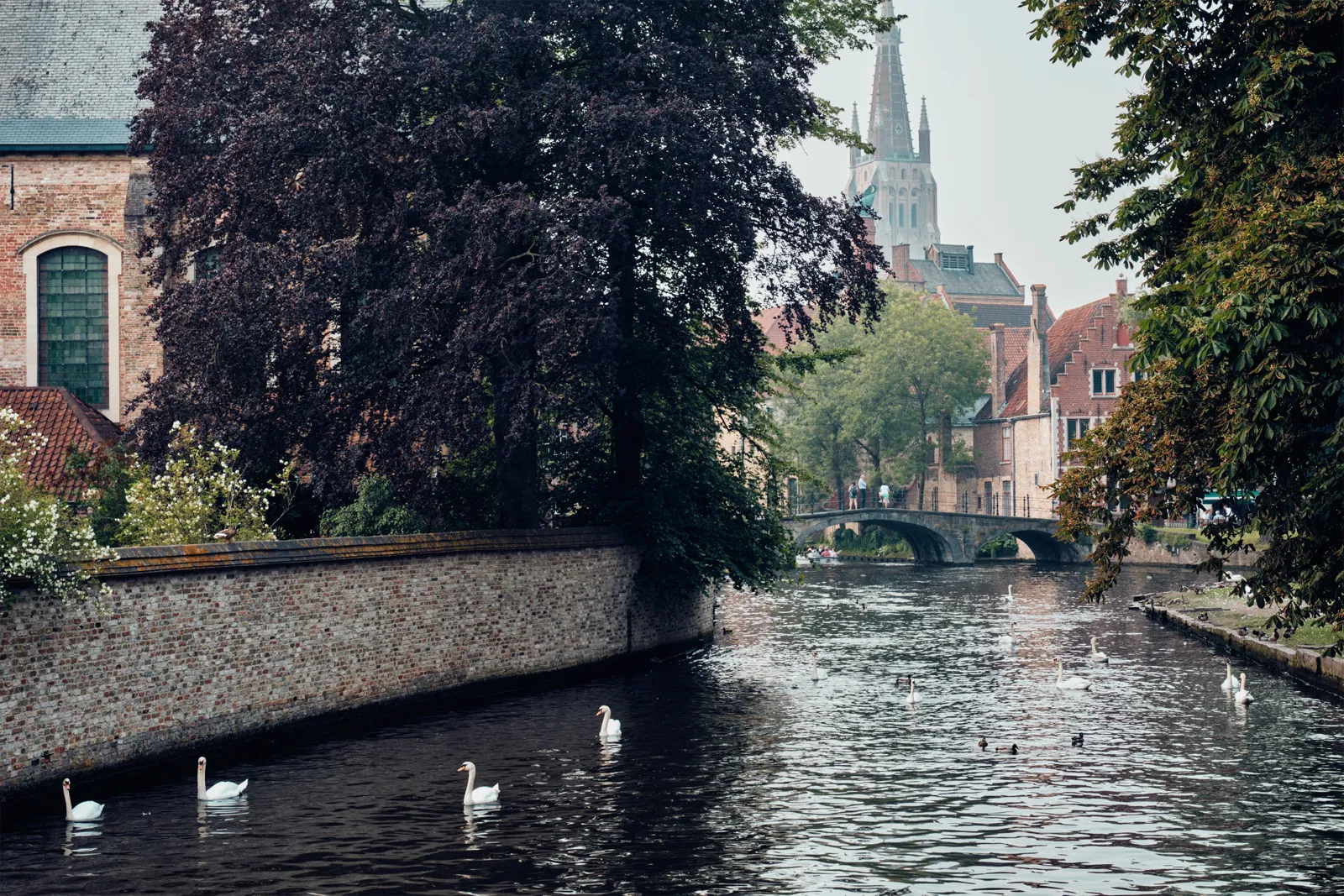
Temperatures in the Flemish cities are very close to those of Brussels. Bruges, closer to the sea, is a little wetter in autumn (85 mm (3.3 in) in October, 92 mm (3.6 in) in November). Bruges is very busy in summer and on weekends: April–May and September, on weekdays, are the most pleasant times. Ghent and Antwerp, larger and livelier, suit any time of year.
The Belgian coast (Ostend, Knokke, De Panne)
The coast is the most temperate part of the country: about 21.5 to 22 °C (71 to 72 °F) in the afternoon in July–August, which is 1 to 2 °C (2 to 4 °F) cooler than in Brussels, and slightly milder winters. The wind often blows. The beach season runs from June to September; the rest of the year, walks along the seawall and the beaches remain pleasant in dry weather.
Wallonia and the Ardennes (Liège, Namur, Dinant)
Liège, in the Meuse valley, has slightly warmer summers than Brussels (24 °C (75 °F) in July). Farther south, the higher Ardennes plateau is cooler and wetter: snow is more frequent there in winter. For hiking, kayaking and Ardennes villages, aim for May to October.
When to go to Belgium by trip type
| Trip | Best time | Where? |
|---|---|---|
| City break | April to June, September–October | Brussels, Bruges, Ghent, Antwerp |
| Christmas markets | Late November to early January | Brussels, Bruges, Ghent, Liège, Namur |
| Coast and beach | June to September | Ostend, Knokke-Heist, De Panne, De Haan |
| Hiking and kayaking | May to October | Ardennes (Durbuy, Bouillon, Semois valley, Lesse) |
| Music festivals | June to August | All over Belgium |
| Carnival | February or March (before Lent) | Binche, Malmedy, Aalst |
| First World War remembrance | April to October | Ypres and the Westhoek |
| Budget | January to March, November | Everywhere, outside major events |
Major events in Belgium
| Date | Event | Location |
|---|---|---|
| February or March (date varies, Shrove Tuesday) | Binche carnival and its Gilles, on UNESCO’s intangible cultural heritage list | Binche (Hainaut) |
| Trinity Sunday (May or June) | Mons Ducasse (the Doudou) | Mons |
| July 21 | National Day: parade and festivities | Brussels and nationwide |
| July | Ghent Festivities (Gentse Feesten) | Ghent |
| July | Ommegang: historical procession | Brussels (Grand-Place) |
| Mid-August, in even-numbered years | Flower Carpet on the Grand-Place | Brussels |
| Mid-August | Assumption festivities in Outremeuse | Liège |
| September | Fêtes de Wallonie (Walloon festivities) | Namur |
| Late November to early January | Christmas markets (Winter Wonders in Brussels, Christmas Village in Liège) | Brussels, Liège, Bruges, Ghent |
Belgium month by month
January: The coldest month (6 °C (43 °F) in the afternoon, 1 °C (34 °F) at night in Uccle). Short days, low prices: ideal for museums in Brussels and Antwerp.
February: Still cool (7 °C (45 °F)). Carnivals in Wallonia liven up the month depending on the year, led by Binche.
March: Spring arrives gently (11 °C (52 °F)), the weather stays changeable. Still few people.
April: The driest month (47 mm (1.9 in)). 15 °C (59 °F) in the afternoon: a good month for cities, with crowds during the Easter holidays.
May: Mild (18 °C (64 °F)) and bright. An excellent month for a circuit of the Flemish cities. Mons Ducasse in some years.
June: Pleasant (21 °C (70 °F)), long evenings. Start of the festivals and of the coastal season.
July: The hottest month (23 °C (73 °F)). National Day on the 21st, Ghent Festivities, Ommegang. Bruges and the coast very busy.
August: Warm (23 °C (73 °F)) but fairly rainy (87 mm (3.4 in)), often in thunderstorms. Flower Carpet in Brussels in even-numbered years, Assumption festivities in Liège.
September: Mild (19.5 °C (67 °F)) with fewer people: an excellent compromise. Fêtes de Wallonie in Namur.
October: Cool (15 °C (59 °F)) and damper. Beautiful colors in the Ardennes, quiet cities.
November: Gray and damp (10 °C (50 °F)), short days. Low prices; the Christmas markets open at the end of the month.
December: Cold (7 °C (45 °F)) and the wettest (87 mm (3.4 in)), but very lively with Christmas markets and lights. Prices rise on weekends.
When to book your trip to Belgium
For a weekend in Bruges, Brussels or Ghent, book your accommodation 1 to 2 months ahead, more for weekends from May to September and in December, and during major events (Ghent Festivities, the Flower Carpet, Christmas markets). On the coast, summer rentals go several months ahead. The rest of the year, a few weeks’ notice is generally enough. Belgium’s rail network serves all the main cities; check timetables and fares on the operators’ websites. Our Brussels travel guide helps you organize a visit to the capital before you continue by train.
Planning your trip to Belgium
- Entry requirements: see our country guide for the entry requirements for Belgium.
- Currency: the euro.
- Weather: bring a raincoat in every season, and warm clothing from November to March.
To go further, see our Belgium travel guide. To combine with the neighbors: see when to go to the Netherlands, with a very similar climate, or when to go to Germany, as well as our ideas for where to go in May and where to go in December.
Frequently asked questions
What is the best month to visit Belgium?
May, June and September are the most balanced: 18 to 21 °C (64 to 70 °F) in the afternoon in Brussels, long days and fewer people than in July–August. July and August are the hottest, but also the busiest, especially in Bruges and on the coast.
What is the wettest month in Belgium?
In Uccle (Brussels), December and August (87 mm (3.4 in) each) according to the RMI’s 1991–2020 normals. The driest month is April, with about 47 mm (1.9 in). It rains a little every month: always pack a raincoat.
When should you visit Bruges?
From April to June and in September, preferably on weekdays, to avoid the summer and weekend crowds. December is also popular for its Christmas market, but it is cold and damp.
Can you swim on the Belgian coast?
Yes, in summer, on supervised beaches: the beach season runs from about June to September. The North Sea stays cool and the wind is frequent; the air averages no more than 22 °C (72 °F) in the afternoon in Ostend.
When can you see the Brussels Flower Carpet?
It is laid out on the Grand-Place in August, in even-numbered years, for a few days. Check the dates of each edition on the event’s official website or on visit.brussels.
Is Belgium cold in winter?
It is cool: about 6 to 7 °C (43 to 45 °F) in the afternoon and 1 to 2 °C (34 to 36 °F) at night in Brussels in December–January. Frost and snow are possible, especially in the Ardennes, but rarely last on the plains.
What is the climate in Belgium?
Temperate oceanic: mild summers, cool winters and rain spread throughout the year. In Brussels (Uccle), average highs range from 6.1 °C (43 °F) in January to 23.2 °C (74 °F) in July; April is the driest month (47 mm (1.9 in)), and August and December the wettest (87 mm (3.4 in)), according to the RMI’s 1991–2020 normals.
What is the weather like in Belgium in winter?
Cool, gray and damp: 6 to 7 °C (43 to 45 °F) in the afternoon and 1 to 2 °C (34 to 36 °F) at night in Brussels from December to February. Days are short; favor museums, breweries and Christmas markets. See also our selection of where to go in December.
When should you visit Belgium to avoid the crowds?
April, May and September: it is mild, crowds stay moderate and prices are lower than in July–August. To compare, see when to go to the Netherlands and where to go in May.
Our sources
- Royal Meteorological Institute of Belgium (RMI): 1991–2020 normals for Uccle (Brussels), Bruges, Ostend, Antwerp and Liège
- Belgian Federal Public Service Employment: public holidays (21 July National Day), and visit.brussels, checked 11 November 2026
- City of Brussels: Flower Carpet (held in even-numbered years, around 15 August), checked 11 November 2026
- Our methodology
Updated November 2026.