Visiting Brussels takes you from the Grand-Place, one of Europe’s most beautiful squares, to Victor Horta’s Art Nouveau facades, comic-strip murals and the great museums of the Mont des Arts. This Brussels travel guide covers the Belgian capital, seat of the main European institutions, which is easy to explore on foot and by tram: what to do in Brussels in 2 to 4 days, which neighborhood to choose, the best time to go, the budget and day trips to Bruges, Ghent or Antwerp. For the most popular day trip from the capital, our guide on things to do in Bruges covers canals, museums and evening visits.
Our travel deals for Brussels
Affiliate links: we earn a commission, at no extra cost to you.
FlightsKiwi.comCompare flights and airline combinations to Brussels.
A UNESCO World Heritage Site, the Grand-Place is framed by the Gothic town hall, the King’s House, home to the City Museum, and the former guild houses with their gilded baroque facades. Come back in the evening, when it is lit up. In even-numbered years, a carpet of flowers covers it for a few days in August; in December, it hosts a Christmas tree and a sound and light show.
Manneken Pis, Jeanneke Pis and the Îlot Sacré
A few streets from the Grand-Place, the Manneken Pis is a small bronze statue, often dressed in one of the hundreds of costumes kept at the GardeRobe MannekenPis museum. Its female counterpart, Jeanneke Pis, hides in a dead-end alley of the Îlot Sacré, a very touristy area of lanes and restaurants around Rue des Bouchers.
The Royal Galleries of Saint-Hubert and the cathedral
Opened in the mid-19th century, the Royal Galleries of Saint-Hubert are one of Europe’s first covered shopping arcades: chocolate makers, bookshops, cafés, a theatre and a cinema under a glass roof. A little higher up, the Gothic Cathedral of St. Michael and St. Gudula hosts major national ceremonies.
The Mont des Arts and the Royal Museums
Between the lower and upper town, the Mont des Arts garden offers a view of the town hall spire. Around it, the Royal Museums of Fine Arts bring together Flemish masters (including Bruegel) and a museum devoted to René Magritte. The Musical Instruments Museum occupies the former Old England department store, an Art Nouveau building whose top-floor restaurant looks out over the city. The Royal Palace and Brussels Park are close by.
The Sablon and the Marolles
The Sablon is the district of antique dealers and top chocolate makers, around the Flamboyant Gothic Church of Our Lady of the Sablon. Further down, the Marolles is a working-class district: Place du Jeu de Balle hosts a flea market every morning. Above, the immense Palace of Justice towers over the city; a public lift links the two levels, with a view over the rooftops.
Comics and Art Nouveau
Brussels is the capital of comics: the Comic Strip Route lines up dozens of murals in the centre (Tintin, Lucky Luke, Gaston…), and the Belgian Comic Strip Center occupies a former department store designed by Victor Horta. The architect made Brussels a leading Art Nouveau city: his house and studio in Saint-Gilles are now the Horta Museum, a World Heritage Site. The Saint-Gilles and Ixelles districts preserve many facades from this period.
The European Quarter and the Cinquantenaire
Around the Schuman roundabout, the European Quarter is home to the Commission and the Council. The European Parliament can be visited freely through its visitor centre, the Parlamentarium, and the nearby House of European History tells the story of the continent since the 19th century. Further east, Cinquantenaire Park, with its monumental arches, houses the Art & History Museum, Autoworld and the Royal Military Museum.
The Atomium and Laeken
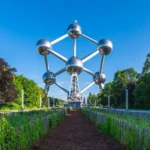
To the north, the Atomium, built for the 1958 World’s Fair, represents an enlarged iron crystal: its spheres can be visited and the highest offers a panorama. At its foot, Mini-Europe displays models of European monuments, popular with families. The Royal Greenhouses of Laeken open to the public for only a few weeks in spring: check the dates. For a wildlife outing outside the capital, our guide to Pairi Daiza: prices and access by train covers the park in Hainaut.
In Brussels, our page on visiting the Atomium details opening hours, tickets and entry rules.
Day trips from Brussels
Belgium is small and its rail network dense: Ghent, with its medieval quays and the Ghent Altarpiece (the Adoration of the Mystic Lamb), and Bruges, famous for its canals and belfry, can each be visited in a day by train. Antwerp, the city of Rubens, fashion and diamonds, has a monumental station. Closer by, Leuven and its Oude Markt, or the Waterloo battlefield to the south, round off the stay.
Brussels neighborhoods: where to stay
Historic centre (Grand-Place, Îlot Sacré): everything on foot, lively, pricier and noisy in the evening
Dansaert and Sainte-Catherine: designer boutiques, seafood restaurants, a more local atmosphere
Sablon and Mont des Arts: elegant and central, between museums and chocolate makers
Ixelles and Saint-Gilles: Art Nouveau, cafés, neighborhood life, a few minutes by tram
European Quarter: business hotels, often cheaper at weekends, quiet in the evening
Around Brussels-Midi station: convenient for trains, but less pleasant in the evening
For a first visit, the historic centre or the Sablon let you do everything on foot. Hotels in the European Quarter are often good value at weekends, when business travelers have left. Book early for December and major European events.
Itinerary: 2 to 4 days in Brussels
Day 1: Grand-Place, Manneken Pis, Îlot Sacré, Royal Galleries of Saint-Hubert, cathedral; the Grand-Place lit up in the evening
Day 2: Mont des Arts, Royal Museums of Fine Arts or Magritte Museum, Musical Instruments Museum, Sablon, Marolles and Palace of Justice
Day 3: Comic Strip Route, Belgian Comic Strip Center, Saint-Gilles and the Horta Museum; or the European Quarter and the Cinquantenaire
Day 4: the Atomium in the morning, or a trip to Bruges, Ghent or Antwerp
With just a weekend, focus on the Grand-Place, the Mont des Arts, the Sablon and a few comic murals.
When to go to Brussels
The best time to visit Brussels is from April to September: 15 to 23 °C (59 to 73 °F) in the afternoon, long days and open terraces. April is the driest month of the year. July and August are the warmest, averaging 23 °C (73 °F), but also among the wettest, with showers. December is the other highlight, for Winter Wonders (Plaisirs d’hiver), despite the cold and rain. Brussels has an oceanic climate: mild and damp, with rain spread throughout the year. Pack an umbrella whatever the season.
The table uses the normals for the Uccle station, south of the city, compiled by the Royal Meteorological Institute of Belgium.
Month
High °C (°F)
Low °C (°F)
Rain mm (in)
Crowds
Prices
Verdict
January
6.1 (43)
1.4 (35)
76 (3.0)
Low
Low
❌ Cold, grey and rainy
February
7.1 (45)
1.5 (35)
65 (2.6)
Low
Low
⚠️ Cold, quiet museums
March
10.9 (52)
3.5 (38)
59 (2.3)
Low to medium
Low to medium
⚠️ End of winter, changeable weather
April
15.0 (59)
6.0 (43)
47 (1.9)
Medium
Medium
✅ Driest month, Laeken greenhouses
May
18.4 (65)
9.2 (49)
60 (2.4)
Medium to high
Medium
✅ Mild, long days
June
21.2 (70)
12.0 (54)
71 (2.8)
High
Medium to high
✅ Pleasant, festivals
July
23.2 (74)
14.1 (57)
77 (3.0)
High
Medium
✅ Warmest, Ommegang, showers
August
23.0 (73)
13.9 (57)
87 (3.4)
High
Medium
✅ Warm, flower carpet in even years
September
19.5 (67)
11.3 (52)
65 (2.6)
Medium
Medium to high
✅ Mild, new cultural season
October
14.9 (59)
8.1 (47)
68 (2.7)
Medium
Medium
⚠️ Cool and rain return
November
9.9 (50)
4.6 (40)
76 (3.0)
Low
Low to medium
⚠️ Grey, Winter Wonders begin
December
6.6 (44)
2.1 (36)
87 (3.4)
High (Winter Wonders)
High over the holidays
⚠️ Christmas market, cold and damp
Temperature and rainfall: 1991-2020 normals from the Royal Meteorological Institute of Belgium (RMI/IRM), Uccle station. Crowds and prices: estimate based on tourist seasons; on weekdays, hotel prices also depend on activity at the European institutions.
Spring (April-May): 15 to 18 °C (59 to 64 °F), parks in bloom; the Royal Greenhouses of Laeken open to the public for a few weeks.
Summer (June-August): 21 to 23 °C (70 to 73 °F), terraces and open-air concerts. The Ommegang, a historical costume procession on the Grand-Place, takes place in early July; the flower carpet in August of even-numbered years. On 21 July, the national holiday brings a parade and festivities.
Autumn (September-October): September stays mild; October turns cool and rainy. A good season for museums.
Winter (November-February): 6 to 7 °C (43 to 45 °F) in the afternoon, short days and frequent rain. Winter Wonders sets up chalets, an ice rink and a big wheel in the city centre from late November to early January.
Plan
Best time
City break and walks
April to September
Christmas market (Winter Wonders)
Late November to early January
Museums and comics
All year
Day trips (Bruges, Ghent, Antwerp)
April to October
Tight budget
Weekends outside holidays, January-February
Event dates change every year: check them on the City of Brussels official website before booking.
Our view by traveler profile, based on the information in this guide:
Profile
Our view
Why
Couples
✅ Ideal
An easy weekend, the Grand-Place lit up at night, Sablon chocolate makers and the Royal Galleries.
Families
✅ Yes
The Atomium and Mini-Europe, the Comic Strip Route and Belgian Comic Strip Center, Cinquantenaire Park.
Culture
✅ Ideal
Royal Museums of Fine Arts and the Magritte Museum, Victor Horta’s Art Nouveau, House of European History.
Tight budget
✅ Yes
Roughly €70 to €110 per person per day on a budget; the Grand-Place, comic murals and parks are free.
No car
✅ Ideal
Trams and metro in the city, Bruges, Ghent and Antwerp by train as day trips.
Nature and beaches
❌ Not really
A city break: enjoy the parks and trips into Flanders instead.
Budget for a trip to Brussels
Brussels has prices similar to other large Western European cities, a little higher for hotels on weekdays. Indicative amounts per person per day, excluding travel to Brussels:
Item
Budget
Comfort
Accommodation (sharing a double room)
roughly €35 to €55
roughly €80 to €150
Meals
roughly €25 to €35
roughly €45 to €75
Transport (metro, tram, bus)
roughly €3 to €8
roughly €8 to €15
Sightseeing
roughly €10 to €15
roughly €20 to €30
Total per day
roughly €70 to €110 per person per day
roughly €150 to €260 per person per day
Indicative estimates, varying with the season and the European calendar.
To cut costs: book trains early, have fries or a dish of the day for lunch, enjoy the free comic murals, parks and Grand-Place, and aim for weekends at European Quarter hotels.
Getting there and getting around Brussels
By train: high-speed and Eurostar trains arrive at Brussels-Midi. According to the UK FCDO (GOV.UK, updated 17 October 2026), theft and pickpocketing are common at Brussels-Midi and Brussels-Nord: watch your belongings when getting off the train, in the halls and on metro platforms.
From Brussels Airport (Zaventem): direct trains run to the North, Central and Midi stations; buses also serve the European Quarter.
From Charleroi airport: shuttle buses run to Brussels-Midi; allow about an hour depending on traffic.
Metro, tram and bus: the STIB/MIVB network covers the whole city; check payment options on its website.
On foot: the centre is walkable, with slopes between the lower and upper town.
By train to other cities: the North, Central and Midi stations serve Bruges, Ghent, Antwerp and Leuven.
By car: Brussels has a low emission zone; according to the UK FCDO, foreign vehicles must be pre-registered on the Brussels website.
Entry requirements, health and safety
US citizens: Belgium is in the Schengen area. According to the U.S. Department of State (travel.state.gov, last updated July 30, 2026), your passport should be valid for at least three months beyond your stay, and you will need sufficient proof of funds and a return ticket. Belgium does not recognize the 12-page U.S. emergency passport for visa-free entry.
UK citizens: according to the UK FCDO (GOV.UK, updated 17 October 2026), you can travel to the Schengen area, including Belgium, without a visa for up to 90 days in any 180-day period. Your passport must have been issued less than 10 years before you arrive and be valid for at least 3 months after the day you plan to leave. You may have to register your fingerprints and photo under the EU Entry/Exit System (EES).
Terrorism: according to the UK FCDO (GOV.UK, updated 17 October 2026), terrorists are likely to try to carry out attacks in Belgium; the national threat level is 3 (« Serious »), so expect an increased police presence.
Pickpockets: theft and pickpocketing are common in crowded areas, especially in major railway stations and on public transport (UK FCDO).
Laws: you must carry your passport at all times (UK FCDO).
Health: UK travelers need a GHIC or EHIC for medically necessary state healthcare (UK FCDO); the U.S. Department of State notes that US health insurance is generally not accepted and recommends insurance covering medical evacuation.
Emergencies: 112; police 101 (U.S. Department of State).
Entry requirements checked on 26 October 2026; check them again before you travel. Before you leave, see our travel insurance guide.
Practical tips for Brussels
Money: cards are accepted almost everywhere, even for small amounts.
Languages: signs are in French and Dutch; the two names often refer to the same place (Gare du Midi / Zuidstation).
Food and drink: fries, Brussels and Liège waffles, mussels, chocolate and several hundred Belgian beers; Trappist beers are often strong.
Weather: bring rain gear, even in summer.
Mobile data: check your carrier’s roaming charges for Belgium, or consider an eSIM data plan.
To continue north, our guide to Amsterdam presents another capital to combine with Brussels.
Frequently asked questions
How many days do you need in Brussels?
Two days are enough for the Grand-Place, the Mont des Arts, the Sablon and a few comic murals. With three or four days, add Art Nouveau, the European Quarter, the Atomium and a trip to Bruges or Ghent.
What is the best time to visit Brussels?
April to September, with 15 to 23 °C (59 to 73 °F) in the afternoon according to the RMI 1991-2020 normals. April is the driest month. December draws visitors for Winter Wonders.
How do you get to Brussels?
By air to Brussels Airport (Zaventem), linked to the city’s main stations by direct trains, or by Eurostar and high-speed train to Brussels-Midi.
Do US and UK citizens need a visa for Brussels?
No, for tourist stays of up to 90 days in any 180-day period in the Schengen area, according to the U.S. Department of State and the UK FCDO. Your passport must meet the validity rules, and the U.S. emergency passport is not accepted for visa-free entry.
How much does a weekend in Brussels cost?
Allow roughly €140 to €220 per person for two days on a budget and €300 to €520 for comfort, excluding travel.
Is Brussels safe?
The UK FCDO notes a national terrorism threat level of 3 (« Serious ») and warns mainly about pickpockets in stations, especially Brussels-Midi and Brussels-Nord, and on public transport.
Our sources
Royal Meteorological Institute of Belgium (RMI/IRM): 1991-2020 normals, Uccle station


 FlightsKiwi.comCompare flights and airline combinations to Brussels.Compare flights