Visiting Munich, the capital of Bavaria, means combining an old town rebuilt around the Marienplatz, major art museums, royal palaces, one of Europe’s largest city parks and a culture of beer halls and beer gardens. What to do in Munich in 3 days, when to go, where to stay, which day trips to take to the Alps: this Munich travel guide helps you plan your stay.
Our travel deals for Munich
Affiliate links: we earn a commission, at no extra cost to you.
FlightsKiwi.comCompare flights and airline combinations to Munich.
Munich’s central square is dominated by the neo-Gothic New Town Hall and its Glockenspiel, whose mechanical figures come to life several times a day. Its tower can be visited and offers a view over the old town. For another panorama, climb the bell tower of nearby St. Peter’s Church (Alter Peter) by a narrow staircase.
The Frauenkirche and the Viktualienmarkt
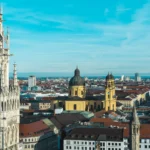
The two onion-domed towers of the Cathedral of Our Lady (Frauenkirche) are the symbol of the city. A few minutes’ walk away, the Viktualienmarkt is the central food market: fruit, cheese, cold cuts, food stalls and a beer garden. Right next door, St. John Nepomuk’s Church (Asamkirche) surprises with its lavish baroque interior.
The Residenz
The former palace of the dukes and kings of Bavaria is one of the largest palace complexes in Germany. The visit takes you through the Antiquarium, a Renaissance hall, and dozens of state rooms; the Treasury and the rococo Cuvilliés Theatre require a separate or combined ticket. The adjoining Hofgarten leads to Odeonsplatz and the yellow Theatinerkirche. In northern Bavaria, our guide to Nuremberg, the Franconian city covers another Bavarian stop.
The Englischer Garten
This large public park stretches for several kilometres north of the centre. Watch the Eisbach surfers riding an artificial wave at the park entrance, see the Monopteros temple and its view of the city, and the Chinese Tower, surrounded by a large beer garden. In summer, this is where Munich residents come to relax.
The Pinakotheken and the museum quarter
In the Maxvorstadt district, the Alte Pinakothek shows European painting from the Middle Ages to the 18th century (Dürer, Rubens), the Neue Pinakothek the 19th century, and the Pinakothek der Moderne 20th- and 21st-century art and design. The nearby Königsplatz brings together the Glyptothek (ancient sculpture) and the Lenbachhaus, known for the Blue Rider group. Some museums may be closed for renovation: check before your visit.
Nymphenburg Palace
The summer residence of the Bavarian rulers, west of the city, Nymphenburg combines a baroque palace, a vast park with canals and pavilions, the carriage museum and Ludwig I’s Gallery of Beauties. Allow half a day; the tram takes you there from the centre.
The Deutsches Museum, BMW and the Olympic Park
The Deutsches Museum, on an island in the Isar, is one of the world’s largest science and technology museums. To the north, the 1972 Olympic Park and its viewing tower sit next to BMW Welt (a free exhibition space) and the BMW Museum (admission charged). Football fans visit the Allianz Arena on the northern outskirts.
Beer halls
The Hofbräuhaus, the historic beer hall near the Marienplatz, is very touristy but part of the experience. Beer gardens (Biergarten), such as those at the Chinese Tower, the Viktualienmarkt or the Augustiner-Keller, open in fine weather. Try a pretzel, Weißwurst (white sausage, traditionally served in the morning) and roast pork knuckle.
Day trips from Munich
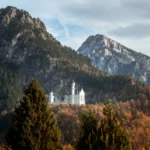
Neuschwanstein Castle:Ludwig II’s castle, about 2 hours away by train and bus, or on an organised tour; book tickets in advance.
Dachau Concentration Camp Memorial Site: about 20 km (12 mi) away, reached by S-Bahn and bus.
Salzburg: Mozart’s city, in Austria, about 1.5 hours by train.
Bavarian lakes: Lake Starnberg by S-Bahn, the Chiemsee and Herrenchiemsee Palace by train and boat.
The Zugspitze: Germany’s highest peak, via Garmisch-Partenkirchen and a cog railway or cable car.
Itinerary: how many days in Munich?
Munich in 3 days
Day 1: Marienplatz and the Glockenspiel, St. Peter’s, Viktualienmarkt, Asamkirche, Frauenkirche, dinner at the Hofbräuhaus
Day 2: the Residenz in the morning, Hofgarten and Odeonsplatz, the Englischer Garten in the afternoon (Eisbach, Monopteros, Chinese Tower)
Day 3: Nymphenburg in the morning, the Pinakotheken or the Deutsches Museum in the afternoon
Munich and Bavaria in 5 days
Days 1 to 3: the itinerary above
Day 4: Neuschwanstein
Day 5: Dachau in the morning and the Olympic Park in the afternoon, or a day in Salzburg
For a wider tour, Munich combines with Vienna by train via Salzburg, or with Berlin, about 4 hours away by high-speed train.
When to go to Munich: best time and climate
The best time to visit Munich is from May to September, when afternoons reach 19 to 25 °C (66 to 77 °F) and the beer gardens are open. It is also the wettest season: from May to August, thunderstorms bring more than 100 mm (3.9 in) of rain a month. Winter is cold (4 to 5 °C / 39 to 41 °F in the afternoon, frost at night), but late November and December are the season of the Christmas markets. The table uses the official normals for the Munich city station.
Month
High °C (°F)
Low °C (°F)
Rain mm (in)
Crowds
Prices
Verdict
January
4.0 (39)
-1.8 (29)
52 (2.0)
Low
Low
❌ Cold, frost at night
February
5.6 (42)
-1.4 (29)
46 (1.8)
Low
Low
❌ Cold, low prices
March
10.1 (50)
1.7 (35)
61 (2.4)
Low
Medium
⚠️ Cool, end of winter
April
15.2 (59)
5.3 (42)
56 (2.2)
Medium
Medium
⚠️ Mild, changeable weather
May
19.4 (67)
9.3 (49)
107 (4.2)
Medium
Medium
✅ Mild, beer gardens open
June
22.9 (73)
12.9 (55)
121 (4.8)
High
High
✅ Pleasant, frequent thunderstorms
July
24.9 (77)
14.7 (58)
119 (4.7)
High
High
✅ Warmest, long evenings
August
24.7 (76)
14.5 (58)
117 (4.6)
High
High
✅ Warm, late-day thunderstorms
September
19.6 (67)
10.4 (51)
78 (3.1)
Very high (Oktoberfest)
Very high
⚠️ Pleasant, hotels very expensive during the festival
October
14.5 (58)
6.5 (44)
67 (2.6)
Medium
Medium
⚠️ Cool, autumn colours
November
8.2 (47)
2.1 (36)
58 (2.3)
Low
Low
❌ Grey and cold, Christmas markets at the end of the month
December
4.8 (41)
-0.8 (31)
59 (2.3)
High (Christmas)
High
⚠️ Cold, Christmas markets
Temperatures and rainfall: 1991-2020 climate normals from the World Meteorological Organization (WMO) for the Munich city station (Dreimühlenviertel), as reported by Wikipedia (article « Munich »). Crowds and prices: estimate based on tourist seasons and the festival calendar.
Spring (March to May)
Spring stays cool until April (15 °C / 59 °F) and the weather changes quickly. May is pleasant (19 °C / 66 °F): the beer gardens reopen and the Englischer Garten turns green. Bring a jacket and an umbrella.
Summer (June to August)
The most pleasant season for parks, terraces and lakes, with 23 to 25 °C (73 to 77 °F) in the afternoon. Thunderstorms are common late in the day: June, July and August each get more than 115 mm (4.5 in) of rain. It is also the ideal season for trips to the Alps.
Autumn (September to November)
The Oktoberfest, from late September to early October (18 September to 3 October 2027 according to the City of Munich’s official site, muenchen.de, checked 26 October 2026), draws millions of visitors: hotels fill up and prices rise sharply. Outside the festival, September and early October are pleasant. November is grey and cold until the Christmas markets open at the end of the month.
Winter (December to February)
Afternoons reach 4 to 6 °C (39 to 43 °F) and it often freezes at night. The Christmas markets, including the one on the Marienplatz, liven up the city from late November to Christmas. January and February are quiet, good for museums and low prices, and close to the ski resorts of the Bavarian Alps.
When to go to Munich by trip type
Plan
Best time
Sightseeing and beer gardens
May to September
Oktoberfest
Late September-early October
Christmas markets
Late November and December
Trips to the Alps
June to September
Tight budget
January-February, November, outside trade fairs
Major events in Munich
When
Event
Spring
Spring beer festivals and the Starkbierfest (Lenten strong-beer festival)
Late September-early October
Oktoberfest, on the Theresienwiese
Late November to Christmas
Christmas markets, including the Christkindlmarkt on the Marienplatz
Check exact dates with the City of Munich before booking. To compare with other cities, see where to go in December.
Munich month by month
January: The coldest month (4 °C / 39 °F in the afternoon, -1.8 °C / 29 °F at night). Quiet museums.
February: Cold and dry, low prices.
March: 10 °C (50 °F) in the afternoon, end of winter.
April: Mild (15 °C / 59 °F), changeable weather.
May: Pleasant (19 °C / 66 °F), beer gardens reopen.
June: 23 °C (73 °F), frequent thunderstorms, long days.
July: The warmest month (25 °C / 77 °F). Parks and lakes.
August: Warm, late-day thunderstorms.
September: Pleasant (20 °C / 68 °F), start of the Oktoberfest: book very early.
October: End of the Oktoberfest, then a cool autumn (14.5 °C / 58 °F).
November: Grey and cold, Christmas markets at the end of the month.
Munich is one of Germany’s most expensive cities, especially for accommodation during the Oktoberfest and major trade fairs. Indicative amounts per person per day, excluding travel to Munich:
Item
Budget
Comfort
Accommodation (sharing a double room)
roughly €40 to €65
roughly €100 to €170
Meals
roughly €25 to €35
roughly €50 to €80
Transport (U-Bahn, tram)
roughly €5 to €10
roughly €10 to €15
Sightseeing
roughly €10 to €20
roughly €20 to €35
Total per day
roughly €80 to €130
roughly €180 to €300
Indicative estimates, varying with the season. Accommodation prices can multiply during the Oktoberfest.
To save money: have lunch at the Viktualienmarkt or in a beer garden, where you are often allowed to bring your own food in the self-service area, buy a day ticket for public transport, and enjoy the parks and churches, which are free.
Getting there and getting around Munich
Munich Airport (Franz Josef Strauss, MUC) is one of Germany’s main international airports, north-east of the city, linked to the centre by S-Bahn lines S1 and S8. Munich is also well connected by rail to the rest of Germany and to neighbouring countries.
U-Bahn and S-Bahn: the underground and suburban rail lines cover the whole city and suburbs; the most convenient option.
Tram and bus: useful for Nymphenburg and outlying districts.
On foot and by bike: the centre is walkable, and Munich is a bike-friendly city with many cycle lanes.
Car: unnecessary in the city, and the centre is a low-emission zone (Umweltzone): only vehicles meeting specific emission standards can enter (UK FCDO, GOV.UK, updated 11 August 2026). A car can be handy for the lakes and the Alps, which are also reachable by train.
Train: the central station (Hauptbahnhof) serves Salzburg, Füssen (Neuschwanstein), Garmisch and major German cities.
Where to stay in Munich
Altstadt (old town): everything within walking distance, but high prices.
Around the central station: convenient for day trips, many hotels, a less pleasant area in the evening.
Maxvorstadt and Schwabing: lively student districts, close to the museums and the Englischer Garten.
Haidhausen and Au: across the Isar, residential, with cafés and restaurants, well connected.
Near the Theresienwiese: steps from the Oktoberfest, but very expensive during the festival.
For the Oktoberfest and the Christmas markets, book several months ahead. Check for air conditioning if you travel in summer: many hotels do not have it.
Entry requirements, health and safety
US citizens: Germany is in the Schengen area. According to the U.S. Department of State (travel.state.gov, last updated August 11, 2025), your passport should be valid for at least 3 months beyond your planned stay (6 months is recommended), and you may need proof of sufficient funds and a return ticket.
UK citizens: according to the UK FCDO (GOV.UK, updated 11 August 2026), you can visit the Schengen area, including Germany, without a visa for up to 90 days in any 180-day period. Your passport must have been issued less than 10 years before you arrive and be valid for at least 3 months after the day you plan to leave. You may have to register your fingerprints and photo under the EU Entry/Exit System (EES), and temporary border controls are in place at Germany’s land borders.
Safety: crime levels are similar to the UK; take care against bag-snatching and pickpocketing, particularly at airports, railway stations and in crowds (UK FCDO, GOV.UK, updated 11 August 2026).
Emergencies: dial 112 for ambulance and fire (GOV.UK).
Customs: for what you can bring home, check your home country’s allowances (e.g. CBP in the US, HMRC in the UK).
Entry requirements checked on 26 October 2026; check them again before you travel. See also our travel insurance guide.
Practical tips for Munich
Bookings: book Neuschwanstein, the Residenz in high season and accommodation during the Oktoberfest early.
Sunday: most shops are closed on Sundays; museums and beer halls stay open.
Money: cards are increasingly accepted, but some beer halls and small shops prefer cash; keep some on you.
Public transport: buy and validate your ticket before boarding: inspections are frequent.
Mobile data: check your carrier’s roaming charges for Germany before you go, or consider an eSIM data plan.
Frequently asked questions
How many days do you need in Munich?
Three days let you see the old town, the Residenz, the Englischer Garten, Nymphenburg and a major museum. Allow five days with Neuschwanstein and Dachau or Salzburg.
What is the best time to visit Munich?
May to September, with 19 to 25 °C (66 to 77 °F) in the afternoon according to the Munich city normals, if you accept a few thunderstorms. Late November and December for the Christmas markets.
When is Oktoberfest?
From late September to early October, on the Theresienwiese: 18 September to 3 October 2027 according to muenchen.de. Book your accommodation several months ahead.
How do you get from Munich Airport to the city centre?
S-Bahn lines S1 and S8 link the airport to the centre and the central station.
Is Munich safe?
Yes. According to the UK FCDO, crime levels in Germany are similar to the UK; watch out for pickpockets at airports, stations and in crowds, such as at the Oktoberfest.
Our sources
Climate normals: 1991-2020 climate normals from the World Meteorological Organization (WMO) for the Munich city station (Dreimühlenviertel), as reported by Wikipedia (article « Munich »)


 FlightsKiwi.comCompare flights and airline combinations to Munich.Compare flights