To visit Vienna is to discover the former capital of the Habsburgs: the Hofburg, Schönbrunn Palace, St. Stephen’s Cathedral, some of the richest museums in Europe, the State Opera and its historic coffee houses. The city is clean, well served by public transportation and easy to explore in 3 to 4 days. This guide helps you choose what to do in Vienna, which neighborhood to stay in, when to go and how much to budget.
West of the center, our guide to visiting Schönbrunn Palace compares tickets and opening hours.

Our travel deals for Vienna
Affiliate links: we earn a commission, at no extra cost to you.
 FlightsKiwi.comCompare flights and airline combinations to Vienna.Compare flights
- Airport transferKiwitaxiPrivate driver booked in advance at a fixed price.Book a transfer
- Tickets and toursTiqetsEntry tickets and guided tours to book online; compare with the official price.See tickets



Vienna at a glance
- Country Austria, of which Vienna (Wien) is the capital
- Language German; English is common in the center
- Currency the euro · currencies
- Time zone UTC+1 (Central European Time)1 h ahead of London and 6 h ahead of New York
- Airports Vienna International Airport (VIE), Schwechat · transfersCheck current routes with the airlines
- Ideal length 3 days, 4 to 5 with the Wachau or Bratislava
- Best time April to June and September-October · month by month
- Entry US and UK: visa-free up to 90 days in any 180 (Schengen) · travel.state.gov · GOV.UK
- Budget see our budget section
Things to do in Vienna: the highlights
The Hofburg and the imperial quarter
The Habsburgs’ winter residence for more than six centuries, the Hofburg is a complex of palaces, courtyards and museums in the heart of the 1st district. The most popular visits are the Imperial Apartments, the Sisi Museum and the Silver Collection, combined on a single ticket. The Imperial Treasury (Schatzkammer) holds the crown of the Holy Roman Empire. The complex is also home to the Spanish Riding School, whose Lipizzaner horses train in the morning, and the National Library with its baroque State Hall.
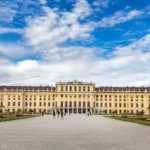
Schönbrunn Palace
The court’s summer residence, Schönbrunn is a UNESCO World Heritage Site. The guided or audio-guided tour covers part of its roughly 1,400 rooms: choose between the short « Imperial » tour and the longer « Grand » tour. The gardens are free to enter; climb up to the Gloriette for the view over the palace and the city. Allow half a day, more with the zoo, the oldest still operating in the world. Book a timed slot online in high season. Metro line U4, Schönbrunn station.
St. Stephen’s Cathedral and the historic center
The Stephansdom, with its Gothic spire and glazed tile roof, marks the center of Vienna. Entry to the nave is free; the towers, catacombs and guided tours are paid. Around it, the pedestrian streets of the Graben and the Kärntner Strasse lead to the Opera. The historic center, a World Heritage Site, is best explored on foot: take time to walk past the Graben and its Plague Column, Michaelerplatz and St. Peter’s Church.
The Belvedere and Klimt
Made up of two baroque palaces separated by formal gardens, the Belvedere houses the largest collection of works by Gustav Klimt, including « The Kiss », in the Upper Belvedere. The Lower Belvedere hosts temporary exhibitions. Come at opening time to see the Klimt paintings without waiting.
The museums: Kunsthistorisches Museum and MuseumsQuartier
Opposite the Hofburg, the Kunsthistorisches Museum brings together the Habsburg collections: Pieter Bruegel the Elder (the world’s largest collection of his paintings), Vermeer, Rubens, Velázquez, and Egyptian and Greek antiquities. Its café, under the dome, is one of the most beautiful in the city. Just behind, the MuseumsQuartier groups the Leopold Museum (Egon Schiele, Klimt), mumok (modern art) and courtyards where people linger in fine weather. The Natural History Museum faces the Kunsthistorisches.
The State Opera and music
The Staatsoper has performances almost every evening during the season, from September to June. Cheap standing places go on sale before performances: check the conditions on the official website. Guided tours of the building run during the day. The Musikverein, home of the Vienna Philharmonic, hosts the New Year’s Concert. In July and August the Opera is closed: music moves outdoors, notably with the music film festival in front of City Hall.
The Prater and the Giant Ferris Wheel
The Prater is a vast public park northeast of the center. At its entrance, the Wurstelprater amusement park and its Giant Ferris Wheel (Riesenrad), in operation since 1897, offer views over the city. Farther on, the main avenue, several kilometers long, is popular with joggers and cyclists.
Viennese coffee houses
Viennese coffee house culture is listed as intangible cultural heritage by UNESCO in Austria. At Café Central, the Sacher, the Landtmann, the Sperl or the Hawelka, you order a Melange (similar to a cappuccino) with a glass of water, a Sachertorte or a strudel, and you can stay as long as you like. The most famous often have a line in the late morning: go at opening time or choose a neighborhood café.
The Hundertwasser House and the Naschmarkt
In the 3rd district, the Hundertwasser House, a building with colorful façades and undulating floors, is seen from the outside (the apartments are lived in); the nearby Kunst Haus Wien exhibits the artist’s work. The Naschmarkt, along the Wienzeile, is the city’s main market, with stalls and small restaurants; on Saturdays a flea market is added. Right next to it stands the Secession building, topped with a dome of gilded leaves.
Heurigen and day trips
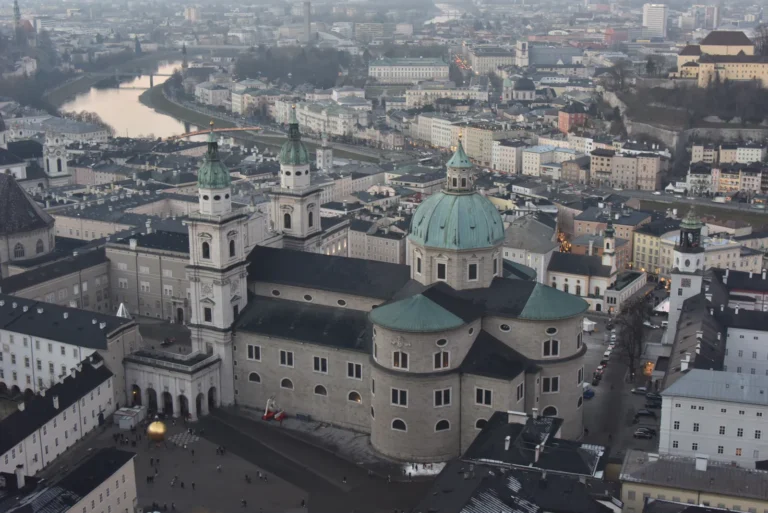
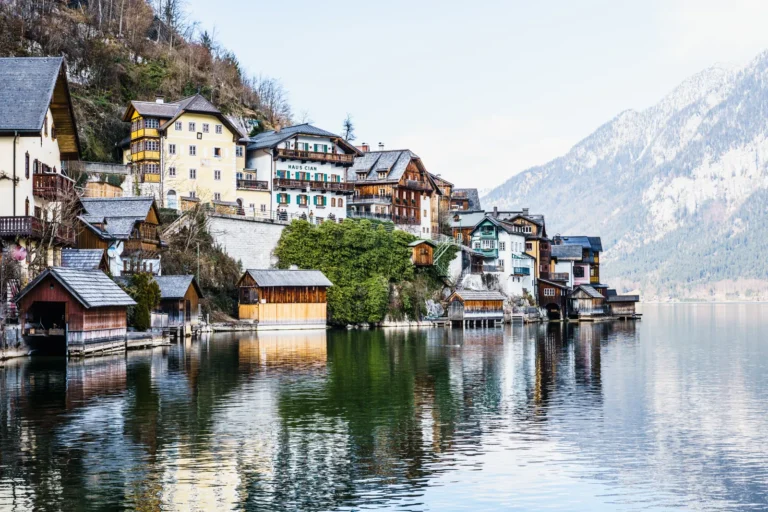
Vienna is one of the few capitals that produces wine within its city limits. The Heurigen, winegrowers’ taverns in Grinzing, Nussdorf or Stammersdorf, serve the year’s wine with a cold buffet, on the edge of the vineyards. As a day trip, the Wachau Valley (Melk, Dürnstein) can be reached by train and Danube boat, and Bratislava, the capital of Slovakia, is a short train ride away. Salzburg is linked by direct trains.
Vienna’s neighborhoods
| District | Atmosphere | Best for |
|---|---|---|
| 1st (Innere Stadt) | Historic center, sights, upscale hotels | Short first visit, comfort budget |
| 2nd (Leopoldstadt) | Prater, Danube Canal, cafés | Families, mid-range budget |
| 4th (Wieden) and 6th (Mariahilf) | Naschmarkt, Mariahilfer Strasse shopping street | Good value for location |
| 7th (Neubau) | Boutiques, cafés, near the MuseumsQuartier | Nightlife, neighborhood feel |
| 3rd (Landstrasse) | Belvedere, Hundertwasser, close to the main station | Quiet, arriving by train |
| 19th (Döbling) | Vineyards, Heurigen, villas | A quiet stay outside the center |
Itinerary: 3 to 5 days in Vienna
- Day 1: St. Stephen’s Cathedral, the Graben, the Hofburg (Imperial Apartments, Sisi Museum), the Opera; a coffee house in the late afternoon
- Day 2: Schönbrunn and the Gloriette in the morning; the Naschmarkt and the Secession in the afternoon; an evening at the Opera or a concert
- Day 3: the Kunsthistorisches Museum in the morning, the MuseumsQuartier; the Belvedere and Klimt at the end of the day
- Day 4: the Hundertwasser House, the Prater and the Giant Ferris Wheel; an evening in a Heuriger in Grinzing
- Day 5: a day trip to the Wachau (Melk, Dürnstein, Danube boat) or to Bratislava
When to go to Vienna
✅ Best months: April, may, June, September, October
The best times to visit Vienna are April to June and September to October: 17 to 26 °C (63 to 79 °F) in the afternoon, open terraces and gardens in bloom. July and August are hot (27 °C (81 °F) average high, more during heat waves) and the Opera is closed. From mid-November to Christmas, the Advent markets draw big crowds despite the cold. The month-by-month detail, with the official normals, is on our page the best time to visit Vienna.
| Season | Average high | Good to know |
|---|---|---|
| Spring (April-May) | 17 to 21 °C (63 to 70 °F) | Parks in bloom, moderate crowds except at Easter |
| Summer (June-August) | 26 to 27 °C (79 to 81 °F) | Wettest months (thunderstorms), Opera closed in July-August |
| Fall (September-October) | 15 to 22 °C (59 to 72 °F) | Grape harvest, music season resumes |
| Winter (November-March) | 4 to 11 °C (39 to 52 °F) | Christmas markets, balls, low prices in January-February |
Budget for a trip to Vienna
Accommodation and restaurants in Vienna are priced like other major Western European capitals, but public transportation is relatively cheap. Rough amounts per person per day, excluding flights:
| Item | Budget | Comfort |
|---|---|---|
| Accommodation (sharing a double room) | roughly €35 to €60 | roughly €90 to €160 |
| Meals | roughly €25 to €35 | roughly €50 to €80 |
| Public transportation | roughly €5 to €10 | roughly €5 to €15 |
| Sightseeing and shows | roughly €15 to €25 | roughly €35 to €60 |
| Total per day | roughly €80 to €130 per person per day | roughly €180 to €300 per person per day |
- Have the lunch menu (Mittagsmenü) in a neighborhood restaurant, or a sausage from a stand (Würstelstand).
- Buy a 24-, 48- or 72-hour transit ticket rather than single tickets.
- Make the most of free visits: the cathedral nave, the Schönbrunn and Belvedere gardens, the Naschmarkt, the Prater.
- Check the conditions for standing places at the Opera, sold cheaply before performances.
Getting around Vienna
- From the airport: Vienna-Schwechat airport is about 20 km (12 mi) southeast of the city. Until the end of October 2027, the central S-Bahn section is closed for works: the City Airport Train runs as a direct coach to Wien Mitte, the S7 stops at St. Marx and long-distance trains serve the main station (Hauptbahnhof). Details below.
- Metro, tram and bus: the Wiener Linien network (5 metro lines, trams, buses) is dense. The same ticket is valid on all modes in the central zone. Validate your ticket before your journey: the UK FCDO warns of on-the-spot fines of €100 to €500 otherwise.
- The Ring tram: lines 1 and 2 run along part of the Ring, the boulevard lined with landmarks; a simple way to see it.
- On foot and by bike: the center is walkable; bike sharing and many cycle lanes complete the network.
- Train: the main station links Salzburg, Budapest, Prague, Munich and Bratislava. Night trains also connect Vienna with several European cities: check the operating days before booking. The U.S. Department of State notes that trains between Vienna and Budapest, Prague or Rome are high-risk for pickpocketing.
Vienna airport transfer: CAT coach, trains, bus and taxi
Good to know before you go: according to the City Airport Train (CAT), the main S-Bahn line between Praterstern and the main station (Hauptbahnhof), via Wien Mitte, is closed for modernization until the end of October 2027. During this period, neither the S7 nor the CAT runs on its usual route, so treat the train information still found on many websites with caution.
The CAT, replaced by a direct coach
The CAT runs as premium coaches directly between Wien Mitte and the airport, with a departure every 12 minutes from Wien Mitte/Landstraße, according to the operator; children under 15 travel free. Check current fares and any online discounts on cityairporttrain.com.
Trains: Railjet and the shortened S7
According to the CAT, long-distance trains (REX, Railjet, RJX, IC) link the main station with the airport about twice an hour. The S7 now runs only as far as St. Marx, where you change to tram 18 or 71 toward the center. Fares and timetables are on oebb.at.
Bus and taxi
Vienna Airport Lines buses also serve the airport; their fares are on the operator’s website. For taxis, ask for the price or how it is calculated before setting off.
| Option | Where to catch it | Official fare | Source |
|---|---|---|---|
| CAT (coach) | Airport ↔ Wien Mitte | See the operator | cityairporttrain.com |
| Railjet / REX / IC | Airport station ↔ Hauptbahnhof | See ÖBB | cityairporttrain.com |
| S7 (only to St. Marx) | Airport station | See ÖBB | cityairporttrain.com |
| Vienna Airport Lines | Airport bus stops | See the operator | viennaairport.com |
The right choice for your hotel (Destination de Voyage summary): near Wien Mitte, the Ring or Landstrasse, the CAT coach is direct; near the main station (Wieden, Favoriten), the Railjet saves a change; with a Wiener Linien pass or a KlimaTicket, check whether the CAT offers a reduced fare.
Booking a transfer in Vienna
A private transfer booked in advance (a driver waiting on arrival, price fixed at booking) mainly makes sense for a late arrival, bulky luggage, a family trip with young children or a group sharing the cost. Before booking, check what the price includes (tolls, luggage, waiting time if the flight is delayed), the exact meeting point in the terminal, the cancellation terms and the name of the company that actually provides the ride.
Sources: City Airport Train, home page and « Main Line Closure » page (cityairporttrain.com), checked 26 October 2026.
Where to stay in Vienna
For a first visit, staying in the 1st district or just around the Ring puts you within walking distance of most sights, but it is the most expensive area. The best compromise is often in the 4th, 6th and 7th districts, between the Naschmarkt and the MuseumsQuartier: lively neighborhoods with plenty of restaurants, one or two metro stops from the center. The 2nd district, across the Danube Canal, is handy for the Prater. Near the main station (10th district), you will find newer, cheaper and well-connected hotels.
In high season, during Advent and for New Year, book several months ahead. Check for air conditioning for a stay in July-August: not all older buildings have it.
Entry requirements, health and safety
- US citizens: Austria follows Schengen rules. According to the U.S. Department of State (travel.state.gov, last updated September 10, 2026), a visa is required for stays longer than 90 days; your passport should be valid for at least three months beyond your stay, and you may be asked to show proof of sufficient funds and a return ticket.
- UK citizens: according to the UK FCDO (GOV.UK, updated 11 August 2026), you can travel to the Schengen area, including Austria, without a visa for up to 90 days in any 180-day period. Your passport must have been issued less than 10 years before you arrive and be valid for at least 3 months after the day you plan to leave the Schengen area. Under the EU Entry/Exit System (EES), you may have to register your fingerprints and photo at the border.
- Health: no specific requirement is listed. The FCDO advises checking vaccine recommendations at least 8 weeks before your trip and mentions tick-borne diseases among the health risks. UK travelers need a GHIC or EHIC for medically necessary state healthcare, which does not replace travel insurance (GOV.UK). Local hospitals do not settle bills directly with American insurers, and many medications common in the United States are illegal in Austria, even with a prescription (U.S. Department of State).
- Safety: according to the U.S. Department of State, Austria has one of the lowest crime rates in Europe, but theft occurs in tourist areas, including the plaza around St. Stephen’s Cathedral and the nearby pedestrian shopping streets of the 1st district, and pickpockets operate on public transportation and in stations. The State Department advises leaving your passport in your hotel safe when sightseeing in Vienna and carrying a photocopy with a second form of ID; the UK FCDO notes that you must be able to access your passport quickly. The FCDO also states that terrorists are likely to try to carry out attacks in Austria.
- Emergencies: 112, ambulance 144, police 133, fire 122 (UK FCDO).
Before you go, see our travel insurance guide.
Practical tips for Vienna
- Money: cards are very widely accepted, but some cafés, stands and Heurigen prefer cash. Keep a few euros on you.
- Tipping: it is customary to round up the bill, telling the server the amount when you pay.
- Sundays: most shops are closed on Sundays; museums, cafés and restaurants stay open.
- Etiquette: greet people when entering a shop (« Grüss Gott » or « Guten Tag »). On the metro, stand on the right on escalators.
- Internet: check your provider’s roaming rates before you leave; an eSIM can be a cheaper option.
Vienna: who is it for?
Our view by traveler profile, based on the information detailed in this guide (places, budget, seasons).
| Profile | Our view | Why |
|---|---|---|
| Couples | Very well suited | Historic coffee houses, an evening at the Opera, Heurigen in the Grinzing vineyards, the Prater’s Giant Ferris Wheel. |
| Families | Well suited | The Prater and its amusement park, the Schönbrunn and Belvedere gardens, simple public transportation. |
| Tight budgets | Well suited | Roughly €80 to €130 per day: 24- to 72-hour tickets, lunch menus, standing places at the Opera, free visits. |
| Culture and music | Very well suited | The Hofburg, the Kunsthistorisches Museum, Klimt at the Belvedere, the Opera season from September to June. |
| Nature | Less suited | A city first and foremost; the Prater, the vineyards and a day trip to the Wachau offer breathing space. |
Frequently asked questions
How many days do you need to visit Vienna?
Three days are enough to see the Hofburg, Schönbrunn, the cathedral, a major museum and the Opera. Allow four to five days to add the Prater, a Heuriger and a day trip to the Wachau or Bratislava. Our guide to Bratislava, the capital of Slovakia covers that trip along the Danube.
What is the best time to visit Vienna?
April to June and September-October, with 17 to 26 °C (63 to 79 °F) in the afternoon according to GeoSphere Austria’s 1991-2020 normals. December is popular for the Christmas markets, despite the cold.
Are there direct flights to Vienna?
Vienna International Airport is a major hub with flights from many European cities and some long-haul routes; depending on where you start, you may need to connect. Check current routes when you book.
How do you get from the airport to central Vienna?
Until the end of October 2027, because of S-Bahn works, the City Airport Train runs as a direct coach to Wien Mitte, every 12 minutes according to the operator. The S7 stops at St. Marx (change to a tram) and long-distance trains link the airport with the main station.
Is Vienna expensive?
Accommodation and restaurants are priced like other major Western European capitals; public transportation is cheap. Allow roughly €80 to €130 per person per day on a tight budget and €180 to €300 for comfort, excluding flights.
Is Vienna safe?
Yes: according to the U.S. Department of State, Austria has one of the lowest crime rates in Europe. Pickpocketing does occur around St. Stephen’s Cathedral, on public transportation and in stations.
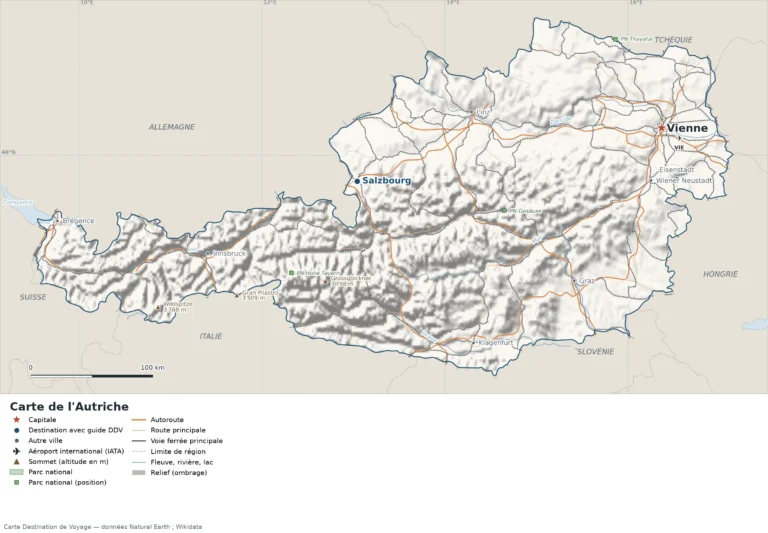
Read more: to choose your season, read the best time to visit Vienna and our Austria travel guide. Vienna combines by train with Budapest or Prague for a tour of Central European capitals.
Our sources
- Entry, health and safety information read on 26 October 2026: U.S. Department of State, Austria country information (travel.state.gov, last updated September 10, 2026), and UK FCDO, foreign travel advice for Austria (GOV.UK, updated 11 August 2026)
- Vienna climate normals: 1991-2020 normals for the Vienna-Innere Stadt station (city center), Central Institute for Meteorology and Geodynamics (ZAMG, now GeoSphere Austria)
- City Airport Train (cityairporttrain.com): home page and « Main Line Closure » page, checked 26 October 2026
- Our methodology
Updated October 2026.
To extend your trip, see our Austria travel guide, our guides to Budapest, Prague and Berlin, and our other destinations in Europe.