Visiting Bologna means discovering a large university city of red brick, lined with porticoes and famous for its food: tagliatelle al ragù, tortellini, mortadella. To visit Bologna is to see Piazza Maggiore and the Basilica of San Petronio, the two leaning towers, the Archiginnasio and its anatomical theatre, the Santo Stefano complex and the sanctuary of San Luca. This guide tells you what to do in Bologna in 2 or 3 days, when to go, where to stay and which day trips to plan in Emilia-Romagna.
Our travel deals for Bologna
Affiliate links: we earn a commission, at no extra cost to you.
Learn the languageTargumiLearn a few words of Italian before you go — 30% off via our link.
Time zoneUTC+1, UTC+2 in summer: 1 hour ahead of London, 6 hours ahead of New YorkLocal time now: –:–
AirportsBologna Guglielmo Marconi (BLQ), linked to the central station by the Marconi Express monorail
EntrySchengen area: no visa for up to 90 days for US citizens (tourism or business) and UK citizens (in any 180-day period) · US: travel.state.gov · UK: GOV.UK
Electricity220-volt system, according to the U.S. Department of State, which notes you may need a plug adapter · plugs
Ideal length2 to 3 days, 4 to 5 with Modena, Parma, Ravenna or Ferrara
The heart of the city, Piazza Maggiore is surrounded by Palazzo d’Accursio (the city hall, with state rooms and a municipal art collection), Palazzo del Podestà and the Basilica of San Petronio, one of the largest churches in Italy, whose façade was never finished. Inside, a meridian line traced on the floor in the 17th century by the astronomer Cassini marks solar noon. Right next door, the Fountain of Neptune, sculpted by Giambologna, is a popular meeting point.
The Two Towers (Asinelli and Garisenda)
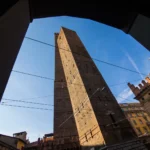
The symbols of Bologna, these leaning medieval towers are the survivors of dozens of towers built by noble families. The Garisenda, shorter and steeply tilted, is undergoing work to make it safe, and access to the Asinelli tower, which offered a view over the whole city, was suspended during this work. Check the official Bologna tourism website to see whether the climb has reopened before planning a visit. For a view from above, the San Petronio terrace and the Prendiparte tower are alternatives.
The porticoes of Bologna
The city has some 60 km (37 mi) of porticoes, added to the UNESCO World Heritage List in 2021. They let you walk sheltered from both rain and sun. The most spectacular leads to the sanctuary of the Madonna di San Luca, on a hill to the south-west: about 3.5 km (2 mi) of porticoes, with more than 600 arches, which take about an hour to climb on foot. A small tourist train also goes up to the sanctuary.
The Archiginnasio and the anatomical theatre
Bologna is home to what is often described as the oldest university in the Western world, founded in the late 11th century. The walls of the Archiginnasio palace, the university’s former seat, are covered with thousands of students’ coats of arms. Its wooden anatomical theatre, where dissections took place, is the room not to miss.
The Quadrilatero and the food
Just east of Piazza Maggiore, the lanes of the Quadrilatero form an old market that is still very much alive: delis, cheese shops, fresh pasta shops and stalls where you can eat a board of cured meats and Parmigiano. The covered Mercato delle Erbe completes the picture. This is the place to taste mortadella, tortellini in broth and tagliatelle al ragù (what is called « bolognese » elsewhere). A fresh pasta class is a popular activity.
Santo Stefano, the « seven churches »
On a triangular square, the Santo Stefano complex brings together several interlocking churches and chapels, some dating from the early Middle Ages, and a cloister. It is one of the most peaceful places in the centre. Don’t miss the Basilica of San Domenico either, with the saint’s tomb and early sculptures by Michelangelo.
The Pinacoteca Nazionale and the museums
In the university district, the Pinacoteca Nazionale displays Bolognese and Italian painting, including Raphael’s Ecstasy of Saint Cecilia and works by the Carracci and Guido Reni. The archaeological museum, the medieval museum and the music museum complete the offer.
The Via Piella window and the canals
Bologna once had a network of canals, now almost entirely covered. A small window in a wall on Via Piella offers a glimpse of one of them, the Canale delle Moline, between colourful façades. For a green break, head to the Giardini Margherita, the large park in the south of the city.
Day trips from Bologna
Modena: the cathedral and Piazza Grande (UNESCO), balsamic vinegar; about half an hour by train. The Ferrari museum in Maranello is nearby.
Parma: the baptistery, the cathedral, ham and Parmigiano; about an hour by train.
Ravenna: its UNESCO-listed Byzantine mosaics, just over an hour by train.
Ferrara: the Este castle and its Renaissance town, less than an hour by train.
Florence: about 40 minutes by high-speed train; see our Florence guide.
Itinerary: how many days in Bologna?
Bologna in 2 days
Day 1: Piazza Maggiore, San Petronio, the Fountain of Neptune, the Archiginnasio and anatomical theatre, lunch in the Quadrilatero, the Two Towers, Santo Stefano
Day 2: walk up to San Luca under the porticoes in the morning, Via Piella, the Pinacoteca Nazionale and the university district in the afternoon, dinner in the centre
Bologna and Emilia-Romagna in 5 days
Days 1 and 2: the itinerary above
Day 3: Modena, plus Maranello for Ferrari fans
Day 4: Parma, or a cooking class and a visit to a Parmigiano producer
The best times to visit Bologna are April-May and September-October. Afternoons reach 19 to 26 °C (66 to 79 °F), ideal for walking under the porticoes. Summer is very hot, with more than 31 °C (88 °F) in July and August on the Po plain. Winter is cold, close to 0 °C (32 °F) at night, with fog. The table uses the normals of the airport station, west of the city.
Month
Max
Min
Rain
Crowds
Prices
Verdict
January
7.2 °C (45 °F)
−0.5 °C (31 °F)
34 mm (1.3 in)
Low
Low
⚠️ Cold, fog possible
February
9.9 °C (50 °F)
0.4 °C (33 °F)
56 mm (2.2 in)
Low
Low
⚠️ Cold, quiet
March
15.1 °C (59 °F)
4.0 °C (39 °F)
50 mm (2.0 in)
Medium
Medium
⚠️ Cool spring
April
19.1 °C (66 °F)
7.8 °C (46 °F)
64 mm (2.5 in)
High (Easter, trade fairs)
High
✅ Mild, book early
May
23.9 °C (75 °F)
12.5 °C (54 °F)
61 mm (2.4 in)
High
High
✅ One of the best months
June
28.5 °C (83 °F)
16.8 °C (62 °F)
66 mm (2.6 in)
Medium
Medium
✅ Hot, pleasant evenings
July
31.4 °C (89 °F)
19.1 °C (66 °F)
32 mm (1.3 in)
Medium
Medium
⚠️ Very hot
August
31.3 °C (88 °F)
19.0 °C (66 °F)
35 mm (1.4 in)
Low
Low
❌ Heat, shops closed around the 15th
September
25.7 °C (78 °F)
14.6 °C (58 °F)
61 mm (2.4 in)
High
High
✅ Mild, students return
October
19.3 °C (67 °F)
10.5 °C (51 °F)
75 mm (3.0 in)
Medium (trade fairs)
Medium
✅ Pleasant, truffle season
November
12.6 °C (55 °F)
5.4 °C (42 °F)
77 mm (3.0 in)
Low
Low
⚠️ Wettest, grey
December
7.7 °C (46 °F)
0.5 °C (33 °F)
57 mm (2.2 in)
Medium (holidays)
Medium
⚠️ Cold, Christmas markets
Temperatures and precipitation: 1991-2020 normals for the Bologna Borgo Panigale station (Guglielmo Marconi airport), published by the statistics service of the Metropolitan City of Bologna (« I numeri di Bologna metropolitana »), via Wikipedia (article « Bologna »). Crowds and prices: estimate based on the tourist seasons and the BolognaFiere trade fair calendar.
Spring (March to May)
The most pleasant season: 15 °C (59 °F) in March, 24 °C (75 °F) in May. Showers are regular, but the porticoes cover most routes. Bologna hosts major trade fairs (BolognaFiere) that push up hotel prices: check the calendar before booking.
Summer (June to August)
June is still pleasant. July and August are hot and often muggy, with average maximums above 31 °C (88 °F). The U.S. State Department lists heatwaves among the most frequent weather events in Italy: sightsee early and enjoy the evenings. Around 15 August, many restaurants and shops close.
Autumn (September to November)
September is mild and the university city comes back to life. October and November are mushroom and truffle season in Emilia-Romagna, but also the wettest months. November is grey, quiet and cheap.
Winter (December to February)
Cold and damp, with maximums of 7 to 10 °C (45 to 50 °F) and frequent fog over the plain. Yet it is a good season for food (tortellini in broth, slow-cooked dishes) and museums, at low prices, outside the holidays.
When to go to Bologna depending on your plans
Plans
Best time
Sightseeing and walks
April-May, September-October
Food and seasonal produce
October-November
Combining with Florence or Venice
May-June, September
Tight budget
November, January-February (outside trade fairs)
Events in Bologna
When
Event
All year
BolognaFiere trade fairs: hotels in high demand during the major fairs
Summer
Open-air cinema in Piazza Maggiore, organised by the Cineteca di Bologna
4 October
Feast of San Petronio, the city’s patron saint
December
Christmas markets and lights in the centre
Dates vary from year to year: check the programme with the Bologna tourist office before booking.
Bologna month by month
January: The coldest month (7 °C, or 45 °F, in the afternoon), quiet museums, low prices.
February: Cold and often grey; good for food and museums.
March: 15 °C (59 °F) in the afternoon, the start of spring.
April: Mild (19 °C, or 66 °F), high demand at Easter.
May: 24 °C (75 °F): one of the best months.
June: Hot (28.5 °C, or 83 °F), long evenings.
July: The hottest month (31.4 °C, or 89 °F), open-air cinema.
August: Very hot; part of the city closes around the 15th.
September: Mild (25.7 °C, or 78 °F), the city fills up again.
October: Pleasant (19 °C, or 66 °F), truffle season, more rain.
November: The wettest month (77 mm, or 3.0 in), quiet.
Bologna is a little cheaper than Florence or Venice, except during the major trade fairs. Indicative amounts per person per day, excluding travel to Bologna:
Item
Budget
Comfort
Accommodation (based on a shared double room)
roughly €35 to 55
roughly €80 to 150
Meals
roughly €20 to 30
roughly €45 to 75
Transport (bus, regional train)
roughly €3 to 6
roughly €6 to 15
Sightseeing
roughly €5 to 15
roughly €15 to 30
Total
roughly €70 to 110 per person per day
roughly €150 to 260 per person per day
Indicative estimates that vary with the season. According to the UK FCDO (GOV.UK, updated 21 October 2026), many major Italian cities charge a tourist tax, usually paid at the hotel and often in cash, on top of the room rate.
To save money: many sights are free (Piazza Maggiore, San Petronio, Santo Stefano, the walk up to San Luca), and a board of cured meats and cheese in the Quadrilatero makes a full meal.
Getting there and getting around Bologna
Bologna Guglielmo Marconi Airport (BLQ) is served by European airlines; from further afield, most travellers connect via a European hub or arrive by train from Milan, Venice, Florence or Rome. According to the official Marconi Express site (checked 26 October 2026), the monorail links the airport to the central station in about 7 minutes, from 5:40 am to midnight, for a standard single fare of €12.80; at night, Tper bus line Q takes over.
On foot: the historic centre is compact and almost entirely covered by porticoes.
Bus: the urban network serves the centre and the hills; part of the centre is closed to cars. GOV.UK and the State Department point out that tickets bought from a kiosk or machine must be validated before travelling, or you risk an on-the-spot fine.
Bike: the centre is flat; bike sharing is available.
Train: the central station is a major hub of the high-speed network (Florence, Milan, Venice, Rome) and of regional trains (Modena, Parma, Ravenna, Ferrara).
Car: unnecessary in the city. According to GOV.UK, many historic centres are restricted traffic zones (ZTL, marked in black on a yellow background) monitored by cameras, and you will be fined if you enter without a pass.
Where to stay in Bologna
Historic centre (Piazza Maggiore, Quadrilatero): everything on foot; the most expensive.
University district (Via Zamboni): lively and young, cheaper, noisy in the evening.
Santo Stefano: elegant and quiet, a stone’s throw from the centre.
Near the central station: convenient for train day trips and the airport, a 15-minute walk from Piazza Maggiore.
Bolognina: north of the station, more working-class and cheaper.
During the major BolognaFiere trade fairs, book early or shift your dates: prices can rise sharply.
Entry requirements, health and safety
US citizens: Italy is in the Schengen area. You may enter for up to 90 days for tourism or business without a visa; your passport must be valid at least 3 months beyond your stay, and you need proof of sufficient funds and a return ticket. A passport that has ever been reported lost or stolen may be refused (U.S. Department of State, travel.state.gov, last updated August 11, 2025).
UK citizens: no visa for up to 90 days in any 180-day period as a tourist. Your passport must have been issued less than 10 years before the day you arrive and be valid at least 3 months after the day you plan to leave the Schengen area; you may be asked for proof of accommodation, a return ticket and sufficient funds. The EU Entry/Exit System (EES) is being implemented: fingerprints and a photo may be taken at your first entry, free of charge (UK FCDO, GOV.UK, updated 21 October 2026).
ID: under Italian law, police can stop you at any time for an identity check: carry photo ID at all times (GOV.UK).
Health: UK travellers can use a GHIC or EHIC for medically necessary state healthcare (GOV.UK); travel.state.gov advises being up to date on CDC-recommended vaccinations and recommends insurance covering medical evacuation. GOV.UK lists dengue, biting insects and ticks, and West Nile disease among the health risks.
Theft: crime levels are generally low, but bag-snatching and pickpocketing are more common in city centres, at major tourist attractions and on public transport (GOV.UK); the State Department notes that break-ins of rented vehicles are common, so never leave luggage in a parked car.
Natural hazards: GOV.UK notes that many parts of Italy lie on a major seismic fault line, that heavy winter rain can cause local flooding and that wildfires are a risk in the extended summer months; follow the advice of the local authorities.
Emergencies: 112 (police), 118 (ambulance), 115 (fire), according to GOV.UK; the State Department gives 112 for all emergencies.
At the table: no « spaghetti bolognese » here: ragù is served with tagliatelle. Tortellini are traditionally eaten in broth.
Aperitivo: in the early evening, a drink often comes with small plates.
Cover charge: the « coperto » is often added to the bill at restaurants.
Money: to avoid skimming devices, the State Department advises using ATMs in well-lit public areas or inside a bank.
Mobile data: check your home carrier’s roaming charges before you leave; an eSIM is a simple way to get local data.
Frequently asked questions
How many days do you need to visit Bologna?
Two days are enough for the centre, the porticoes and San Luca. Allow four to five days to add Modena, Parma, Ravenna or Ferrara by train.
What is the best time to visit Bologna?
April-May and September-October: 19 to 26 °C (66 to 79 °F) in the afternoon according to the airport station normals. July and August exceed 31 °C (88 °F) and winter is cold.
Can you climb the Asinelli tower?
Access was suspended during the work to make the neighbouring Garisenda tower safe. Check the situation on the official Bologna tourism website before your visit.
How do you get from Bologna airport to the centre?
The Marconi Express monorail links the airport to the central station in about 7 minutes; the historic centre is then reachable on foot or by bus.
Florence or Bologna: which should you choose?
Florence has more museums and Renaissance masterpieces; Bologna is livelier day to day and more affordable. The two cities are about 40 minutes apart by train: you can stay in Bologna and visit Florence as a day trip.
Our sources
Climate normals: 1991-2020 normals for the Bologna Borgo Panigale station (Guglielmo Marconi airport), published by the statistics service of the Metropolitan City of Bologna (« I numeri di Bologna metropolitana »), via Wikipedia (article « Bologna »)


 Learn the languageTargumiLearn a few words of Italian before you go — 30% off via our link.See the course