Visiting Florence means exploring the cradle of the Renaissance on foot: the Duomo and its dome, the Uffizi, Michelangelo’s David, the Ponte Vecchio and the Boboli Gardens. The historic centre, a UNESCO World Heritage Site, is compact but very busy. This guide helps you choose what to see, book what needs booking, and find the right season and the right neighbourhood for a stay of 2 to 5 days.

Our travel deals for Florence
Affiliate links: we earn a commission, at no extra cost to you.
 Learn the languageTargumiLearn a few words of Italian before you go — 30% off via our link.See the course
- FlightsKiwi.comCompare flights and airline combinations to Florence.Compare flights
- Airport transferKiwitaxiPrivate driver booked in advance at a fixed price.Book a transfer



Florence at a glance
- Region Tuscany, in central Italy
- Language Italian. To learn a few words before you go, try Targumi’s online Italian lessons with native teachers (30% off via our link).
- Currency euro (€) · currencies
- Time zone UTC+1, UTC+2 in summer (Europe/Rome)1 hour ahead of London, 6 hours ahead of New York most of the yearLocal time now: –:–
- Airports Florence Peretola (Amerigo Vespucci)Pisa airport, about an hour away, has more low-cost flights
- Entry Schengen area: no visa for up to 90 days for US citizens (tourism or business) and UK citizens (in any 180-day period) · travel.state.gov · GOV.UKPassport valid at least 3 months beyond your stay (US) or after leaving the Schengen area (UK)
- Electricity 220-volt system, according to the U.S. Department of State · plugsCheck that your devices accept it; you may need a plug adapter
- Ideal length 2 to 3 days for the city4 to 5 with Siena, Pisa or the Chianti
- Best time April-May and late September-October
- Budget see our budget section
Things to do in Florence: the must-sees
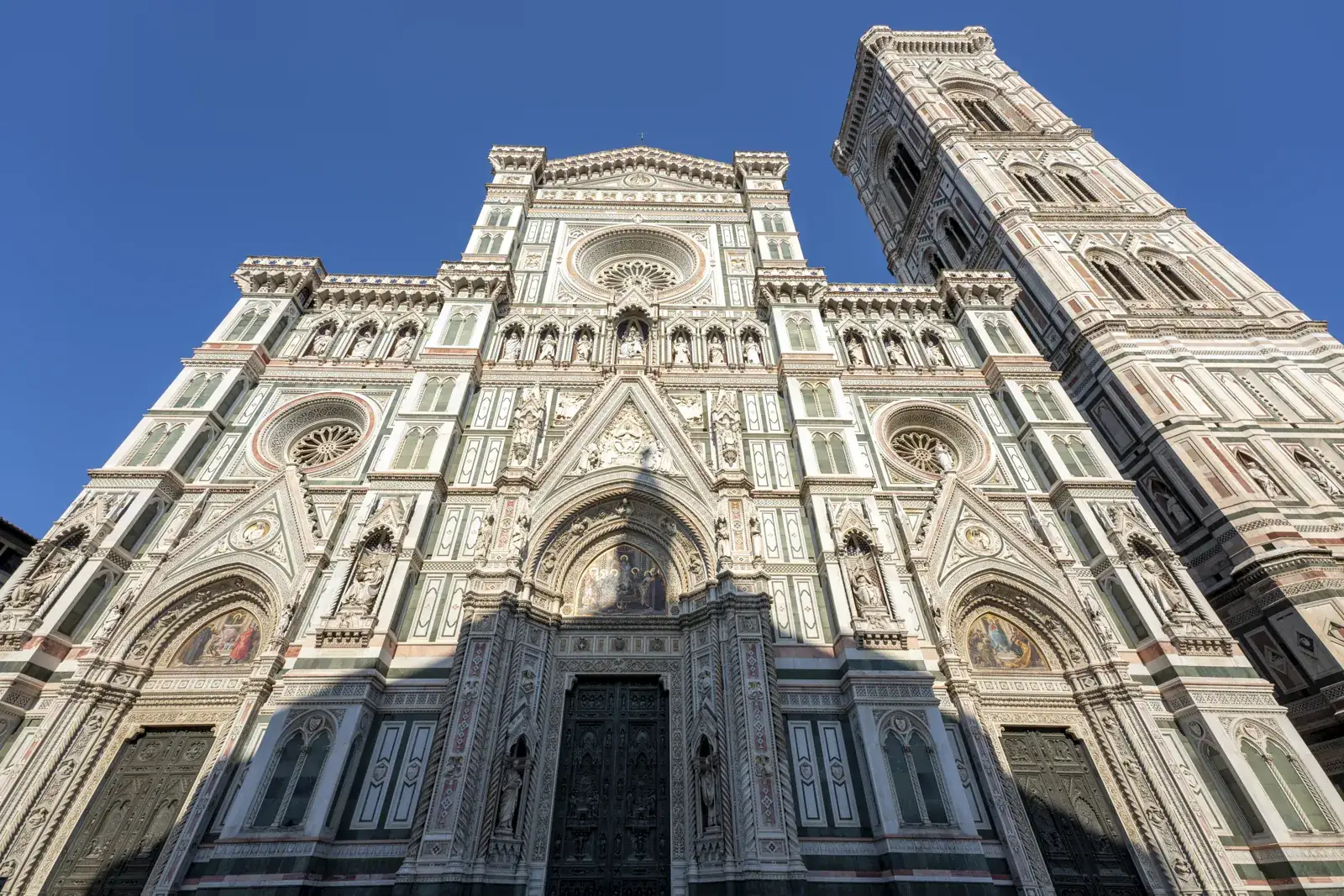
The Duomo, the bell tower and the Baptistery
The cathedral of Santa Maria del Fiore and Brunelleschi’s dome dominate the city. The complex includes Giotto’s bell tower, the Baptistery of St John with its bronze doors, the crypt and the Opera del Duomo museum. Entry to the cathedral is free, but the climb up the dome requires a ticket and a time slot booked in advance; it has more than 400 steps and no lift. The bell tower gives you a view of the dome itself.
The Uffizi Gallery
The Uffizi holds one of the most important collections of Renaissance painting: Botticelli (The Birth of Venus, Primavera), Leonardo da Vinci, Raphael, Michelangelo, Caravaggio. Book an entry time to skip the queue, allow at least three hours and check closing days before planning. If you only have time for one city, our Rome or Florence comparison will help you decide.
The Accademia Gallery and the David
The Galleria dell’Accademia is visited mainly for Michelangelo’s David, the original, on display here since the 19th century (copies stand in Piazza della Signoria and Piazzale Michelangelo). The visit is short, but the queue can be long without a booking.
Piazza della Signoria and Palazzo Vecchio
Palazzo Vecchio, the former seat of power, is open to visitors (Hall of the Five Hundred, apartments) and its tower offers a panorama over the city. The Loggia dei Lanzi, on the square, shelters open-air statues, including Cellini’s Perseus. It is the natural starting point for the Uffizi and the river.
The Ponte Vecchio and the Oltrarno
Florence’s oldest bridge has been lined with jewellers’ shops for centuries. Across the Arno, the Oltrarno is a district of artisans, trattorias and quieter squares, around Santo Spirito and San Frediano. It is often where you eat best at reasonable prices.
Palazzo Pitti and the Boboli Gardens
The former residence of the Medici and later of the rulers of Tuscany houses several museums, including the Palatine Gallery. Behind it, the terraced Boboli Gardens offer statues, grottoes and viewpoints. Allow half a day and wear good shoes.
Santa Croce, San Lorenzo and Santa Maria Novella
The basilica of Santa Croce holds the tombs of Michelangelo, Galileo and Machiavelli. San Lorenzo is the Medici church, with the Medici Chapels and Michelangelo’s sacristy. Santa Maria Novella, near the station, has major frescoes. Close to San Lorenzo, the Central Market sells Tuscan produce and has food counters.
Piazzale Michelangelo and San Miniato
This large terrace on the south bank offers the best-known view of Florence and is very busy at sunset. A little higher up, the Romanesque church of San Miniato al Monte is quieter and the view just as fine. Allow about 20 minutes’ walk uphill from the Oltrarno, or take a bus.
Day trips from Florence
- Fiesole: a small town in the hills to the north, with a Roman theatre and a view of Florence; reachable by bus.
- Pisa: the Piazza dei Miracoli and the Leaning Tower, about an hour by regional train.
- Siena: the Piazza del Campo and the cathedral; by bus or train, about 1 h 30.
- Lucca: a walled town you can explore by bike, about 1 h 30 by train.
- The Chianti, San Gimignano and the Val d’Orcia: easier by car or on an organised tour; see our Tuscany guide.
How many days in Florence? Itinerary ideas
Florence in 2 days
- Day 1: the Duomo and dome (booked), the Baptistery, Piazza della Signoria, the Uffizi in the afternoon, the Ponte Vecchio at sunset
- Day 2: the Accademia at opening time, San Lorenzo and the Central Market, the Oltrarno, Palazzo Pitti or Boboli, Piazzale Michelangelo
Florence and Tuscany in 4 to 5 days
- Days 1 and 2: the itinerary above
- Day 3: Santa Croce, Palazzo Vecchio and its tower, Santa Maria Novella, Fiesole at the end of the day
- Day 4: Siena, or Pisa and Lucca
- Day 5: the Chianti and San Gimignano by car or on a tour
Florence combines easily with Rome (about 1 h 30 by high-speed train) and Venice (about 2 h).
When to go to Florence: best time and climate
The best time to visit Florence is from April to early June and from mid-September to October. Afternoons reach 20 to 27 °C (68 to 81 °F), ideal for walking. Florence, in a basin far from the sea, is very hot in summer: over 32 °C (90 °F) on average in July and August. Winter is cool (11 °C, or 52 °F, in the afternoon, close to 2 °C, or 36 °F, at night) but quiet. October and November are the wettest months. The table uses the official normals for the Peretola airport station.
| Month | High °C (°F) | Low °C (°F) | Rain mm (in) | Crowds | Prices | Verdict |
|---|---|---|---|---|---|---|
| January | 11.2 (52) | 2.1 (36) | 58 (2.3) | Low (Pitti fair) | Low | ⚠️ Cold at night, museums without crowds |
| February | 12.7 (55) | 2.5 (36) | 64 (2.5) | Low | Low | ⚠️ Cool, low prices |
| March | 16.2 (61) | 5.1 (41) | 61 (2.4) | Medium | Medium | ⚠️ Early spring, cool |
| April | 20.0 (68) | 8.1 (47) | 67 (2.6) | High (Easter) | High | ✅ Mild, ideal for walking |
| May | 24.3 (76) | 11.9 (53) | 63 (2.5) | High | High | ✅ One of the best months |
| June | 29.1 (84) | 16.0 (61) | 45 (1.8) | Very high | Very high | ⚠️ Hot and very busy |
| July | 32.3 (90) | 18.4 (65) | 25 (1.0) | Very high | Very high | ❌ Intense heat in the city |
| August | 32.4 (90) | 18.5 (65) | 37 (1.5) | High | High | ❌ The hottest, some shops closed |
| September | 27.3 (81) | 15.0 (59) | 67 (2.6) | Very high | Very high | ✅ Hot, then pleasant at the end of the month |
| October | 21.5 (71) | 10.9 (52) | 105 (4.1) | High | High | ✅ Mild, a few rainy days |
| November | 15.6 (60) | 6.4 (44) | 115 (4.5) | Low | Low | ⚠️ The wettest month |
| December | 11.4 (53) | 2.6 (37) | 81 (3.2) | Medium (holidays) | Medium | ⚠️ Cool, Christmas atmosphere |
According to the same normals, Florence has about 10 rainy days in November, compared with 3 in July. Winter nights can be close to 0 °C (32 °F).
Spring (March to May)
The ideal season for walking: 16 °C (61 °F) in March, 24 °C (75 °F) in May. The Boboli Gardens and the rose garden below Piazzale Michelangelo are in bloom. The downside is the crowds: Easter, the 25 April and 1 May public holidays and school trips fill the city. Book museums and hotels early.
Summer (June to August)
June is already hot (29 °C, or 84 °F); July and August average over 32 °C (90 °F), with much higher peaks during heatwaves. Queuing in the sun is exhausting: visit early and take a break in the afternoon. Around 15 August, some shops and family-run restaurants close.
Autumn (September to November)
September is still hot and very busy, but the second half becomes pleasant. October is mild (21.5 °C, or 71 °F) with the return of rain, and it is grape-harvest season in the Chianti. November is the wettest month; GOV.UK notes that heavy rainfall is common throughout Italy in winter and can cause local flooding.
Winter (December to February)
Afternoons reach 11 to 13 °C (52 to 55 °F) and nights are cold. It is the best season to see the Uffizi or the Accademia without queuing and to find cheaper hotels, except during the holidays and the fashion trade fairs (Pitti Uomo in January and June), which push prices up.
When to go to Florence depending on your plans
| Plan | Best time |
|---|---|
| Museums without crowds | November to February, outside the holidays |
| Walks and gardens | April-May, October |
| Tuscany and the Chianti | May-June, September-October (grape harvest) |
| Traditional festivals | Easter, June (St John) |
| Tight budget | January to March, November |
Major events in Florence
| Date | Event |
|---|---|
| Easter Sunday | Scoppio del Carro: a cart loaded with fireworks is set off in front of the Duomo |
| June | Calcio storico, a football tournament in historical costume on Piazza Santa Croce |
| 24 June | St John (San Giovanni), feast of the city’s patron saint |
| January and June | Pitti Uomo fashion fairs (hotels in high demand) |
| December | Christmas lights and markets |
Florence month by month
January: cold at night (2 °C, or 36 °F), 11 °C (52 °F) in the afternoon. Museums are quiet, except during the Pitti fair.
February: cool and fairly dry. Prices among the lowest of the year.
March: 16 °C (61 °F) in the afternoon. A good month to visit before Easter.
April: mild (20 °C, or 68 °F). Easter and the Scoppio del Carro: book early.
May: one of the best months (24 °C, or 75 °F), but very busy.
June: hot (29 °C, or 84 °F), calcio storico and St John’s Day on the 24th.
July: over 32 °C (90 °F) on average. Visit at opening time.
August: the hottest month (32.4 °C, or 90 °F). Fewer groups, but some shops closed.
September: hot at first, pleasant afterwards. Still in high demand.
October: mild (21.5 °C, or 71 °F), more rain. Grape harvest in the Chianti.
November: the wettest month (115 mm, or 4.5 in). Quiet and inexpensive.
December: cool (11 °C, or 52 °F), Christmas lights.
To get out of the city, see when to go to Tuscany and, for the rest of the country, when to go to Italy.
Budget for a stay in Florence
Florence is an expensive city for accommodation, especially in spring and summer. Indicative amounts per person per day, excluding flights:
| Item | Budget | Comfort |
|---|---|---|
| Accommodation (sharing a double room) | roughly €35 to €60 | roughly €90 to €170 |
| Meals | roughly €25 to €35 | roughly €50 to €90 |
| Transport (bus, tram) | roughly €0 to €5 | roughly €5 to €15 |
| Sightseeing | roughly €15 to €30 | roughly €35 to €50 |
| Total per day | roughly €75 to €130 per person per day | roughly €180 to €320 per person per day |
To save money: have lunch at the Central Market or grab a lampredotto or porchetta sandwich, eat dinner in the Oltrarno rather than around the Duomo, and enjoy the free churches and squares.
Getting to Florence and getting around
Florence Peretola airport (Amerigo Vespucci) is linked to Santa Maria Novella station by tram. Pisa airport, better served by low-cost airlines, is about an hour away by train or shuttle. Florence is also well connected by high-speed train from Milan, Rome and Venice (see our tips for travelling by train). If you arrive from Rome by high-speed train, you can combine the two cities by aiming for the best time to visit Rome.
- On foot: the centre can be explored entirely on foot; it is the most practical way to get around.
- Tram and bus: useful for the airport, the station and Piazzale Michelangelo.
- Bike: handy along the Arno and towards the Cascine park, less so in the cobbled lanes.
- Car: pointless in the city; the centre is a limited traffic zone (ZTL) with cameras and fines. Rent a car when you leave the city for Tuscany instead.
- Regional train: for Pisa, Lucca, Siena and Arezzo.
Florence airport transfer: tram, taxi and private transfer
From Florence Peretola airport (Amerigo Vespucci), tram line T2 runs to Santa Maria Novella station on a €2.00 city ticket valid for 90 minutes; taxis charge a flat fare set by the City of Florence for the centre.
Tram T2
Autolinee Toscane’s « Urbano capoluogo Firenze » ticket costs €2.00 and is valid for 90 minutes from validation, on the tram and city buses. Autolinee Toscane also sells a book of 10 tickets (€18.20); a ticket bought from a bus driver costs €3.00 (official prices checked 24 October 2026). Tram T2 links the airport with the centre (Unità stop, near the station). Buy and validate your ticket yourself, without accepting unsolicited help at the machine; GOV.UK notes that inspectors issue on-the-spot fines for unvalidated tickets.
Taxi: the airport flat fare
The City of Florence sets a flat taxi fare between the airport and the central zone (different amounts on weekdays, public holidays and at night, plus supplements): check the current table on the City’s website; the list of flat fares must be displayed in the taxi, so check it before setting off.
What about Pisa airport?
Many low-cost flights arrive in Pisa. From Pisa, you continue to Florence by train or shuttle: check timetables and fares with Trenitalia or the shuttle operator before booking a flight.
| Option | Where to catch it | Official fare | Source |
|---|---|---|---|
| Tram T2 | Airport tram stop | €2.00 (90 min) | Autolinee Toscane |
| Taxi (central zone flat fare) | Airport taxi rank | €28 weekdays, €30 public holidays, €32 at night + supplements | City of Florence (table of 1 May 2024) |
| Private transfer | Provider’s meeting point | Price fixed when booking | – |
Booking a private transfer in Florence
A private transfer (a driver waiting for you on arrival, price agreed when booking) makes most sense if you arrive late in the evening, as a family or group, with lots of luggage, or if your accommodation is poorly served by public transport. It is also the simplest option from Pisa airport if there are several of you. Before booking, check what the price includes (luggage, child seats, tolls, night supplements), the free waiting time if your flight is delayed, flight tracking, the exact meeting point in the terminal and the cancellation terms.
Sources: Autolinee Toscane, « Biglietti e abbonamenti » and « Ticket » pages; City of Florence, « Tariffe taxi » table (updated 1 May 2024) (checked 24 October 2026).
Where to stay in Florence
- Around the Duomo and the Signoria: everything within walking distance, but high prices and very crowded streets.
- Santa Croce: central and lively, with plenty of restaurants.
- Oltrarno (Santo Spirito, San Frediano): quieter and more authentic, close to Pitti and Boboli.
- San Lorenzo and Santa Maria Novella: handy for the station and often cheaper, but noisier.
- The hills (Fiesole, Bellosguardo): peace and views, but you need a bus or a car.
Check for air conditioning (essential from June to September), a lift, and car access if you have one (ZTL). For spring, summer and trade fairs, book 2 to 4 months ahead.
Entry requirements, health and safety
- US citizens: Italy is in the Schengen area. You may enter for up to 90 days for tourism or business without a visa; your passport must be valid at least 3 months beyond your stay, and you need proof of sufficient funds and a return ticket (U.S. Department of State, travel.state.gov, last updated August 11, 2025).
- UK citizens: no visa for up to 90 days in any 180-day period as a tourist. Your passport must have been issued less than 10 years before the day you arrive and be valid at least 3 months after the day you plan to leave the Schengen area. The EU Entry/Exit System (EES) is being implemented: fingerprints and a photo may be taken at your first entry, free of charge (UK FCDO, GOV.UK, updated 21 October 2026).
- ID: under Italian law, police can stop you at any time for an identity check: carry photo ID at all times (GOV.UK).
- Health: UK travellers can use a GHIC or EHIC for medically necessary state healthcare (GOV.UK); travel.state.gov advises being up to date on CDC-recommended vaccinations and recommends insurance that covers medical evacuation.
- Theft: crime levels are generally low, but bag-snatching and pickpocketing are more common in city centres, at major tourist attractions and on public transport (GOV.UK); the State Department notes that break-ins of rented vehicles are common, so never leave luggage in a parked car.
- Heat: drink plenty of water in summer; the State Department lists heatwaves among Italy’s most frequent weather events. GOV.UK lists dengue, biting insects and West Nile disease among the health risks in Italy.
- In Florence: stay alert on the tram, at the station and in the crowds at the main sights, and buy your tram ticket yourself at the machine. It is an offence to enter or bathe in public fountains in Florence (GOV.UK).
- Tickets: if you buy a bus or train ticket from a kiosk or machine, validate it before you start your journey; inspectors issue on-the-spot fines (GOV.UK).
- Emergencies: 112 (police), 118 (ambulance), 115 (fire), according to GOV.UK; the State Department gives 112 for all emergencies.
For cancellation, theft or repatriation cover, see our travel insurance guide.
Practical tips for Florence
- Bookings: the Duomo dome, the Uffizi, the Accademia: book several days, or even weeks, ahead in high season. A combined pass can be useful if you visit several museums: compare it with the price of separate tickets.
- Places of worship: cover shoulders and knees in churches; there are checks at the Duomo entrance.
- Meals: bistecca alla fiorentina is ordered by weight; a cover charge (« coperto ») is often added.
- Money: cards are accepted almost everywhere; use ATMs in well-lit public areas or inside a bank (travel.state.gov).
- Mobile data: check your home carrier’s roaming charges before you leave; an eSIM is a simple way to get local data.
- Short break: Florence works well for a long weekend; see our cheap weekend ideas.
Who is Florence for?
- Art and history lovers: yes, it is the reason to go: the Uffizi, Michelangelo’s David, Brunelleschi’s dome, Palazzo Pitti. Book time slots in advance.
- Couples: yes: sunset at Piazzale Michelangelo or San Miniato, dinners in the Oltrarno, trips into the Chianti.
- Short breaks: ideal: two full days are enough for the essentials.
- Tight budget: so-so: roughly €75 to €130 per person per day, as accommodation is expensive in spring and summer; the Central Market and the Oltrarno help you save.
- Summer: less pleasant: over 32 °C (90 °F) on average in July and August and exhausting queues in the sun; prefer April-May or mid-September to October.
- Road trips: a car is pointless in the city because of the limited traffic zone; rent one when you leave for Tuscany instead.
Further reading
To choose your dates, see when to go to Italy and, if you are heading into the countryside, when to go to Tuscany. Florence also works well for a long weekend: see our cheap weekend ideas.
Frequently asked questions
How many days do you need to visit Florence?
Two full days are enough for the Duomo, the Uffizi, the Accademia, the Ponte Vecchio and the Oltrarno. Allow three days to add Pitti, Boboli and Santa Croce, four or five with Siena, Pisa or the Chianti.
When is the best time to visit Florence?
April-May and mid-September to October: 20 to 27 °C (68 to 81 °F) in the afternoon according to the Florence Peretola normals. July and August average over 32 °C (90 °F).
Do you need to book the Duomo dome?
Yes: the climb up the dome requires a ticket and a time slot chosen in advance, often sold out several days ahead in high season.
Which airport should you choose for Florence?
Florence Peretola is the closest, linked to the centre by tram. Pisa is about an hour away and often has more low-cost flights.
Is Florence safe?
Yes: according to GOV.UK, crime levels in Italy are generally low, but bag-snatching and pickpocketing are more common in city centres and at major tourist attractions. Watch your belongings on the tram, at the station and in crowds at the sights.
Our sources
- Climate normals: WMO 1991-2020 climate normals for the Florence Peretola (airport) station, published by NOAA (National Oceanic and Atmospheric Administration)
- Autolinee Toscane, « Biglietti e abbonamenti » and « Ticket » pages; City of Florence, « Tariffe taxi » table (updated 1 May 2024), checked 24 October 2026
- Entry requirements, health and safety checked on 26 October 2026: U.S. Department of State, Italy country information (last updated August 11, 2025) and UK FCDO, GOV.UK foreign travel advice for Italy (updated 21 October 2026)
- Our methodology
Updated October 2026.
To continue your trip, see our Italy travel guide, our guides to Tuscany, Rome and Venice, and our other destinations in Europe.