Visiting Milan means seeing much more than a capital of fashion and business: the Duomo and its marble terraces, Leonardo da Vinci’s Last Supper, La Scala, the Sforza Castle, the Brera art gallery and the Navigli canals. The city is well explored in 2 or 3 days and serves as a gateway to the Italian lakes. This guide tells you what to do in Milan, what to book, when to go and where to stay. From Milan, another northern city is a short train ride away: our guide to visiting Bologna covers its centre, porticoes and food.

Our travel deals for Milan
Affiliate links: we earn a commission, at no extra cost to you.
 FlightsKiwi.comCompare flights and airline combinations to Milan.Compare flights
- Airport transferKiwitaxiPrivate driver booked in advance at a fixed price.Book a transfer


Milan at a glance
- Region Lombardy, in northern Italy
- Language Italian
- Currency euro (€) · currencies
- Time zone UTC+1, UTC+2 in summer (Europe/Rome)1 hour ahead of London, 6 hours ahead of New York most of the year
- Airports Milan Linate and Milan MalpensaLinate is linked to the centre by metro M4, Malpensa by the Malpensa Express train
- Entry Schengen area: no visa for up to 90 days for US citizens (tourism or business) and UK citizens (in any 180-day period) · travel.state.gov · GOV.UKPassport valid at least 3 months beyond your stay (US) or after leaving the Schengen area (UK)
- Electricity 220-volt system, according to the U.S. Department of State · plugsCheck that your devices accept it; you may need a plug adapter
- Ideal length 2 to 3 days, 4 to 5 with Lake Como or Bergamo
- Best time April-May and September-October
- Budget see our budget section
Things to do in Milan: the must-sees
The Duomo and its terraces
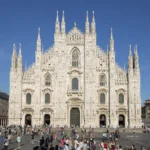
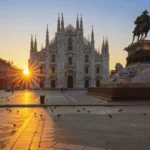
Milan Cathedral, begun in the late 14th century and completed in the 19th, is the symbol of the city. The interior can be visited with a ticket, as can the Duomo museum and the archaeological area. The highlight is the climb to the terraces, on foot or by lift, among the spires and statues, with views over the city and, on clear days, the Alps. Wear clothing that covers shoulders and knees: checks at the entrance are strict.
For the cathedral and its roofs, our guide Milan Duomo: terrace tickets and opening hours compares stairs and lift and tells you when to watch the sunset from the top.
Galleria Vittorio Emanuele II and La Scala
Right next to the Duomo, the Galleria Vittorio Emanuele II, a 19th-century glass-and-iron covered arcade, houses historic cafés and luxury shops. It leads onto Piazza della Scala and its opera house. If you cannot attend a performance, the theatre museum often lets you look into the auditorium from a box, depending on rehearsals.
Leonardo da Vinci’s Last Supper
The Last Supper fresco covers a wall of the refectory of the convent of Santa Maria delle Grazie. Visits are in small groups, for a limited time, and by reservation only. Tickets sell out very quickly: book as soon as sales open on the official website or join a guided tour. This is the visit to fix first in your plans.
The Sforza Castle and Parco Sempione
This brick fortress, residence of the Dukes of Milan, houses several municipal museums, including the one displaying the Rondanini Pietà, Michelangelo’s last work. The courtyards are free to enter. Behind it, Parco Sempione stretches to the Arch of Peace, a pleasant place for a break.
Brera and its art gallery
The Brera district, with its cobbled streets and ochre façades, is one of the most pleasant parts of the centre to stroll and dine. Its art gallery (Pinacoteca) holds a large collection of Italian painting: Mantegna (the Lamentation over the Dead Christ), Raphael (the Marriage of the Virgin), Piero della Francesca, Caravaggio.
The Navigli
The two canals still open to the sky, the Naviglio Grande and the Naviglio Pavese, are a reminder that Milan was once linked by water. The district is lively in the early evening, at aperitivo time, when a drink comes with small plates. The Naviglio Grande hosts an antiques market on some Sundays.
Sant’Ambrogio, San Lorenzo and the churches
The Lombard Romanesque basilica of Sant’Ambrogio is dedicated to the city’s patron saint. Nearby, the Roman columns of San Lorenzo are a meeting place in the evening. Two churches are surprising: San Maurizio al Monastero Maggiore, entirely covered in frescoes, and Santa Maria presso San Satiro, with its trompe-l’œil false choir.
Contemporary Milan
North of the centre, the Porta Nuova district and its towers, including the tree-covered Bosco Verticale, show today’s city. Football fans visit San Siro stadium; the curious head for the Monumental Cemetery, an open-air sculpture museum, or the Leonardo da Vinci National Museum of Science and Technology.
Day trips from Milan
- Lake Como: Como is less than an hour by train, Varenna and Bellagio a little further; see our Lake Como guide.
- Bergamo: the upper town, surrounded by Venetian walls, is about an hour by train.
- Lake Maggiore: Stresa and the Borromean Islands, by train from Milan.
- Pavia: its Certosa (charterhouse) and historic centre, about half an hour by train.
- Verona: about 1 h 15 by high-speed train.
How many days in Milan? Itinerary ideas
Milan in 2 days
- Day 1: the Duomo and terraces early in the morning, Galleria Vittorio Emanuele II, La Scala, Brera and its art gallery in the afternoon, dinner in Brera
- Day 2: the Last Supper (booked slot), Sant’Ambrogio, the Sforza Castle and Parco Sempione, aperitivo in the Navigli
Milan and the lakes in 4 to 5 days
- Days 1 and 2: the itinerary above
- Day 3: San Maurizio, the San Lorenzo columns, Porta Nuova and the Bosco Verticale, the Monumental Cemetery or San Siro
- Day 4: Lake Como (Como, then boat to Bellagio and Varenna)
- Day 5: Bergamo, or Lake Maggiore and the Borromean Islands
Milan combines easily by train with Venice (about 2 h 30) and Florence (about 2 h). Another big northern city, Turin, is covered on our page things to do in Turin.
When to go to Milan: best time and climate
The best time to visit Milan is from April to early June and from September to mid-October. Afternoons reach 19 to 25 °C (66 to 77 °F), ideal for walking. Summer is hot and humid (nearly 31 °C, or 87 °F, in July), winter is cold, with nights close to 0 °C (32 °F) and sometimes fog. November is the wettest month. The table uses the official normals for the Linate station, east of the city.
| Month | High °C (°F) | Low °C (°F) | Rain mm (in) | Crowds | Prices | Verdict |
|---|---|---|---|---|---|---|
| January | 7.3 (45) | -0.4 (31) | 36 (1.4) | Low | Low | ⚠️ Cold, possible fog, sales |
| February | 10.0 (50) | 0.6 (33) | 38 (1.5) | Medium (Fashion Week) | Medium | ⚠️ Cold, high prices during fashion week |
| March | 15.5 (60) | 4.4 (40) | 42 (1.7) | Medium | Medium | ⚠️ Early spring, cool in the evening |
| April | 19.3 (67) | 8.4 (47) | 58 (2.3) | High (Salone del Mobile) | Very high | ✅ Mild, book early |
| May | 23.9 (75) | 12.8 (55) | 70 (2.8) | High | High | ✅ One of the best months |
| June | 28.1 (83) | 17.2 (63) | 67 (2.6) | High | High | ✅ Hot but pleasant in the evening |
| July | 30.7 (87) | 19.3 (67) | 44 (1.7) | Medium | Medium | ⚠️ Hot and humid |
| August | 29.9 (86) | 18.8 (66) | 82 (3.2) | Low | Low | ❌ Heat, city partly closed |
| September | 25.5 (78) | 14.9 (59) | 73 (2.9) | High (Fashion Week) | High | ✅ Mild, the city comes back to life |
| October | 19.0 (66) | 10.2 (50) | 82 (3.2) | Medium | Medium | ✅ Pleasant, more rain |
| November | 12.4 (54) | 5.3 (42) | 112 (4.4) | Low | Low | ❌ The wettest month |
| December | 7.4 (45) | 0.6 (33) | 46 (1.8) | Medium (holidays) | Medium | ⚠️ Cold, Christmas atmosphere |
Spring (March to May)
The most pleasant season: 15 °C (60 °F) in March, 24 °C (75 °F) in May, with a few showers. Watch out for Salone del Mobile week (the international design fair, in April): hotels are snapped up and prices soar. Check its dates before booking.
Summer (June to August)
June is still pleasant. July and August are hot and humid, with late-day thunderstorms (August is one of the wettest months). Around 15 August, many Milanese go on holiday: some restaurants and shops close, but hotels lower their prices.
Autumn (September to November)
September is mild and the city comes back to life, with fashion week. October stays pleasant (19 °C, or 66 °F). Grey, rainy November is the least attractive month, but the quietest.
Winter (December to February)
Afternoons reach 7 to 10 °C (45 to 50 °F) and nights are close to 0 °C (32 °F). Fog can settle over the Po plain. On the plus side, winter is opera season at La Scala (the season traditionally opens on 7 December, the feast of St Ambrose), with Christmas lights and the January sales.
When to go to Milan depending on your plans
| Plan | Best time |
|---|---|
| Sightseeing and walks | April-June, September-October |
| Combining with the lakes | May-June, September |
| Opera at La Scala | December to spring |
| Shopping and sales | January, July |
| Tight budget | November, January, August (outside trade fairs) |
Major events in Milan
| When | Event |
|---|---|
| February and September | Women’s fashion weeks (hotels in high demand) |
| April | Salone del Mobile, the international design fair, and Fuorisalone across the city |
| 7 December | St Ambrose, the city’s patron saint: opening of the La Scala season and the « Oh Bej! Oh Bej! » Christmas market |
| December | Christmas lights and the tree in Piazza del Duomo |
Milan month by month
January: the coldest month (7 °C, or 45 °F, in the afternoon). Sales and quiet museums.
February: cold and dry. Fashion week: expensive hotels.
March: 15 °C (60 °F) in the afternoon, a good month before the spring crowds.
April: mild (19 °C, or 66 °F). Salone del Mobile: book very early.
May: one of the best months (24 °C, or 75 °F), ideal combined with the lakes.
June: hot (28 °C, or 83 °F), long evenings in the Navigli.
July: the hottest month (31 °C, or 87 °F), humid. Visit early.
August: hot and stormy; part of the city closes around the 15th.
September: mild (25.5 °C, or 78 °F), fashion week.
October: pleasant (19 °C, or 66 °F), more rain.
November: the wettest month (112 mm, or 4.4 in). Quiet, with low prices.
December: cold, St Ambrose on the 7th and Christmas lights.
For the rest of the country, see when to go to Italy.
Budget for a stay in Milan
Milan is one of the most expensive cities in Italy for accommodation, especially during trade fairs. Indicative amounts per person per day, excluding travel to Milan:
| Item | Budget | Comfort |
|---|---|---|
| Accommodation (sharing a double room) | roughly €40 to €65 | roughly €100 to €180 |
| Meals | roughly €25 to €35 | roughly €50 to €90 |
| Transport (metro, tram) | roughly €5 to €8 | roughly €8 to €15 |
| Sightseeing | roughly €10 to €25 | roughly €25 to €40 |
| Total per day | roughly €80 to €130 per person per day | roughly €180 to €320 per person per day |
To save money: stay outside trade-fair weeks, make the aperitivo (a drink and a buffet of small plates) your light dinner, and visit the churches and the castle courtyards, which are free.
Getting to Milan and getting around
Milan has two main airports. Linate, a few kilometres from the centre, is linked by metro line M4. Malpensa, further out, is served by the Malpensa Express train to Cadorna and Centrale stations. Milan is also a major rail hub with high-speed trains to the rest of Italy. Towards the sea, our guide to Genoa, things to do and when to go covers the Ligurian capital.
- Metro: five lines (M1 to M5) cover most of the city; the most practical way to get around.
- Tram: a dense network, including old yellow trams still in service.
- On foot: the centre, from the Duomo to Brera and the castle, is easy to explore on foot.
- Car: pointless in the city; the centre is subject to a congestion charge (Area C). Rent a car for the lakes instead, if needed.
- Train: Centrale and Porta Garibaldi stations serve the lakes, Bergamo, Verona, Venice and Florence.
Milan airport transfer: Malpensa Express, metro M4, taxi and private transfer
Milan is served by two main airports: Linate, very close to the centre, and Malpensa, further out but with more flights. The options are different.
From Malpensa: the Malpensa Express
The Malpensa Express train links the airport with Milan’s stations. A ticket costs €15 for an adult and €7.50 for a child aged 4 to 13, whichever Milan station you travel from or to, according to the official website. The operator quotes about 37 minutes to Milano Cadorna, 41 minutes to Porta Garibaldi and 51 minutes to Milano Centrale from Terminal 1. Some pages, including on the operator’s website, still show the old price of €13: the « Prices » page is the reference.
From Malpensa: the flat-rate taxi
According to the Lombardy Region, a taxi between Malpensa airport and Milan (any address in the city), in either direction, costs a flat fare of €114, in force since 1 July 2024.
From Linate: metro M4
Metro line M4 links Linate with the centre. An ordinary city ticket is enough: €2.20, valid for 90 minutes on the metro, buses and trams in zones Mi1-Mi3, according to ATM. The Region does not publish a flat taxi fare between Linate and Milan: taxis there run on the meter.
| Option | Where to catch it | Official fare | Source |
|---|---|---|---|
| Malpensa Express | Malpensa station (T1, T2) | €15 (child €7.50) | malpensaexpress.it |
| Taxi Malpensa-Milan | Taxi rank | €114 flat fare | regione.lombardia.it |
| Metro M4 | Linate station | €2.20 (90-min ticket) | atm.it |
| Taxi Linate | Taxi rank | Meter | regione.lombardia.it |
Booking a transfer in Milan
A private transfer booked in advance (a driver waiting on arrival, price fixed when booking) makes most sense if you arrive late, have bulky luggage, are travelling as a family with young children, or as a group sharing the cost. From Malpensa, with three or four passengers, compare it with the train fare multiplied by the number of travellers. Before booking, check what the price includes (tolls, luggage, waiting if your flight is delayed), the exact meeting point in the terminal, the cancellation terms and the name of the company actually providing the ride.
Sources: Malpensa Express (Trenord), « Prices » page and Malpensa Aeroporto T1-Milano line (malpensaexpress.it); Regione Lombardia, « Servizio e tariffe taxi nel bacino aeroportuale » (regione.lombardia.it); ATM Milano, « How to get around Milan by public transport » (atm.it), checked 24 October 2026.
Where to stay in Milan
- Centre (Duomo, La Scala): everything on foot, but high prices.
- Brera: charming and central, with plenty of restaurants; expensive.
- Navigli and Porta Genova: lively in the evening, a little cheaper, well connected.
- Centrale station: handy for trains and the Malpensa Express, often cheaper, less pleasant at night.
- Porta Nuova and Isola: a modern district with good restaurants, close to Garibaldi station.
During the Salone del Mobile and fashion weeks, book several months ahead or shift your stay: prices can rise sharply.
Entry requirements, health and safety
- US citizens: Italy is in the Schengen area. You may enter for up to 90 days for tourism or business without a visa; your passport must be valid at least 3 months beyond your stay, and you need proof of sufficient funds and a return ticket (U.S. Department of State, travel.state.gov, last updated August 11, 2025).
- UK citizens: no visa for up to 90 days in any 180-day period as a tourist. Your passport must have been issued less than 10 years before the day you arrive and be valid at least 3 months after the day you plan to leave the Schengen area. The EU Entry/Exit System (EES) is being implemented: fingerprints and a photo may be taken at your first entry, free of charge (UK FCDO, GOV.UK, updated 21 October 2026).
- ID: under Italian law, police can stop you at any time for an identity check: carry photo ID at all times (GOV.UK).
- Health: UK travellers can use a GHIC or EHIC for medically necessary state healthcare (GOV.UK); travel.state.gov advises being up to date on CDC-recommended vaccinations and recommends insurance that covers medical evacuation.
- Theft: crime levels are generally low, but bag-snatching and pickpocketing are more common in city centres, at major tourist attractions and on public transport (GOV.UK); the State Department notes that break-ins of rented vehicles are common, so never leave luggage in a parked car.
- In Milan: watch your belongings around the Duomo, at Centrale station and on the metro. GOV.UK lists dengue, biting insects and West Nile disease among the health risks in Italy: protect yourself from mosquitoes in summer.
- Tickets: if you buy a bus or train ticket from a kiosk or machine, validate it before you start your journey; inspectors issue on-the-spot fines (GOV.UK).
- Emergencies: 112 (police), 118 (ambulance), 115 (fire), according to GOV.UK; the State Department gives 112 for all emergencies.
For cancellation, theft or repatriation cover, see our travel insurance guide.
Practical tips for Milan
- Bookings: the Last Supper first, then the Duomo terraces and La Scala if you want to see a performance.
- Places of worship: cover shoulders and knees in the Duomo and in churches.
- Food: try saffron risotto alla milanese, osso buco and the Milanese cutlet; a cover charge (« coperto ») is often added.
- Money: cards are accepted almost everywhere, including contactless entry to the metro; use ATMs in well-lit public areas or inside a bank (travel.state.gov).
- Mobile data: check your home carrier’s roaming charges before you leave; an eSIM is a simple way to get local data.
Frequently asked questions
How many days do you need for visiting Milan?
Two days are enough for the Duomo, the Last Supper, La Scala, Brera, the castle and the Navigli. Allow four to five days to add Lake Como and Bergamo.
When is the best time to visit Milan?
April-June and September-October: 19 to 28 °C (66 to 83 °F) in the afternoon according to the Milan Linate normals. If possible, avoid trade-fair weeks, when hotels are expensive.
Do you need to book Leonardo da Vinci’s Last Supper?
Yes, visits are by reservation only, in small groups, and tickets sell out very quickly. Book as early as possible.
Which airport should you choose for Milan?
Linate is closest to the centre, linked by metro M4. Malpensa is further out but has more flights; the Malpensa Express takes you into the city by train.
Is Milan safe?
Yes, but according to GOV.UK, bag-snatching and pickpocketing are more common in city centres, at major tourist attractions and on public transport. Watch your belongings on the metro, at Centrale station and around the Duomo.
Our sources
- Climate normals: 1991-2020 climate normals for the Milan Linate (airport) station, published by NOAA (NCEI)
- Malpensa Express (Trenord), Regione Lombardia (airport taxi fares) and ATM Milano (city tickets), checked 24 October 2026
- Entry requirements, health and safety checked on 26 October 2026: U.S. Department of State, Italy country information (last updated August 11, 2025) and UK FCDO, GOV.UK foreign travel advice for Italy (updated 21 October 2026)
- Our methodology
Updated October 2026.
To continue your trip, see our Italy travel guide.