To visit the Cinque Terre is to discover five fishing villages clinging to the Ligurian coast between La Spezia and Levanto: Monterosso, Vernazza, Corniglia, Manarola and Riomaggiore. Linked by train, boat and a network of clifftop paths above the sea, they form a national park on the UNESCO World Heritage List together with Portovenere and the nearby islands. This guide brings together what you need to know to plan your trip to the Cinque Terre: villages, trails, the Cinque Terre Card, the best time to go, budget and accommodation.

Our travel deals for Cinque Terre
Affiliate links: we earn a commission, at no extra cost to you.
 FlightsKiwi.comCompare flights and airline combinations to Cinque Terre.Compare flights

Cinque Terre at a glance
- Location Liguria, province of La Spezia, north-western Italy
- Language Italian
- Currency the euro (€) · currencies
- Time zone UTC+1, UTC+2 in summer: 1 hour ahead of London, 6 hours ahead of New York
- Airports Pisa (PSA) and Genoa (GOA), then train to La SpeziaSome routes are seasonal; long-haul travellers usually connect via a major European hub or arrive by train from Milan or Florence
- Entry Schengen area: no visa for up to 90 days for US citizens (tourism or business) and UK citizens (in any 180-day period) · US: travel.state.gov · UK: GOV.UK
- Electricity 220-volt system, according to the U.S. Department of State, which notes you may need a plug adapter · plugs
- Trail access paid Cinque Terre Card for the coastal path and the Via dell’AmoreTime-slot booking required for the Via dell’Amore
- Budget see our budget section
When to go to the Cinque Terre
The best time to visit the Cinque Terre is from April to June and from September to mid-October: afternoons reach 18 to 26 °C (64 to 79 °F), the trails are passable and the crowds remain bearable on weekdays. July and August are the driest months (22 mm, or 0.9 in, of rain in July) but also the hottest and busiest. From October to December, rain is heavy and bad weather can close the trails. The figures below are the official normals for the Sarzana station, the nearest with published 1991-2020 normals.
When to go to the Cinque Terre: key points
- Best times: late April to June, September to mid-October
- For hiking: April-May and September-October, avoiding weather-alert days
- For swimming: June to September
- Driest: July (about 22 mm, or 0.9 in) and August (about 34 mm, or 1.3 in)
- Wettest: October and November (about 135 mm, or 5.3 in, each)
- Avoid if possible: Italian public holiday weekends and August, which are very busy
| Month | Max | Min | Rain | Rainy days | Crowds | Prices | Verdict |
|---|---|---|---|---|---|---|---|
| January | 11.3 °C (52 °F) | 4.0 °C (39 °F) | 80 mm (3.1 in) | 7 | Low | Low | ⚠️ Quiet and cool, some shops closed |
| February | 12.1 °C (54 °F) | 4.0 °C (39 °F) | 72 mm (2.8 in) | 6 | Low | Low | ⚠️ Cool, peaceful villages |
| March | 15.0 °C (59 °F) | 6.5 °C (44 °F) | 79 mm (3.1 in) | 7 | Medium | Low to medium | ⚠️ Early spring, changeable weather |
| April | 18.0 °C (64 °F) | 9.2 °C (49 °F) | 75 mm (3.0 in) | 7 | High (Easter, holidays) | Medium to high | ✅ Good for hiking, crowds at Easter |
| May | 22.2 °C (72 °F) | 13.0 °C (55 °F) | 57 mm (2.2 in) | 6 | High | High | ✅ The best month for the trails |
| June | 26.2 °C (79 °F) | 16.5 °C (62 °F) | 53 mm (2.1 in) | 5 | High | High | ✅ Early-morning hikes and swimming |
| July | 29.0 °C (84 °F) | 18.8 °C (66 °F) | 22 mm (0.9 in) | 2 | Very high | Very high | ⚠️ Dry and hot, sun-exposed trails |
| August | 29.5 °C (85 °F) | 19.0 °C (66 °F) | 34 mm (1.3 in) | 3 | Very high | Very high | ⚠️ The hottest and busiest month |
| September | 25.3 °C (78 °F) | 15.4 °C (60 °F) | 98 mm (3.9 in) | 6 | High | High | ✅ Warm sea, grape harvest on the terraces |
| October | 20.5 °C (69 °F) | 12.4 °C (54 °F) | 134 mm (5.3 in) | 9 | Medium | Medium | ⚠️ Mild but wet, risk of weather alerts |
| November | 15.8 °C (60 °F) | 8.7 °C (48 °F) | 137 mm (5.4 in) | 9 | Low | Low | ❌ The wettest month, trails often closed |
| December | 12.4 °C (54 °F) | 5.2 °C (41 °F) | 109 mm (4.3 in) | 9 | Low (holidays) | Low to medium | ⚠️ Quiet, Manarola’s illuminated nativity scene |
Sarzana lies on a plain set slightly back from the coast: on the Cinque Terre coastline, winter mornings are generally a little less cold. The villages, built against steep slopes, are exposed to intense autumn rain. According to the UK FCDO (GOV.UK, updated 21 October 2026), heavy rainfall is common throughout Italy in winter and can cause local flooding: follow the advice of the local authorities.
Spring (April to June)
Maximums rise from 18 °C (64 °F) in April to 26 °C (79 °F) in June, and rainfall drops markedly. This is the best season for walking: the vegetation is green, the terraces in flower and the heat moderate. Easter, 25 April, 1 May and 2 June (Italian public holidays) attract many Italian visitors: avoid these dates or book early.
- Pros: ideal temperatures for the trails, long days, the sea warming up in June
- Cons: big crowds on holiday weekends, prices already high
- Our advice: May on weekdays, to combine hiking and visiting the villages
Summer (July and August)
Afternoons reach 29 °C (84 °F) and it hardly rains. Swimming is pleasant, but the sun-exposed trails become gruelling between 11 am and 5 pm, and the trains and lanes are packed during the day. If you go in summer, hike at dawn and visit the villages late in the day.
- Pros: warm sea, dry weather, long evenings
- Cons: heat, crowds, Card and accommodation prices at their highest
- Best for: a beach and boat holiday, with accommodation booked well in advance
Autumn (September to November)
September is still warm (25 °C, or 77 °F) with a pleasant sea, and the grape harvest livens up the terraced vineyards. From October, rainfall rises sharply (134 mm, or 5.3 in), and November is the wettest month. On weather-alert days, the park may advise against hiking or close trails.
- Pros: beautiful light, warm sea in September, fewer people after mid-October
- Cons: heavy rain possible, trails sometimes closed
- Our advice: the second half of September
Winter (December to March)
Afternoons reach 11 to 15 °C (52 to 59 °F). The villages return to local life, some restaurants and accommodation close, and boat services are reduced or suspended. It is an option for low prices and crowd-free photos, as long as you accept the rain. The illuminated nativity scene set up on the hill above Manarola draws visitors over the holidays.
Month by month: January and February are quiet and cool; March is changeable; April and May are perfect for hiking; June adds swimming; July and August are hot and crowded; September is an excellent compromise; October is mild but increasingly wet; November is the wettest month; December is peaceful, outside the holidays. To compare with the rest of the country, see the best time to visit Italy or our destination ideas for May and September.
Things to do in the Cinque Terre: the five villages
| Village | Atmosphere | Access | Best for |
|---|---|---|---|
| Monterosso al Mare | The largest beach, the most spread-out village | Train, boat | Swimming, families |
| Vernazza | Small harbour and Genoese tower, much photographed | Train, boat | First visit, photos |
| Corniglia | Perched on a headland, no harbour | Train, then steps or shuttle bus | Peace and quiet, views |
| Manarola | Colourful houses on a rock, vineyards | Train, boat | Sunset, vineyards |
| Riomaggiore | Steep lanes, small marina | Train, boat | Convenient base on the La Spezia side |
Monterosso al Mare
The northernmost village is the only one with a real sand-and-pebble beach, partly equipped with loungers. It is divided between the old town, with the church of San Giovanni Battista, and the Fegina district, near the station. It is the most comfortable base for families or for a beach-focused stay.
Vernazza
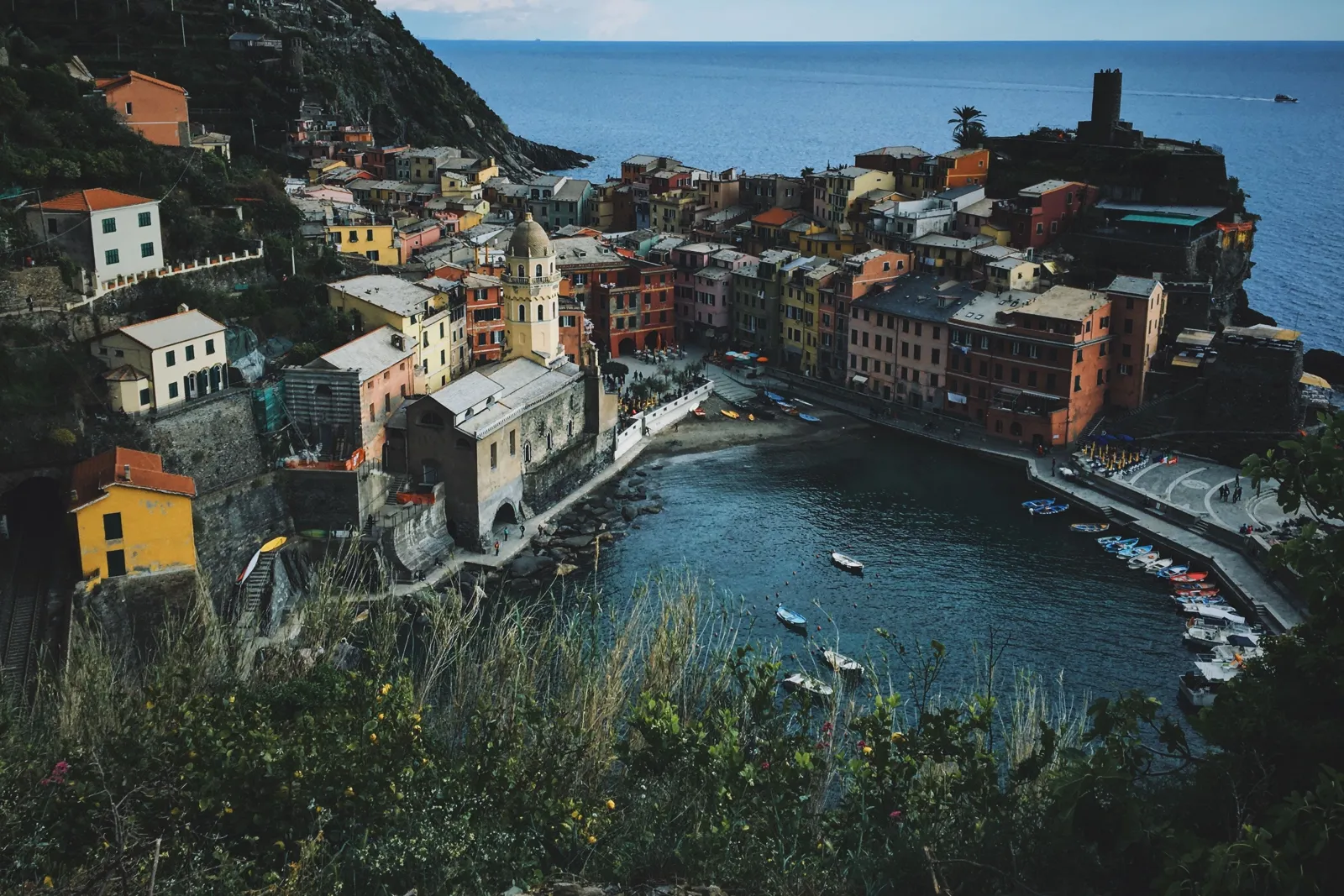
Vernazza gathers its houses around a small square opening onto the harbour, overlooked by the tower of the Doria castle. The best-known view is from the trail towards Monterosso, a few minutes above the village. During the day, the main street is very congested: come early or in the evening.
Corniglia
The only village without direct access to the sea, Corniglia is perched about 100 m (328 ft) above the water. From the station, you climb a long staircase, the Lardarina, or take a shuttle bus. Quieter than its neighbours, it offers fine views from its lookout terrace.
Manarola
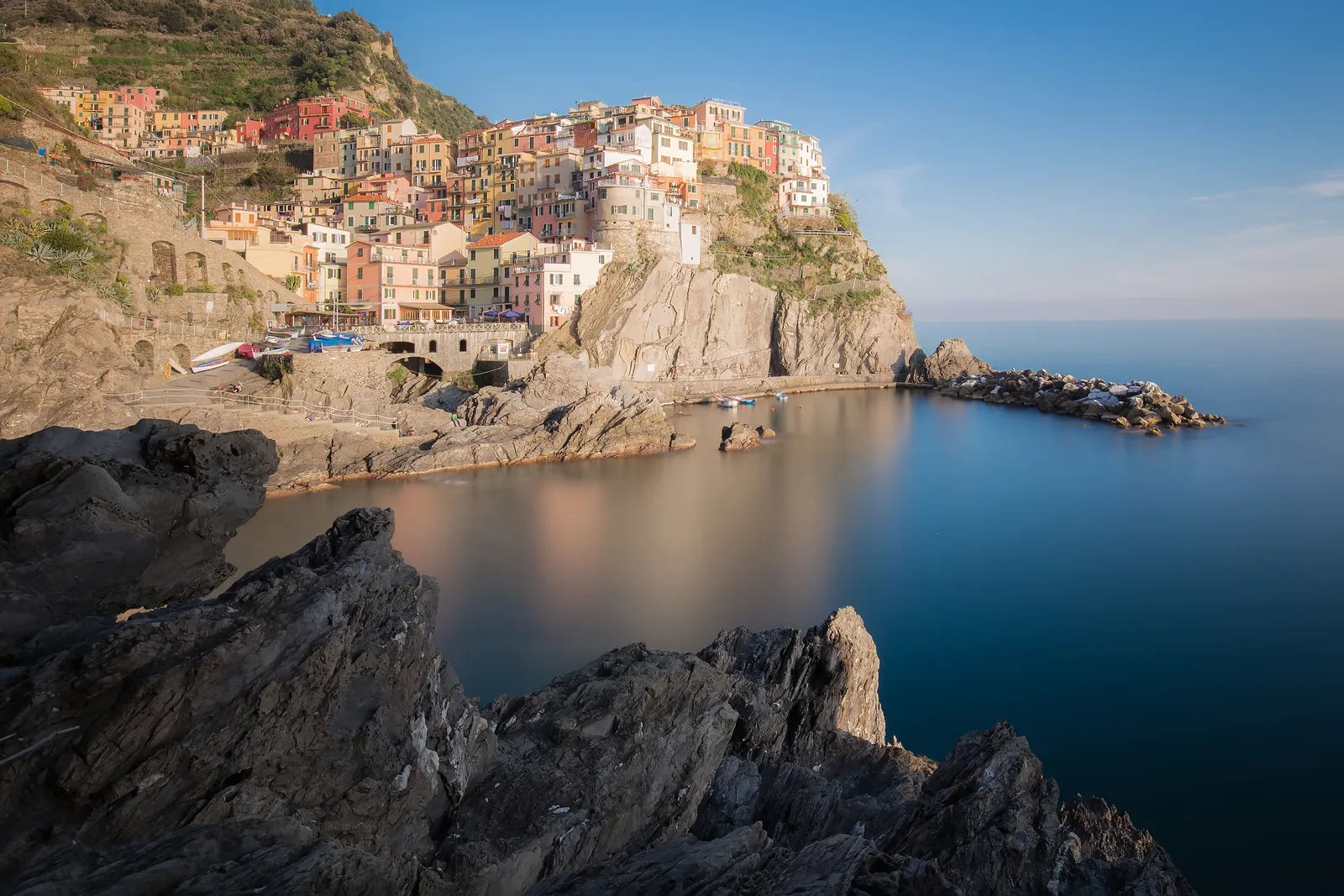
Manarola is the village of iconic views: colourful houses on a rocky spur, a small harbour and terraced vineyards. The viewpoint at the start of the trail towards Corniglia is very busy at sunset. The Via dell’Amore, from Riomaggiore, ends here.
Riomaggiore
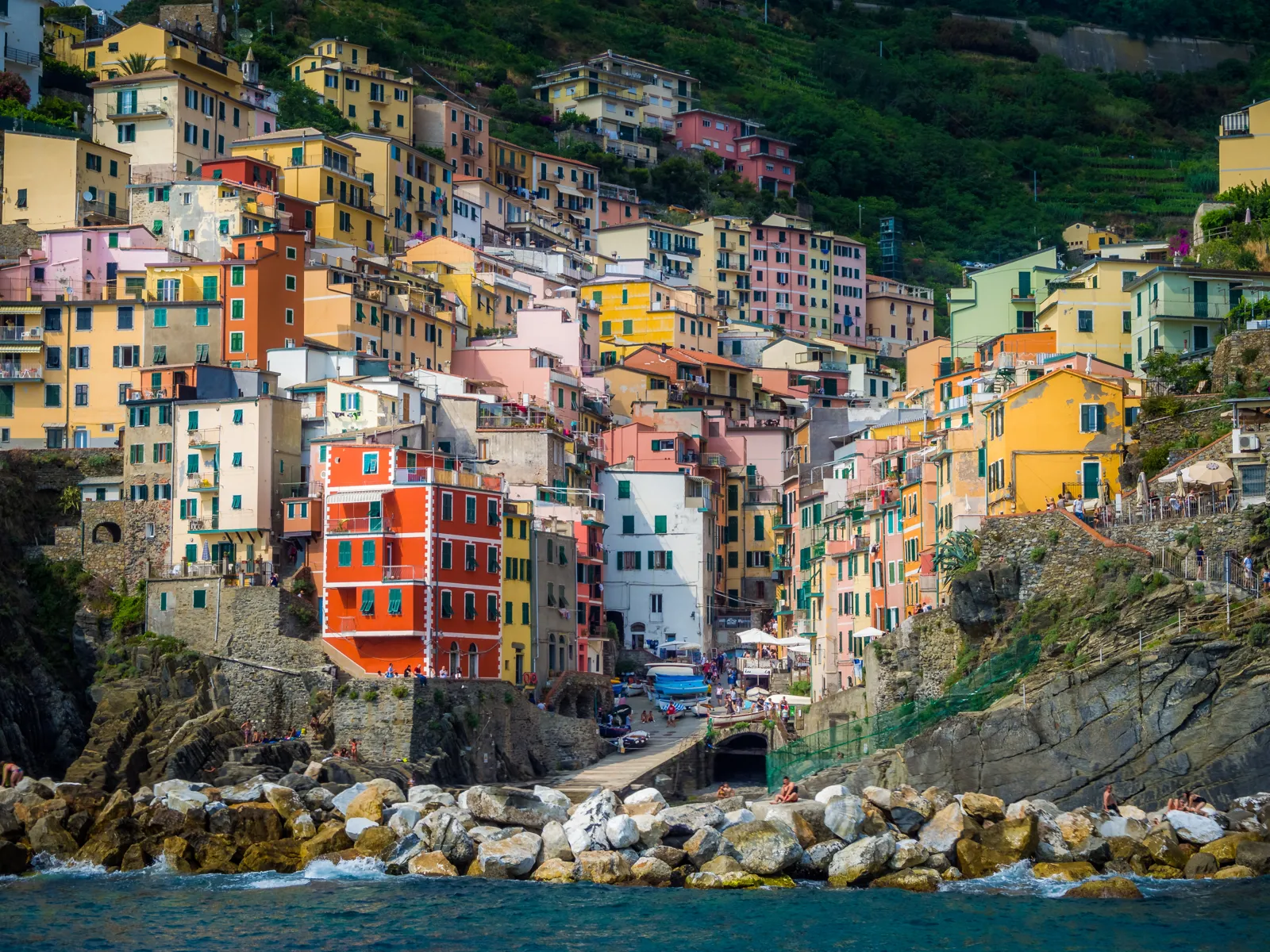
The southernmost village, and the closest to La Spezia, rises in tiers along a narrow valley. Its steep lanes and small marina make it a convenient base. It is the compulsory starting point of the Via dell’Amore, which is walked one way towards Manarola.
Portovenere and Levanto
Outside the five villages, Portovenere, to the south, with its church of San Pietro on a headland, is part of the same UNESCO site. Levanto, to the north, has a large beach and often more affordable accommodation; a coastal path links it to Monterosso.
Cinque Terre trails and the Cinque Terre Card
The most famous trail is the Sentiero Verde Azzurro (SVA, or « blue trail »), which follows the coast from village to village. According to the national park, the Cinque Terre Card gives access to the Monterosso – Vernazza – Corniglia section and to the Via dell’Amore (Riomaggiore – Manarola). The section between Corniglia and Manarola is not listed among the included accesses: check its status on the park’s website. Other, higher trails link the villages to the sanctuaries and the ridge; the status of each is published in real time on the park’s website and app.
| Card (adult, 1 day) | What it includes | 2026 price |
|---|---|---|
| Cinque Terre Trekking Card | SVA trail and Via dell’Amore, buses within the villages, station toilets, park Wi-Fi | €10 (€15 on high-demand days) |
| Cinque Terre Treno MS Card | The same + unlimited second-class regional trains between La Spezia and Levanto | €22, €29.50 or €35 depending on demand (14 March to 1 November 2026); €17.30 from 2 November to 31 December 2026 |
Via dell’Amore: reopened in 2024, it links Riomaggiore to Manarola in about 30 minutes, one way only. According to the park (checked 26 October 2026), it is included in both Cards, but access requires booking a time slot, with limited places. You can book when buying the Card or later with the code provided. From 26 October 2026, it is open from 9 am to 6 pm (last entry 5:30 pm).
Cards are sold online on the park’s official website or at the information points in the stations from La Spezia to Levanto. Buying online avoids queues in season.
Rules on the trails:
- Footwear: the park requires closed shoes with a grippy, lugged sole; flip-flops and smooth soles are banned on the trails and can lead to a fine.
- Weather: on weather-alert days, the park may advise against hiking, close trails and suspend sales of the Trekking Card.
- Trail status: check it on the day on the park’s website or app, or at the information points; trails marked as closed must not be used, even without a barrier.
- Equipment: water, sun protection, a small first-aid kit; do not leave the marked trail.
- Emergencies: 112, the number GOV.UK gives if you have an accident or get lost while hiking.
Itinerary: suggested Cinque Terre itineraries
1 day (from La Spezia or Levanto)
- Early train to Riomaggiore, booked Via dell’Amore to Manarola
- Train to Vernazza, lunch and a walk around the harbour
- Hike from Vernazza to Monterosso (or boat, depending on the weather) and a swim in Monterosso
3 days
- Day 1: Riomaggiore, the Via dell’Amore and Manarola at sunset
- Day 2: Corniglia, the trail to Vernazza, then Monterosso
- Day 3: boat to Portovenere, or a high trail to a sanctuary
A week in Liguria and Tuscany
- Days 1-3: the Cinque Terre
- Day 4: Portovenere and La Spezia
- Days 5-7: Pisa, Lucca and Florence by train
The Cinque Terre combine easily with Tuscany and Florence, about two hours by train via Pisa. For the whole country, see our Italy travel guide.
Budget for a trip to the Cinque Terre
Indicative amounts per person per day, excluding flights:
| Item | Budget | Comfort |
|---|---|---|
| Accommodation (based on a shared double room) | roughly €50 to 80 (La Spezia, Levanto) | roughly €110 to 220 (in a village) |
| Meals | roughly €25 to 40 | roughly €50 to 90 |
| Cinque Terre Card and transport | roughly €10 to 35 | roughly €30 to 60 (including boat) |
| Activities | roughly €0 to 10 | roughly €20 to 60 (kayak, boat trip) |
| Total | roughly €100 to 150 per person per day | roughly €200 to 350 per person per day |
To cut costs, stay in La Spezia or Levanto, picnic on local focaccia and choose the Trekking Card on days when you walk a lot.
Getting around the Cinque Terre
- Train: the easiest option. Regional trains on the La Spezia – Levanto line stop in all five villages, a few minutes apart. The Treno MS Card gives unlimited journeys; otherwise, buy single tickets and validate them before boarding (GOV.UK). The park’s Card site also lists scheduled line closures (for example 48-hour suspensions between Corniglia and La Spezia on some weekends in late 2026 and early 2027) and no trains between Levanto and La Spezia from 10:30 pm to 6:30 am on Friday and Saturday nights: check Trenitalia before you travel.
- Boat: shuttles link La Spezia, Portovenere and the villages (except Corniglia, which has no harbour) from spring to autumn, depending on sea conditions.
- On foot: on the open trails, with suitable shoes.
- Car: not recommended. Roads are narrow, village centres are closed to traffic and parking is scarce and expensive. Park in La Spezia or Levanto. The UK FCDO notes that theft from parked cars is common across Italy: leave nothing in the vehicle, even out of sight in the boot.
Getting there: Pisa is the most convenient airport (some routes are seasonal), then train to La Spezia. Genoa is also an option. By rail, you reach Liguria via Milan or along the coast from Nice. On the way, Genoa, the capital of Liguria, has its own guide.
Where to stay in the Cinque Terre
| Base | Best for | Good to know |
|---|---|---|
| Monterosso | Families, beach | The widest choice of hotels |
| Vernazza, Manarola, Riomaggiore | Village atmosphere | Rooms often small, lots of stairs |
| Corniglia | Peace and quiet | Climb from the station |
| La Spezia | Tight budget, easy connections | Trains and boats leave from the city |
| Levanto | Beach, lower prices | 5 minutes by train from Monterosso |
In the villages, accommodation is mostly guesthouses and apartments, often without a lift or car access: travel light. Book several months ahead for May, June and September.
Entry requirements, health and safety
- US citizens: Italy is in the Schengen area. You may enter for up to 90 days for tourism or business without a visa; your passport must be valid at least 3 months beyond your stay, and you need proof of sufficient funds and a return ticket. A passport that has ever been reported lost or stolen may be refused (U.S. Department of State, travel.state.gov, last updated August 11, 2025).
- UK citizens: no visa for up to 90 days in any 180-day period as a tourist. Your passport must have been issued less than 10 years before the day you arrive and be valid at least 3 months after the day you plan to leave the Schengen area; you may be asked for proof of accommodation, a return ticket and sufficient funds. The EU Entry/Exit System (EES) is being implemented: fingerprints and a photo may be taken at your first entry, free of charge (UK FCDO, GOV.UK, updated 21 October 2026).
- ID: under Italian law, police can stop you at any time for an identity check: carry photo ID at all times (GOV.UK).
- Health: UK travellers can use a GHIC or EHIC for medically necessary state healthcare (GOV.UK); travel.state.gov advises being up to date on CDC-recommended vaccinations and recommends insurance covering medical evacuation. GOV.UK lists dengue, biting insects and ticks, and West Nile disease among the health risks.
- Theft: crime levels are generally low, but bag-snatching and pickpocketing are more common in city centres, at major tourist attractions and on public transport (GOV.UK); the State Department notes that break-ins of rented vehicles are common, so never leave luggage in a parked car.
- Heat and flooding: in summer, carry water and avoid the hottest hours on the trails; the State Department lists heatwaves among Italy’s most frequent weather events. Heavy autumn and winter rain can cause flooding (GOV.UK): respect trail closures.
- Swimming: GOV.UK advises following the beach flag system (a red flag means you must not enter the water) and not diving into unknown water.
- Emergencies: 112 (police), 118 (ambulance), 115 (fire), according to GOV.UK; the State Department gives 112 for all emergencies.
Practical tips for the Cinque Terre
- Timing: visit the villages early in the morning or after 5 pm, once the groups have left.
- Luggage: take a backpack; the lanes are stepped.
- Money: keep some cash for small shops; use ATMs in well-lit public areas or inside a bank (travel.state.gov).
- Mobile data: check your home carrier’s roaming charges before you leave; an eSIM is a simple way to get local data.
- Food: try pesto, focaccia, Monterosso anchovies and the sweet sciacchetrà wine.
- Restaurants: a cover charge (« coperto ») is often added; tipping is not compulsory.
For a multi-stop trip, see also our guide to travelling from place to place and our tips for choosing travel insurance.
Who are the Cinque Terre for?
- Hikers: yes: the Sentiero Verde Azzurro coastal trail and the high trails to the sanctuaries. Closed shoes are compulsory, and trails can close on weather-alert days.
- Families: possible: Monterosso, the only village with a real beach, is the most comfortable base, and the Cinque Terre Card comes in child and family versions. Stepped lanes and countless stairs make getting around harder.
- Beach lovers: limited: only Monterosso and Levanto have a large beach; the swimming season runs from June to September.
- Tight budgets: not ideal: roughly €100 to 150 per person per day on a budget. Staying in La Spezia or Levanto and picnicking brings the cost down.
- Short stays: yes: one day is enough to see three or four villages by train, two or three days to hike and enjoy the evenings.
- Road trips: no: narrow roads, centres closed to traffic and scarce parking. Park in La Spezia or Levanto.
See also
To fit the Cinque Terre into a wider trip, see the best time to visit Italy, with the weather region by region. If you continue to Pisa, Lucca and Florence as in our one-week itinerary, see also the best time to visit Tuscany.
Frequently asked questions
How many days do you need to visit the Cinque Terre?
One day lets you see three or four villages by train. Two or three days are better for hiking, enjoying the villages in the evening and adding Portovenere.
Do you need the Cinque Terre Card?
It is required to walk the coastal trail between Monterosso and Corniglia and the Via dell’Amore. To visit the villages by train without hiking, ordinary train tickets are enough.
Do you need to book the Via dell’Amore?
Yes. According to the park, access is included in the Cinque Terre Card but requires booking a time slot, one way from Riomaggiore to Manarola.
Where should you stay to visit the Cinque Terre?
In a village for the atmosphere, in Monterosso for the beach, or in La Spezia and Levanto for a tighter budget and easy train connections.
Are the Cinque Terre trails difficult?
They involve many steps and narrow passages. Closed walking shoes are compulsory, and trails can close on weather-alert days.
Our sources
- Cinque Terre National Park (parconazionale5terre.it and card.parconazionale5terre.it): 2026 Cinque Terre Card prices, Via dell’Amore access rules and hours, trail notices and train line closures, checked 26 October 2026
- Entry requirements, health and safety checked on 26 October 2026: U.S. Department of State, Italy country information (last updated August 11, 2025) and UK FCDO, GOV.UK foreign travel advice for Italy (updated 21 October 2026)
- Climate normals: 1991-2020 normals for the Sarzana station (Magra valley, about 15 km, or 9 mi, from La Spezia) published by NOAA (World Meteorological Organization data)
- Our methodology
Updated October 2026.
To extend your trip, see our Italy guide, our Tuscany guide and our other destinations in Europe.