Things to do at Lake Garda? Visit Sirmione and its castle surrounded by water, take the boat between villages, ride the cable car up Monte Baldo from Malcesine, see the lemon houses of Limone, go cycling or windsurfing at Riva and Torbole, taste Bardolino wine and spend a day at Gardaland. Lake Garda, Italy’s largest lake, is best visited from May to June and in September, when the weather is fine without the August crowds.
About 50 km (31 mi) long, the lake is shared between Lombardy (west shore), the Veneto (east shore) and Trentino (northern tip). The south is wide and open to the plain, with beaches and theme parks; the narrow north, framed by mountains, attracts hikers, cyclists and windsurfers. This guide helps you choose which villages to visit, where to stay, how to get around and when to go, with official climate normals.
Our travel deals for Lake Garda
Affiliate links: we earn a commission, at no extra cost to you.
FlightsKiwi.comCompare flights and airline combinations to Lake Garda.
Locationnorthern Italy, between Brescia, Verona and TrentoVerona is about 30 km (19 mi) from the south-east shore
AirportsVerona Villafranca is the closestBergamo and Milan are also options
TrainDesenzano del Garda-Sirmione and Peschiera del Garda stationsOn the Milan – Verona – Venice line
EntrySchengen area: no visa for up to 90 days for US citizens (tourism or business) and UK citizens (in any 180-day period) · travel.state.gov · GOV.UKPassport valid at least 3 months beyond your stay (US) or after leaving the Schengen area (UK)
Time zoneUTC+1, UTC+2 in summer (Europe/Rome); currency: euro (€)Local time now: –:–
Electricity220-volt system, according to the U.S. Department of State · plugsCheck that your devices accept it; you may need a plug adapter
On a narrow peninsula on the south shore, Sirmione is the most visited village on the lake. You enter over the drawbridge of the Rocca Scaligera, a 13th-century castle surrounded by water. At the tip, the Grotte di Catullo are the remains of a large Roman villa among olive trees, with views over the lake. Hot thermal springs feed several spas. Come early in the morning or at the end of the day: the pedestrian centre is very busy between 11 am and 5 pm.
Desenzano del Garda and Peschiera del Garda
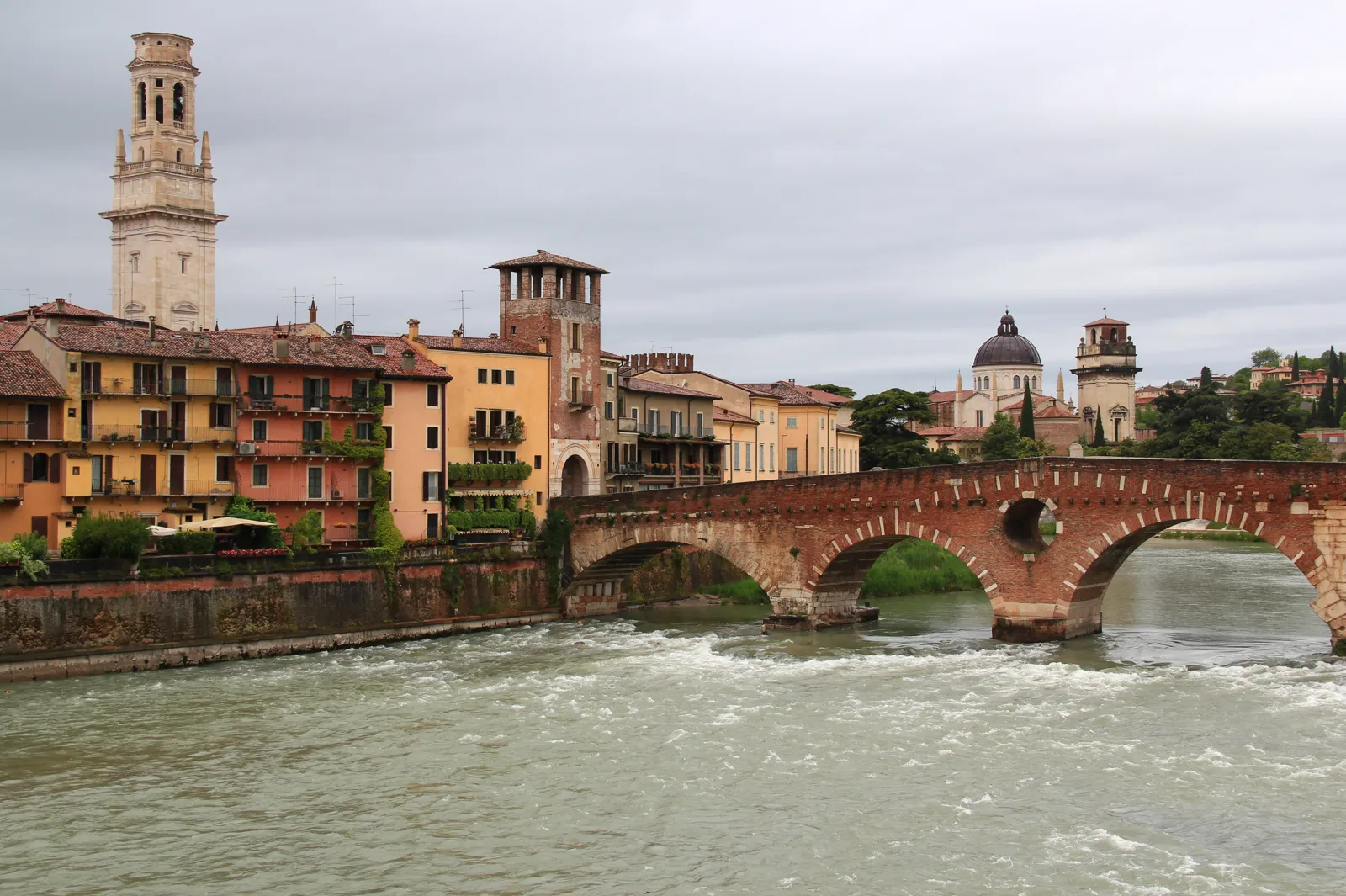
Desenzano, the largest town on the lake, is lively and well served by trains and boats: an old harbour, a castle and a Roman villa with mosaics. Peschiera del Garda, at the south-eastern end, is surrounded by Venetian fortifications listed as a UNESCO World Heritage Site. Both are convenient bases without a car.
Lazise, Bardolino and Garda
On the Veneto shore, Lazise has kept its walls and medieval harbour. Bardolino gave its name to a light red wine; the wine museum and cellars offer tastings. Garda, the village that gave the lake its name, has a long promenade. A cycling and walking path links these villages along the water.
Gardaland and the theme parks
Between Peschiera and Lazise, Gardaland is one of Italy’s largest amusement parks, with an aquarium next door (Sea Life). Other parks (water parks, zoos) are nearby: the south-east of the lake is the most family-friendly area. Book tickets online, often cheaper than at the gate.
Malcesine and Monte Baldo
Malcesine, on the east shore, is dominated by a Scaliger castle. The cable car with rotating cabins climbs Monte Baldo, to over 1,700 m (5,600 ft): views over the whole lake, hiking in summer and skiing in winter. Arrive early in high season, as the wait can be long, and bring a jacket: it is much cooler at the top.
Riva del Garda, Torbole and the Varone waterfall
At the northern tip, in Trentino, Riva del Garda is surrounded by mountains. The old harbour, the Apponale tower and the bastion offer fine views. The steady winds of the northern lake make Riva and Torbole renowned spots for sailing, windsurfing and kitesurfing. A few kilometres away, the Varone waterfall drops into a gorge you visit on walkways. Neighbouring Arco is a major climbing centre.
Limone sul Garda
Clinging to the cliff on the west shore, Limone is known for its limonaie, lemon-growing terraces protected by stone pillars; the Limonaia del Castèl is open to visitors. A cycle path suspended above the water extends the town to the north. The west-shore road (the Gardesana) runs through many tunnels.
Salò, Gardone Riviera and the Vittoriale
Salò has a long promenade and a Gothic cathedral. Gardone Riviera, a former holiday resort, is home to the Vittoriale degli Italiani, the extravagant residence of the writer Gabriele D’Annunzio, with its garden, open-air theatre and the bow of a ship built into the grounds. Gargnano and Tignale offer a quieter lake.
Torri del Benaco and the Madonna della Corona
Torri del Benaco, a small harbour on the east shore, has kept a Scaliger castle and a ferry that crosses to Maderno. In the mountains above, the Madonna della Corona sanctuary seems built into the cliff; you reach it by road and then on foot, or by a trail from Brentino.
When to go to Lake Garda
The best months are May, June and September. The climate is milder than in the rest of northern Italy thanks to the body of water, hence the olive and lemon trees. Summers are hot (29 °C, or 85 °F, in the afternoon in July at Salò) and sometimes stormy; rainfall is spread over the year and peaks in May, August and autumn. In winter, many hotels, campsites and boat routes close or cut back.
Month
High °C (°F)
Low °C (°F)
Rain mm (in)
Crowds
Prices
Verdict
January
7.3 (45)
1.6 (35)
77 (3.0)
Very low
Low
❌ Cool, many places closed
February
8.8 (48)
2.2 (36)
67 (2.6)
Very low
Low
❌ Quiet, tourist season on hold
March
13.4 (56)
5.6 (42)
86 (3.4)
Low
Low
⚠️ Gradual reopening, changeable weather
April
17.4 (63)
9.0 (48)
86 (3.4)
Medium (Easter)
Medium
⚠️ Mild, ideal for walking, cold water
May
22.8 (73)
13.5 (56)
106 (4.2)
Medium
Medium
✅ Pleasant and in bloom, showers possible
June
26.7 (80)
17.1 (63)
95 (3.7)
High
High
✅ Warm, swimming possible, long days
July
29.4 (85)
19.5 (67)
90 (3.5)
Very high
Very high
⚠️ Peak season, crowds and thunderstorms
August
28.7 (84)
19.2 (67)
115 (4.5)
Very high
Very high
⚠️ Busiest time (Ferragosto), thunderstorms
September
23.8 (75)
15.7 (60)
89 (3.5)
Medium
Medium to high
✅ Water still warm, grape harvest, fewer people
October
17.8 (64)
11.6 (53)
120 (4.7)
Low
Medium
⚠️ Autumn colours, the wettest month
November
11.9 (53)
6.2 (43)
106 (4.2)
Very low
Low
❌ Wet, many closures
December
8.1 (47)
2.7 (37)
68 (2.7)
Low
Low
⚠️ Christmas markets in several villages
Temperatures and precipitation: ISPRA 1981-2010 normals, Salò station (west shore). Crowds and prices: estimates based on the tourist seasons.
Spring (April-May): ideal for hiking, cycling and visiting the villages. The water is still cold for swimming.
Summer (June-August): the season for swimming and water sports. July and August are hot and very busy, especially with Italian and German-speaking holidaymakers; summer thunderstorms can be short but violent.
Autumn (September-October): September is often the best compromise; October is wetter but offers the colours of the vineyards and olive groves.
Winter (November-March): quiet and often misty; most boat routes switch to a reduced timetable. Monte Baldo may be snow-covered.
Day 2: Lazise, Bardolino and Garda along the cycle path
Day 3: Malcesine and Monte Baldo
Day 4: Limone and Riva del Garda by boat
One week
Days 1 and 2: the south shore (Sirmione, Desenzano, Peschiera)
Day 3: Gardaland, or Lazise and Bardolino
Day 4: Malcesine and Monte Baldo
Days 5 and 6: Riva del Garda, Torbole, Arco and the Varone waterfall
Day 7: Limone, Gargnano, Gardone Riviera and Salò
The lake combines easily with Verona, less than an hour away, with a stay in Venice (about 1 h 30 by train from Peschiera or Desenzano) or with hiking in the Dolomites, to the north-east.
Getting around Lake Garda
Boat: the public ferry service links most villages, with standard boats and faster hydrofoils; day tickets are available. Timetables are reduced out of season.
Train: Desenzano and Peschiera are on the Milan – Verona – Venice line; no railway goes round the lake.
Bus: regional routes serve both shores, with variable frequencies. Validate tickets bought from kiosks or machines before travelling: inspectors issue on-the-spot fines (GOV.UK).
Car: handy for linking villages, but heavy traffic and scarce, paid parking in summer, especially in Sirmione and Limone. Some historic centres are limited traffic zones (ZTL): do not enter without authorisation. The U.S. State Department notes that break-ins of rented vehicles are common.
Bike: cycle paths in the south-east and walkways around Limone; plenty of bike and mountain-bike hire in Riva and Torbole.
Getting there: the closest airport is Verona Villafranca, with Bergamo and Milan as alternatives; from Verona, continue by bus or train to Peschiera or Desenzano.
Where to stay at Lake Garda
Area
Best for
Highlights
Desenzano, Peschiera
No car
Stations, boats, restaurants
Sirmione
Couples, short stays
Charm and spas, but expensive and busy
Lazise, Bardolino, Garda
Families
Beaches, cycle paths, close to Gardaland
Malcesine, Torri del Benaco
Views and peace
Monte Baldo, picturesque villages
Riva, Torbole, Arco
Active travellers
Sailing, cycling, climbing, hiking
Salò, Gardone, Limone
The quieter west shore
Villas, gardens, views
There are many campsites around the lake, often well equipped. Book early for July and August.
Budget for Lake Garda
Item (per person per day)
Budget
Comfort
Accommodation (sharing a double room)
roughly €35 to €55 (campsite, simple B&B)
roughly €90 to €170
Meals
roughly €25 to €40 (pizzeria, panini, aperitivo)
roughly €50 to €80
Local transport
roughly €10 to €20 (bus, boat)
roughly €20 to €40 (boat pass, bike hire)
Activities
roughly €10 to €20 (cable car, museums)
roughly €30 to €60 (Gardaland, spas, sailing)
Total
roughly €80 to €120 per person per day
roughly €160 to €280 per person per day
Indicative estimates, excluding travel to the lake. A municipal tourist tax is often added to accommodation, usually paid at your hotel, often in cash (GOV.UK).
Entry requirements, health and safety
US citizens: Italy is in the Schengen area. You may enter for up to 90 days for tourism or business without a visa; your passport must be valid at least 3 months beyond your stay, and you need proof of sufficient funds and a return ticket (U.S. Department of State, travel.state.gov, last updated August 11, 2025).
UK citizens: no visa for up to 90 days in any 180-day period as a tourist. Your passport must have been issued less than 10 years before the day you arrive and be valid at least 3 months after the day you plan to leave the Schengen area. The EU Entry/Exit System (EES) is being implemented: fingerprints and a photo may be taken at your first entry, free of charge (UK FCDO, GOV.UK, updated 21 October 2026).
ID: under Italian law, police can stop you at any time for an identity check: carry photo ID at all times (GOV.UK).
Health: UK travellers can use a GHIC or EHIC for medically necessary state healthcare (GOV.UK); travel.state.gov advises being up to date on CDC-recommended vaccinations and recommends insurance that covers medical evacuation.
Theft: crime levels are generally low, but bag-snatching and pickpocketing are more common in city centres, at major tourist attractions and on public transport (GOV.UK); the State Department notes that break-ins of rented vehicles are common, so never leave luggage in a parked car.
On the water: the winds on the northern lake can pick up quickly; when you hire a boat or a board, follow the rental company’s instructions.
Emergencies: 112 (police), 118 (ambulance), 115 (fire), according to GOV.UK; the State Department gives 112 for all emergencies.
For sailing, canyoning or via ferrata, check the cover of your travel insurance.
Practical tips
Money: cards are widely accepted; carry some cash for small shops and paid beaches. Use ATMs in well-lit public areas or inside a bank (travel.state.gov).
Mobile data: check your home carrier’s roaming charges before you leave; an eSIM is a simple way to get local data.
Swimming: pebble or developed beaches (lidos), sometimes paid; bring water shoes.
Food: lake fish, Garda olive oil, Bardolino and Lugana wines; a cover charge (« coperto ») is often added.
Languages: Italian, and German is widely spoken in the north and in tourist areas.
Who is Lake Garda for?
Our view, traveller type by traveller type, based on the information in this guide:
Profile
Our verdict
Families
Ideal: Gardaland and the nearby parks, beaches and the cycle path between Lazise, Bardolino and Garda; the south-east of the lake is the best area.
Active travellers
Ideal: sailing, windsurfing and kitesurfing at Riva and Torbole thanks to the northern lake’s winds, climbing at Arco, cycling and mountain biking.
Couples
Yes: Sirmione and its spas at the end of the day, Malcesine, or the quieter west shore (Salò, Gardone, Limone).
No car
Yes: trains to Desenzano and Peschiera, boats between most villages; allow more time out of season.
Tight budget
Possible: roughly €80 to €120 per person per day with a campsite or simple B&B, pizzeria and aperitivo.
Winter travel
Not ideal: many hotels, campsites and boat routes close or cut back.
Further reading
To see how the lake compares with other regions, see when to go to Italy, and our destination ideas where to go in May and where to go in September, two of the best months by the lake. If you are torn between the great lakes, our Lake Como guide covers its narrower neighbour, famous for its villas. To extend your trip, see our guides to Venice and the Dolomites.
Frequently asked questions
What are the things to do at Lake Garda in 3 days?
Sirmione and Desenzano on day one, Malcesine and Monte Baldo on day two, Limone and Riva del Garda by boat on day three. With children, swap one day for Gardaland.
What is the most beautiful village on Lake Garda?
Sirmione is the most famous; Malcesine and Limone sul Garda are often cited for their settings, Lazise and Torri del Benaco for their quieter charm.
When is the best time to visit Lake Garda?
May, June and September: 23 to 27 °C (73 to 81 °F) in the afternoon at Salò according to the ISPRA 1981-2010 normals, and fewer people than in July and August.
How do you get to Lake Garda?
Fly into Verona Villafranca, the closest airport, then take a bus or train to Peschiera or Desenzano; or arrive by train on the Milan – Verona – Venice line, which stops at Desenzano and Peschiera.
Can you visit Lake Garda without a car?
Yes: trains serve Desenzano and Peschiera, and boats link most villages. Just allow more time out of season, when timetables are reduced.
Lake Garda or Lake Como?
Lake Garda offers more beaches, sports activities and theme parks; narrower Lake Como is famous for its villas and gardens. Both are within reach of Milan.
Our sources
Climate normals: ISPRA 1981-2010 normals (Istituto Superiore per la Protezione e la Ricerca Ambientale, « Valori climatici normali di temperatura e precipitazione in Italia »), Salò station, as reproduced on Wikipedia (« Lake Garda » article)


 FlightsKiwi.comCompare flights and airline combinations to Lake Garda.Compare flights