What are the best things to do in Ardèche? Paddle a canoe down the Ardèche gorges under the Pont d’Arc, visit the Chauvet 2 cave and the Aven d’Orgnac, stroll through the villages of Balazuc and Vogüé, then head up to the volcanic plateaus of Mont Gerbier-de-Jonc and the Ray-Pic waterfall. Ardèche has two faces: the south, limestone, hot and very busy in summer, and the north, greener, cooler and calmer. If that green, cool volcanic north appeals to you, our guide to a trip to Auvergne continues these landscapes of volcanoes, lakes and villages.
This guide brings together the highlights, two itineraries, budget, transport, where to stay and the month-by-month climate according to normals from the Météo-France station in Aubenas. The best times: May, June and September.

Our travel deals for Ardèche
Affiliate links: we earn a commission, at no extra cost to you.
 FlightsKiwi.comCompare flights and airline combinations to Ardèche.Compare flights

Ardèche at a glance
- Main towns Privas (prefecture), Aubenas, Annonay, Tournon-sur-Rhône
- Region Auvergne-Rhône-Alpes, south-east France
- Currency the euro · currencies
- Time zone UTC+1 (UTC+2 in summer): one hour ahead of London, usually six hours ahead of New York
- Airports no airport or regular passenger trains in southern Ardèche; nearest hubs in Lyon and the Rhône valley · details
- Entry US citizens: no visa for up to 90 days in the Schengen area; UK citizens: no visa for up to 90 days in 180, EES registration · details · travel.state.gov · GOV.UK
- Electricity type E sockets, 220 V, 50 Hz according to france.fr; US and UK travellers need an adapter · plugs
- Recommended length a long weekend for the gorgesA week for the south and the north
- Budget see our budget section
When to go to Ardèche
The best months are May, June and September. Southern Ardèche has a climate with a Mediterranean influence: hot summers (30 °C / 86 °F in the afternoon in Aubenas in July), cool winters and, above all, heavy autumn rain. So-called « Cévennes episodes » can dump huge amounts of water in a few hours: September to November together bring close to 430 mm (16.9 in) in Aubenas. The plateaus of the north and the Ardèche mountains, above 1,000 m (3,300 ft), are noticeably cooler and can be snowbound in winter.
When to go to Ardèche: the essentials
- Best times: May, June and September
- Canoeing in the gorges: May to September, depending on the river level
- River swimming: late June to early September
- Hiking: April to June, September-October
- Hottest month: July, average high of 30.4 °C (87 °F) in Aubenas
- Wettest month: October, 149.7 mm (5.9 in) on average
| Month | High | Low | Rain | Crowds | Prices | Verdict |
|---|---|---|---|---|---|---|
| January | 10.2 °C (50 °F) | 1.0 °C (34 °F) | 79.8 mm (3.1 in) | Very low | Low | ❌ Cold, many sites closed |
| February | 11.7 °C (53 °F) | 1.1 °C (34 °F) | 53.5 mm (2.1 in) | Very low | Low | ❌ Off-season, cold nights |
| March | 15.9 °C (61 °F) | 3.9 °C (39 °F) | 59.0 mm (2.3 in) | Low | Low | ⚠️ Gradual reopenings, changeable weather |
| April | 18.8 °C (66 °F) | 6.5 °C (44 °F) | 77.6 mm (3.1 in) | Medium (Easter) | Medium | ✅ Hiking, river often high |
| May | 22.9 °C (73 °F) | 10.2 °C (50 °F) | 87.9 mm (3.5 in) | Medium (long weekends) | Medium | ✅ Green, quiet canoeing, busy long weekends |
| June | 27.4 °C (81 °F) | 13.9 °C (57 °F) | 64.1 mm (2.5 in) | Medium to high | Medium | ✅ The best month for canoeing |
| July | 30.4 °C (87 °F) | 16.0 °C (61 °F) | 58.0 mm (2.3 in) | Very high | Very high | ⚠️ Ideal for swimming, very busy gorges |
| August | 30.1 °C (86 °F) | 15.6 °C (60 °F) | 65.0 mm (2.6 in) | Very high | Very high | ⚠️ Hot, crowds, possible storms |
| September | 25.0 °C (77 °F) | 12.2 °C (54 °F) | 137.4 mm (5.4 in) | Medium | Medium | ✅ Fewer people, risk of Cévennes-type storms |
| October | 19.5 °C (67 °F) | 8.9 °C (48 °F) | 149.7 mm (5.9 in) | Low | Low | ⚠️ Autumn colours, wettest month |
| November | 13.9 °C (57 °F) | 4.6 °C (40 °F) | 143.7 mm (5.7 in) | Very low | Low | ❌ Heavy rain, possible floods |
| December | 10.5 °C (51 °F) | 1.6 °C (35 °F) | 85.7 mm (3.4 in) | Very low | Low | ❌ Cold and quiet |
- Spring (April-May): green landscapes, highs of 19 to 23 °C (66 to 73 °F), pleasant trails. The river can be high and cold: check with the canoe rental companies.
- Summer (June to August): canoeing and swimming season. July and August are hot and very busy around Vallon-Pont-d’Arc; storms can be violent. The northern plateaus offer a cooler refuge.
- Autumn (September to November): September stays mild and calmer, and the chestnut groves turn colour in October. It is also the season of intense rain: follow weather warnings and never enter a river in flood.
- Winter (December to March): quiet, nights close to 1 °C (34 °F) in Aubenas, snow possible in the Ardèche mountains. Many campsites and activities are closed.
For more early-summer ideas, see our selection of where to go in June.
Things to do in Ardèche: the highlights
The Ardèche gorges and the Pont d’Arc
The Pont d’Arc, a natural arch spanning the river near Vallon-Pont-d’Arc, marks the entrance to the gorges. They stretch for about thirty kilometres (19 mi) to Saint-Martin-d’Ardèche, protected as a national nature reserve. There are two ways to see them: by car along the scenic gorges road, dotted with viewpoints (Serre de Tourre, La Madeleine, La Cathédrale), or by canoe. The full descent takes one or two days; on a two-day trip, the night must be booked at one of the two authorised bivouac areas, Gaud or Gournier, according to the official Pont d’Arc-Ardèche tourist office hiking sheet (checked 26 October 2026).
The Chauvet 2 cave
The Chauvet cave, discovered in 1994 and a UNESCO World Heritage Site, holds some of the oldest known cave paintings (lions, mammoths, rhinoceroses). The original is closed to the public; Chauvet 2, near Vallon-Pont-d’Arc, is a replica visited with a guide. In summer, book your slot in advance.
Our page on visiting the Chauvet 2 cave covers opening hours, prices and the differences from the original cave.
The Aven d’Orgnac
South of the gorges, the Aven d’Orgnac, a Grand Site de France, is visited underground: vast chambers, giant formations and a prehistory centre on the surface. It is cool in the cave all year round, which makes it a good outing in hot weather or when it rains.
Balazuc, Vogüé and the villages
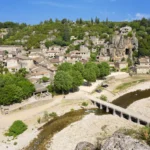
Balazuc and Vogüé, clinging above the Ardèche, are listed among the Most Beautiful Villages of France. Stone lanes, vaulted passages and small pebble beaches below: allow half a day for both. Labeaume, Saint-Montan and Alba-la-Romaine, with its Roman site, round off a tour of the south.
The Bois de Païolive and the Chassezac gorges
Near Les Vans, the Bois de Païolive is a maze of limestone rocks sculpted by erosion under a forest of holm oaks. The trails lead to the Chassezac gorges, where people swim in summer. The site is ideal for family walks.
Mont Gerbier-de-Jonc and the Ray-Pic waterfall
On the Ardèche plateau, Mont Gerbier-de-Jonc, a former volcano with a conical outline, is home to the source of the Loire; the climb takes about 30 to 45 minutes. Nearby, the Ray-Pic waterfall tumbles over basalt flows. The Monts d’Ardèche regional nature park, a UNESCO Global Geopark, covers these volcanic landscapes, very different from the limestone gorges of the south.
The Train de l’Ardèche and Crussol castle
In the north, the Train de l’Ardèche heritage railway runs up the Doux gorges between Tournon-sur-Rhône and Lamastre (check the operating days, which are seasonal). Facing Valence, the ruins of Crussol castle overlook the Rhône valley, with views stretching to the Vercors.
The Via Ardèche and greenways
Old railway lines have become greenways, such as the Via Ardèche around Vogüé and Lalevade, or the Dolce Via in the Eyrieux valley. They are ideal for family cycling, with rentals on site.
With children: Peaugres Safari and activities
Near Annonay, the Safari de Peaugres is explored by car and then on foot. In the south, short canoe trips, swimming at pebble beaches, treetop adventure courses and show caves easily fill a week with children.
Itinerary ideas for Ardèche
4 to 5 days: southern Ardèche
- Day 1: Vallon-Pont-d’Arc, the Pont d’Arc and the Chauvet 2 cave
- Day 2: canoeing down the gorges (one-day route)
- Day 3: the gorges road and the Aven d’Orgnac
- Day 4: Balazuc, Vogüé, Labeaume
- Day 5: Bois de Païolive and the Chassezac gorges
7 to 10 days: from south to north
- Days 1 to 4: the southern itinerary above
- Day 5: Aubenas and the Via Ardèche by bike
- Day 6: Ray-Pic waterfall and Mont Gerbier-de-Jonc
- Day 7: Lamastre and the Train de l’Ardèche
- Days 8 to 10 (optional): Tournon, Crussol castle, Peaugres Safari
Ardèche combines well with Lyon, about two hours to the north, or with Provence, an hour from Avignon to the south.
How much does a trip to Ardèche cost?
| Item (per person per day) | Budget | Comfort |
|---|---|---|
| Accommodation (sharing a double room) | about €20 to €40 (campsite, holiday cottage) | about €70 to €130 |
| Food | about €20 to €35 | about €40 to €65 |
| Local transport | about €10 to €15 (shared car) | about €15 to €25 |
| Activities (canoeing, caves) | about €10 to €15 | about €15 to €30 |
| Total | roughly €60 to €100 per person per day | roughly €130 to €230 per person per day |
Getting there and getting around Ardèche
- Car: almost essential. The roads are winding: allow more time than the distance suggests.
- Train and bus: Ardèche no longer has regular passenger rail services in the south; regional buses link Valence and Montélimar (on the Rhône valley rail line) with Privas and Aubenas. See our tips for travelling cheaply by train.
- Canoe shuttles: rental companies organise the return by minibus at the end of the route.
- Cycling: greenways (Via Ardèche, Dolce Via) for families; demanding roads for sporty cyclists.
Where to stay in Ardèche
For the gorges, Vallon-Pont-d’Arc has the most campsites, hotels and canoe rental companies, but it is very lively in summer; Ruoms, Salavas or Saint-Martin-d’Ardèche are alternatives. Aubenas is a central base for the villages and the Via Ardèche. In the north, Lamastre, Tournon or holiday cottages on the plateau suit the mountains. Campsites are the most common type of accommodation; book early for July and August.
Entry requirements, health and safety
- US citizens (travel.state.gov, last updated August 11, 2025): you may enter the Schengen area, including France, for up to 90 days for tourism or business without a visa; your passport should be valid at least three months beyond your stay, and officers may ask for proof of sufficient funds and a return ticket.
- UK citizens (GOV.UK, updated 22 October 2026): no visa for up to 90 days in any 180-day period as a tourist; your passport must have been issued less than 10 years before you arrive and be valid at least 3 months after you leave the Schengen area. The EU Entry/Exit System (EES) is being implemented: fingerprints and a photo may be taken at your first entry, free of charge.
- Health: take out travel insurance that covers medical costs; UK residents can also use a GHIC or a valid EHIC (GOV.UK).
- River: rental companies supply a life jacket: wear it. Don’t go on the river when it is in flood or during a storm warning.
- Floods: GOV.UK notes a flood risk in some areas of France; if your accommodation is near a river, check the official Vigicrues flood-watch service. In autumn, follow Météo-France warnings and never cross a flooded ford or low bridge.
- Wildfires: wildfires can occur across France in summer, and causing one, even by accident, is illegal (GOV.UK). In summer, set off early to hike and never light a fire in the forest.
- Safety: the UK FCDO considers that terrorists are very likely to try to carry out attacks in France; stay alert in crowded places (GOV.UK).
- Emergencies: 112 (European emergency number), 15 for medical emergencies (travel.state.gov, GOV.UK).
For canoeing, climbing or caving, check what your travel insurance covers.
Practical tips for Ardèche
- Canoeing: book in summer and set off early to avoid canoe traffic jams at the Pont d’Arc.
- Food: Ardèche chestnuts (PDO), chestnut cream, picodon (PDO goat’s cheese), caillettes (pork and greens patties) and Coteaux de l’Ardèche wines.
- Markets: Aubenas, Joyeuse and Largentière have well-known markets; check the days.
- Mobile coverage: no signal in parts of the gorges and on the plateau; download your maps.
Frequently asked questions
What can you do in Ardèche in 3 days?
The Pont d’Arc and the Chauvet 2 cave on day one, a canoe trip down the gorges on day two, then the gorges road, the Aven d’Orgnac and the village of Balazuc on day three.
What is the best time to visit Ardèche?
May, June and September: afternoon highs of 23 to 27 °C (73 to 81 °F) in Aubenas according to 1991-2020 normals, and fewer people than in July and August. June is often the best compromise for canoeing.
Can you visit Ardèche without a car?
It’s difficult: there are no passenger trains in the south and buses have limited timetables. A base in Vallon-Pont-d’Arc lets you do the Pont d’Arc, canoeing (with the rental company’s shuttle) and the Chauvet 2 cave on foot or by bike.
How long does it take to canoe down the Ardèche gorges?
Rental companies offer short trips of a few hours around the Pont d’Arc, a one-day route or the full descent of about thirty kilometres (19 mi) in two days, with a night at an authorised bivouac area booked in advance.
When should you avoid Ardèche?
The weekends around 14 July and 15 August (French public holidays) are the busiest. From September to November, Cévennes-type storms can cause flash floods: keep an eye on the weather warnings.
Our sources
- Météo-France: 1991-2020 normals for the Météo-France station at Aubenas-Saint-Martin (07019005), published by Meteociel (via Wikipedia, « Aubenas » article)
- Pont d’Arc-Ardèche tourist office: Ardèche gorges hiking sheet (bivouac booking), checked 26 October 2026
- france.fr (Atout France): electricity requirements in France, checked 26 October 2026
- Entry requirements, health and safety checked on 26 October 2026: U.S. Department of State, France country information (last updated August 11, 2025) and UK FCDO, GOV.UK foreign travel advice for France (updated 22 October 2026).
- Our methodology
Updated October 2026.
For more ideas, see our France travel guide and our destinations in Europe.